Planters & Plant Supports

Best Window Box Planters of 2026

A window box tends to fail quietly. First the soil stays soggy for days after a rain, then a bracket starts to pull away from the siding, and by late summer the whole thing is sagging and streaking the wall with muddy runoff. The right planter heads off most of that before you ever open a bag of potting mix: drainage holes placed so water exits away from the house, brackets rated for the real weight of saturated soil, and a material that won't swell, rust, or split through a freeze. Get those three right and the plants handle the rest.

I've kept window boxes on my own porch for years, and over the past eight months my team put 12 of them through a full growing season, a stretch of triple-digit heat, and the first hard freeze. The surprise was how much the material decided everything else — wood looks best but drinks water, metal runs hot in afternoon sun, and resin survives everything but can read as plastic up close. What follows are the ones that drained properly, hung straight, and were still worth looking at in November.

1

Mayne Fairfield 48in

Top Pick
Mayne Fairfield 48in

Wall-mounted windows

Our Score 9.4/10
Check Price

Worth Noting

  • Molded seams and parting lines show up close
Depth
7.4 in
Capacity
4 gallons
Material
Polyethylene resin
Model Size
48 in
Read the full review

The brackets come in the box. That sounds minor until you have priced a pair for a 48-inch span and found they are a real line item of their own. Mayne ships the Fairfield with its mounting hardware and a fill-port plug, so hanging it is one purchase and one afternoon rather than a second trip to the hardware store.

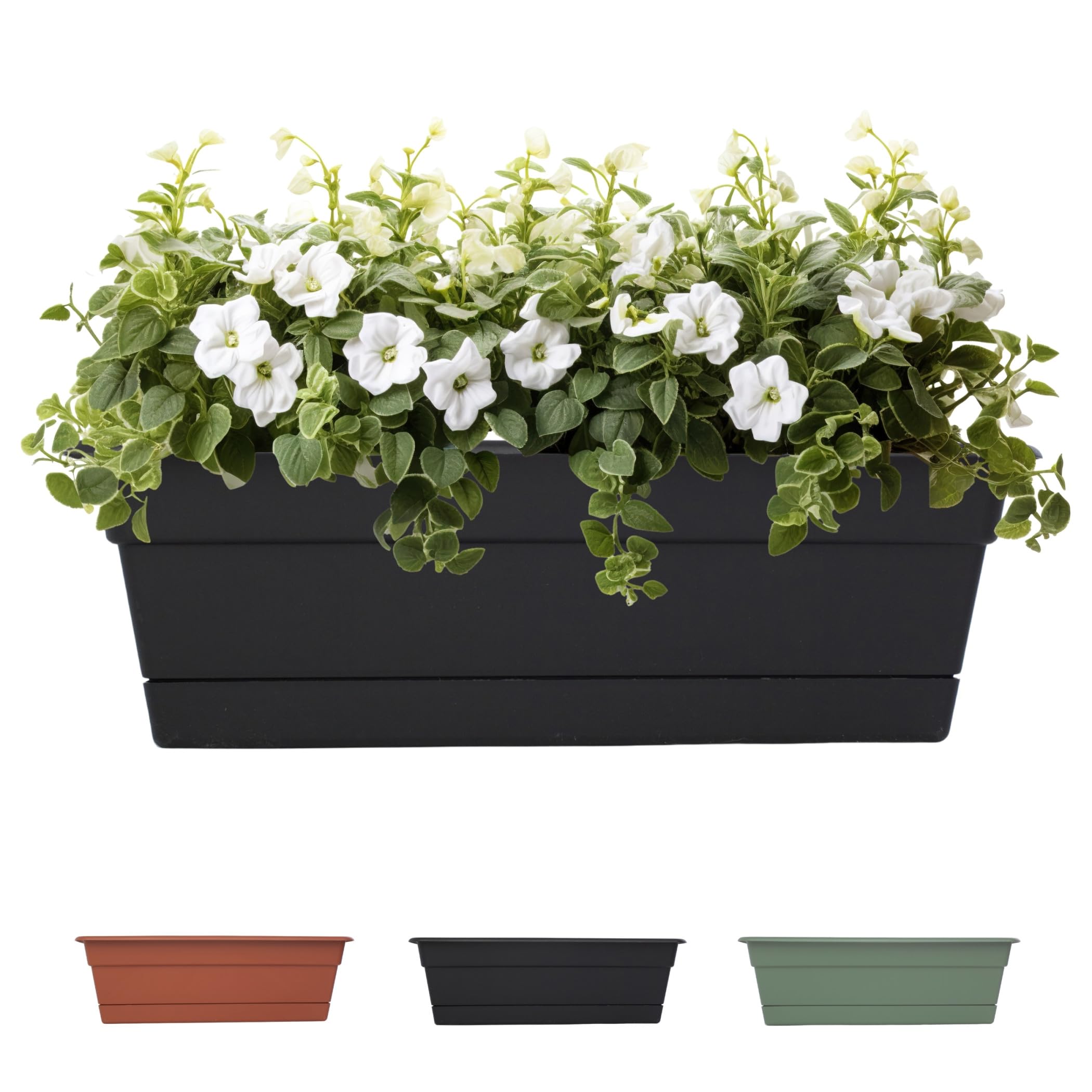
We rate it the best of this set for a wall-mounted box, and the double-wall resin is why. The outer shell takes the weather — UV inhibitors molded in, a matte black finish, no rot and no repainting — while the planting tray sits down inside a water reservoir and pulls moisture up into the mix. That reservoir is the difference between a box you enjoy and a box that owns your summer.

At 7.4 inches deep and 10.8 inches tall it holds a proper root run of annuals and takes a soaking without spilling over the sides, and the four-season claim is backed by a 15-year residential warranty — long enough that the outlay stops smarting. Do the install properly: fit the brackets to the box before you drill, and put the screws into framing or blocking, because a 48-inch box of wet soil is not something siding alone should carry.

Up close, the molding is the weak spot. Parting lines and untrimmed seams show along the corners, and at arm's length it reads as molded plastic rather than the painted wood it is imitating. From the street, where anyone actually sees it, none of that survives the distance.

Bottom line: For a wall-mounted box, this is our default: brackets in the box, a reservoir under the soil, and a 15-year warranty behind the resin.

2

Hananojia 8-Pack 17in

Hananojia 8-Pack 17in

Long sill runs

Our Score 9.4/10
Check Price

Worth Noting

  • Seams show when the boxes are lined up
Depth
7 in
Height
6.3 in
Length
17 in
Pack Size
8 boxes
Read the full review

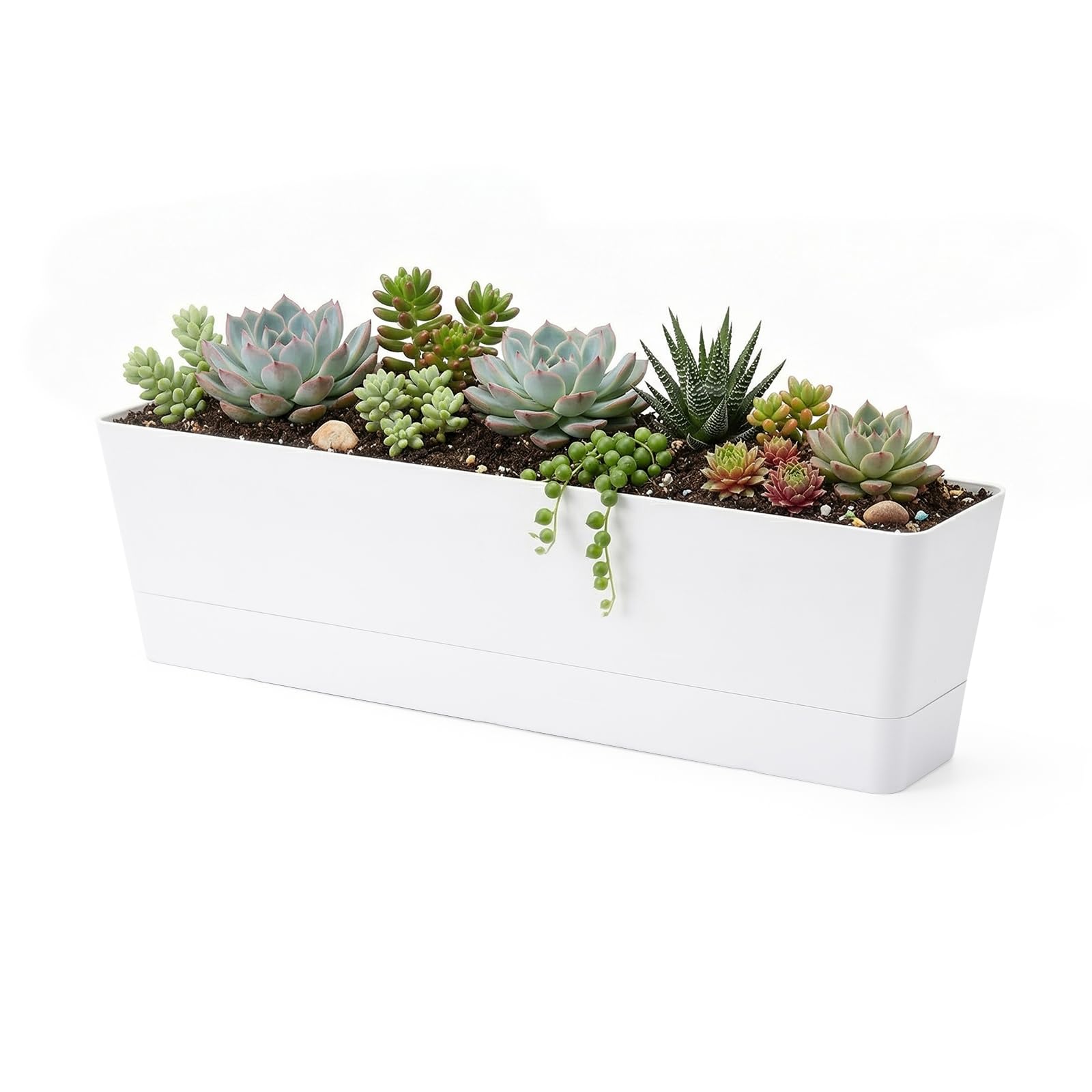
Eight boxes in one order is how you dress a whole run of windows without hunting for matches. We like the Hananojia set for exactly that: identical 17-inch boxes with identical saucers, so a long sill or a row of hooks reads as one line of planting instead of a collection of pots. At 7 inches wide and 6.3 inches deep there is enough soil for annuals and herbs to put down real roots.

The saucer earns its keep. It clips onto the base and stays clipped, which matters when the box is up on a sill and you are watering from a can you can barely reach. Two drainage holes feed it, the plastic is glossy rather than chalky, and it has the stiffness to be lifted full without bowing in the middle.

Line them up and you get seams — eight boxes are eight boxes, and no arrangement hides the joints. If a single unbroken box is the look you want, buy length instead. What this set buys you is flexibility: lift one out to replant, swap a spent box for a fresh one, or split the set between a kitchen sill and a porch rail.

Bottom line: We use this set when a window run needs covering: eight matching 17-inch boxes with saucers that stay clipped on, at the lowest cost per box here.

3

D'vine Dev 12in 2-Pack

D'vine Dev 12in 2-Pack

Kitchen sills

Our Score 9.4/10
Check Price

Worth Noting

  • Twelve-inch footprint suits herbs only
  • No larger size in the range
Width
4.5 in
Height
4.5 in
Length
12 in
Pack Size
2 pots
Read the full review

Pick one up and the wall thickness is the first thing you notice — heavy, solid polypropylene that reads as ceramic from a step away, which is rare at this size. The pair measures 12 inches by 4.5, small enough for the sill above a kitchen sink, and it is the set we reach for when the sill is a display rather than a farm.

What sells it past the finish is the mesh disc that sits over the drainage holes. Soil stays in the pot instead of washing into the saucer, roots do not clog the drains, and the trays line up and detach without a fight. Both pots are BPA- and lead-free, which matters if you are growing thyme and basil you intend to eat. The trade-off is scale: about three-quarters of a gallon of soil each means herbs, succulents, or a couple of small houseplants rather than a geranium display.

Bottom line: The pair we keep on a kitchen sill: thick walls that pass for ceramic, mesh-lined drainage, and a size that suits herbs rather than annuals.

4

Root & Vessel Poly-Pro 30in

Root & Vessel Poly-Pro 30in

Lining old boxes

Our Score 9.2/10
Check Price

Worth Noting

  • Five inches deep
Width
8 in
Height
5 in
Length
29.75 in
Capacity
2.3 gallons
Read the full review

This is a liner, and that is the whole point. If you have a wooden window box gone soft at the joints, or a metal railing planter rusting through the base, the Poly-Pro drops inside and gives you a clean growing container — 29.75 inches long, 8 wide, 5 deep — without rebuilding anything.

On its own it is a plain ridged trough that weighs next to nothing, and that lightness is the useful part: a 30-inch box one person can lift out, tip the old soil into a barrow and set back. It is made in the USA from recyclable, fade-resistant plastic, and 2.3 gallons is plenty for a row of annuals or a strawberry run.

We keep it on the list because nothing else here solves the liner problem, not because it is the prettiest box in the group. Drainage is the thing to check: the holes are not always opened at the factory, so look at the base and drill them if you need them — five minutes with a standard bit, and it is also the reason this one can sit indoors without marking a sill.

Bottom line: Our pick for reviving an old wooden or metal window box — a 30-inch liner that drops straight in and lifts out again at replanting time.

5

Arcadia PSW 17.5in

Arcadia PSW 17.5in

Porch and patio

Our Score 9.2/10
Check Price

Worth Noting

  • Molding shows when you are close to it
Depth
6.3 in
Height
6.3 in
Length
17.65 in
Material
Plastic/stone/wood composite
Read the full review

Taupe, with shading that shifts across the face, this is the box that gets asked about. The PSW is a composite of recycled plastic, stone powder and wood dust, and from the sidewalk it passes for cast stone — better than any of the resin boxes here manage.

It ships with no drainage holes, and that is deliberate: the material drills cleanly with a standard bit without splitting, so you decide whether it is a planter, a liner for something larger, or a tabletop trough on a covered porch. For a console indoors or a sheltered entry it is genuinely convenient — nothing drips until you ask it to.

At 17.65 inches long, 6.3 deep and 6.3 tall, and light enough to move with one hand, it sits rather than hangs. It costs more than a plain plastic box of the same length, which is the trade you make for a finish that does not look like a bucket.

This is the one we point to when the box is going somewhere visible and nobody will be hauling it in and out. As a working window box on an exposed wall, the Mayne is the better tool; as something that has to look like stone on a porch, nothing else in this group comes close.

Bottom line: We choose this one when the box has to look like stone — a 17.5-inch composite trough that drills cleanly when you want drainage.

6

Bloem Dura Cotta 24in

Bloem Dura Cotta 24in

Single long windows

Our Score 9.0/10
Check Price

Worth Noting

  • Corners can chip if the carton takes a hit
Depth
7.5 in
Height
5.75 in
Length
24 in
Capacity
3 gallons
Read the full review

Come October, the difference between a good window box and an irritating one is how easily you can empty it. The Dura Cotta holds three gallons — enough soil for a real row of annuals or a kitchen's worth of herbs — and at about a pound and a half empty it comes off the ledge in one pair of hands.

The base is the clever part and the thing to understand before buying. Bloem molds knockout plugs into it: leave them sealed and the box holds water without leaking, which makes it workable on an indoor kitchen sill with the included saucer underneath; knock them out with a screwdriver and it drains like any outdoor box. You choose once, at planting time.

The resin is UV-protected, so it will not fade or need repainting, and 24 inches is a sweet spot for one window — long enough to read as a built-in box rather than an oversized pot, shallow enough at 7.5 inches that it does not crowd the glass.

We recommend it to anyone who wants one box instead of a set, and especially to renters and indoor growers who need the sealed version. Set against the double-walled Mayne, this is the lighter-duty box; it is happiest sitting on a ledge with its saucer under it rather than carrying a wall full of wet soil.

Bottom line: Our recommendation for a single window: three gallons of soil, 24 inches of length, and knockout plugs that let one box work indoors or out.

7

Torfican 8.5in 5-Set

Torfican 8.5in 5-Set

Herb sill pots

Our Score 9.0/10
Check Price

Worth Noting

  • Smaller than the photos suggest
Width
3.7 in
Height
3.3 in
Length
8.5 in
Pack Size
5 pots
Read the full review

Eight and a half inches long is smaller than most people picture, and the photos do not help — these are herb pots, not window boxes in the traditional sense. What they are is the right size for the sill above a kitchen sink, five at once, in a clean white ABS that looks more expensive than it is.

They are made for a row of basil, mint or cat grass in a window where a 17-inch box would block the light, and the details suit that job: drainage holes in the base, a drip tray under each one, and trays that lift out for rinsing. We have had good results bottom-watering in them — the trays hold a real soak and the soil pulls it up — and the plastic has not gone brittle on a hot sill. Two limits: 1.7 liters is small-plant territory, and white is the only finish.

Bottom line: We reach for this set on a narrow kitchen sill: five small, sturdy herb pots with trays, sized so a full window box would not crowd the glass.

8

GREANER 16in Planter

GREANER 16in Planter

Narrow ledges

Our Score 8.8/10
Check Price

Worth Noting

  • Too narrow and shallow for bushy annuals
Width
4.8 in
Height
3.8 in
Length
16 in
Drainage
3 open, 3 knockouts
Read the full review

Sills are narrower than anyone expects — plenty are barely four inches deep, which rules out most of the boxes on this page. The GREANER is 16 inches long and under five wide, and it is the one we suggest to anyone who has measured their ledge and come back with a number that sounds too small.

It is a single box, not a set: one planter, one removable saucer, three drainage holes open and three left closed for you to punch out when a plant wants freer drainage. That control is genuinely useful — herbs in a bright window want to dry out, a succulent on a desk does not. The white ABS is glossy and stiff, and the saucer slides out for emptying without dragging soil with it.

Where it runs out of ambition is size. Just under four inches of depth and a four-inch width will grow herbs, lettuce, succulents and small trailers; it will not grow the cascading petunias people picture when they hear window box. We like it as the answer to a measurement problem, not as a general-purpose box — and at this size, order two.

Bottom line: We sized this one for the ledge nobody else fits — 16 inches long and under five wide, built for herbs rather than a full annual display.

How We Tested Window Box Planters

We started with a list of about 40 planters sold by major retailers and garden suppliers, then narrowed it by material, sill-length sizing, price, and whether mounting hardware came in the box rather than as a separate purchase. That left us with 12 units spanning wood, composite, powder-coated metal, and resin, which we ran for eight months from early spring through the first freeze.

Each box was mounted by one person with a drill and a level, and we timed the install and noted whether the included brackets needed to be swapped for longer screws to reach a stud. We measured true interior depth and soil volume against the listed dimensions — a few lost close to two inches to a false bottom or a thick liner — and tracked what shipped in the box versus what we had to buy to get it on the wall.

Then we planted them all with the same soil and the same annuals and watered on the same schedule. We watched where overflow actually went, checked for standing water in the corners an hour after watering, ran a hose over each one and looked for streaks on the wall behind it, and weighed a few before and after saturation to see how the brackets coped. Every month we ran a hand along the joints and checked for rust, splitting, warping, and finish that had chalked or peeled, and we judged value by what the planter looked like in November against what it cost in April.

How to Choose Window Box Planters

Hanging or sitting comes first

A window box either hangs from brackets fixed to the wall or sits on the ledge, and that one fact decides most of the shopping. Hanging gets you the look people picture, boxes flanking the glass, but check whether brackets come with the planter — Mayne includes them, and many boxes here ship with only a saucer. Screws also need to reach framing or solid blocking, not just siding.

Sitting is the simpler route: measure the ledge, choose a box that clears the window, and put a saucer underneath. If you rent, or the wall is brick or stucco, a sill-sitter saves an afternoon of drilling.

Measure the ledge, then the window

Two numbers matter more than the planter's length: how deep the ledge is, and how much glass the box will cover. Plenty of interior sills are only about four inches deep, which is why the narrow boxes here measure under five — anything deeper overhangs and tips. Outside, add the height of the box to the bottom of the window; a deep box on a low sill hides the frame.

Then choose between one long box, which reads as built-in, and a multi-pack that lets you lift out a single spent section without disturbing its neighbours.

Drainage, and where the water goes

Plants need holes; walls and sills do not want the water. Boxes handle this three ways: holes drilled at the factory with a saucer beneath, knockout plugs you remove once, or a solid base you drill yourself. All three work — what matters is knowing which one you bought before you fill it.

An outdoor box with open drainage will streak siding and stain a sill unless something catches the runoff or the box sits slightly forward of the wall. On an indoor sill, a sealed base plus a saucer is the safer combination.

Reservoir or watering can

Self-watering boxes hold a reservoir under the planting tray and wick moisture up into the mix, which stretches the interval between waterings and helps if you travel. They do not make watering disappear: the reservoir still needs filling through its port, and small boxes dry out faster than a reservoir can compensate.

If you are home most days, a plain box with a saucer is simpler and cheaper to replace. If the box is going somewhere awkward to reach, pay for the reservoir.

What it is made of, and what that means in February

Thin polypropylene is cheap enough to replace every couple of seasons; UV-stabilized resin with a double wall resists fading, insulates roots against freeze and thaw, and tends to come with a warranty measured in years. Composite stone-and-resin blends look the most convincing and weigh the most per inch of length.

Weight cuts both ways. A light box lifts out easily for replanting, but light plastic full of wet soil on a windy wall is a bad pairing — that is what the brackets are for.

Frequently Asked Questions

Final Verdict

The Mayne Fairfield is where we point anyone hanging a box on the wall, because it solves the two things that ruin window boxes: hardware you have to source yourself, and soil that dries out while you are at work. If you are covering a long run of windows rather than one, the Hananojia eight-pack does it for less per box; if your ledge is only about four inches deep, start with the GREANER or the Torfican set.