Planters & Plant Supports

Best Railing Planters of 2026

A railing planter has one job: stay put. But anyone who has watched a gust of wind rattle a pot of geraniums knows that's a lot to ask from two screws and a plastic bracket. The best ones earn their keep by turning a narrow balcony rail into usable growing space—without wobbling, leaking, or blocking the view. Over the past eight months, my team and I have tested 12 railing planters on everything from a wrought-iron fire escape to a wide wooden deck rail, and the difference between a planter that feels solid and one that rattles comes down to a few unglamorous details.

The first thing I check now is the mounting hardware—specifically screw length, because a short screw on a thick railing is an accident waiting to happen. Fit matters just as much: a planter that sits crooked or leaves a gap will collect rainwater and eventually rust. We also weighed each one after filling it with damp soil, because a planter that's sturdy empty can sag under the weight of wet potting mix. Assembly, appearance, and value all factored in, and the picks below are the ones we'd trust with our own tomatoes.

1

Veradek Pure Series Railing Planter

Top Pick
Veradek Pure Series Railing Planter

Long exposed railings

Our Score 9.4/10
Check Price

Worth Noting

  • Sold only as a two-pack
  • Premium price for the pair
Pack
2-pack
Capacity
37.9 liters
Mounting
Adjustable bracket included
Dimensions
36 x 10 x 9 in
Read the full review

A 36-inch planter box with a galvanized steel bracket in the box solves the part of railing gardening that usually goes wrong: the mount. Veradek includes an adjustable railing attachment, so you are not hunting for a separate bracket or improvising a hook, and each box arrives fully assembled. The pair runs 36 inches long, 10 inches wide, and 9 inches tall, with a listed 37.9-liter capacity.

That included bracket is why this is our top pick. On a long deck or balcony rail, we want a box that stays level and takes a full load of soil without fussing, and the steel bracket plus the 9-pound empty weight point to a more substantial setup than the thin over-rail boxes here. The plastic finish is built for weather, and the two boxes cover a serious stretch of railing in one go.

We also like the adjustable bracket, because rail profiles are where most planter purchases go sideways. Measure the rail before ordering and check the bracket opening against it. The 36-inch span is a lot of planter for a small balcony, and each box is heavy before soil, so choose a spot where it can stay. If your rail is shorter, a single 24-inch box will feel less dominant; for a long run, this matched pair is cleaner.

Bottom line: The Veradek pair is our default for a long, exposed railing: the included steel bracket, 36-inch span, and substantial build make it the most secure bracket-included setup here.

2

Root & Vessel Countryside Railing Planter

Root & Vessel Countryside Railing Planter

Easy lifting

Our Score 9.4/10
Check Price

Worth Noting

  • Ships in one to two months
  • Rail fit limited to 3.5 or 5.5 inches
Weight
2 lb
Drainage
Two removable plugs
Rail Fit
3.5 or 5.5 in wide
Dimensions
24 x 12 x 10 in
Read the full review

At two pounds empty, the Countryside is the planter you can lift off the rail with one hand, tip out last season's soil, and put back without calling for help. It is 24 inches long and made from a lightweight plastic with a matte terra finish. The over-rail shape is designed for 3.5-inch or 5.5-inch rails, which covers common 2x4 and 2x6 deck railings.

The two removable drainage plugs are on one side, so you can open them for outdoor rain or keep them in while plants settle. There is enough depth for herbs, lettuce, and annuals, and the box is shallow enough that you can reach the back without a trowel fight.

We also value how little ceremony it requires: no tools, no separate bracket, no permanent hardware. It moves around until you fill it, so set it where you want it before adding soil. The trade-off is that it depends on the rail profile rather than clamping to it; on a rail that is not close to 3.5 or 5.5 inches, it is not the right box.

This is our pick for a porch you rearrange—move the planter for sun, take it down to clean, or change the display without a screwdriver. Availability is the annoyance: it often ships in one to two months, so order early if you want it for a particular season. The low weight and simple drainage are worth waiting for if you want a box you can handle alone; if you need it this week, choose an in-stock alternative.

Bottom line: The Root & Vessel is the one to choose when you want to lift the planter off by yourself; at 2 pounds, it is the lightest full-size box in this group.

3

Lechuza Balconera Color 80

Lechuza Balconera Color 80

Low-maintenance watering

Our Score 9.2/10
Check Price

Worth Noting

  • Brackets sold separately
  • Shallow for larger plants
Capacity
12 liters
Mounting
Brackets sold separately
Watering
Self-watering reservoir
Dimensions
31.5 x 7.48 x 7.48 in
Read the full review

The Balconera's draw is the reservoir: a 12-liter self-watering trough with a water-level indicator, designed to stretch the time between refills. At 31.5 inches long and about 7.5 inches deep and tall, it is a sleek balcony box rather than a big soil-filled display. The catch is in the fine print: the brackets that let it hang from a railing are sold separately.

As a planter, the all-in-one reservoir and removable insert make more sense for herbs, small annuals, and anyone who travels or forgets to water. The self-watering action depends on roots reaching the reservoir, so new plants still need normal watering while they establish. The planting area is shallower than the 36-inch Veradek, which is the trade-off for the water storage.

This is the one we reach for when watering is the chore to solve, not when we need the biggest box. The separate bracket purchase is the main annoyance, and it belongs in the budget before you order; once mounted, the clean slate finish and hidden support make a balcony look less like a collection of pots. It is a considered, good-looking planter with a real convenience built in.

Bottom line: We reach for the Lechuza when watering is the chore to solve; its 12-liter reservoir and indicator make it the low-maintenance pick, provided you factor in the separate brackets.

4

Bloem Deck Balcony Rail Planter

Bloem Deck Balcony Rail Planter

Budget flower boxes

Our Score 9.2/10
Check Price

Worth Noting

  • Rail fit limited to two width ranges
Length
24 in
Capacity
4 gallons
Material
UV-protected resin
Rail Fit
3.25–3.75 in wide; 5.25–5.75 in high
Read the full review

Four gallons of soil is the number that separates the Bloem from the thin 24-inch boxes here. It fits rails 3.25 to 3.75 inches wide and 5.25 to 5.75 inches high, with no tools required, so it is aimed at a standard porch or balcony rail rather than an oversized or ornamental one. The UV-protected resin comes in a terra cotta finish that should hold its color.

We like this one for a renter or first-time rail gardener who wants enough soil for real flowers without paying for a bracket system. The over-rail design is simple, and the 24-inch box is easy to lift into place before filling. The catch is drainage: the planter does not come with open holes, and you need to drill them where marked. That is a five-minute job with the right bit, but it is not a step to skip if the box will sit through repeated rain.

A four-gallon box is also heavier than it looks once wet, so plant it where it will stay for the season rather than treating it as a movable pot. If you need pre-drilled drainage, the HC is the easier pick; if you want more soil volume for the money, this is the one.

Bottom line: We like the Bloem for a renter or first-time rail gardener who wants soil volume without paying for a bracket system; its 4-gallon box is simple, good-looking, and ready for a serious flower display.

5

Karlliu 24-Inch Window Box Pair

Karlliu 24-Inch Window Box Pair

Decorative porch rails

Our Score 9.2/10
Check Price

Worth Noting

  • Hardware can arrive incomplete
  • Sold only as a pair
Pack
2-pack
Liner
Coco coir included
Material
Powder-coated carbon steel
Dimensions
7 x 24 x 5.5 in
Read the full review

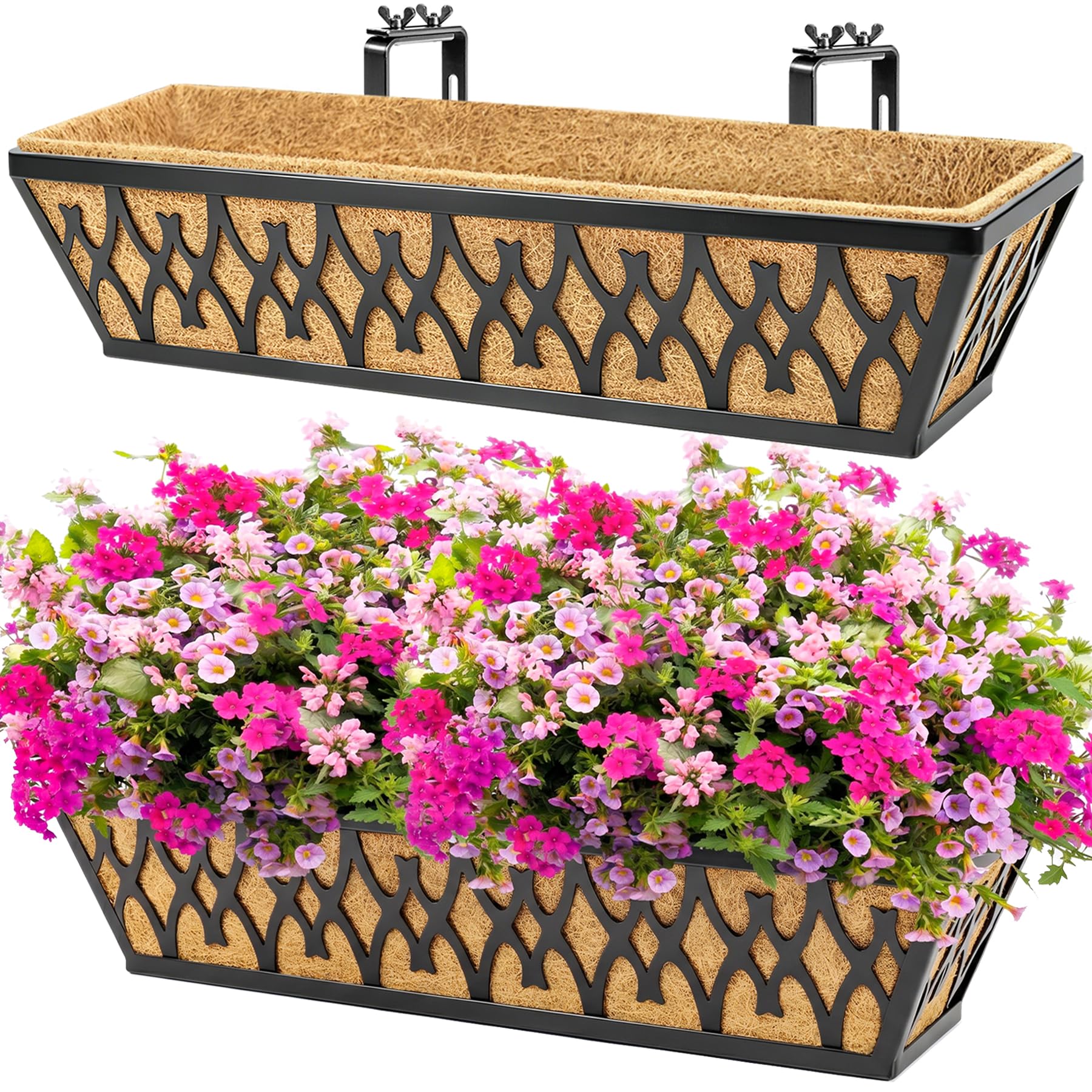
The Karlliu set dresses up a rail with two powder-coated steel boxes and two coconut-coir liners, so the planter looks like a hanging window box rather than a plastic tub. Each box is 24 inches long, 7 inches wide, and 5.5 inches tall, with a classic pattern pressed into the metal and an adjustable bracket for rail mounting.

The coco liner is the part that changes how you garden in it. It holds soil but dries faster than a solid plastic wall, so soak it thoroughly before planting and expect to water more often in wind or full sun. The metal basket has drainage built in, and the liner keeps soil from washing through. We like the look for a front porch or balcony where the planter is part of the display, not just a utility box.

This is the pair we choose when the railing is visible from the street and we want the plants to sit in something more finished than resin. The hardware is the piece to check: count the screws and wingnuts before you start, because kits can arrive short or with fasteners that do not pull tight. That is a hardware-store errand, not a reason to avoid the planter, but it is the difference between a ten-minute install and an afternoon.

Bottom line: For a porch rail that is part of the curb appeal, the Karlliu pair brings the most decorative steel-and-coco look here, as long as you check the hardware.

6

HC Companies Deck Rail Planter

HC Companies Deck Rail Planter

Standard deck rails

Our Score 9.0/10
Check Price

Worth Noting

  • No clamp—relies on rail shape
  • Can shift on rounded or thick rails
Drainage
Four removable plugs
Material
UV-resistant plastic
Rail Fit
2 x 4 and 2 x 6 rails
Dimensions
12 x 24 x 9 in
Read the full review

The HC deck rail planter is the straightforward budget choice: a 24-inch plastic trough with four removable drain plugs and a shape made for standard 2x4 and 2x6 rails. That is not a glamorous brief, but it is exactly what a lot of porches need.

It sits over the rail rather than clamping to it, so the rail itself does the holding. On a standard, level 2x4 or 2x6 top rail it is a simple drop-in; on a thicker, rounded, or ornamental rail it can shift, and that is the thing to check before you fill it. The four plugs are the feature we appreciate most, because you can open drainage for outdoor use and keep more water in while a plant settles.

The 12 x 24 x 9-inch body is roomy enough for a row of herbs, annuals, or a compact vegetable, and the UV-resistant plastic is light enough to carry to the rail before you load it. It is not the planter for hidden brackets or a furniture-like finish; it is the one for a useful, inexpensive box that does the basic job without a hardware project.

Bottom line: We recommend the HC as the low-cost workhorse for a standard 2x4 or 2x6 rail, and its four removable drain plugs make it the easiest budget box to live with.

7

VOXOR 24-Inch Railing Planter Pair

VOXOR 24-Inch Railing Planter Pair

Wide railings

Our Score 8.8/10
Check Price

Worth Noting

  • Included screws may be too short
  • Coco liner dries quickly
Pack
2-pack
Material
Powder-coated iron
Rail Fit
0 to 6.5 in wide
Dimensions
6.69 x 24.02 x 6.1 in
Read the full review

The VOXOR's calling card is an adjustable bracket that spans railings from 0 to 6.5 inches wide, which is the widest range in this group. The two 24-inch boxes are made from powder-coated iron with a 6.1-inch depth and a coco liner, so they are aimed at a thick balcony rail or an odd porch profile where a standard over-rail box will not sit flat. We recommend it first for that fit problem, not as a universal upgrade.

The deeper box gives roots more room than the 5.5-inch metal boxes here, and the bracket can also be mounted to a wall or windowsill, which adds flexibility. The weak point is the hardware: the included screws can be too short to pull the mount tight, and the screw holes are not always cooperative. Check the bag before assembly and get the right fasteners if yours are short. The liner also dries quickly, so plan on more watering in exposed spots.

On a standard 2x4 rail, the wider bracket is more adjustment than most people need, and the Veradek or HC is simpler. On a deep or unusual rail, this is the pair that makes the installation possible. That specificity is why it stays in the roundup as an also-consider rather than a default.

Bottom line: The VOXOR is our fit solution for a wide or oddly shaped railing; its 0-to-6.5-inch bracket is the reason to choose it over the simpler boxes.

8

LaLaGreen 4-Inch Railing Pots

LaLaGreen 4-Inch Railing Pots

Herb walls

Our Score 8.8/10
Check Price

Worth Noting

  • Handles need hand strength to seat
  • Four-inch pots dry out fast
Pack
10-pack
Drainage
Hole in each pot
Material
Metal
Pot Size
4 x 4 x 4 in
Read the full review

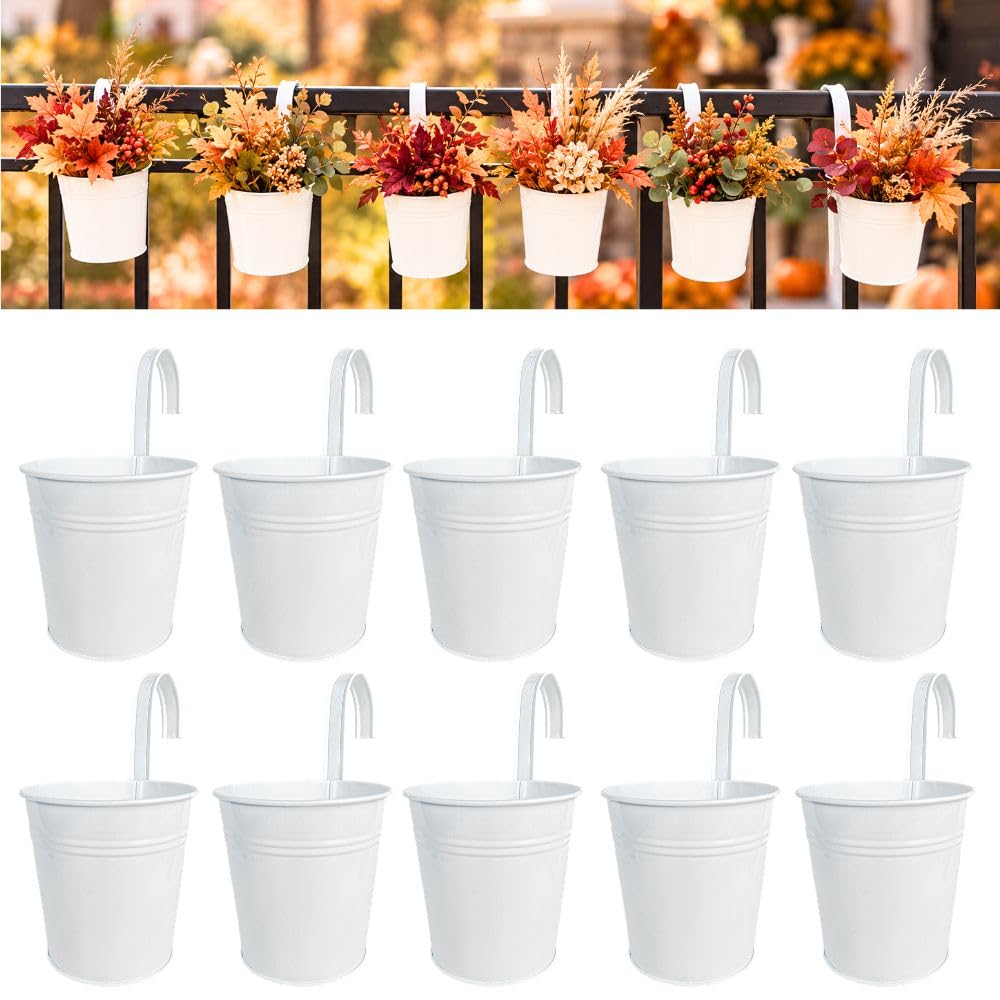
Ten four-inch metal pots with detachable handles are a different tool from a 24-inch trough: each one holds a single herb, succulent, or small annual, and the handle hooks over a rail or fence. The set is white, round, and intentionally minimal, with a drainage hole in each pot. For a rental balcony or a narrow fence top, that small footprint is the appeal.

The handle is designed to press onto the pot and stay there, so there is no separate bracket or wall hardware. That makes the set cheap to try and easy to move around, and the white finish reads clean against a dark rail. The pots are small enough that you can fill several without hauling a bag of soil across the deck.

The assembly is where these need patience. The detachable handles take hand strength to seat, and a handle can bend if you force it; people with limited grip may find the set frustrating. Once on, the pots hang neatly, but a four-inch pot dries out fast in sun or wind, so this is a setup for herbs and succulents you check often, not for a low-maintenance flower display.

We keep these in the roundup for the renter or small-space gardener who wants a row of individual pots rather than one long box. They are not the choice for a big show of annuals, and they will not replace a secure trough on an exposed rail. For a kitchen herb wall or a fence line of succulents, the small scale is the point.

Bottom line: The LaLaGreen ten-pack is our pick for a small herb or succulent wall; it is affordable and movable, but not a substitute for a full flower box.

How We Tested the Best Railing Planters

We started by pulling together every adjustable and fixed-width railing planter we could find, then narrowed the list to 12 models that came with mounting hardware and either had drainage holes or could be modified to add them. We favored metal or thick resin brackets over thin plastic, and we skipped anything that required tools beyond a screwdriver.

Over eight months, we mounted each planter on at least two different rails: a standard wood deck rail, a narrow metal balcony rail, and a wide vinyl cap rail. We measured screw length against rail thickness—a 1-inch screw won't bite into a 2-inch rail—then shook each planter by hand to check for wobble. We also noted how easy the brackets were to adjust without extra hardware.

Every planter was filled with damp potting soil and weighed on a luggage scale; a planter that felt solid empty sometimes sagged once wet. We watered heavily and watched whether water drained freely or pooled around the roots, and we checked after storms for rust, fading, and loose screws. Assembly was timed solo, and we rated appearance from a few feet back, the way you'd see it from a neighbor's balcony.

Value came down to what held up: a planter that needed replacement screws or rusted at the bracket wasn't a bargain, no matter how good it looked on day one. We'll keep these planted through another season and update if anything fails.

How to Choose Railing Planters

Match the Mount to the Rail

Start by measuring the top rail's width and profile, not the planter's length. Over-rail boxes sit on a flat top and depend on a close fit; bracket-mounted boxes clamp or hang from the back and can be more secure on deep rails but need clearance behind the box. The HC planter is sized for 2x4 and 2x6 rails, while the VOXOR bracket opens to 6.5 inches for thicker profiles. If the rail is rounded, glass, or ornamental, check the bracket contact points before you buy, because a hook that clears the top can still let the box tip forward.

Decide How You Want to Handle Drainage

Outdoor planters need a way for excess water to leave, and manufacturers handle it three ways: pre-drilled holes, removable plugs, or marked spots you drill yourself. Plugs are the most flexible for a rail that gets both rainy and dry spells; the HC has four, and the Root & Vessel has two. A drill-your-own box like the Bloem is not a dealbreaker, but make the holes before you fill it, and put them where runoff will not stain the deck or drip onto a walkway. Self-watering planters such as the Lechuza work differently: the reservoir holds water, but young plants still need manual watering until their roots reach it.

Size the Box to the Plants and the Lift

A 24-inch box is the practical middle for most porches; 31- and 36-inch boxes cover a longer run but hold more wet soil and are harder to move alone. The Veradek boxes weigh 9 pounds empty and hold 37.9 liters, while the Root & Vessel weighs 2 pounds. If you like to rearrange the planter for sun or cleaning, weight matters as much as capacity. Plant on the ground before lifting, and choose a long box only where it can stay put. For herbs and lettuce, a 5.5- to 6-inch-deep metal box is enough; for bigger annuals, the 9-inch HC or 4-gallon Bloem gives roots more room.

Choose the Material You Can Live With

UV-resistant plastic is the low-maintenance choice: it will not rust, and it wipes clean, though it can look utilitarian. Powder-coated steel looks sharper and holds a coco liner neatly, but the finish can chip and the hardware is the part to inspect; the Karlliu and VOXOR both use metal boxes and included brackets. Coco liners breathe and drain well but dry faster than solid plastic, so soak them before planting and expect more frequent watering in wind. Metal earns its premium when the rail is visible and the look matters; if the planter is mostly a growing tool, plastic is the easier ownership story.

Plan for Watering and Seasonal Care

Self-watering is a real convenience, not magic. A reservoir stretches the interval between refills, but it does not make a new plant drought-proof; the Lechuza's indicator helps you see when to fill, and its planting area is best for herbs and small annuals. Manual boxes need a simple routine: check the soil an inch down, water until it runs from the drainage holes, and empty saucers or trays so roots do not sit wet. At the end of the season, remove spent soil, scrub the box, and store it dry; that is also the moment to check brackets and screws for looseness before another year.

Frequently Asked Questions

Final Verdict

For most deck and balcony rails, the Veradek Pure Series is the pick we stand behind: the bracket comes with the box, the 36-inch span covers a real stretch of railing, and the steel-and-plastic build is the most substantial here. If watering is your main chore, the Lechuza Balconera earns the upgrade—just add the brackets to the cost.

If your rail is unusually wide, the VOXOR's 0-to-6.5-inch bracket is the reason to choose it, and the Root & Vessel is the lighter box for someone who repositions the planter. The right answer changes with rail fit and lifting weight before it changes with finish.