Greenhouses & Hydroponics

Best Vertical Hydroponic Systems of 2026

The pitch on a vertical hydroponic system is almost too good: fill the reservoir, drop in a pod, plug in the pump, and a month later you're pinching basil off a tower on the kitchen counter. What the box doesn't mention is that two systems can look nearly identical and produce wildly different harvests. A good one takes the three things that kill indoor herbs — inconsistent light, guesswork feeding, and forgotten watering — and puts them on a schedule for you.

My team and I spent eight months with ten of these systems in real kitchens, from a bright south-facing counter to a dim apartment corner, and the spread was embarrassing: some filled a salad bowl every few weeks, others produced leggy seedlings and a slick of algae. Assembly ranged from ten minutes to a lost afternoon, and more than one unit arrived without the nutrients or seed pods you'd assume were in the box. The picks below are the ones that grew well, stayed stable, and didn't quietly bill me for pods I didn't need.

1

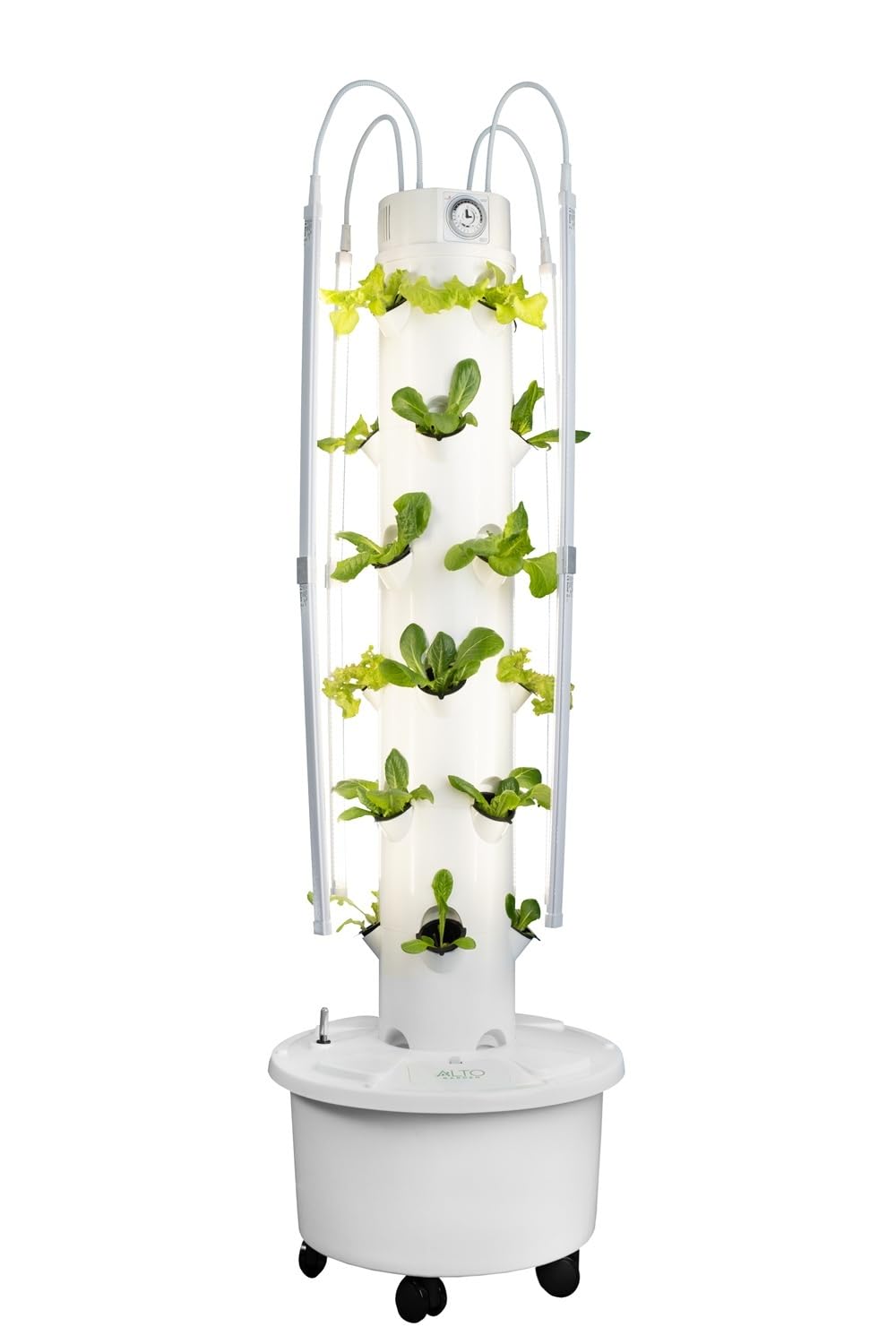
ALTO GARDEN GX Tower

Top Pick
ALTO GARDEN GX Tower

Set-and-forget tower

Our Score 9.0/10
Check Price

Worth Noting

  • Premium price for 24 growing sites
  • 66 inches tall plus light clearance
Lighting
LED panels with built-in timer
Footprint
20 x 20 x 66 inches
Reservoir
10 gallons
Growing Sites
24 net pots
Read the full review

Six levels, 24 net pots and a 10-gallon reservoir on casters: the ALTO is the most complete system here out of the box, because the broad-spectrum LED panels and the water pump both run on timers that ship with it. Set the light cycle and the irrigation cycle once and the tower takes over, with no app, no pairing and no subscription. That combination is why we trust it as the default recommendation for someone who wants a vertical garden rather than a project.

The build is the other half of that confidence. The tower walls are 2mm thick, the heaviest wall specification in this set, and the six sections stack into a cylinder 66 inches tall on a 20-inch square base. That base matters, because a column carrying 10 gallons of water and two dozen plants is a lot of mass up high. The reservoir wheels out for refills and scrubbing, which is the difference between cleaning a tower and dreading it.

Twenty-four pots around one cylinder means plants share the light and the nutrient mix, so this is a tower for herbs, lettuce and strawberries rather than beefsteak tomatoes. Thirty rockwool cubes come in the box to get you started; seeds and nutrient refills are on you.

Two things to know before you commit: 24 sites is modest for the money, since the Ahopegarden below gives you 66 for less, and 66 inches plus light clearance wants a room with real headroom. If you have a corner with the ceiling for it and no interest in hand-holding a pump timer, neither point changes the answer.

Bottom line: We recommend the ALTO to anyone who wants a tower that waters and lights itself, stands solid, and never asks for a subscription.
2

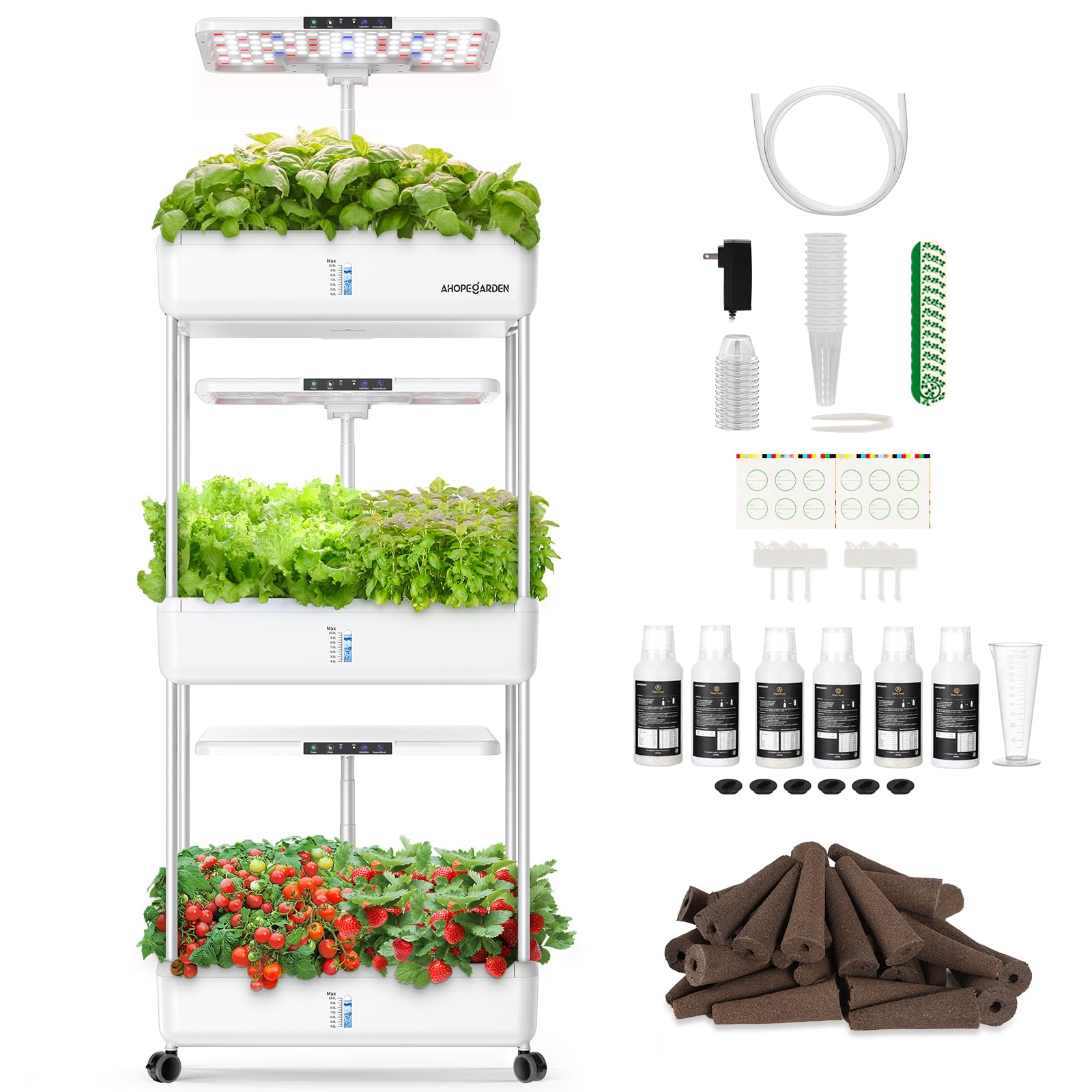
Ahopegarden 66-Pod System

Ahopegarden 66-Pod System

Several crops at once

Our Score 9.0/10
Check Price

Worth Noting

  • Short frame limits tall fruiting plants
  • Panels can work loose where tiers join
Pumps
One per tier
Footprint
25.59 x 14.96 x 21.65 inches
Reservoir
30 L (10 L + 10 L + 10 L)
Growing Sites
66 pods
Read the full review

Three 10-liter tanks, three pumps and three lighting panels sit on one collapsible frame here, which makes the Ahopegarden less a single garden than three gardens stacked. Sixty-six pods is the headline, but the split is what matters day to day: a lettuce tier can run one light mode while an herb tier runs another, nutrients can differ between zones, and one tier can be shut down while the rest keep going. The whole frame rolls on casters, and the light posts telescope about 14.7 inches as plants grow.

What makes it the value pick for us is the combination rather than any one number: three separately controlled zones and 66 sites at a midrange price, with dual grow-light modes and a kit that includes sponges, domes and nutrient bottles. Nothing else here hands a family that much divided growing space for the money.

Living with it is straightforward. The frame collapses if you need to store it between seasons, and the tanks come out individually for cleaning. The joints are where it gives ground to the ALTO, since panels can work loose where the tiers meet on a loaded frame, so check them when you refill. It is also the shortest system here at 21.65 inches, which suits greens and herbs and caps anything that wants to vine.

Bottom line: Our pick for a household growing several crops at once: three independent zones, 66 sites, and the best sites-per-dollar in this group.

3

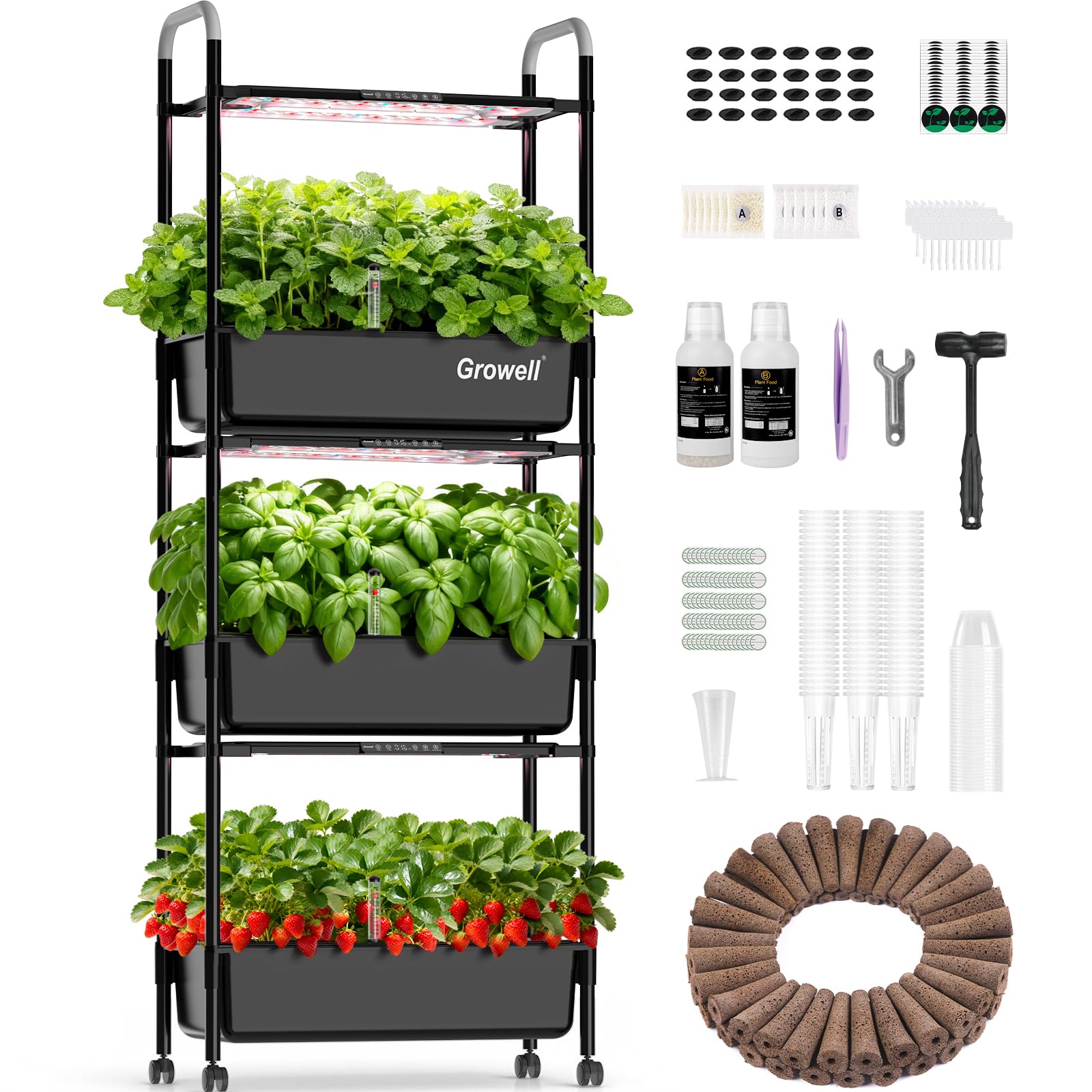
Growell 120-Pod System

Growell 120-Pod System

Maximum harvest volume

Our Score 8.4/10
Check Price

Worth Noting

  • 36.6 inches wide needs a long wall
  • Seeds not included in the kit
Lighting
120 W (30 W x 4)
Footprint
10.2 x 36.6 x 67.3 inches
Reservoir
48 L (24 L + 8 L + 8 L + 8 L)
Growing Sites
120 pods
Read the full review

A hundred and twenty planting sites is not a number most kitchens need, and that is the honest way to read this Growell. It is a four-tier production rack for someone who wants to harvest in bulk: greens for a big family, fodder for chickens, or enough lettuce to stop shopping for it. The frame runs 67.3 inches tall and 36.6 inches wide, so plan a wall rather than a corner.

The plumbing is the interesting part. A 24-liter main tank feeds three 8-liter tiers, the 120 watts of lighting splits into separate vegetable and flower-and-fruit modes on their own timers, and the whole rack rolls on lockable casters so you can pull it out to service. The kit is genuinely complete apart from seeds, at 754 pieces including baskets, sponges, domes and nutrients, which is the difference between unboxing a garden and unboxing a shopping list.

We were struck by how much of the design is aimed at volume rather than convenience: four light bars, four tanks, 120 pods to fill and a nutrient mix to keep balanced. That is the trade. Fewer, bigger harvests and more work per session, against the smaller towers that ask five minutes a week. If you want a salad a day, this is overkill; if you want to stop buying greens for five people, it is the only system here sized for the job.

Bottom line: Buy the Growell 120 if you want to harvest in volume, provided you have the wall for 36.6 inches of frame and the patience for a lot of nutrient mixing.

4

Growell 81-Pod System

Growell 81-Pod System

Independent tiers

Our Score 8.4/10
Check Price

Worth Noting

  • Casters can fail under full tanks
Lighting
26 W per tier
Footprint
11.96 x 25.98 x 64.37 inches
Reservoir
42 L (3 x 14 L)
Growing Sites
81 pods
Read the full review

Three tiers, three 14-liter tanks, three pumps and three light panels: the Growell 81 is built so each level can run its own schedule. A lettuce tier on twenty hours of light beside an herb tier on fourteen is exactly what this design allows, and each panel's timer adjusts from 12 to 23 hours independently of its neighbors.

Eighty-one pods at 27 per tier is a lot of growing space for a frame 25.98 inches wide, and the float indicator on each tank takes the guesswork out of refills. The kit arrives with nutrients, baskets, sponges, domes, labels and small tools, so the only thing missing is seeds. It stands 64.37 inches tall on lockable casters.

We found the value here sits in the middle of the range: less than the 120-site Growell, more capable than any single-tank tower, and per-tier control is what you are really paying for. The casters are the part to watch once three full tanks are on the frame, so site it on a level floor and do not shove it around loaded.

Bottom line: We see the Growell 81 as the three-crop tower: separate tanks, pumps and lights on every tier, for a good deal less than the 120-site model.

5

Gardyn Home 4

Gardyn Home 4

Small rooms and flats

Our Score 8.2/10
Check Price

Worth Noting

  • App coaching needs a paid plan after the trial
  • 0.6-gallon reservoir is small for 30 plants
Levels
4
Footprint
2 sq ft
Reservoir
0.6 gallons
Growing Sites
30 yCubes
Read the full review

Two square feet of floor is the whole footprint, and the Gardyn Home 4 puts 30 plants into it across four levels on a slim steel and aluminum frame. For a flat where the kitchen is also the living room, that counts for as much as the yield, and we think it is the most livable tower in this group. White finish, brushed metal, no obvious plumbing on show.

Watering and lighting are automatic, and the 30 yCubes that ship with it arrive seeded, so the first crop starts the day the box does. Kelby, the app coach, runs for 30 days and then becomes a paid subscription; the tower keeps watering and lighting on its own schedule without it, so treat the coaching as a first-season nicety rather than a requirement.

The reservoir is 0.6 gallons, which is small for 30 plants and the reason this one wants more frequent top-ups than anything else here. The entry price is also the highest in the group, so you are paying for the design, the seeded pods and the coaching. If that trade suits a small, visible room, nothing else here fills the same gap.

Bottom line: We point small-space growers to the Gardyn: two square feet of floor, 30 plants, and coaching that keeps a first season on track.

6

LYCereal 30-Site Tower

LYCereal 30-Site Tower

Bright windowsills

Our Score 8.2/10
Check Price

Worth Noting

  • No grow lights included
  • 10 L tank needs frequent topping up
Included
Pump, timer, water gauge
Footprint
9.84 x 9.84 x 33.86 inches
Reservoir
10 L
Growing Sites
30 pots
Read the full review

No grow lights. That omission is what makes the LYCereal the least expensive tower here, and it is the first thing to settle before you buy: this system wants a bright window, a sunroom, or a light you already own. What is in the box is the water side of hydroponics done properly, with six tower sections holding 30 pots, a 10-liter tank with a visible level gauge, a pump on a timer, a filter, sponges and pots.

At 9.84 inches square and 33.86 inches tall it goes where a 20-inch-wide tower will not: the end of a kitchen run, a narrow gap beside the fridge, a sheltered balcony corner. We like it for herbs by a south-facing window, where the pump timer is the only job you might otherwise forget. Plan on more refills than the bigger towers, since 10 liters across 30 sites goes down fast, and check the light in that spot before you order, because nothing in this kit fixes a dim room.

Bottom line: As long as you have a bright window, the LYCereal is the tower to buy: 30 sites, a pump on a timer, and no lights to pay for.

7

SJZX 25-Pod Tower

SJZX 25-Pod Tower

Tight floor space

Our Score 8.2/10
Check Price

Worth Noting

  • Tight pod spacing suits small plants
Lighting
360-degree full spectrum
Footprint
2.3 sq ft
Reservoir
12 L
Growing Sites
25 pods
Read the full review

Twenty-five pods in 2.3 square feet is a small ask for a floor-standing tower, and the SJZX makes the most of it: five tiers around a central column, with full-spectrum light bars running up the sides so plants on every level get light rather than only the top row.

The water side is modest and honest about it. A 12-liter tank, a pump on an included smart plug cycling roughly every 30 minutes, and a visible water window so you can read the level without lifting anything. Refills are quoted at two to three weeks, and the closed loop is claimed to recycle most of the water it uses.

It arrives as a box of pipes and parts, so inventory them against the list before you start, since a missing filter or tray stalls the whole build. Assembly is straightforward once the pieces are counted, and the tower comes apart again for cleaning.

The lighting is where this one spends its money, with full-spectrum bars around the column rather than a single panel over the top, and that is the right trade at this size, because light and not water is what limits a 12-liter system. The pods sit close together, so treat it as an herb and lettuce tower and leave the fruiting crops to something with more room.

Bottom line: For a balcony or kitchen corner where floor space is tight, the SJZX packs 25 sites and 360-degree lighting into 2.3 square feet.

8

AOONEG 42-Pod System

AOONEG 42-Pod System

Taller plants indoors

Our Score 8.0/10
Check Price

Worth Noting

  • Light cords and casters are weak points
Footprint
18 x 9.8 x 59 inches
Reservoir
23 L
Growing Sites
42 pods
Max Plant Height
23.6 inches
Read the full review

Plants up to 23.6 inches tall can finish in the AOONEG, because the light bars mount on the pipe uprights and the frame extends as the crop grows. That is the tallest supported plant height stated on any system here, and it changes what is possible: compact tomatoes, peppers and bush cucumbers rather than only lettuce and herbs.

The 23-liter tank is the other number worth knowing. AOONEG rates a full tank at about 20 days from the seed stage, the pump cycles on an adjustable adapter, and the tank itself is PP5 food-grade plastic rather than the ABS most of these use. Six 30-watt light bars run off three timer settings, and 42 sites ring the column.

It stands 59 inches tall on an 18 x 9.8 inch footprint and moves on casters, which is how you get it to a drain for water changes. The frame is the least rigid in this group at full height, and the light cords are the part to inspect when it arrives.

Here is where we land: the AOONEG grows taller plants than the towers priced near it, and it does it with a bigger reservoir. The pump setup is the one step that needs care, so read it twice or watch the setup video, because getting it wrong is how a tower ends up pumping onto the floor. Do that and it is a lot of system for the money.

Bottom line: We recommend the AOONEG to anyone who wants taller plants indoors without paying tower prices, as long as they take the pump setup slowly.

How We Tested the Best Vertical Hydroponic Systems

We started by pulling every vertical system we could find from major retailers and narrowing the field to ten, filtering out anything with a reservoir under a gallon, a footprint that wouldn't clear a standard counter, or a starter kit missing the seeds and nutrients that make it a starter kit. Each one then ran for eight months.

Assembly came first: I built every unit alone, with a stopwatch running, using only the included instructions, and noted where a step was missing or a diagram didn't match the parts in the box. Then I filled each reservoir to its max line, set the tower on an 18-inch counter, and gave it a firm nudge to see how much it rocked; I measured the base and height and checked whether the light hood cleared the upper cabinets. I also ran each pump through a full cycle to hear how loud it was — a couple were audible from the next room. Units that wobbled or needed a foot of vertical clearance lost ground no matter how well they grew.

The real test was the growing. Every system grew the same three crops from seed — basil, leaf lettuce, and cherry tomatoes — under the same roof, and I weighed each harvest on a kitchen scale and logged the days to first cutting. Weekly I checked water levels, wiped the reservoir walls for algae, and looked for leaks at the seams, and I left the pumps running continuously to see what wore out first. Along the way I tallied every pod, nutrient bottle, and filter each system required over eight months and compared that running cost with a supermarket basil plant, which is where the value question actually gets answered.

How to Choose Vertical Hydroponic Systems

Start with what you'll eat, not the pod count

Sixty-six sites sounds twice as good as thirty until you price the nutrients and realize you have to fill all of them. Work backwards from your kitchen: a household that eats salad most days is well served by 24 to 30 sites, while 66 or more suits several crops at once, batch growing, or feeding animals. Pod spacing matters as much as the total. Pots packed around a narrow cylinder favor herbs, lettuce and strawberries; anything that fruits needs room to finish, which is where an adjustable light post and a taller frame earn their money.

Reservoir size sets your refill rhythm

Divide the tank by the number of sites and you get a rough sense of how often you will be filling. The ALTO's 10 gallons spread over 24 pots is generous. The Gardyn's 0.6 gallons over 30 plants is not, and it will want topping up more often. A visible level indicator or a float is the small feature that saves you guessing, and a tank you can lift out makes emptying and rinsing it far less of a chore. If you travel, buy the biggest reservoir that fits.

Measure the ceiling, not just the floor

A 66- to 67-inch tower is taller than most people picture once it is standing in the room, and it needs clearance above the top tier for the light. Measure floor to ceiling where it will live, then subtract a hand's width. Floor-standing systems also want a level, solid surface: a full reservoir plus plants is heavy, and casters on a soft floor or a thick rug are how a tower ends up leaning. Locking casters help, but the floor decides.

Check what's in the box and what bills later

The difference between a complete kit and a starter is usually seeds and nutrients. Some systems ship 30 seeded pods; others say no seed on the box and leave you to order. Nutrients run out and get bought again, so treat them as a standing cost rather than a one-off. Watch for subscriptions too: one system here includes an AI coaching trial that turns into a paid plan, though the watering and lighting keep working without it.

Lights, timers, and living with the glow

Full-spectrum LEDs are bright enough to light a room after dark, so decide early whether the tower goes in a spare room, a basement, or the middle of the kitchen. Adjustable light height matters more than wattage, because the panel has to rise as plants stretch. Independent per-tier control is worth paying for when you grow different crops on different cycles; a single shared timer is fine for a tower where everything is harvested together.

Frequently Asked Questions

Final Verdict

Two things decide this purchase: whether the system lights itself, and whether you will still be filling it in February. The ALTO GARDEN GX answers both. The LEDs and the pump run on timers that come in the box, the 10-gallon reservoir buys you time between refills, and there is no app between you and a harvest. We recommend it as the default tower for a kitchen with the headroom.

If 24 sites will not cover what you eat, the Ahopegarden more than doubles the capacity with three independent zones for less money. If you already have a bright window and a spare light, the LYCereal automates the water for a fraction of the cost.