Greenhouses & Hydroponics

Best Hydroponic Growing Systems of 2026

There’s a particular optimism in bringing home a potted basil in January. It sits on the windowsill, you water it faithfully, and by the next week it’s a sad little stick. A hydroponic growing system is the fix: you drop seed pods into a reservoir of moving nutrient water, set a timer for the grow light, and let the machine handle the rest. The good ones make fresh herbs and salad greens feel almost automatic, even in a dim kitchen with no south-facing window.

I’ve killed my share of supermarket herbs, so I was skeptical when we set up a dozen units on countertops, a windowsill, and a dark basement shelf. Over eight months, the differences came down to things you don’t see: whether the light is strong enough for fruiting plants, how long setup took, how often you top off the water, and whether the pump is quiet in month six. More pods isn’t better—crowded plants shade each other, and a unit that lets you raise the light as stems stretch beats a bigger one that doesn’t.

1

iDOO 12-Pod Hydroponic System

Top Pick
iDOO 12-Pod Hydroponic System

First-time growers

Our Score 9.0/10
Check Price

Worth Noting

  • Light is strongest in the middle of the tray
  • Pump and power supply are the weak points
Reservoir
4 L
Grow Light
22 W LED, two modes
Air Movement
Built-in fan
Growing Stations
12
Read the full review

Twelve stations, a four-liter tank, and a small fan built into the light hood — the iDOO does more than any other system here without asking you to open an app. The fan is the part we ended up valuing most. It moves air across the tray, which keeps leaves drier under the LEDs and spreads the heat the light throws straight down onto the middle pods. The LetPot Air has ten stations and no fan; this is the more forgiving place to learn.

Four liters covers a full tray of seedlings for a good while; once twelve plants are established, the honest summer rhythm is a top-up every few days rather than once a month. The window on the front turns that into a glance instead of a lift-and-squint. The assembled unit stands about fifteen and a half inches tall — plenty for lettuce, basil, and dill, short of what a staked tomato wants.

Setup is where it separates from the field: fill, plant, plug in. The light runs on its own timer with two spectrum modes, no pairing, no schedule to build, no firmware. We like that in a kitchen appliance. The fewer decisions that depend on a phone at eleven at night, the more likely the thing is still growing something in March.

The compromise is coverage. A 22-watt panel over twelve stations is brightest in the middle, and seedlings that stall are usually sitting at the ends of the tray. Put your slower germinators at the two edges, keep the tall growers from leaning over their neighbors, and it stops mattering. What earns it the top spot is that nothing in the first month depends on being organized: fill it, plant it, and it gets on with the job.

Bottom line: If you want one system to learn on, we point you here: twelve stations, a fan moving air, and a light that runs itself without an app.
2

LetPot Air 10-Pod Smart Garden

LetPot Air 10-Pod Smart Garden

App control

Our Score 9.0/10
Check Price

Worth Noting

  • Low-water alerts can fire on a full tank
  • Ten stations on a 3.5-liter tank fill fast
Controls
App and WiFi
Reservoir
3.5 L
Grow Light
24 W full spectrum
Growing Stations
10
Read the full review

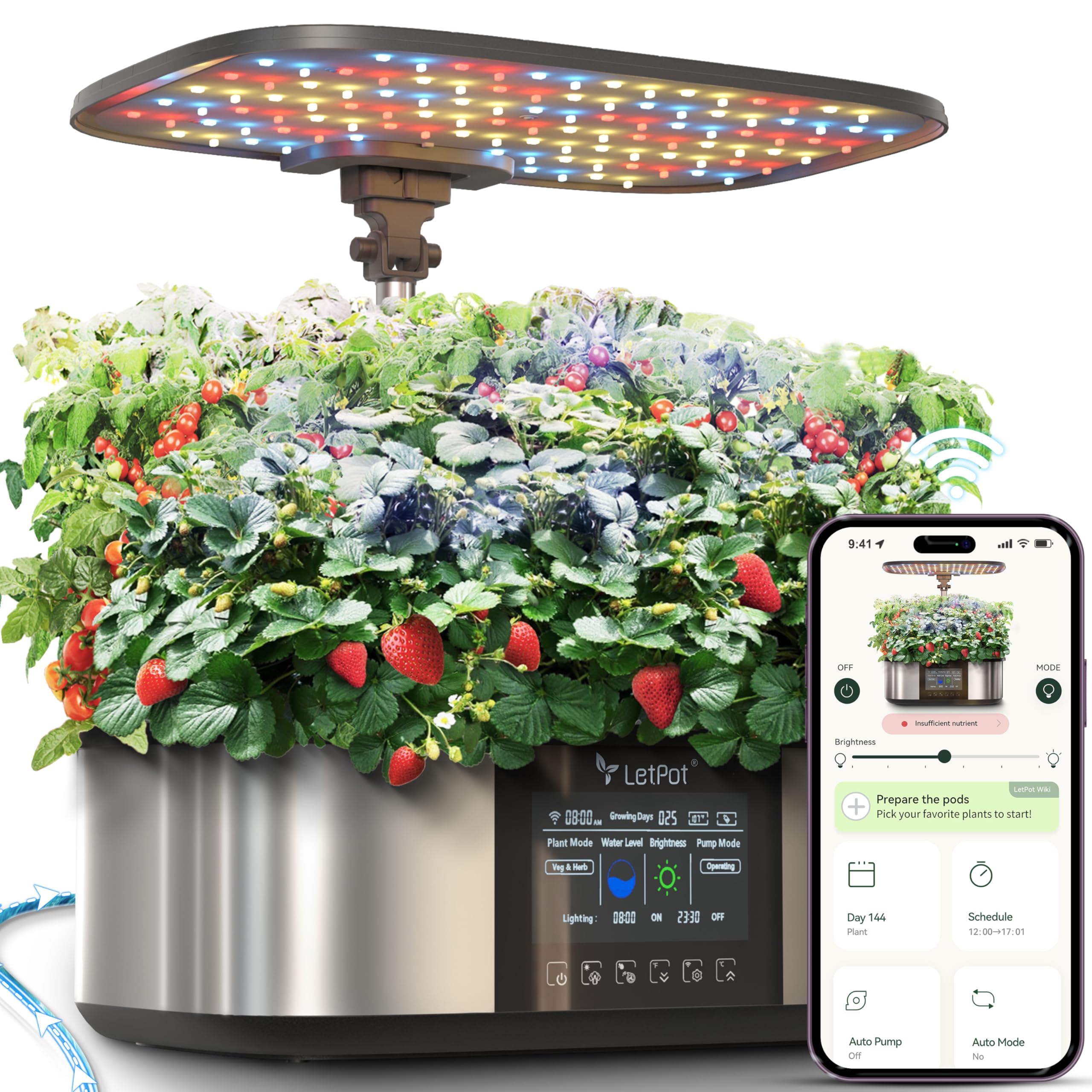
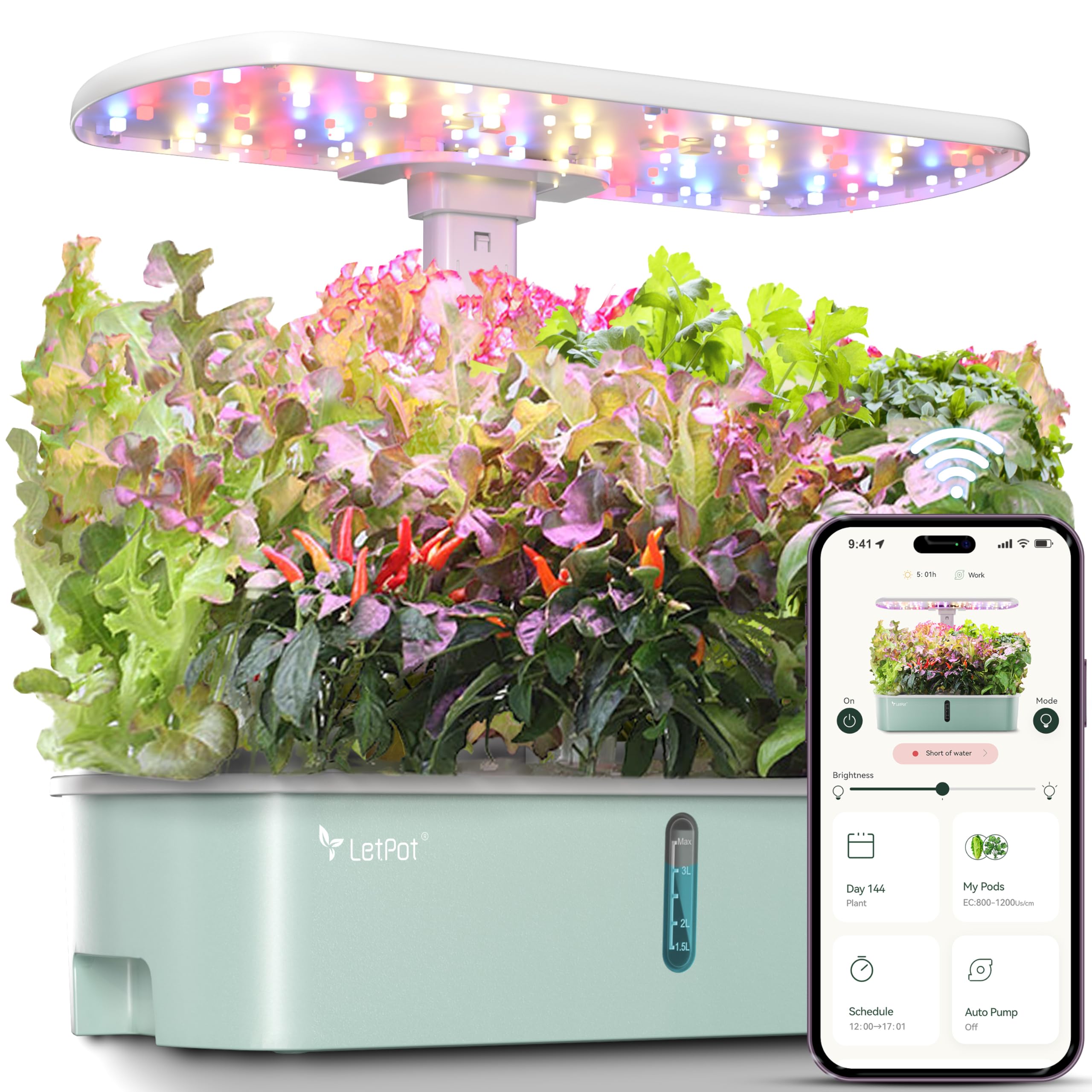
The reason to choose the LetPot Air over our top pick is the phone. Not because an app grows better basil, but because a 24-hour light schedule you build yourself beats a fixed one: run the light through the evening if that's when you're home to see it, or overnight if the counter faces a bright window all day. We think it's the smart system to buy here — the same app as LetPot's larger units, fewer pods, less of your money tied up in a second tray.

Ten pods is the real limit. That's a basil plant, two lettuces, and space for whatever someone in the house wants to watch sprout; cook with herbs daily and you'll want twelve or twenty-one. The 24-watt full-spectrum bar is bright, growth shows inside the first fortnight, and the unit looks like something you leave on a shelf rather than hide in a spare room. Setup is genuinely quick: no tools, no plumbing, and the app finds the unit without a fight.

Two frictions. The low-water warning can fire while there's still water in the tank, which sends you to the kitchen for nothing until you learn to trust your eyes over the notification. And ten stations on a 3.5-liter reservoir means a full tray in summer wants topping up more often than the twelve-pod systems here. If the schedule and the alerts are what you're after, neither is a dealbreaker; if you want to fill a tank and disappear for a month, buy bigger.

Bottom line: We like this one for the schedule on your phone: build a 24-hour light cycle, get water alerts, and still spend less than the top pick.

3

Ahopegarden 12-Pod Hydroponics Kit

Ahopegarden 12-Pod Hydroponics Kit

Budget buyers

Our Score 9.0/10
Check Price

Worth Noting

  • Light post tops out at 14.2 inches
  • Controls limited to two preset light modes
Reservoir
4 L
Grow Light
Two modes, full spectrum
Light Height
Up to 14.2 in
Growing Stations
12
Read the full review

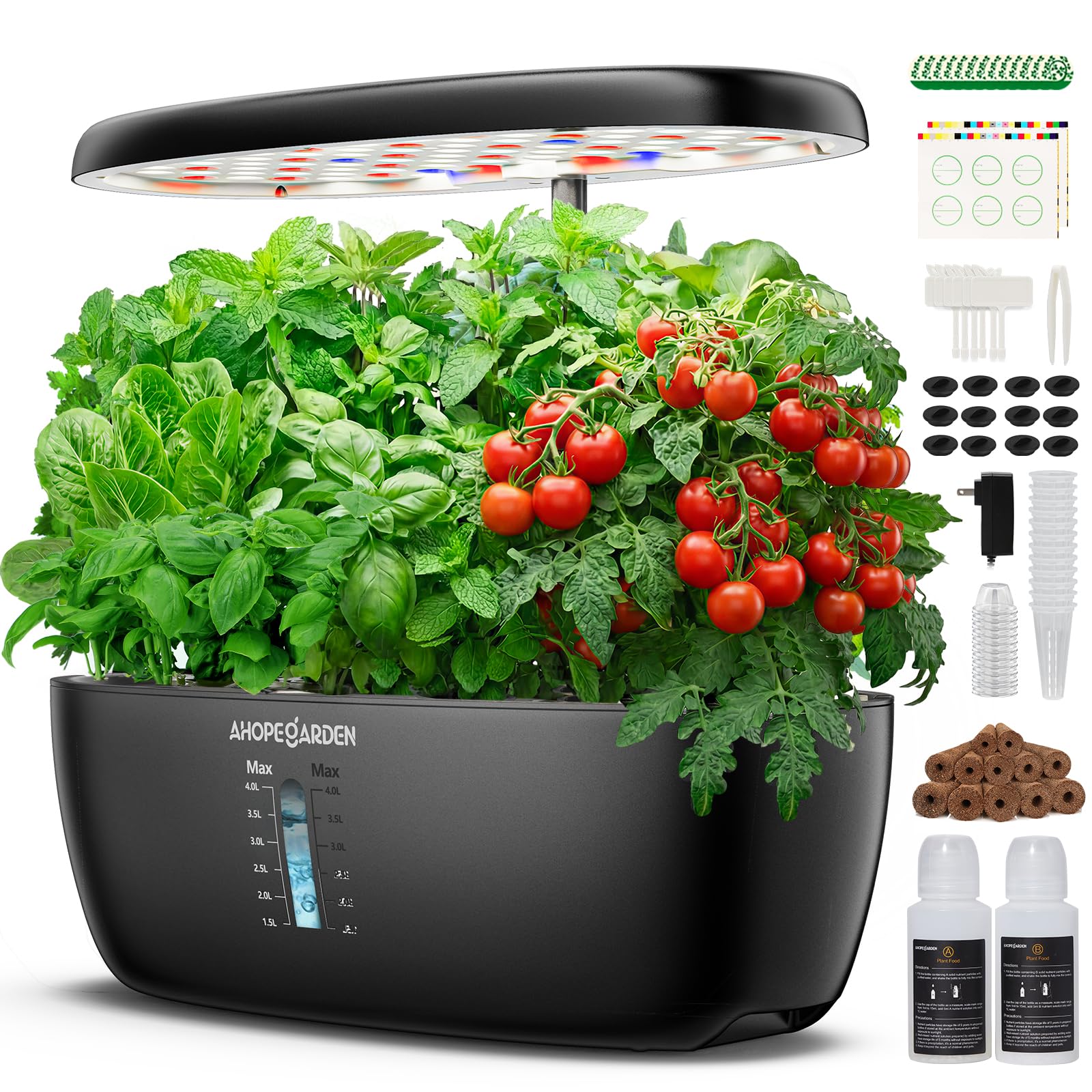
Twelve stations, two light modes, a four-liter tank, and no app — this is what a hydroponic system looks like when the money goes into the tray instead of the software. Toward the bottom of the price range here, it's the twelve-pod kit we recommend: nothing feels stripped out, and nothing needs a password.

Day to day it's quiet. The pump circulates without a sound you notice from the next room, the light runs on its own timer, and the water window means you check the level without lifting anything. Basil is the crop it flatters most — fast, and still producing after you start cutting. Dill, mint, and parsley are slower; you'll spend a fortnight convinced nothing is happening and then find roots through the basket. Keep plants of similar size sharing a tray, because a leggy tomato shades everything on its side of the light.

The light post tops out at 14.2 inches, which is the honest ceiling on this thing: herbs, lettuce, and a compact pepper, not a full tomato. Controls stop at two preset modes and a timer, with no dimming and no phone in the loop — which for a lot of kitchens is exactly the right amount of control. It suits a household that wants a steady supply of basil and salad greens and has no interest in managing another app. Three trays and a travel schedule, and you want the LetPot instead.

Bottom line: Our value pick: twelve stations, two light modes, and a four-liter tank for buyers who don't want another app in their life.

4

URUQ 8-Pod Hydroponics System

URUQ 8-Pod Hydroponics System

Small counters

Our Score 9.0/10
Check Price

Worth Noting

  • Bright enough to light the room at night
  • Light can quit while the pump keeps running
Reservoir
3 L
Grow Light
24 W LED, detachable post
Pump Noise
Under 20 dB
Growing Stations
8
Read the full review

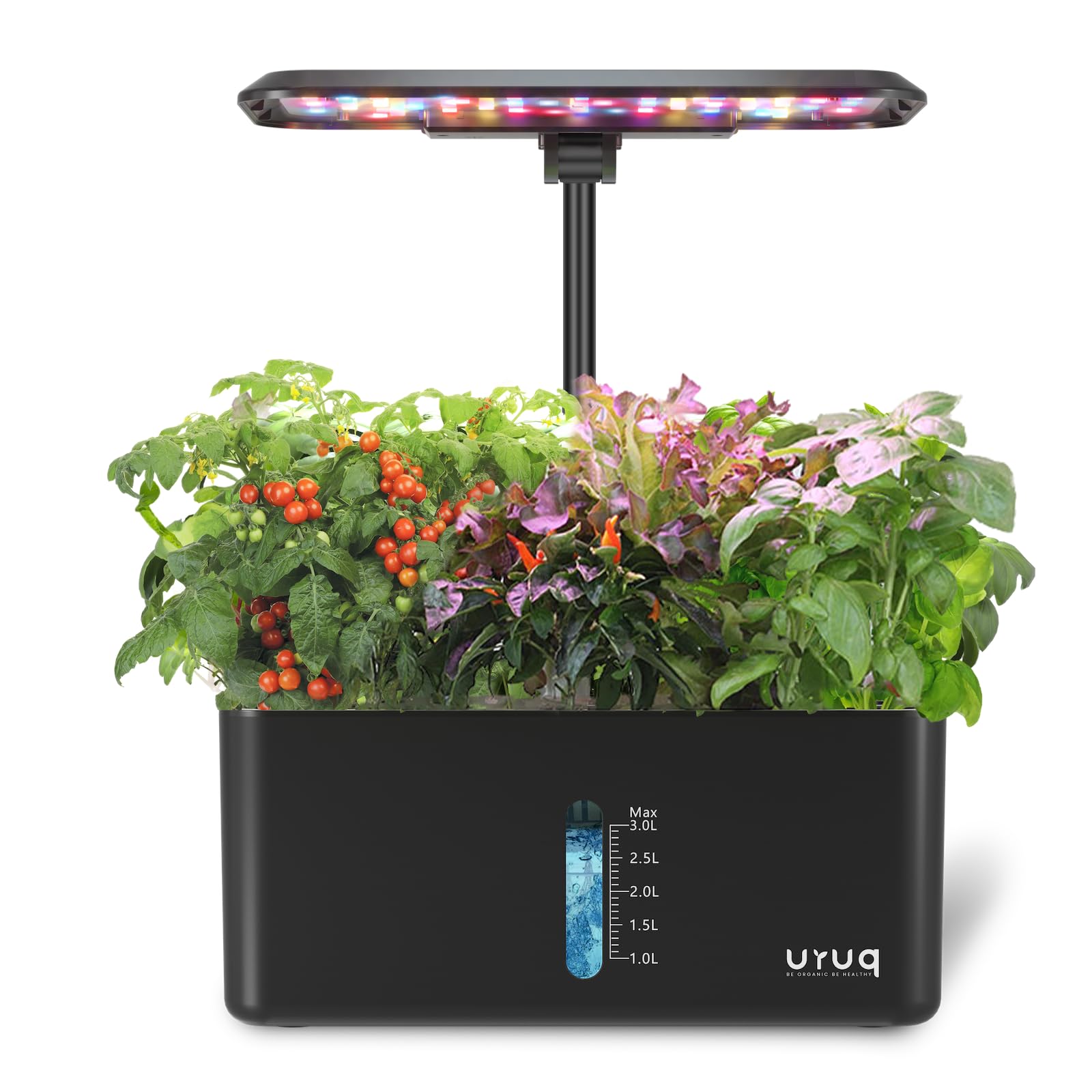
Eight pods is the right number for a kitchen with one clear foot of counter and no more, and the URUQ makes that space work: a pump quiet enough to sit in the same room as, a timer you set once, and a footprint that doesn't crowd the kettle. That's the whole case for it over the twelve-pod systems — it asks for less room and gives back less.

The 24-watt bar is brighter than eight pods suggests — it will light the wall behind it at night, so pick the spot before you fill it, not after. The 3-liter tank is the smallest here, and eight mature plants will have you topping up more often than the twelve-pod systems; that's the trade for the footprint. What we didn't expect to use as much as we did is the light post: it lifts off, so you can wipe the tray and the underside of the LEDs without working around a cable.

Bottom line: For a counter with one spare foot, we choose the URUQ: eight quiet pods, a light post that lifts off, and nothing to pair.

5

LetPot Max 21-Pod Smart Garden

LetPot Max 21-Pod Smart Garden

Large harvests

Our Score 8.8/10
Check Price

Worth Noting

  • Highest price in this group by far
  • Automation depends on app and WiFi
Feeding
Automatic water and nutrient
Reservoir
7.5 L
Grow Light
36 W, eight height levels
Growing Stations
21
Read the full review

Twenty-one pods is not a garnish station. The Max is the system here built around volume: 21 stations on the main tray, a separate two-pod tray for something big, a 7.5-liter reservoir, and a 36-watt bar that climbs through eight heights and tilts through 180 degrees so you can aim it at the growth.

What makes that many plants realistic is the automation. A water-level sensor tops the reservoir up and doses nutrient with it, which removes the weekly job that sinks big hydroponic setups — mixing feed for twenty plants and getting the strength wrong. Lettuce, kale, and herbs are the natural fit, and at this size you're growing a supply rather than a garnish. We think it's the only system here that genuinely feeds a household.

The trade-offs are as big as the tray. It costs more than any other pick here by a wide margin, it takes seventeen inches of counter width and eleven and a half of depth, and the automation lives in the app, so a flaky WiFi connection becomes a gardening problem. For a household that eats greens daily it's a fair exchange; for anyone who wants basil for pesto once a month, it's a lot of machine.

Bottom line: Twenty-one stations and automatic feeding make this the system we suggest for households that eat greens daily — at a price that only makes sense at that scale.

6

Ahopegarden 10-Pod with Display

Ahopegarden 10-Pod with Display

Cold, dry rooms

Our Score 8.8/10
Check Price

Worth Noting

  • Ten pods and a three-liter tank cap the harvest
  • No app or phone alerts despite the display
Display
Temperature and humidity
Reservoir
3 L
Light Height
Up to 15.4 in
Growing Stations
10
Read the full review

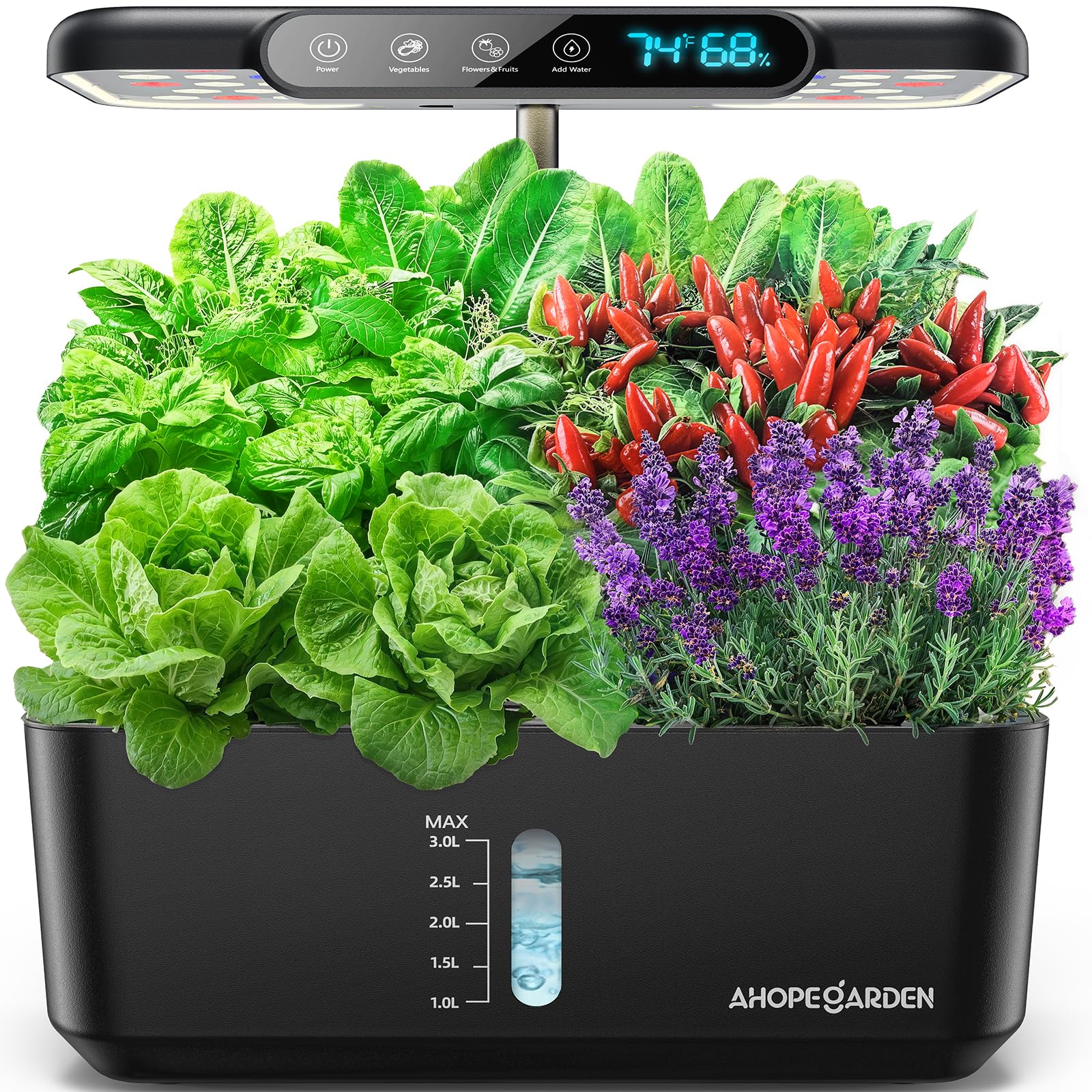
The screen is the whole idea. Temperature and humidity, live, on the front of a ten-pod system — which sounds like a gimmick until you've tried to germinate basil in a cold spare room and wondered why nothing happened. Here the room tells you what it's doing, so you can move the unit somewhere warmer before a whole tray stalls.

The rest of the package is sensible: a light post that extends to 15.4 inches in four sections, a low-water alarm, and a front window so you can see the three-liter tank without lifting it. Sponges, baskets, domes, tweezers, and nutrient come in the box, which means one order and you're growing.

Ten pods and three liters are the ceiling, and there's no app — the display reads the room, it doesn't schedule the light from your phone. What it does well is take the guesswork out of a difficult spot: a dry apartment, a north-facing kitchen, a basement shelf where a failed tray otherwise feels like your own fault. If your growing space is easy, the readout isn't worth much; if it isn't, it's the most useful thing here.

Bottom line: We recommend this one for a cold or dry room, where the temperature and humidity readout tells you why a tray stalled before you lose it.

7

DRYADES 12-Pod Hydroponic Planter

DRYADES 12-Pod Hydroponic Planter

Tight budgets

Our Score 8.8/10
Check Price

Worth Noting

  • Light post stops at 14.8 inches
  • Stands nearly 21 inches tall with the light up
Reservoir
4 L
Grow Light
Two modes, full spectrum
Light Height
Up to 14.8 in
Growing Stations
12
Read the full review

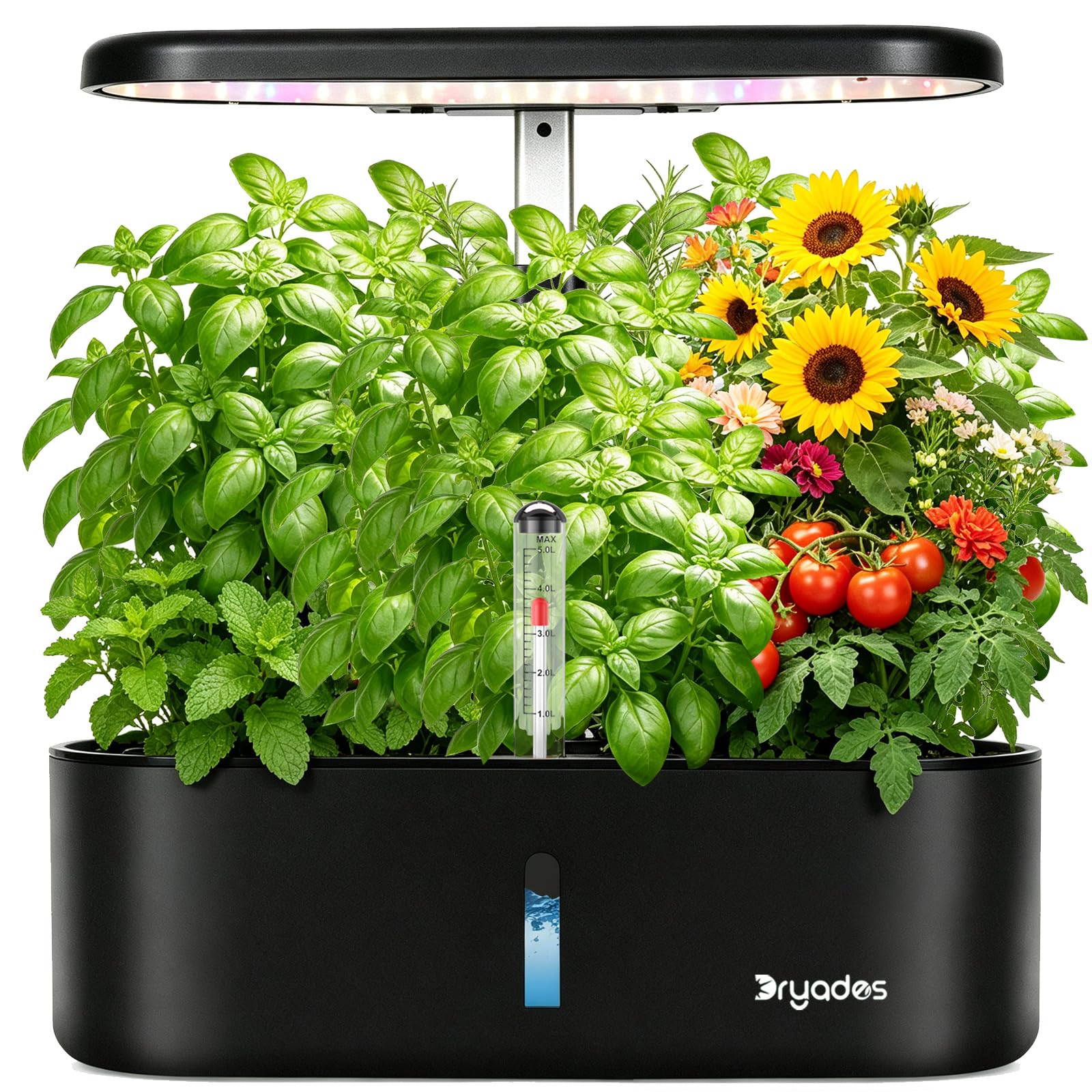
The DRYADES is the least expensive way into twelve stations here, and the list doesn't read like it: a four-liter tank, a light that climbs to 14.8 inches, two spectrum modes, a water-shortage alarm, and a pump rated under 20 decibels that cycles every half hour.

It's also the newest design in this group, so there's less history behind it than the iDOO or the Ahopegarden, and the parts to watch are the light and the power board rather than the pump. Set it up early, run it through a few full light cycles while the return window is open, and only then commit seedlings. Do that and it's the budget pick for someone who wants twelve stations and doesn't mind being the first on the block with one.

Bottom line: The cheapest way to try twelve stations, and we think it's worth a shot if you set it up early and watch it through the return window.

From Seed Pod to Salad: How We Tested

We started by pulling together countertop and freestanding hydroponic systems we found at a range of prices, then narrowed the list by reservoir size, light adjustability, pod capacity, and whether replacement pods were easy to order. We ended up with 12 units and ran them for eight months—long enough to start from seed, harvest multiple rounds of basil and lettuce, and try cherry tomatoes and peppers. They lived where they would in a home: a kitchen counter, a windowsill, a dark basement shelf, and a small apartment where noise and light spill mattered.

Setup was timed solo, from unboxing to adding water and pods, and noted whether instructions were usable without a video. We tracked germination and first harvest, then weighed each cut to compare yield against the cost of the unit and replacement pods—value here is about cost per salad, not sticker price. Ease of use came down to real routines: how heavy the reservoir was to lift and dump, how often the low-water light came on, and whether the pump cleaned without a screwdriver.

Lighting got its own check: we measured intensity at the canopy, raised and lowered the light as plants grew, and watched for scorched leaves or leggy stems. We also ran each unit in a dark room to see how much light spilled out at night. Build quality showed up by month six—reservoirs that sealed cleanly, grow decks without cracks, pumps that hadn’t developed a rattle—and on models with battery backup, we unplugged each unit mid-cycle to time how long the pump kept running, noting which units had no backup at all. Versatility meant growing something beyond herbs: lettuce, cherry tomatoes, and a pepper plant that got too tall for two of the units.

How to Choose Hydroponic Growing Systems

Match the pod count to what you'll eat

The number on the box is stations, not harvest. Eight pods is a windowsill's worth: a basil plant, a couple of lettuces, and room to experiment. Twelve is the sweet spot for a household that cooks with herbs most weeks, and twenty-one only makes sense if greens are a routine grocery rather than an occasional one.

The trap is crowding. A twelve-pod tray planted to capacity shades itself, and the pods at the ends of a wide tray get less light than the ones under the middle of the panel. We prefer eight healthy plants to twelve leggy ones, so buy the station count you'll fill properly rather than the biggest tray that fits.

Tank size is really a refill schedule

A 3-liter reservoir and a 7.5-liter reservoir are the same appliance on different schedules. With a full tray of mature plants, a small tank wants attention every few days; the big ones buy you a week or more, and the LetPot Max goes further by topping itself up from a water-level sensor.

For most kitchens the window matters as much as the volume — being able to see the level without lifting the lid is what keeps a tank from running dry. If you travel, buy the largest reservoir you can fit rather than the longest feature list.

Look at the light post before the wattage

Every system here runs a 22- to 36-watt LED bar, and the wattage tells you less than the height does. A post that stops at 14 inches is a herb and lettuce machine; 16 inches with some adjustment gets you compact peppers and dwarf tomatoes. Two spectrum modes are a convenience, not a requirement.

The trap is width: one panel over twelve stations is brightest in the middle, so slower growers belong at the ends. Measure the gap between your counter and the underside of the cabinets before anything else, because some of these stand close to two feet tall with the light raised.

Pumps, controls, and the second season

The parts that fail are the pump, the power supply, and the light board, usually within the first few months rather than years in — so the return window is part of the specification. Set the unit up, run it through full light cycles, and only then commit seedlings. Check that replacement sponges and baskets are sold for the model too, because they're consumable.

On controls, the choice is simple: an app buys a custom schedule and water alerts, buttons buy one less thing to configure. Noise rarely decides anything in a kitchen — a pump rated under 20 decibels and cycling every half hour disappears into the background.

Frequently Asked Questions

Final Verdict

The iDOO 12-pod is the system we recommend to most people: twelve stations, a four-liter tank, a fan moving air over the tray, and a light that runs itself without a phone. It is the least fiddly route to a counter that actually produces, and it leaves room for the herbs you'll want that aren't basil.

Change one requirement and the answer changes with it. Want the schedule and the alerts on your phone? The LetPot Air does that in less space. Growing for a household rather than a windowsill? The LetPot Max out-produces everything here and automates the feeding. Whatever you choose, buy the size you'll keep filled — a half-planted tray is how these systems end up in a cupboard.