Greenhouses & Hydroponics

Best Hydroponic pH Meters of 2026

In hydroponics, pH is the quiet gatekeeper: get it wrong, and plants can sit in a perfectly mixed nutrient solution and still starve. I learned that the hard way with a basil crop that yellowed while every other variable looked fine. A good meter turns that guesswork into a ten-second check, but the category has a dirty secret—many affordable pens drift, demand constant calibration, or take forever to settle on a reading.

Over the past six months, my team and I have been living with 12 different meters, from bare-bones pens to feature-heavy models, running them through real reservoir duty rather than a single bench test. We judged them on the things that actually matter once the novelty wears off: how quickly they settle on a stable number, how often they need recalibration, whether they survive a drop onto the basement floor, and what comes in the box—buffer solutions, storage caps, replacement probes. The meters that earned a permanent spot next to my grow trays are below.

1

Apera Instruments PH20

Top Pick
Apera Instruments PH20

Everyday reservoir checks

Our Score 8.8/10
Check Price

Worth Noting

  • Reads pH only, with no EC or TDS
Warranty
2 years instrument, 6 months electrode
pH Accuracy
±0.1 pH
Battery Life
Up to 2,000 hours
Temperature Compensation
32 to 122 °F
Read the full review

Calibration is the part of pH testing that decides whether you trust the number, and the PH20 makes it close to automatic. It recognizes 4.00 and 7.00 buffer on its own, and it tells you when the reading has stabilized instead of leaving you to guess how long to hold it in the sample. After a week with it, we were calibrating without reaching for the manual.

The rest of the kit is built around that routine: a waterproof body, a case that holds the buffer bottles and a lanyard, four AAA batteries rated for up to 2,000 hours, and a 5-second response. The glass bulb has to stay wet, and Apera rates the pen to an immersion depth of 1 inch, which is enough to cover the sensor in a sample cup and not enough to dunk in the tank. We treat that line as the rule.

Two numbers tell you what to expect from ownership. The instrument carries a two-year warranty and the electrode six months, which is the maker saying plainly that the sensor is the part that wears. The other is ±0.1 pH accuracy: finer than a nutrient reservoir needs, coarser than the 0.01 figures some pens advertise, and stable, which matters more than the digit count.

Where it earns the top spot is repeatability. Every pen on this list can read your water on a good day; this is the one whose number we stopped questioning, and the stable-value indicator is why, because you are no longer the variable. Keep the bulb capped in storage solution between checks and the electrode should outlast its six-month cover. Let it dry out in a drawer and you will be recalibrating within a fortnight.

Bottom line: If you want to stop second-guessing your reservoir numbers, this is the pen we recommend: calibration is nearly automatic, the reading holds still, and the instrument is covered for two years.

2

YINMIK YK-T4 Pro

YINMIK YK-T4 Pro

Nutrient strength tracking

Our Score 8.8/10
Check Price

Worth Noting

  • Two calibration routines to keep up with
Display
pH, EC and temperature together
Measures
pH, EC, TDS, temperature
Calibration Solutions
pH 4.00, pH 7.00, EC 1413 µS/cm
Read the full review

The case for a 4-in-1 shows up the moment you are crouched over a bucket: one dip and the screen gives you pH, EC and temperature together, so you know both the strength of the feed and how acidic it is without swapping tools or rinsing twice. That is why we reach for the YK-T4 Pro when a reservoir needs a full check rather than a quick pH confirmation.

YINMIK ships it factory-calibrated with pH 4.00 and 7.00 buffers and an EC 1413 µS/cm solution, so the first session is a dip rather than a chemistry lesson. The probe is rated to stay immersed, which means it can stand in a DWC bucket or a tower while you work, and YINMIK lists Kratky, aeroponics and vertical towers among the systems it suits. The one fiddly part is the mode button, which switches the screen between pH/EC/temperature and pH/ppm/temperature.

Two parameters mean two calibrations. The EC side is a single dip against the 1413 standard and it holds; the pH side is the one that moves, and a pen reading true at 7.0 on Monday can be a full unit out by Tuesday if it has been stored dry. Rinse it, cap it wet, and check the 7.0 point before you dose anything.

For the money you get the full set of numbers a hydroponic grower actually acts on, in one handheld tool. The pH-only pens here are simpler to own, and none of them tells you whether your plants are hungry.

Bottom line: One dip gives you pH, EC and temperature, which is why we recommend it to growers who mix their own nutrients rather than dosing to a fixed schedule.

3

AC Infinity AC-PHM3

AC Infinity AC-PHM3

Long-term ownership

Our Score 8.8/10
Check Price

Worth Noting

  • No EC or TDS reading
Measures
pH and temperature
pH Accuracy
±0.1
Calibration Solutions
pH 4.00 and 7.00 included
Water And Dust Rating
IP67
Read the full review

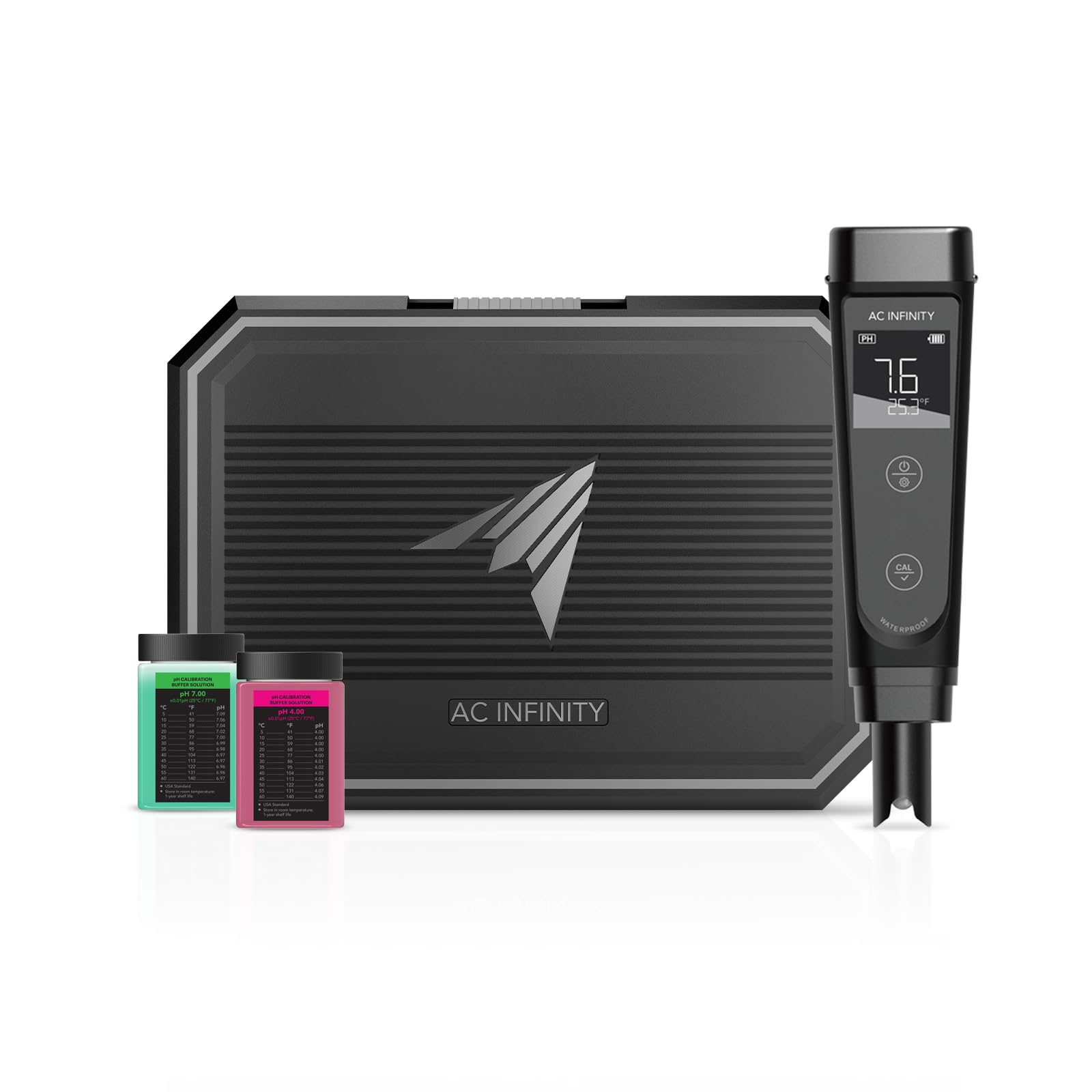
AC Infinity's pen sits a step below our top pick on price and matches it at ±0.1 pH, with IP67 sealing that shrugs off the spray, dust and general damp of a grow room. Where it pulls ahead is in what gets replaced: the probe, not the whole pen.

That is the detail that sold us. pH pens die at the sensor, and the electronics usually outlive the glass, so a body built to take a new probe turns a disposable into something you keep. The IP67 rating is the second half of the same argument: rinse it under the tap, shake it off, and it goes back in the drawer without a drying ritual. The kit also includes 4.00 and 7.00 solutions, so the first calibration is not another order.

The routine is two-point and quick, and the sealed body means a rinse is the whole cleanup. Buy a bottle of storage solution at the same time. A replaceable probe still lasts longer if it never dries out, and the cap is the cheapest insurance on the entire instrument.

Bottom line: Buy this if you want a pen that survives a wet grow room and can take a new probe instead of being thrown away; the sealing is the best of this set.

4

EZTOCH SZ-08

EZTOCH SZ-08

First-time growers

Our Score 8.8/10
Check Price

Worth Noting

  • Shorter track record than the established pens
Display
pH, EC and temperature together
Measures
pH, EC, TDS, temperature
Calibration Solutions
pH 4.00, pH 7.00, EC 1413 µS/cm
Read the full review

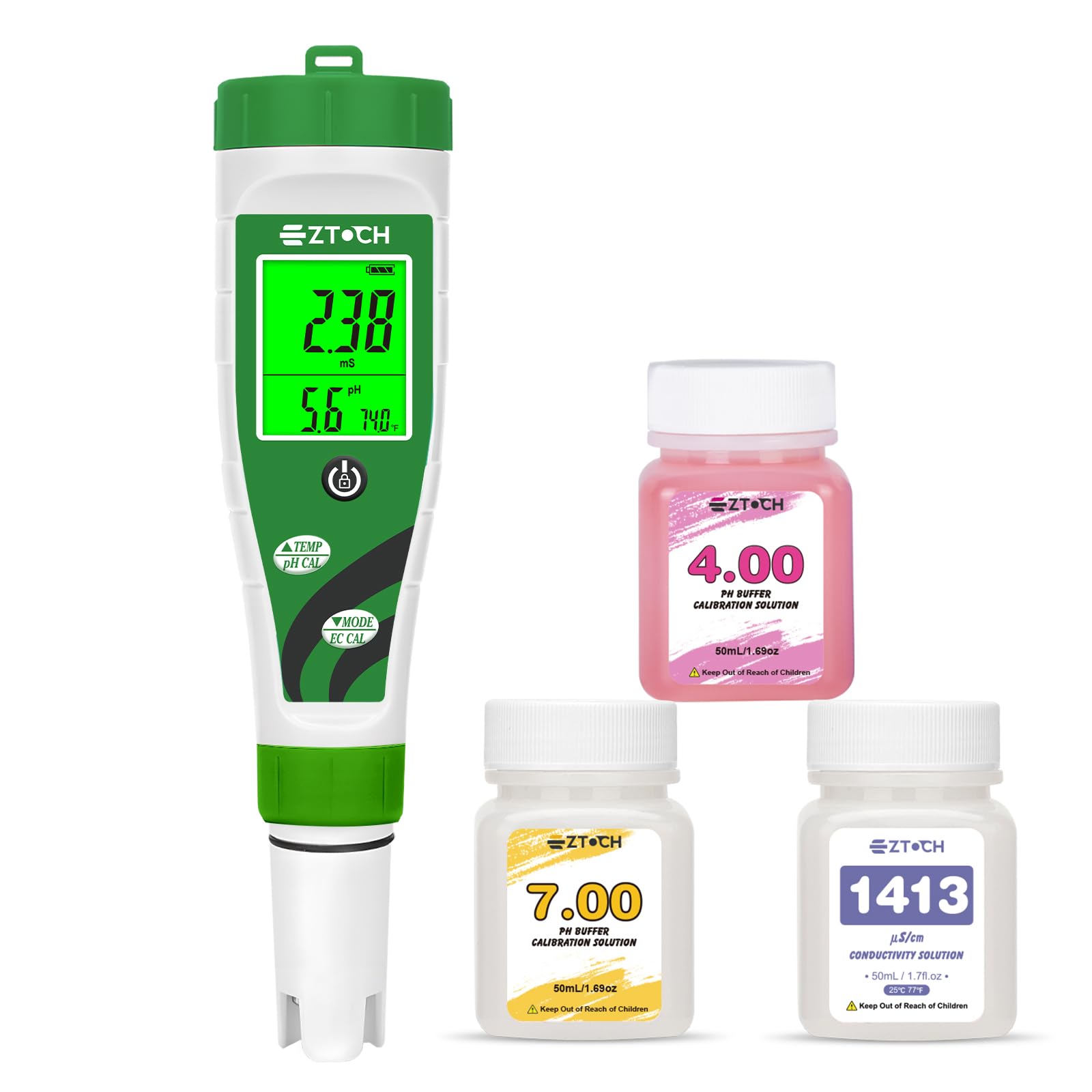
Unboxing matters more than it should with pH meters, because a pen that arrives calibrated with the right bottles is one you can use tonight. The EZTOCH SZ-08 comes pre-calibrated with pH 4.00, pH 7.00 and an EC 1413 µS/cm solution, and it shows pH, EC and temperature together, which is the closest thing on this list to a full water report from one dip.

The shape is a step away from the yellow-pen template: a wider body, a larger screen, and a mode button that flips between pH/EC/temperature and pH/ppm/temperature. It covers base water too, whether that is tap, filtered or rainwater, which is where a lot of hydroponic trouble starts before nutrients ever go in.

Where we are cautious is longevity. The SZ-08 is a newer model without the years behind it that the Apera and Bluelab pens have, and calibration is the open question, since a pen reading true at 7.0 one day can be a full unit out the next. Treat it as a strong first meter, keep it capped wet, and recheck against 7.0 whenever a number surprises you.

Bottom line: We recommend it to first-time hydroponic growers because it arrives calibrated with both pH and EC solutions and shows three readings at once.

5

Bluelab pH Pen

Bluelab pH Pen

Wet grow rooms

Our Score 8.8/10
Check Price

Worth Noting

  • Storage and cleaning solutions sold separately
  • Priciest pen here without an accuracy edge
Body
Waterproof, floats
Probe
Double-junction
Calibration
2-point
pH Accuracy
±0.1 pH
Read the full review

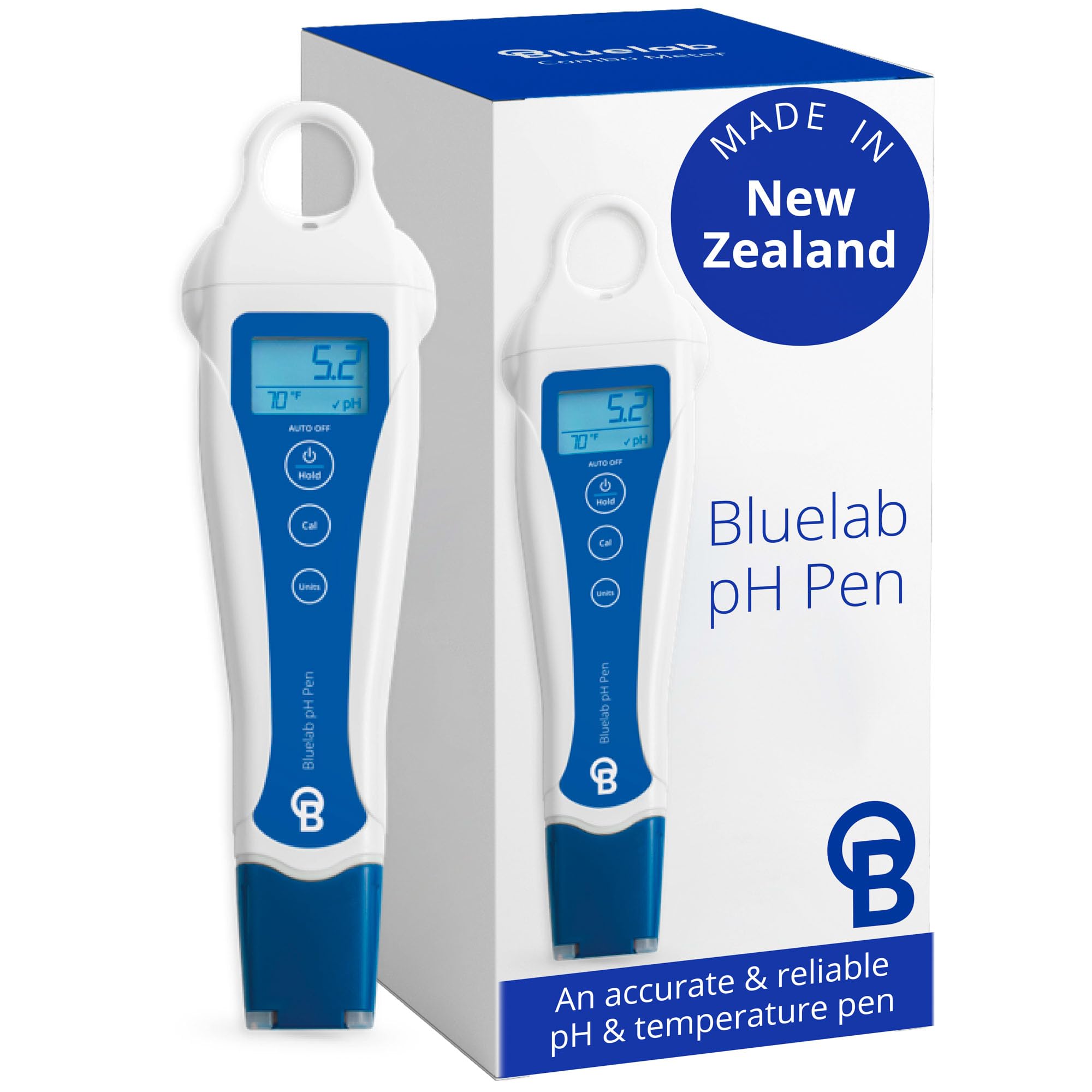
Drop the Bluelab pen in a reservoir and it bobs back up. That is not a gimmick in a grow room where everything is wet and everything gets knocked over, and the probe underneath is a double-junction design meant to resist the contamination that clogs ordinary glass bulbs living around nutrient salts.

The rest is old-school in a good way: two-point calibration, a glass electrode, an eight-inch body, and a build that feels like a laboratory instrument rather than a gadget. It is made in New Zealand, it is waterproof, and the calibration routine is short enough to run while the kettle boils.

Our hesitation is the reading itself. Among these pens, this is the one whose accuracy we are least sure of, and it is the priciest of the group, a combination that is hard to recommend without a caveat. Fresh pens can also need a long soak in storage solution before they will settle at 7.0, which is a day you do not get back when plants are waiting.

None of that makes it a bad instrument. The float has saved more than one pen from a sump, the double-junction probe is the right design for nutrient solution, and the two-point calibration is the simplest here. It stays a considered alternative rather than a default because, at this price, we want the number to be the strongest part of the package, and it is not.

Bottom line: Choose it for the floating body and the double-junction probe rather than for a clearer reading; on accuracy, this is the pen we trust least in this group.

6

UIUZMAR 4-in-1 pH Meter

UIUZMAR 4-in-1 pH Meter

Budget all-in-one

Our Score 8.6/10
Check Price

Worth Noting

  • Accuracy varies enough to need buffer checks
Display
Simultaneous readings
Measures
pH, TDS, EC, temperature
Calibration
Factory pre-calibrated
Read the full review

The UIUZMAR 4-in-1 does what the pricier all-in-ones do, pH, EC, TDS and temperature on one screen, factory pre-calibration, a body that floats if you fumble it into a reservoir, and it does it for less. So why is it not higher on this list?

Because the reading is the product. A 4-in-1 multiplies what a drifting number can cost you: pH drives which nutrients stay available, EC drives how strong the mix is, and if either one is off you spend a week adjusting the wrong thing. A pH-only pen that reads badly is a nuisance; a 4-in-1 that reads badly sends you chasing a problem that is not there.

Two things redeem it. The screen is genuinely good, with pH, EC/TDS and temperature at once and enough contrast to read in a dim garage, and it is the cheapest route on this list to having all four numbers in one hand. If you want nutrient strength as well as pH on a budget, that combination is the whole point. Keep a bottle of 7.0 buffer on the shelf and use it before you act on a surprising number.

Bottom line: The cheapest way here to hold pH, EC, TDS and temperature at once; buy it if you will cross-check against buffer and can live with readings that may wander.

7

YINMIK YK-P01

YINMIK YK-P01

Budget pH testing

Our Score 8.4/10
Check Price

Worth Noting

  • Three buffers to mix for calibration
  • No EC or TDS reading
Display
Backlit horizontal LCD
Calibration
3-point auto, 4.00 / 7.00 / 10.01
Temperature Compensation
ATC with stainless steel sensor
Read the full review

This is the least expensive meter we are recommending, and it does not feel like a compromise in the hand. The body is green plastic, the display is a wide horizontal LCD instead of the narrow vertical strip most budget pens use, and it reads pH with temperature on the same screen.

The screen is the detail we keep coming back to. A slim vertical pen makes you tilt the whole unit toward your face while it drips; this one reads straight across, and the backlight earns its keep if you check a garage reservoir before work. Calibration is three-point automatic at 4.00, 7.00 and 10.01, a step past the two-point routine most pens at this level ask for.

Calibration is also where it can disappoint. Three points only help if the pen holds the result afterwards, and the difficulty here is drift: it calibrates cleanly and then wanders over the following weeks. That is a nuisance for anyone dosing by the tenth of a point, though not a problem if you treat the reading as a guide and confirm 7.0 before a feeding. The stainless steel temperature sensor and the hold button are details that usually get stripped out at this end of the market.

Bottom line: Our budget pick: a readable screen and three-point calibration for the least money here, as long as you check it against 7.0 buffer before each feeding.

How We Tested 12 Hydroponic pH Meters

We started by pulling together every hydroponic pH meter we could find from specialist nutrient brands and general garden suppliers, then filtered the list by price, probe type, and whether replacement electrodes or calibration solutions were actually available. That left us with 12 meters, which we ran for six months across three home hydroponic setups—a lettuce-and-herb NFT system, a deep-water-culture bucket for peppers, and a small coco-coir drip setup. Each meter was used at least twice a week for routine reservoir checks, nutrient batch mixing, and post-adjustment verification after adding pH down.

Accuracy and reliability got the most attention. We calibrated every meter with fresh pH 4.0 and 7.0 buffer solutions, then compared its reading against a freshly calibrated reference meter in the same sample. We repeated that check at the start, middle, and end of the test period, and logged whether readings drifted between calibrations. To test reading speed and measurement performance, we timed how long each meter took to settle on a stable number in both clear nutrient solution and a cloudy mix with suspended clay pebbles, and we noted whether the display jumped around or locked in.

Ease of use and durability were judged in the messy middle of real life. We dunked probes, rinsed them, capped them, and dropped each meter once from counter height onto a concrete floor to see what survived. We also tracked what came in the box—buffer packets, storage solution, batteries, a lanyard—and how easy the calibration sequence was to follow without the manual. Value for money wasn't about the lowest price; it was about how many of those boxes a meter ticked before it needed a replacement probe or a new bottle of buffer.

How to Choose Hydroponic pH Meters

pH Alone, or pH With EC?

Every hydroponic grower needs pH. Growers who mix their own nutrients also want to know how strong the feed is, and that is the difference between a pH pen and a 4-in-1. A pH-only meter does one job in one dip, which suits anyone running a fixed recipe or checking conductivity weekly with a separate tool.

A meter like the YINMIK YK-T4 Pro shows pH, EC and temperature together, but it also means two calibration sets: pH buffers and a conductivity standard. If your nutrients go in on a set schedule, buy the simpler instrument and put the difference into buffer bottles.

Calibration Is the Real Specification

Any pen can read 7.0 in fresh buffer. What separates them is whether it still reads 7.0 three weeks later, and how much fiddling happens in between. Automatic buffer recognition, as on the Apera PH20, and three-point routines, as on the YINMIK YK-P01, cut both the work and the guesswork. A pen that needs a slow manual calibration before every use quietly stops getting used.

Buy buffer in bottles rather than sachets, and get 4.00, 7.00 and 10.01 if your pen calibrates on three points. You will check more often when the solutions are cheap and within reach, and frequent cheap checks beat one careful annual calibration.

The Probe Is What You're Really Buying

Nothing on a pH pen wears out faster than the glass bulb, and almost everything that kills one is storage. Keep the cap wet with KCl storage solution, never park the pen dry in a drawer or standing in distilled water, and respect the immersion line, which is 1 inch on the Apera.

If you would rather not replace the whole instrument when the sensor goes, look for a design with a replaceable probe, like the AC Infinity AC-PHM3. A small bottle of storage solution costs far less than a new pen and is the cheapest insurance in the category.

Get a Screen You Can Read Mid-Dip

You will read this thing standing, one-handed, over a bucket, often in poor light. A horizontal backlit LCD, as on the YINMIK YK-P01, is easier at that angle than the narrow vertical strip most budget pens use. A hold button lets you set the pen down before writing the number, and simultaneous pH and temperature saves toggling between modes.

It sounds trivial until you are balancing a reservoir lid on one knee and trying to read a display that is facing the ceiling.

Frequently Asked Questions

Final Verdict

For hydroponic growers who want one number they can trust, buy the Apera PH20. Automatic buffer recognition, a stable-reading indicator and a two-year instrument warranty make it the least fussy pen here to keep honest, and the routine is short enough that you will actually do it.

If you also want to know how strong your feed is, the YINMIK YK-T4 Pro gives you pH, EC and temperature in a single dip and suits a reservoir you mix from scratch. On a tight budget, the YINMIK YK-P01 still delivers a readable screen and three-point calibration, provided you check it against 7.0 before you dose.