Planters & Plant Supports

Best Trellis Netting for Gardens and Grow Tents of 2026

The summer my cucumber vines yanked a nylon net clean off the fence and took half the crop with them, I learned what trellis netting is actually for. It isn't decoration for vines to lean against — it's a load-bearing structure. Good netting keeps heavy fruit off the soil, holds leaves open to sun and airflow, and stays taut when a plant is fully grown and soaked after a rain. Bad netting turns into a hammock by July and takes the vines down with it.

I put 16 nets through a full growing season — in raised beds, in pots on my balcony, and in a friend's community plot — and the gap between a thin bargain roll and a well-made panel showed up within weeks. Here's the thing nobody tells you first: mesh size drives everything. Wide openings are easy to reach through at harvest but useless for peas, while tight mesh catches small tendrils and then fights you every time you want to pick. The picks below are the ones that were still standing in September.

1

AC Infinity Elastic Trellis Netting

Top Pick
AC Infinity Elastic Trellis Netting

5x5 tents

Our Score 9.2/10
Check Price

Worth Noting

  • Runs small against its 5 x 5 ft. rating
Weight
7 oz
Coverage
Up to 5 x 5 ft
Hardware
Steel hooks
Material
Rubber and polyester
Read the full review

At 7 ounces, AC Infinity's elastic net adds almost nothing to a grow-tent frame. The 5 x 5 ft. panel is built from rubber cords wrapped in polyester, and the non-abrasive surface is meant to protect stems as you tuck them through. The steel hooks are the part we appreciated most: they clip onto standard tent poles and let you move the net up or down without knotting string around the frame.

We recommend it for a 5 x 5 ft. tent because the elastic gives you tension across the canopy, and the grid gives plenty of places to train branches during flowering. It is also a practical choice for low-stress training, where you want a soft barrier rather than a rigid wire screen. Against a cut roll like the VIVOSUN, it wins on convenience inside a tent and loses on flexibility outside one.

This is a tent-first net. On an outdoor fence or a rough post, the elastic has nothing to tension against, and you lose the convenience of the hooks. For a garden row, a cut roll is the better tool. We also treat the listed size as a stretch target rather than a guaranteed footprint.

Bottom line: We recommend this elastic net for a 5 x 5 ft. grow tent when you want steel hooks and a light, stretchy panel instead of a cut-to-size roll.
2

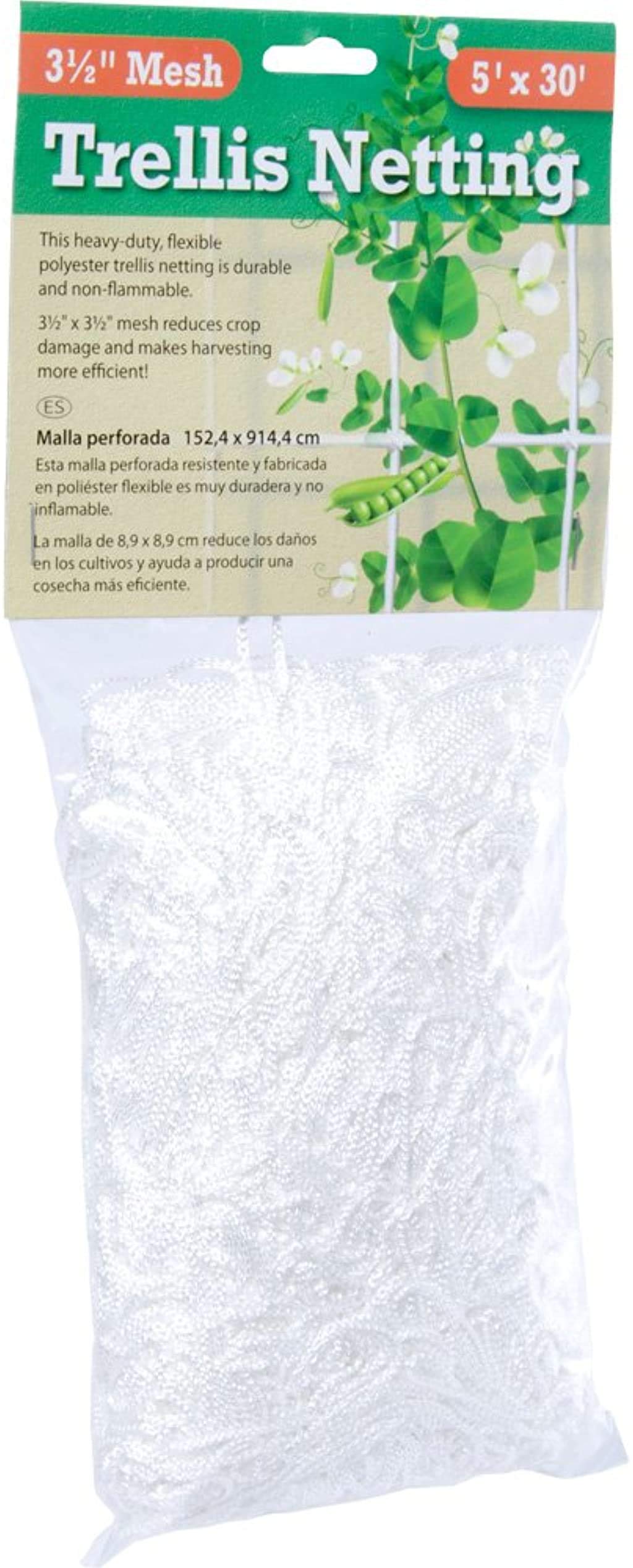
Hydrofarm 5 x 30 ft. Trellis Netting

Hydrofarm 5 x 30 ft. Trellis Netting

Scrog screens

Our Score 9.2/10
Check Price

Worth Noting

  • Woven string can fray after sun exposure
Coverage
5 x 30 ft
Material
Soft woven polyester string
Mesh Opening
3.5 in
Read the full review

Hydrofarm's net feels different from the elastic panels the moment you handle it. It is a soft woven string, not a stretchy web, and the 3.5-inch squares hold their shape when you pull the roll tight. That makes it a natural fit for a scrog screen or a tidy row of peas, where you want a stable grid rather than a net that moves with every breeze.

The 5 x 30 ft. piece is long enough to cut several panels, and because it does not stretch, a section stays the size you cut. We used it where we wanted the net to sit at a fixed height above a bed; it hangs cleanly from a top wire and does not creep upward as the plants grow. The openings are small enough to keep tomatoes and beans from flopping through, but still wide enough to reach in for pruning.

Our reservation is longevity. Woven string can fray and dry out after repeated sun, especially along cut edges, so this is the pick for a gardener who will inspect and replace sections rather than expect a permanent structure. We keep it for the tent and the tight row, not for a windy exposed fence where a plastic mesh might last longer. If you want the same 3.5-inch grid with a softer hand, this earns its place.

Bottom line: Hydrofarm is our pick when you need a soft, woven 3.5-inch mesh that holds a scrog screen or a tidy garden row without elastic sag.

3

Toolazy 5 x 350 ft. Trellis Netting

Toolazy 5 x 350 ft. Trellis Netting

Large plantings

Our Score 9.2/10
Check Price

Worth Noting

  • Large roll is more than most home gardens need
Coverage
5 x 350 ft
Material
Nylon
Packaging
Cardboard reel
Mesh Opening
6 in
Read the full review

A 350-foot roll is only useful if you can get it off the roll without turning it into a bird's nest. Toolazy winds its netting onto a 6.9 x 9.8 inch cardboard reel, and that packaging is the detail that makes the size practical. You can unroll a few feet, cut what you need, and put the rest back on the reel without fighting the whole length.

We recommend it for a large garden, a greenhouse wall, or a community plot because the 6-inch mesh covers a lot of ground and the nylon has enough give to tie around posts. The soft fibers are easier on stems than rigid wire, and the white color shows up against dark soil when you are setting the lines. Compared with the smaller Tcamp roll, it trades a higher upfront commitment for far more coverage and less repeat buying.

The size is the caveat as much as the selling point. Once it is open, storage matters; keep it on the reel and out of the sun. We also check the knots along the edge before hanging it, because a loose knot can slip under wind load. For a big planting, those are reasonable habits.

Bottom line: For a large garden or greenhouse, we recommend this 350-foot reel because it keeps a big cut-to-size net manageable.

4

VIVOSUN 4 x 4 ft. Elastic Trellis Netting

VIVOSUN 4 x 4 ft. Elastic Trellis Netting

4x4 tents

Our Score 9.2/10
Check Price

Worth Noting

  • Can sag when stretched to the limit
Coverage
4 x 4 ft stretched
Hardware
4 S-hooks
Material
Elastic thread
Mesh Opening
3.9 in
Read the full review

The VIVOSUN elastic square is built around four S-hooks and a 4 x 4 ft. stretchy panel. The 3.9-inch mesh is large enough to push a hand through for pruning, and the elastic lets you pull it taut around tent poles without a separate frame.

The 3mm elastic thread gives it more give than a woven net, so it moves with a plant instead of cutting into stems. We found that useful for training a canopy across the tent, where a little flex is kinder than a rigid grid.

It is also simple to cut down for a smaller tent. The trade-off is that an elastic net only works as well as its attachment points; four hooks cover the corners, but a long run or an irregular frame needs extra ties. The hooks are rustproof, which matters in a humid grow space.

This is a good fit for a 4 x 4 ft. tent when you want a basic elastic panel and do not need the heavier hardware of the AC Infinity net. Check the actual pole spacing first, because the panel has to stretch to reach the corners. For a simple tent setup, we think it earns its place as the budget-minded alternative.

Bottom line: For a 4 x 4 ft. grow tent, this elastic square is a straightforward choice, provided you check the final coverage against your poles.

5

vensovo 79 in. x 328 ft. Trellis Netting

vensovo 79 in. x 328 ft. Trellis Netting

Farm-scale runs

Our Score 9.0/10
Check Price

Worth Noting

  • Very wide roll needs trimming on narrow beds
Coverage
79 in x 328 ft
Material
Plastic
Packaging
Roll
Mesh Opening
6 in
Read the full review

The vensovo roll is in a different size class from everything else here: 79 inches wide and 328 feet long. That width covers a wide row or a greenhouse wall in one pass, and the 6-inch plastic mesh is stiff enough to tie around posts without a lot of fuss.

The plastic construction has one clear advantage over soft string: it does not shed fibers onto fruit or into the soil. The 6-inch openings are also easy to reach through at harvest, which makes it a practical choice for cucumbers, squash, and other heavy crops that need room.

The net also arrives as a large roll, so unroll it on a clean surface and keep the rest wound tight; a loose pile of plastic mesh is a nuisance to separate. The material is stiffer than woven string, so it does not drape as softly around delicate stems.

We recommend it for farm-scale runs, long greenhouse walls, and gardeners who know they will use hundreds of feet. For a couple of backyard beds, the Toolazy roll or a compact panel is easier to live with. The vensovo's value is in the scale, not in being the tidy choice.

Bottom line: We recommend this wide plastic roll for farm-scale runs and large greenhouse walls, not for a couple of raised beds.

6

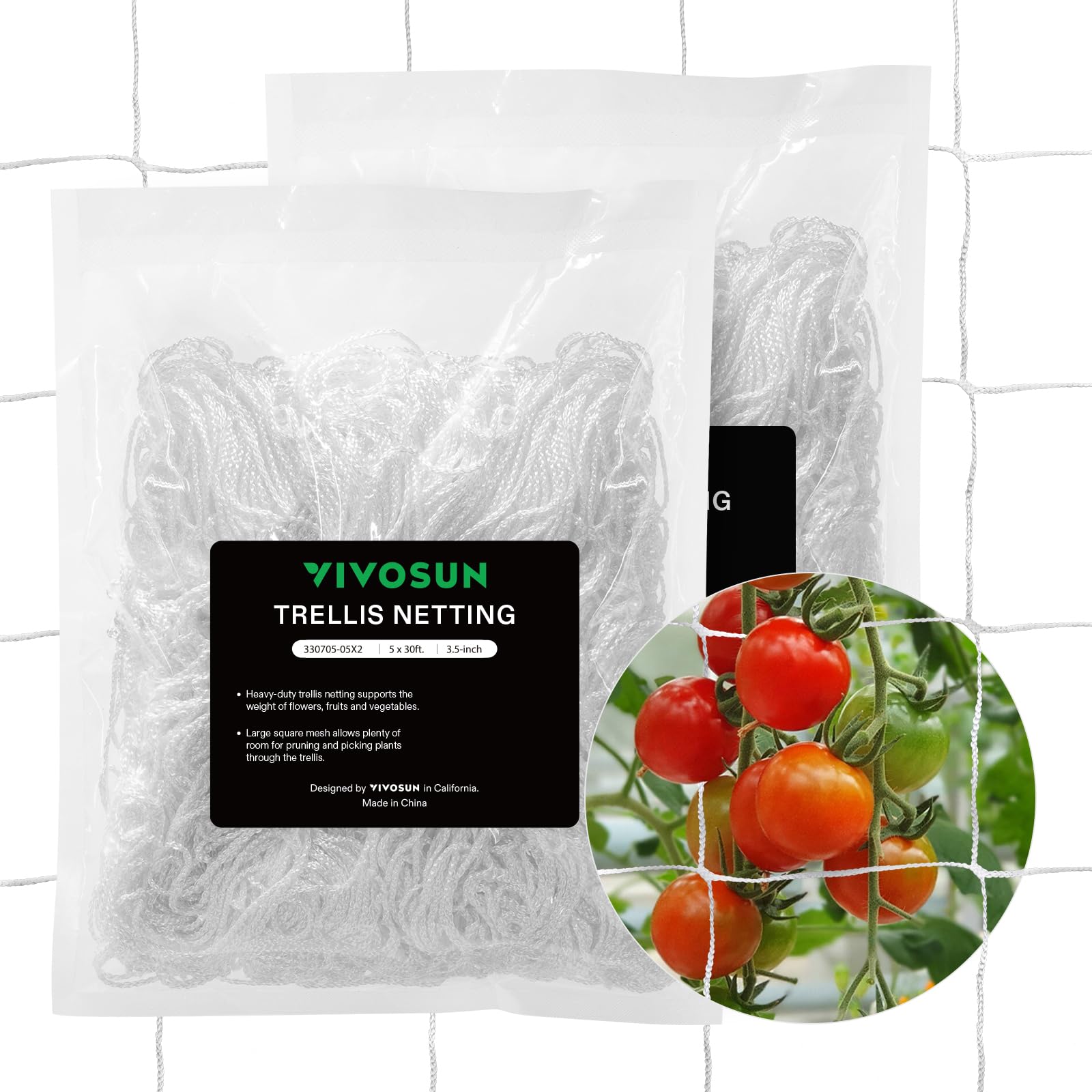
VIVOSUN 5 x 30 ft. Trellis Netting

VIVOSUN 5 x 30 ft. Trellis Netting

Garden rows

Our Score 8.8/10
Check Price

Worth Noting

  • Cut edges can fray after a season
Pack
2 pieces
Coverage
5 x 30 ft per piece
Material
Heavy-duty polyester
Mesh Opening
3.5 in
Read the full review

The first thing we check on a bulk trellis roll is whether the mesh is small enough to hold a tomato vine without making harvest a chore. VIVOSUN's 3.5-inch squares are the balance we keep coming back to: small enough to give peas and tomatoes plenty of tie points, large enough to push a hand through. Each piece runs 5 x 30 ft., and the two-pack means you can cut one panel for a fence and keep the other intact. That is why this is our default for garden rows.

The netting is soft braided polyester, and it cuts to size with ordinary scissors. We strung a section along a staked row and appreciated that it wraps and ties around posts rather than demanding a dedicated frame. It also works horizontally over a low A-frame, though the 3.5-inch grid is tighter than a 6-inch cucumber net and rewards a little patience when you weave in new growth.

The trade-off is handling. A long roll can tangle as it comes open, so unroll only what you need and keep the rest under tension. That is a small ritual, not a dealbreaker, and it is the price of getting a long continuous run in one piece. For a garden with several rows, those are manageable habits.

Bottom line: For garden rows and fences, this is our default trellis roll: the 3.5-inch mesh supports vines without blocking harvest, and the two 5 x 30 ft. pieces give you room to cut.

7

Tcamp 5 x 15 ft. Trellis Netting

Tcamp 5 x 15 ft. Trellis Netting

Budget rows

Our Score 8.8/10
Check Price

Worth Noting

  • Light build can feel flimsy under heavy vines
Coverage
5 x 15 ft
Material
Nylon
Packaging
Vacuum-sealed bag
Mesh Opening
6 in
Read the full review

Tcamp's roll is the one we reach for when a bean row needs netting now and the budget is thin. The 5 x 15 ft. piece opens into a 6-inch mesh, which is big enough to reach through with a whole hand and forgiving when a cucumber gets fat. It is white nylon, soft rather than wiry, and it ties around posts without demanding a frame.

The vacuum-sealed bag is the detail to plan for. The net arrives compressed, so open it on a clean patch of ground and unroll slowly; pulling a corner free in a hurry is how you create a tangle. Once it is up, the wide openings are better for cucumbers, squash, and beans than for fine pea tendrils.

We think of this as seasonal netting, not an heirloom trellis. The wide mesh and white color make it easy to see and cut, and the low cost means you can replace a worn section without regret. For a first trellis, a temporary row, or a gardener who likes to start fresh each spring, it is a sensible choice.

Bottom line: This is the roll we suggest for a seasonal bean or cucumber row when you want useful coverage without spending much.

8

Miuezuth 8.2 x 6.6 ft. Trellis Netting

Miuezuth 8.2 x 6.6 ft. Trellis Netting

Small beds

Our Score 8.8/10
Check Price

Worth Noting

  • Can arrive smaller than the listed footprint
Pack
1 panel
Color
Green
Coverage
8.2 x 6.6 ft
Mesh Opening
4 in
Read the full review

Some gardens need a panel, not a roll. Miuezuth's net is 8.2 x 6.6 ft., which is enough to cover a compact cucumber bed or a short run of beans without leaving half a roll in the shed. The 4-inch mesh is a useful middle ground: more support than a 6-inch net, less fiddly than a 3.5-inch grid.

The green color is a small thing we appreciated. It disappears against foliage once the vines fill in, so the bed looks less like a construction site, but it is still visible enough to line up when you are tying the top corners. The net is light, soft, and easy to cut if your bed is narrower than the listed width.

We like it best as a single-bed solution. It is not the net for a long fence or a commercial row; the panel is sized for a compact bed, and that focus is the point. For a small plot, it does the job without a storage problem.

Bottom line: We like this compact green panel for a small cucumber or bean bed where a full roll is more netting than you need.

How We Tested Trellis Netting Through a Full Growing Season

To build the shortlist, I sorted through listings and customer reviews by mesh opening, material, listed dimensions, and how the corners were finished — brass grommets, sewn loops, or nothing at all. Anything that needed tools to install got cut, and so did mesh under half an inch for large-fruited crops. That left 16 nets, from bare nylon rolls to reinforced polypropylene panels, and all of them went up in May.

Testing happened where the plants were, not on a bench. In my raised beds I ran netting between two posts for tomatoes and cucumbers and checked weekly whether the vines grabbed on their own or had to be tied. On a second-story balcony I hung panels behind pots of peas and pole beans, where wind is harsher than in a garden, and watched whether the corner hooks held through storms or the mesh bellied out. A friend's community plot took the heavier squash and melon nets, which is where I learned that a net rated for the load and a net that actually carries it are two different things.

Untangling got timed, because a net you dread unrolling is a net you stop using: I clocked how long it took one person to get a 5-by-15-foot net out of the package and up without snipping the wrong strand. I measured every net after stretching it between two points and compared that to the listed size, since a few grew three or four inches once tension was on them. At the end of the season I counted broken strands, checked whether the weave had pulled out of square, and looked closely at the stems where the mesh touched them. Any net that bruised a stem, shed fibers, or cost more per square foot than it returned in durability came off the list.

How to Choose the Right Trellis Netting for Gardens and Grow Tents

Start With Mesh Size

Mesh is the first specification that changes how the net feels in use. A 3.5- to 4-inch grid gives peas, tomatoes, and smaller vines plenty of places to grab and keeps fruit from slipping through; a 6-inch grid is easier to reach through and better suited to cucumbers, squash, and other heavy climbers. Smaller is not automatically better: tight mesh can be fussy to weave new growth into and harder to clean at the end of the season. Pick the crop first, then the roll. If you grow both, a 4-inch net is the compromise we reach for.

Choose Elastic for Frames, Woven for Rows

Elastic panels with hooks are the easy choice inside a grow tent: they tension across a rectangular frame, move with the canopy, and can be clipped higher as plants stretch. A cut-to-size woven or plastic roll is better for an outdoor fence, A-frame, or raised-bed row, where you can tie it to posts and trim the surplus.

The trap is buying an elastic net for a rough garden fence. It has nothing to pull against, so it sags instead of staying taut. Match the format to the structure before you compare lengths.

Measure Coverage and Plan the Cuts

Rolls are usually described as width by length, so a 5 x 30 ft. piece gives you 150 square feet of net, not a 30-foot-tall panel. Sketch the row or wall and decide which way the mesh should run, then add a little extra at the ends for tying off.

A 5 x 15 ft. roll suits a few short rows, while a 5 x 350 ft. roll is a farm-scale purchase. The VIVOSUN two-pack is useful because one piece can go up while the other stays intact for later cuts.

Keep the Roll Under Control

Trellis netting is most frustrating before it is on the frame. Unroll only the section you need, keep the rest wound tight, and cut on a clean surface so the mesh does not catch on itself. A cardboard reel, as on the Toolazy roll, is worth more than it sounds when you are handling hundreds of feet; vacuum-sealed panels need the same patience when you open the bag.

Fasten the top edge to a rigid wire or frame first, then tension the bottom. That sequence keeps the net square and makes the first row of plants easier to tuck in.

Frequently Asked Questions

Final Verdict

For most gardens, we recommend the VIVOSUN 5 x 30 ft. roll. The 3.5-inch mesh gives peas and tomatoes plenty of support, the two pieces let you cut for a fence and keep a spare, and it is the most flexible format here.

If your plants live on a 5x5 grow-tent frame, the AC Infinity elastic net is easier to hang; for a scrog screen, the Hydrofarm woven net holds a tighter grid. Match the format to the frame and the mesh to the crop, and the choice gets simple.