Soil & Fertilizer

Best Tree Fertilizers of 2026

A tree doesn't tell you it's hungry until it has been hungry for a while. By the time the leaves come in thin and pale, or the annual growth slows to a couple of inches, it has probably spent a season or two running on reserves. Fertilizer closes that gap: it puts nitrogen, phosphorus, and potassium within reach of the roots, so a young tree can establish itself and an older one can hold its color through a hot August.

The catch is that more is not better. Push heavy nitrogen at a mature oak and you get a flush of soft leaves and a weaker root system; skimp on a newly planted sapling and it spends its first summer just surviving. My team and I spent the past growing season with 12 fertilizers — spikes, granules, liquids, and a hose-end bottle — on young trees, mature shade trees, and a row of evergreens. Odor, ease of application, and how far each container actually went separated them as much as the numbers on the bag did, and the picks below reflect all of it.

1

Miracle-Gro Shake 'N Feed Citrus

Top Pick
Miracle-Gro Shake 'N Feed Citrus

Citrus and avocado

Our Score 9.4/10
Check Price

Worth Noting

  • Shaker top can jam and dump in one spot
Bag Size
4.5 lb
NPK Analysis
8-2-10
Target Trees
Citrus, avocado, mango
Feeding Duration
Up to 3 months
Read the full review

The patio lemon gets its own formula, and this is the bag we point citrus growers to first. It is an 8-2-10 granule carrying magnesium and sulfur alongside the big three, and one application feeds for up to three months — long enough that a container tree gets fed a few times a season instead of every couple of weeks.

Application takes about thirty seconds: scatter the granules evenly inside the spread of the branches, keep them off the trunk and the foliage, and water them in. Trees in the ground and trees in containers take it the same way, which not every feed here can claim. The formula is built for citrus, avocado, and mango, and the results are the ones you want from a fruit tree — new flushes of leaf, buds, a heavier set.

Two things to know. The shaker top is the weak part of the package; it can jam and dump a pile in one spot, so hold the bag low and keep it moving, or decant into a cup first. And this is not a shade-tree food. Spread it on an oak and you have paid for a citrus ratio the tree has no particular use for.

Bottom line: For a potted lemon, lime, or avocado this is the bag we hand people first: one shake feeds the tree for up to three months.

2

Jobe's Tree & Shrub Spikes

Jobe's Tree & Shrub Spikes

Yard trees

Our Score 9.2/10
Check Price

Worth Noting

  • Each spike feeds only the soil around it
Spike Count
15
NPK Analysis
16-4-4
Target Trees
Tree and shrub
Feeding Schedule
Twice a year
Read the full review

Twice a year, with a hammer, is the whole feeding program. Jobe's spikes go in around the drip line in early spring and again in late fall, and the 16-4-4 formula releases below the surface where the roots that take up nutrients are actually working. Fifteen pre-measured spikes come in the box, so there is no scoop, no dilution, and no way to overdo it.

Of everything here, this is the one we reach for when the tree in question is just a tree. Deciduous, evergreen, a flowering dogwood, an acid-loving magnolia — the target list is the plainest in this group, with no fruit or bloom qualifier attached, and that plainness is why it holds the top spot. It is also the least fussy feeding method we handled: push the spike in, water, walk away.

Hard, dry ground is the catch. In stiff clay, or a bed that has not seen rain in two weeks, the spikes can crumble on the way in and you are left pushing fragments into the hole. Water the area the day before, or start each hole with a sturdy dibber, and the problem mostly disappears.

What you accept in exchange is reach: each spike feeds the pocket of soil around it rather than the whole root zone, so placement matters more than it does with granules. Space them around the drip line instead of bunching them near the trunk and a mid-size tree is well covered by one box. For a specimen whose drip line needs a tape measure to find, buy two.

Bottom line: If you want a yard tree fed in two sessions with nothing to mix, these spikes are the ones we point you to — provided you water the ground first.

3

TPS Lemon Tree Fertilizer

TPS Lemon Tree Fertilizer

Potted citrus

Our Score 9.2/10
Check Price

Worth Noting

  • A batch has to be mixed at every feeding
Form
Liquid
Mix Rate
2 tablespoons per gallon
Target Trees
Lemon and citrus
Container Size
32 fl oz
Read the full review

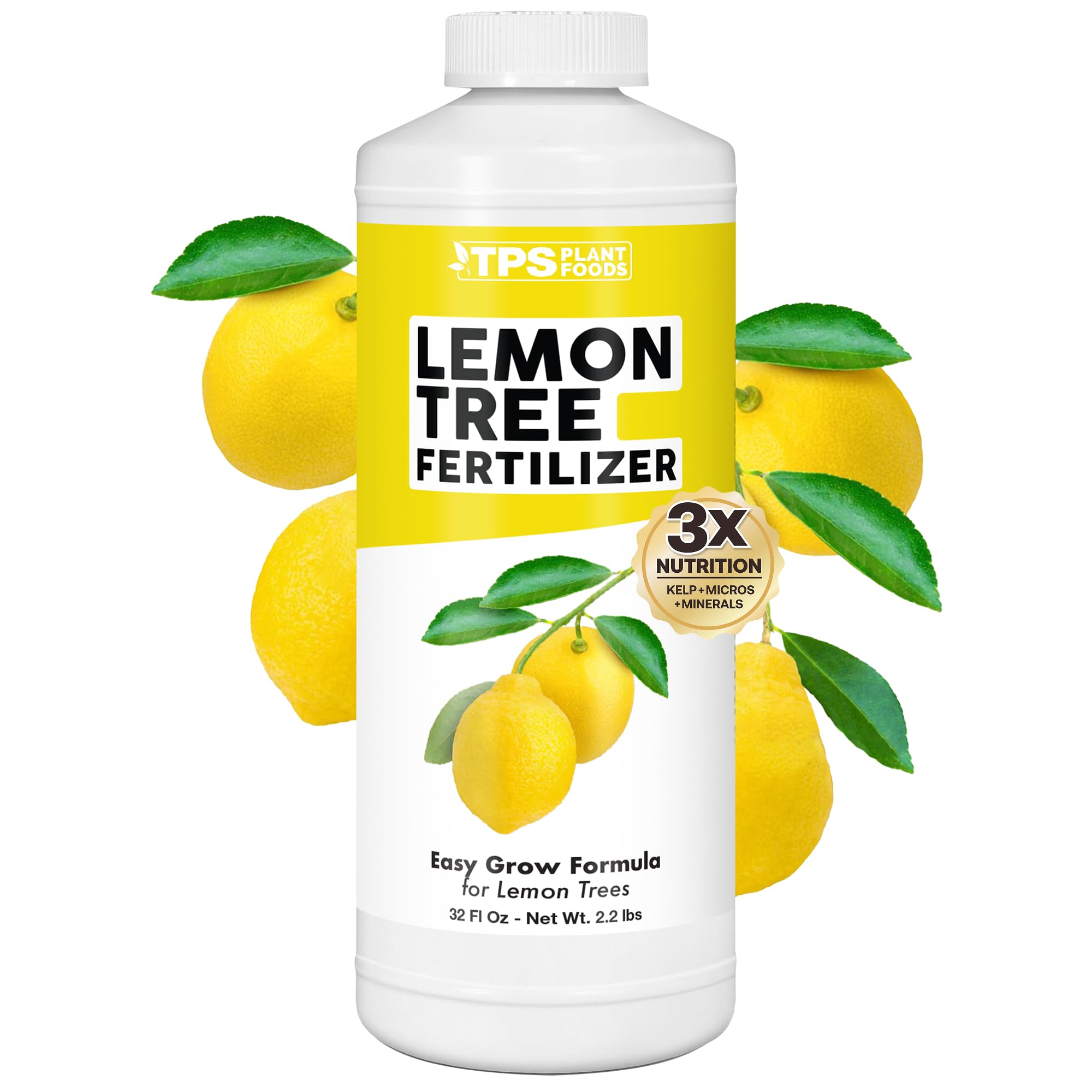
Two tablespoons per gallon. That is the entire learning curve, and after a few weeks of use we stopped thinking of it as a chore, because the feed goes into the can you were already filling. Mix it, pour it through the root zone, and you are done.

It is a powder rather than a ready-mixed liquid, so you are not paying to ship water, and a measuring spoon comes in the tub so the dose stays repeatable. The label also lists foliar feeding, which is worth knowing for a tree that has stalled and needs a faster nudge than the roots will give.

Where the liquid beats the granular picks is control. You decide how strong the batch is and how often it goes on, which matters for a container tree pushing growth all summer and wanting more than a feed every three months. The price of that control is the ritual — there is always a jug to make up. If you want to feed a tree and forget it, spikes are the better answer; if the watering can is already in your hand twice a week, this is the cleanest route.

Bottom line: Buy this if you are already watering a container citrus twice a week; mixing a batch is the tidiest way to get nutrients into a pot.

4

Jobe's Organics Fruit & Citrus

Jobe's Organics Fruit & Citrus

Organic fruit trees

Our Score 9.2/10
Check Price

Worth Noting

  • Strong organic smell after application
  • Needs feeding every four to eight weeks
Bag Size
4 lb
NPK Analysis
3-5-5
Certification
OMRI listed
Feeding Schedule
Every 4 to 8 weeks
Read the full review

The bag tells you what you are in for the moment you open it. This is an organic 3-5-5 and it smells like one — earth, barnyard, a bit of the farm. That is not a defect in an organic feed, but it does decide where you can use it: outdoors, in a bed or on a porch, never in the corner of a living room.

For that trade you get the only OMRI-listed pick here and one built for fruit and citrus rather than general greenery. This is what we choose for a Meyer lemon or a fig in a big outdoor pot, where the extra phosphorus earns its keep at flowering time and the organic matter does the soil some good alongside the NPK.

The schedule is the part people underestimate. This is a gentle feed meant to go on every four to eight weeks through the growing season, not a slow-release granule you apply twice a year. Skip a couple of rounds in summer and you will see it in the leaf color before long. Measure rather than pouring from the bag; the analysis is mild, but a heaped scoop every month is not what the label intends.

Come autumn, reseal the bag and store it dry, out of reach of the dog. It keeps, and next spring's first feeding is already paid for.

Bottom line: Our pick for anyone feeding a fruiting tree organically, as long as it lives outdoors where the smell will not follow you inside.

5

Miracle-Gro Shake 'N Feed Flowering

Miracle-Gro Shake 'N Feed Flowering

Flowering trees

Our Score 9.2/10
Check Price

Worth Noting

  • Formulated for flowering and acid-loving plants
NPK Analysis
18-6-12
Where To Use
In-ground and containers
Target Plants
Flowering trees and acid-lovers
Feeding Duration
Up to 3 months
Read the full review

An 18-6-12 with a nitrogen lean and a list of natural ingredients meant to feed the soil as well as the plant. That is the shape of a flowering-tree food: enough nitrogen to push growth, phosphorus and potassium to carry it through bud set, and a microbial component a straight salt fertilizer does not bother with. The target list is specific — flowering trees, shrubs, and the acid-lovers that share the bed, magnolias and dogwoods and hydrangeas among them.

Application is a shake and a watering. Scatter it evenly under the canopy, water it in, and it releases for up to three months, which lands you at three feeds across a growing season. In containers and in the ground both, which is unusual for a granular feed.

The natural ingredients are what separate it from a plain salt fertilizer: they feed the microbes that break organic matter down, which is a slower route to greener foliage but a better one for a bed you plan to keep planting in.

For a border planned around bloom, this is the granular we keep coming back to — one scoop covers the flowering trees and the acid-loving shrubs underneath them, so there is no second product to buy for the hydrangeas. It is not a shade-tree formula, though. An oak gets nothing from it that a general feed would not give, so keep the bag for the flowering half of the garden.

Bottom line: This is the granular we choose for a border built around bloom — magnolias, dogwoods, hydrangeas, all fed from one bag.

6

Scotts Evergreen Tree & Shrub

Scotts Evergreen Tree & Shrub

Evergreens and acid-lovers

Our Score 9.2/10
Check Price

Worth Noting

  • Feeds for only about two months
Bag Size
3 lb
Application
Direct to soil
Target Plants
Evergreens and acid-loving shrubs
Feeding Duration
Up to 2 months
Read the full review

The least expensive bag in this group, and the one that asks the least of you: a continuous-release feed for evergreens and the acid-lovers that share their bed — dogwoods, hydrangeas, magnolias, azaleas, camellias, rhododendrons. If your garden is a run of arborvitae and a row of hydrangeas, that list covers the whole job.

Application is a scoop and a watering can. Spread it on the soil, water it in, and it feeds for up to two months. The label promises no burn when it is used as directed, which is worth knowing if you spread by eye rather than by measure. A little goes a long way, and a single bag covers a whole border of shrubs.

Two months is the catch. Where the Shake 'N Feed granules run three, this one wants reapplying sooner, so a season is three or four passes rather than two or three. For a hedge you walk past with a bucket anyway, that is nothing. What we buy it for is evergreens and acid-lovers: it is the most targeted formula here for that group and the least expensive way to keep a conifer hedge fed.

Bottom line: The value pick: nothing here costs less for keeping evergreens and acid-loving shrubs green, though you will feed more often.

7

BioAdvanced Protect & Feed

BioAdvanced Protect & Feed

Insect-prone trees

Our Score 9.2/10
Check Price

Worth Noting

  • An insecticide first, not a plain tree feed
Form
Granules
Bag Size
10 lb
Active Ingredient
Imidacloprid
Protection Period
Up to 12 months
Read the full review

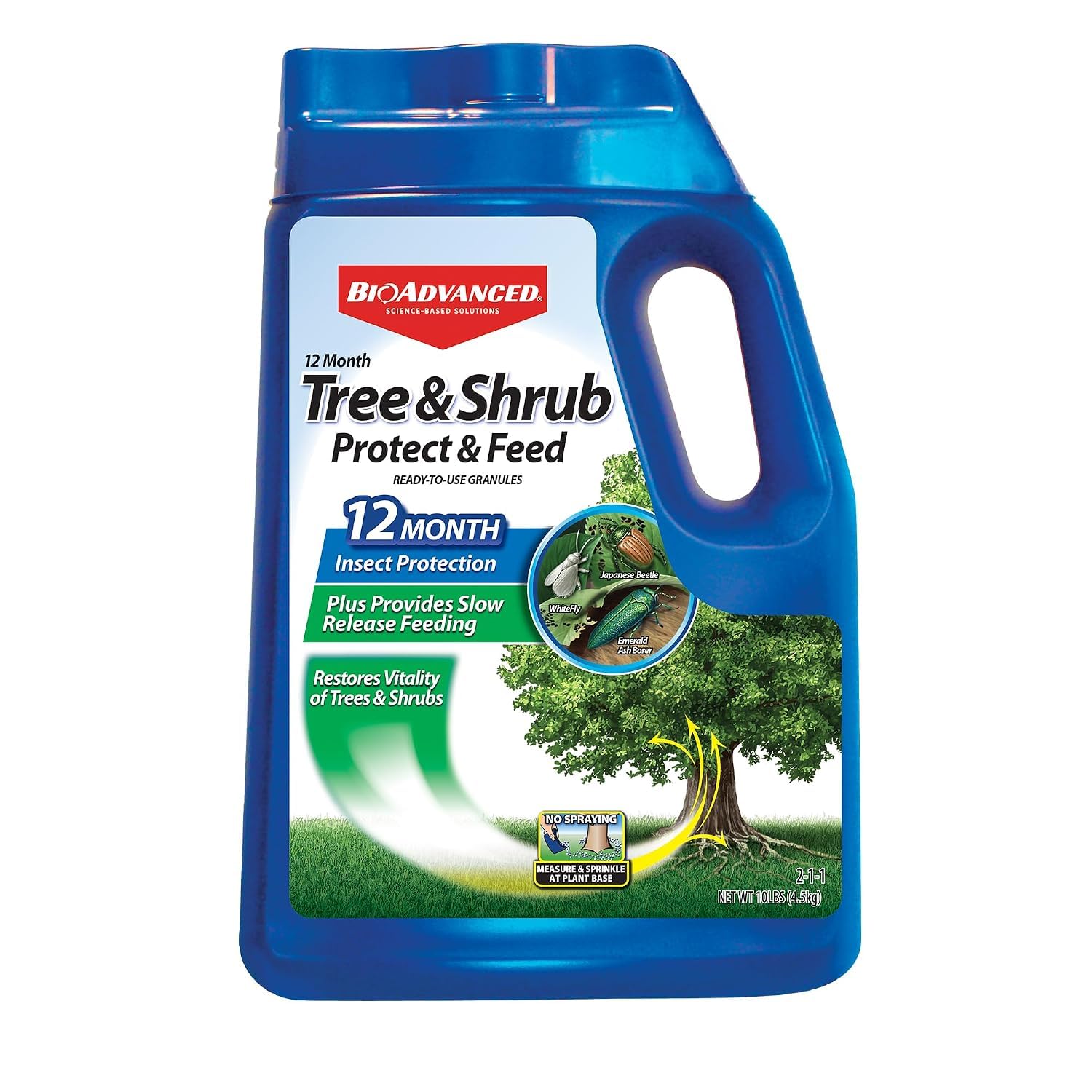
If the tree is losing leaves to something with legs, this is the product here that treats the cause rather than the symptom. It pairs a slow-release fertilizer with imidacloprid, a systemic insecticide the roots take up and move through the plant, and one application is labeled to kill listed borers, beetles, adelgids, leafminers, and aphids and hold off new infestations for up to a year.

Applying it is genuinely simple, and we appreciated not having to mix anything: measure with the cup built into the cap, sprinkle around the base, water it in. Because it is systemic, the insecticide reaches the places a spray cannot — the wood and the undersides of the leaves where borers and adelgids do their damage. For an ash with borer damage, or a magnolia chewed two summers running, that is a different order of help from a bag of NPK.

The conditions are worth stating plainly. It is a protect-and-feed product rather than a plain fertilizer, so read the label before using it anywhere near a fruit crop. Put it down after flowering, once bees have moved on — a systemic insecticide applied to a tree in bloom is bad news for pollinators. And it is the priciest product here; on a healthy tree that only needs feeding, a plain granule does the job for less.

Bottom line: Worth the premium when insects are what is hurting the tree, since it feeds and protects for a year in a single application.

How We Tested Tree Fertilizers

We started with roughly 40 fertilizers sold for trees and shrubs and cut the list by reading labels: products with vague nutrient ratios, no release timeline, or coverage claims that didn't match the bag weight came off first. We also filtered by form, since a spike and a hose-end sprayer solve different problems, and by price per application rather than sticker price. Twelve made the cut, and each one ran for a full growing season — about eight months, from the first spring feeding through fall color.

Every product went on real trees: a two-year-old maple in my yard, two mature shade trees that had never been fed, a row of arborvitae along a driveway, and a container-grown fig. We followed label rates exactly and timed each application to see whether it was a ten-minute job or an afternoon spent pushing a spreader. Right after feeding, we noted how strong the smell was and whether it still hung around a day later, since several of these go down within a few feet of a patio.

Each month we measured new shoot growth on tagged branches with a soft tape and held leaves against a color card to track how deep the green went. We watched for burn at the drip line, checked whether granules broke down or sat on the surface through a heavy rain, and noted which spikes crumbled on the way into dry clay. Durability mattered too: how the leftover product held up in a hot garage over the summer, and how many trees one container genuinely covered. At the end we compared cost per tree per season rather than cost per bag, because a cheap box that feeds two trees is not the bargain it looks like.

How to Choose Tree Fertilizers

Start With the Tree, Not the Numbers

The three numbers on the bag are nitrogen, phosphorus, and potassium, and the ratio tells you what the feed is pushing: nitrogen for leafy growth, phosphorus and potassium for flowers, fruit, and roots. What matters more is the target list on the front. A citrus and avocado formula like Miracle-Gro Shake 'N Feed Citrus is built for fruit set in a pot; an evergreen and acid-lover feed like Scotts suits conifers, dogwoods, and hydrangeas; a general tree-and-shrub spike such as Jobe's covers deciduous and evergreen trees alike.

Read that list before the analysis, and be honest about what you are feeding. A great formula for the wrong plant is an expensive way to do nothing.

Pick the Format You'll Actually Keep Up With

Spikes are the lowest-effort option for a tree in the ground: two sessions a year, nothing to measure, nothing to mix. Their weakness is reach, so they need to go out at the drip line rather than against the trunk, and they can crumble in hard, dry soil. Granules spread evenly and cover a wider area. Liquids make the most sense for containers, where you control the dose and can feed through a watering you were doing anyway.

The trap is placement. A spike hammered in beside the trunk is feeding the one part of the root system that is not doing the work; walk out to where the canopy ends instead.

Work Out the Cost in Visits

Feeding duration separates these products as much as price does. Scotts runs about two months, the Shake 'N Feed granules run three, and BioAdvanced claims twelve. Multiply that against your growing season and you have the number of times you will be out there with a scoop.

For a hedge along the driveway, frequent light feeds cost you nothing. For a tree at the back of the lot, buy the longest release you can find and skip the walk.

Decide Whether the Problem Is Hunger or Insects

Yellowing leaves, thin growth, and small fruit are feeding problems. Chewed leaves, dieback, and borers are not, and no bag of NPK will fix them. A combined protect-and-feed product such as BioAdvanced handles both in one application, but it is the most expensive route here and no substitute for water, mulch, and a look at the soil.

Feed a healthy tree; diagnose a sick one. If you do use a systemic insecticide, put it down after flowering so pollinators are not working the tree.

Frequently Asked Questions

Final Verdict

The default is Jobe's Tree & Shrub Spikes. A general tree-and-shrub formula covers the mixed yard most of us actually have, two feedings a year is a schedule nobody abandons, and there is nothing to measure.

The exception is a tree in a pot. A container citrus wants the three-month citrus granule, or the liquid you mix into the watering can, because that is where you can control the dose. And if the leaves are being eaten rather than yellowing, start with the protect-and-feed granule instead of another bag of NPK.