Soil & Fertilizer

Best Slow Release Fertilizers of 2026

Slow-release fertilizer is a coated prill: water seeps through the shell, and the nutrients inside leak out over weeks instead of all at once. That slow drip is the entire point. Feed once in spring and your plants get a steady supply rather than a flush of green that washes away with the next hard rain, or a scorched patch where your spreader settings went wrong. The right granular feed takes the guesswork out of it — one pass, and the beds are fed for months.

I've learned that the NPK ratio printed on the front of the bag tells you less than the release window and whether the coating holds up in heat. Over the past six months, our team has fed 12 slow-release fertilizers through a full growing season, and the differences showed up in the beds, not on the label. The picks below are the ones I'd hand to a neighbor without a caveat.

1

Osmocote Smart-Release Plus

Top Pick
Osmocote Smart-Release Plus

Mixed beds and pots

Our Score 9.6/10
Check Price

Worth Noting

  • Most expensive bag in this group
Coverage
Up to 300 sq ft
Nutrients
11 essential nutrients
Feeding Window
Up to 6 months
Application Rate
1 scoopful (3 tablespoons) per 2 gal. pot or 4 sq ft
Read the full review

Six months is the number that makes this the bag we reach for first. One application in spring keeps feeding containers, window boxes, houseplants, and beds into fall, which is the whole promise of a slow-release fertilizer delivered in a single product. The granules are resin-coated, so nutrients come out gradually rather than in one flush after watering, and an 8-pound container covers up to 300 square feet. Long window, broad plant list, nothing to mix: that combination is why it's our top pick.

The dosing is where it earns its keep in practice. One scoopful — three tablespoons — feeds a 2-gallon pot or 4 square feet of bed, so a row of containers takes a couple of minutes and you're not guessing at fractions of a cup. We also like that the same granules work indoors. A ficus in the living room and a rose in a patio pot get the same treatment, which means one bag on the shelf instead of two.

Osmocote's no-burn pledge applies when you use it as directed, and that qualifier does real work: the margin comes from the coating and the rate, not from the granule being harmless in any quantity. Scatter it evenly, work it into the top inch or two in beds, and water it in. In display pots the granules sit on the surface for months; scratch them under the top inch if the look bothers you.

Coverage is the number to check against your own garden. Three hundred square feet is a small slice of a big yard, so a serious border takes two bags, and that's before you count the pots. For a garden built from containers, a few beds, and a shelf of houseplants, though, nothing else here makes as few decisions for you: one product, one scoop, and no jug to rinse.

Bottom line: If you want one bag that feeds pots, houseplants, and beds until fall, this is the one we recommend — the six-month window and forgiving dose do more for a mixed garden than a cheaper, shorter feed.

2

Osmocote Flower & Vegetable

Osmocote Flower & Vegetable

Vegetable gardens

Our Score 9.4/10
Check Price

Worth Noting

  • No feeding window in months printed on the bag
Bag Size
8 lb (128 oz)
NPK Analysis
14-14-14
Where To Use
Outdoor vegetable gardens and beds
Application Rate
1 scoopful per 4 sq ft
Read the full review

The Plus bag talks about 11 nutrients; this one leads with a number. It's 14-14-14, the highest total nutrient formula Osmocote sells, aimed squarely at seasonal vegetables and perennials. One scoopful covers 4 square feet, worked into the top 1 to 3 inches, and the whole bag is built for outdoor beds rather than the plant shelf in the living room.

That balance is what we want in a vegetable bed. A 14-14-14 feeds roots, flowers, and fruit at once instead of pushing leaf at the expense of tomatoes and peppers, and the mistake-proof claim is unusually generous: even at three times the recommended rate, Osmocote says it won't burn the plant. We didn't push ours that far, but the claim tells you how much margin the coating buys when a scoop slips on a windy morning.

The trade-off is scope. This is an outdoor fertilizer, so the houseplants stay on the other bag, and your growing has to be edible or flowering to get the most from the analysis — a border of shrubs gains less from it than a tomato row does. If your garden is vegetables, annuals, and perennials, that costs you nothing, and the scoop rate is the easiest thing here to repeat across a whole bed.

Bottom line: For a vegetable row or a bed of hungry annuals, we pick this over the all-purpose bag — the 14-14-14 balance and the burn margin suit heavy feeders better than a longer window does.

3

Miracle-Gro Shake 'N Feed

Miracle-Gro Shake 'N Feed

Easy all-purpose feeding

Our Score 9.4/10
Check Price

Worth Noting

  • Three-month window needs a top-up around shrubs
Bag Size
4.5 lb
Application
Shake on and work into top 1-3 in.
Where To Use
Containers, raised beds, in-ground
Feeding Window
Up to 3 months
Read the full review

The shaker top is the reason this bag lives on our shelf. Flip the cap, shake an even band over the soil, work it into the top inch or two, and a border of annuals is fed before the watering can is full. No scoop, no measuring cup, no granules stuck to a wet hand.

It feeds for up to three months and works in containers, raised beds, and in-ground gardens, on flowers, vegetables, and herbs. Miracle-Gro also blends in natural ingredients that feed soil microbes alongside the granules — a small bonus rather than the reason to buy, but it fits the way a mixed border actually gets fed.

The shaker is generous. Tilt it and the granules come out faster than you expect, which is fine over a bed and less fine over a patio, so keep the spout low and shake in short bursts. The 4.5-pound bag is also light enough to carry one-handed around the yard, which sounds trivial until you're feeding the far end of a property.

Where it fits best is a garden that gets replanted. Annuals and vegetables that go in each spring are done before the granules are, so a shorter window costs you nothing and saves the premium the longer feeds charge. Shrubs and perennials you want fed until fall are the case for spending more.

Bottom line: If you want feeding to take two minutes and don't need a six-month window, this is the bag we hand people — the shaker does the work and the price stays low.

4

Scotts All Purpose Flower & Vegetable

Scotts All Purpose Flower & Vegetable

Small in-ground beds

Our Score 9.4/10
Check Price

Worth Noting

  • In-ground use only, not for containers
Bag Size
3 lb
Coverage
About 150 sq ft
Application
Sprinkle and rake into top 1-3 in.
Feeding Window
Up to 2 months
Read the full review

Three pounds for about 150 square feet of bed is the entire point of this bag. It's the least expensive way into a continuous-release feed in this group, it runs up to two months, and for a couple of raised beds or a tomato row that's the right amount of both. Sprinkle it, rake it into the top inch or two, water, and you're done.

Two months of continuous-release nitrogen means a repeat application if your season runs long, and that's the cost of buying small. Measure the bed before you order: 150 square feet goes quickly once you're feeding a border, and a second bag midseason is cheaper than under-feeding and wondering why the peppers stalled. For flowers, annuals, tomatoes, and shrubs in the ground, it does the job without ceremony.

Bottom line: For a small in-ground bed on a budget, this is the bag we buy — two months of feed for the least money here, as long as you're not filling pots.

5

FoxFarm Happy Frog All Purpose

FoxFarm Happy Frog All Purpose

Organic edible gardens

Our Score 9.4/10
Check Price

Worth Noting

  • Premium price for a 4 lb bag
Bag Size
4 lb
Includes
Soil microbes and mycorrhizal fungi
NPK Analysis
6-4-5
Certification
OMRI Listed
Read the full review

OMRI Listed is the first thing to notice here. That certification is what makes the bag usable in certified organic production, and it's the only product in this roundup that carries it — a real difference if you sell what you grow or simply want to know exactly what's going into the bed.

The analysis is low: 6-4-5, with soil microbes and mycorrhizal fungi blended in. That's a different philosophy from a coated salt granule. Happy Frog feeds gently and expects soil biology to do part of the work, so it builds a bed over a season rather than rescuing a plant by the weekend.

Handling takes a minute to get used to. It's a dry, powdery granule with an earthy smell, and it doesn't scatter as neatly as a coated prill — you're spreading a powder as much as a granule, so apply it on a still day and work it in. The listed rates cover new plantings and established beds, which makes it forgiving on timing.

We keep it for vegetable beds and new plantings where we want organic inputs and a slow, steady feed. What you give up is speed and concentration: this won't green up a struggling shrub the way a stronger analysis will. Buy it for the certification and the biology, and buy a coated granule if you want a number on the window and a faster response.

Bottom line: Choose this one when organic certification matters and you're feeding beds rather than rescuing plants — it's the only OMRI Listed bag here, and the soil biology is the point.

6

Southern Ag Osmocote 14-14-14

Southern Ag Osmocote 14-14-14

Pots and baskets

Our Score 9.2/10
Check Price

Worth Noting

  • Brief directions compared with the consumer brands
Bag Size
5 lb
NPK Analysis
14-14-14
Feeding Window
Up to 4 months
Application Rate
1/4 to 1/2 cup per cubic foot
Read the full review

The label is plain and the directions are short, but the contents are straightforward: 5 pounds of 14-14-14 controlled-release granules that meter nutrients for up to four months, sold through a nursery supplier rather than a consumer garden brand. The rate is given per cubic foot — a quarter to a half cup — which tells you who it's written for: people filling pots, flats, and baskets, not dressing a border.

That's how we used it, blended into potting mix at the bench, where a per-cubic-foot rate scales cleanly and a whole tray of containers gets done in one go. The same granules work as a top dressing on flower beds and vegetable gardens, though at that point you're converting cups to square feet by eye and the scoop on the bigger bag is easier to trust.

Against the other 14-14-14 bag here, this is the potting-bench size: the same analysis and a stated four-month window, with a smaller outlay for 5 pounds rather than 8. It's built for someone who fills a tray of containers in one session and thinks in cubic feet. For a border you visit twice a season, the bigger bag with the scoop rate is easier to live with.

Bottom line: If you mix your own potting soil and want controlled-release granules by the cubic foot, this is the bag we point you to — same analysis as the big name, less packaging.

7

The Grow Co Indoor Plant Food

The Grow Co Indoor Plant Food

Houseplants

Our Score 9.0/10
Check Price

Worth Noting

  • Small 5 oz bag for a large collection
Dose
1/4 tsp per 2 in. of pot width
Form
Urea-free granules
Bag Size
5 oz
NPK Analysis
10-10-10
Read the full review

A quarter-teaspoon per 2 inches of pot width is the whole method. A 6-inch pot takes three-quarters of a teaspoon, poked into the mix or scattered on top, and the granules keep feeding for months. No dilution, no jug, no fertilizer smell in the living room.

This is the houseplant product we recommend because it removes the two things that stop people feeding indoor plants: measuring a liquid concentrate and finding somewhere to do it. The 10-10-10 analysis is urea-free and balanced, so it suits an ordinary mix of pothos, philodendron, snake plants, and ficus rather than any one specialty, which is what most indoor collections actually are.

Where it stops is scale. Beds and borders need a granule with a square-foot rate and a scoop, and measuring quarter-teaspoons across a flower bed is nobody's idea of a good afternoon. Treat this as the indoor half of your feeding routine, and leave the outdoor half to a bag with a coverage figure on it.

Bottom line: For a shelf of houseplants, this is the easiest feed we tested — a quarter-teaspoon per 2 inches of pot, no mixing, and months between applications.

8

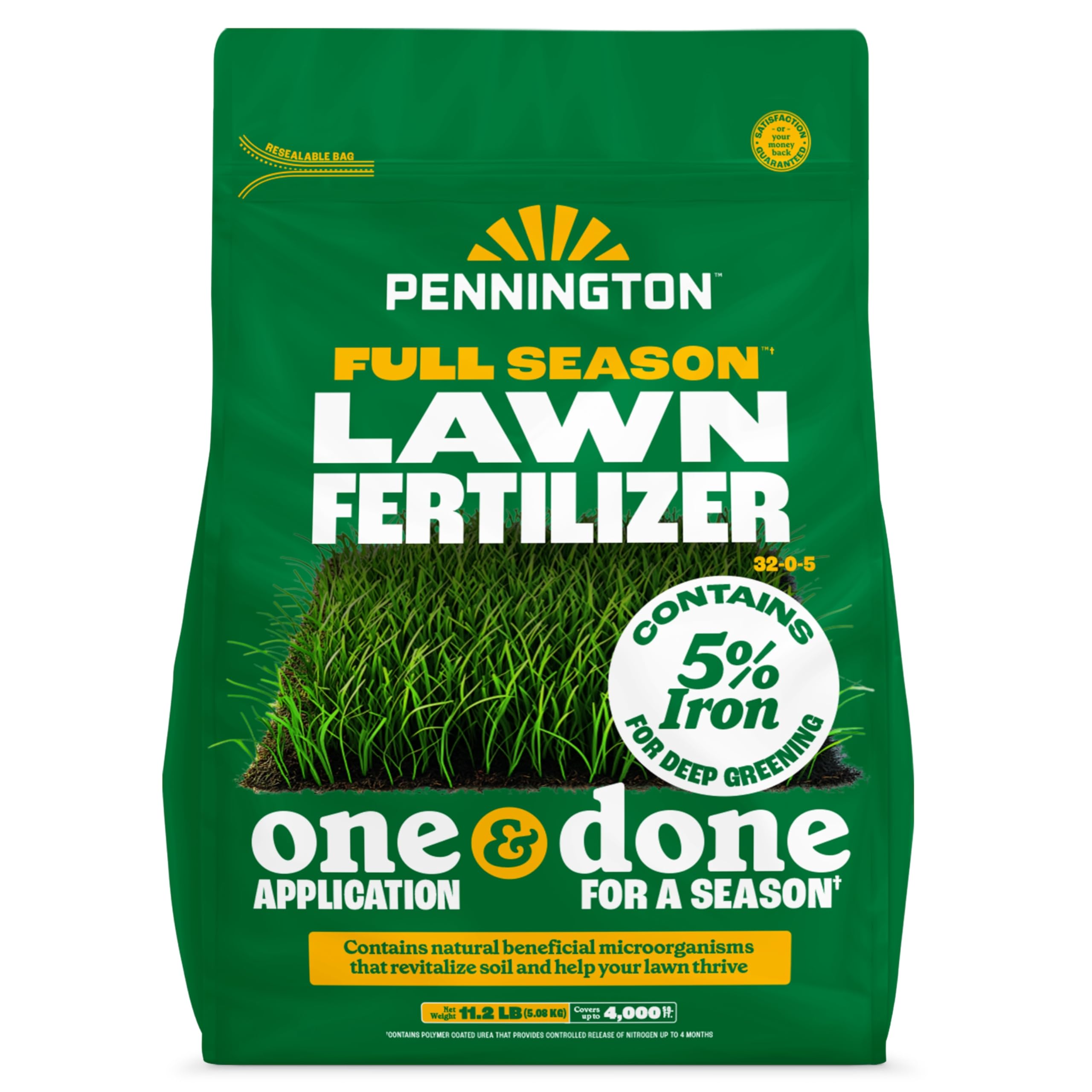
Pennington Full Season Lawn Fertilizer

Pennington Full Season Lawn Fertilizer

Lawns

Our Score 8.6/10
Check Price

Worth Noting

  • Not sold in Hawaii or South Dakota
  • Needs a spreader for even coverage
Iron
5% iron
Coverage
4,000 sq ft
NPK Analysis
32-0-5
Slow-release Nitrogen
Up to 4 months
Read the full review

Lawns are where the rest of this list stops. Pennington's 32-0-5 is turf fertilizer: polymer-coated urea that meters out nitrogen for up to four months, 5% iron for color, and a stated 4,000 square feet of coverage from an 11.2-pound bag. One application is meant to carry a season.

The iron is what separates it from a plain nitrogen feed. It's the nutrient behind deep green color rather than top growth, and it's why this reads as a lawn product instead of a garden one. Coverage assumes the label rate, so measure the lawn before ordering: at 4,000 square feet the bag is doing exactly what it claims, and a bigger lawn needs a second bag rather than a heavier hand.

Results are the least consistent thing about it. Some lawns green up within days; others show little change, and the difference usually comes down to rate and watering rather than the bag itself. Spread it evenly, water it in, and give it a couple of weeks before judging. For grass, this is the product in this group built to do the job — the rest are for beds.

Bottom line: If you're feeding grass rather than beds, this is the pick — four months of coated nitrogen and iron in one pass, provided you spread it evenly and water it in.

How We Tested the Best Slow-Release Fertilizers

We started by gathering every slow-release fertilizer we could find that listed both a release window and a coverage area — about 40 candidates — then narrowed that to 12 based on release period, nutrient ratio, bag size, and price per 1,000 square feet. Testing ran from early spring through late summer, roughly six months, across raised beds of tomatoes and peppers, a dozen patio containers, a tired front lawn, and a row of hydrangeas that had been sulking for two years. I did most of the feeding; my team handled the measuring and the record-keeping.

Every application started on a Saturday morning with a kitchen scale. We weighed each dose instead of trusting the scoop that came in the bag, noted how the prills poured — dusty, clumpy, or free-flowing — and whether the bag had a handle or a resealable top that actually sealed. After watering in, we flagged any leaf burn within the first week and checked the soil surface every couple of weeks to see whether granules were still intact or had broken down early.

Effectiveness got measured rather than eyeballed: we tracked new growth on the tomato transplants with a ruler, counted blooms, and watched for yellowing lower leaves or crispy edges on the containers. We also counted how many beds each bag actually covered before it ran out, which rarely matched the label, and stored the leftovers in a hot garage to see whether the granules caked into a brick by midsummer.

How to Choose Slow Release Fertilizers

Start With the Feeding Window

Two months, three, four, six — the window is the first number to compare, because it sets how many times you'll be back out there with a scoop. Annuals, vegetables, and anything replanted each season suit a two- or three-month feed. Shrubs, perennials, and houseplants you don't want to revisit suit four to six. Longer isn't automatically better: you pay for the extra months, and a bed that gets turned over in August has no use for feed that runs to October.

Match the Analysis to What You're Growing

A balanced blend such as 14-14-14 feeds roots, flowers, and fruit together, which is what a vegetable bed wants. Turf is the exception — a lawn product like Pennington's 32-0-5 pushes nitrogen and iron for color and top growth, and it's the wrong bag for a flower border. If organic certification matters, look for OMRI Listing rather than a particular analysis. And in containers, a lower, balanced analysis is safer than a strong one: a pot has nowhere to send the excess.

Containers, Beds, and Lawn Take Different Products

Some granules are labeled for in-ground use only, and container soil behaves differently — it dries faster, warms more, and holds a smaller root volume. If most of your growing happens in pots, buy a product whose directions mention containers and give a rate per pot size. For a border, a square-foot rate is easier to work with. For grass, you want a spreader and a stated coverage in square feet, because a garden granule is not a lawn feed.

Dose Control Decides How Evenly It Lands

Slow-release granules feed the soil immediately around them, so an uneven scatter shows up months later as a lush patch beside a pale one. A shaker top is fast across a mixed border, a scoop gives you a repeatable dose in pots, and a spreader is the only realistic way to land 11 pounds evenly over 4,000 square feet. Whichever format you choose, work the granules into the top inch or two where the label says to and keep the dose at the printed rate.

Buy by Area, Not by Bag Size

Coverage figures are stated at the label rate, and they differ by an order of magnitude: 8 pounds of Osmocote covers up to 300 square feet of bed, while an 11.2-pound lawn bag covers 4,000. That's not a pricing trick — turf takes a fraction of the product per square foot that a planting bed does. Measure what you're feeding before you order and check the rate on the bag, because a garden that looks modest can take two bags of bed fertilizer.

Frequently Asked Questions

Final Verdict

Across a whole garden, the Osmocote Plus bag is what we recommend: six months of feed from one application, a scoop that doses a 2-gallon pot or 4 square feet, and a plant list that runs from houseplants to roses. You pay the most for it, and that's the trade — fewer applications and a wider margin for error.

Change one requirement and the answer changes with it. Vegetable beds want the 14-14-14 Flower & Vegetable bag; a lawn wants Pennington, the only turf product here; organic certification points to FoxFarm; and a shelf of houseplants belongs to The Grow Co.