Birding & Garden Decor

Best Suet Feeders of 2026

A feeder outside the kitchen window earns its keep in January, when the chickadees and woodpeckers arrive and the suet disappears fast. Then the cake is on the ground, the cage is bent, and a squirrel is sitting on the pole looking pleased with itself. A good suet feeder is really a small piece of engineering: it holds the cake firmly, keeps rain and snow off it, and makes it awkward for anything without wings to hang on.

I've had 14 suet feeders hanging in my yard over the past five months, and the ones that held up share a few traits: smooth metal, a lid that latches, and nothing for a squirrel to grip. One thing nobody tells a first-time buyer: suet softens and swells as the weather warms, so a cage that fits snugly in February can jam by April. Where you plan to hang it — a pole, a branch, a window bracket — matters as much as the feeder itself. The picks below drew the most birds, cleaned up easily, and didn't make me curse in the cold.

1

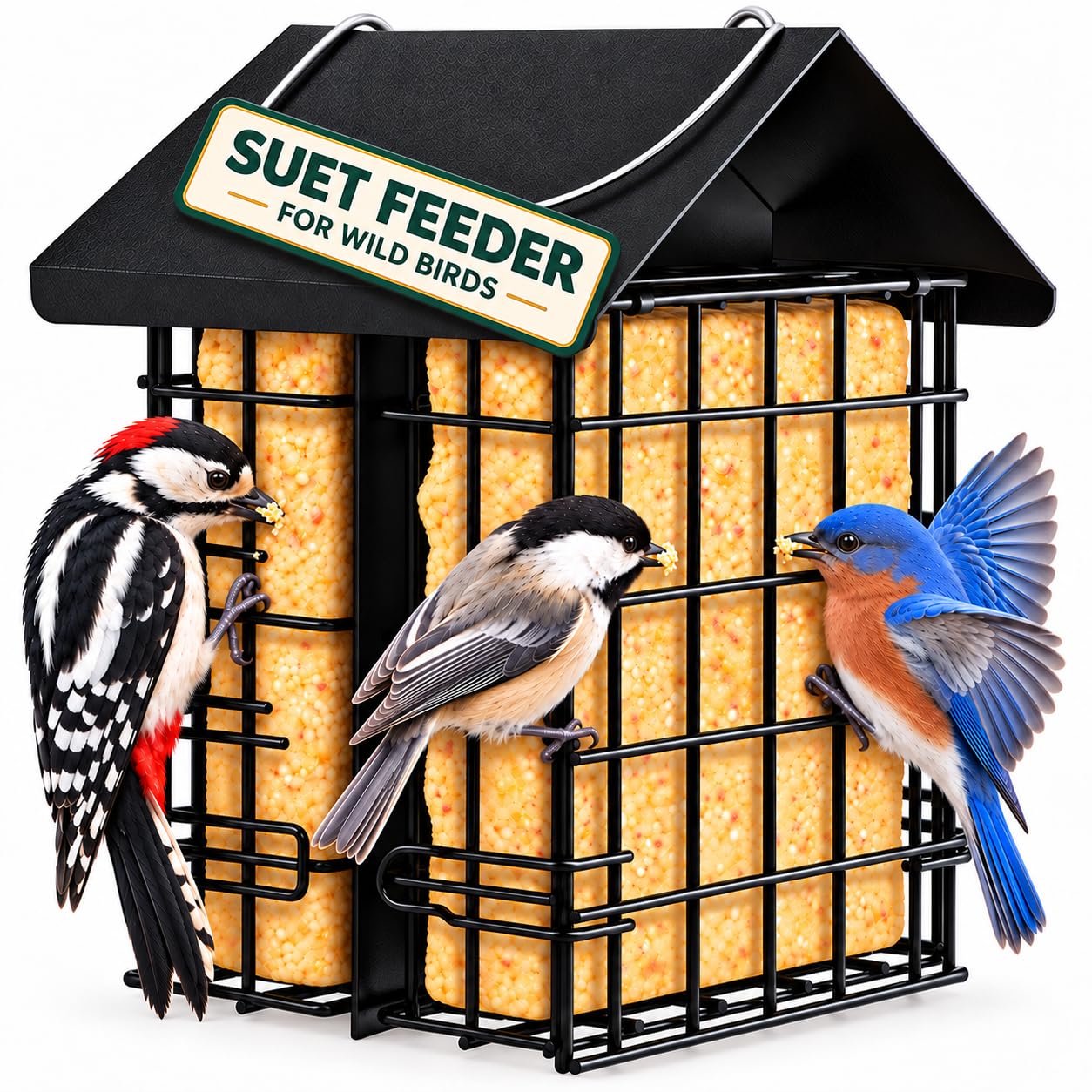
Kingsyard Double Suet Feeder with Perch

Top Pick
Kingsyard Double Suet Feeder with Perch

Most backyard birds

Our Score 9.6/10
Check Price

Worth Noting

  • Roof lifts off entirely, so refills take two hands
Perches
Two metal perches
Construction
Powder-coated all-metal
Suet Capacity
2 standard cakes
Weather Protection
Weatherproof roof
Read the full review

Most suet feeders ask a bird to cling to the mesh and hang upside down. The Kingsyard gives them two small metal perches below the cages instead, and that is the detail that won us over: chickadees and titmice that won't dangle get somewhere to stand while the woodpeckers work the mesh above them. One feeder, more species.

The rest is built the way we want a suet feeder built. The body is powder-coated metal with a roof that overhangs both cages, so a downpour doesn't turn the cakes to mush, and two standard cakes go in at once, which stretches refills out in a busy yard. The roof lifts off in one piece for loading and cleaning, and the whole thing measures 5 by 5 by 8 inches, small enough to hang from a thin branch without dragging it down.

Squirrels still get to this one. They hang off the cage and reach through the mesh, which is the nature of a cage feeder. What they can't do is lift the roof and carry off a whole cake, and that is the failure that empties a feeder fastest.

The one thing to plan around is that roof. It comes off completely rather than hinging, so refilling means setting it down somewhere while you load two cakes — fine at a hook you can reach, awkward at the top of a pole. A small price for a feeder that stays loaded, stays dry, and gets used by more than the acrobats.

Bottom line: Our pick for most yards: an all-metal double that loads from the top, keeps the cakes dry, and gives perching birds somewhere to sit.

2

More Birds Double Suet Cake Feeder

More Birds Double Suet Cake Feeder

Clinging birds

Our Score 9.4/10
Check Price

Worth Noting

  • Squirrels can reach through the open mesh
Dimensions
7.2 x 6.5 x 6.5 in
Construction
Powder-coated steel
Suet Capacity
2 suet cakes
Weather Protection
Shingle-pattern roof
Read the full review

This is the double we point to when the budget is the deciding factor. It holds the same two cakes as our top pick, under a shingle-pattern roof, in a powder-coated steel body, and it does it for less.

The double-locking closure is the part we appreciate most. Each cage has its own door, both latch firmly, and the cakes stay put through wind and weather — that closure is doing the real work here, not the cage. The roof does the rest, shedding rain and snow off the top of both cakes, and the whole thing opens easily for a refill without taking it down off the hook.

What it lacks is a perch, and that narrows the guest list. Woodpeckers, nuthatches, and titmice won't care; cardinals, finches, and other birds that like to sit while they eat will pass it by. If your yard is already busy with clingers this is an easy buy. If you want the widest traffic, the perches on the Kingsyard are worth the step up.

Bottom line: Our value pick: two locking cages and a roof that sheds weather, at the lowest price of the doubles here, and best for yards already full of clinging birds.

3

Kingsyard Tail-Prop Suet Feeder 2-Pack

Kingsyard Tail-Prop Suet Feeder 2-Pack

Big woodpeckers

Our Score 9.4/10
Check Price

Worth Noting

  • Squirrels can chew the plastic frame
  • Tall body limits where it hangs
Design
Woodpecker tail prop
Material
Recycled plastic, steel mesh
Pack Size
2 feeders
Suet Capacity
2 cakes each
Read the full review

A pileated woodpecker doesn't so much cling to a suet cage as brace against it, tail jammed down for leverage. This Kingsyard gives it a flat prop board to push against, and that is the detail that makes it the pick for anyone hoping to pull in the big woodpeckers rather than just the chickadees.

The frame is recycled plastic, which turns out to be the right call for something that hangs outside all year. It doesn't soak up water, it doesn't rot the way the wooden feeders it is styled to resemble eventually do, and it wipes clean in seconds. The mesh panels slide straight out of the frame, so clearing old suet out of the cage is a one-minute job rather than a scrub. You get two feeders in the box, each holding two cakes.

Plastic has a cost, and it is the squirrel. A determined one can chew at the frame in a way it couldn't with an all-metal cage: the mesh holds, the plastic around it may not. The 16-inch height also makes it a bigger presence on a branch than the compact doubles here. If chewing is your problem, go metal; if woodpeckers are, this is the one.

Bottom line: The woodpecker specialist: a tail prop, sliding mesh, and a second feeder in the box, and best where pileated and hairy woodpeckers visit.

4

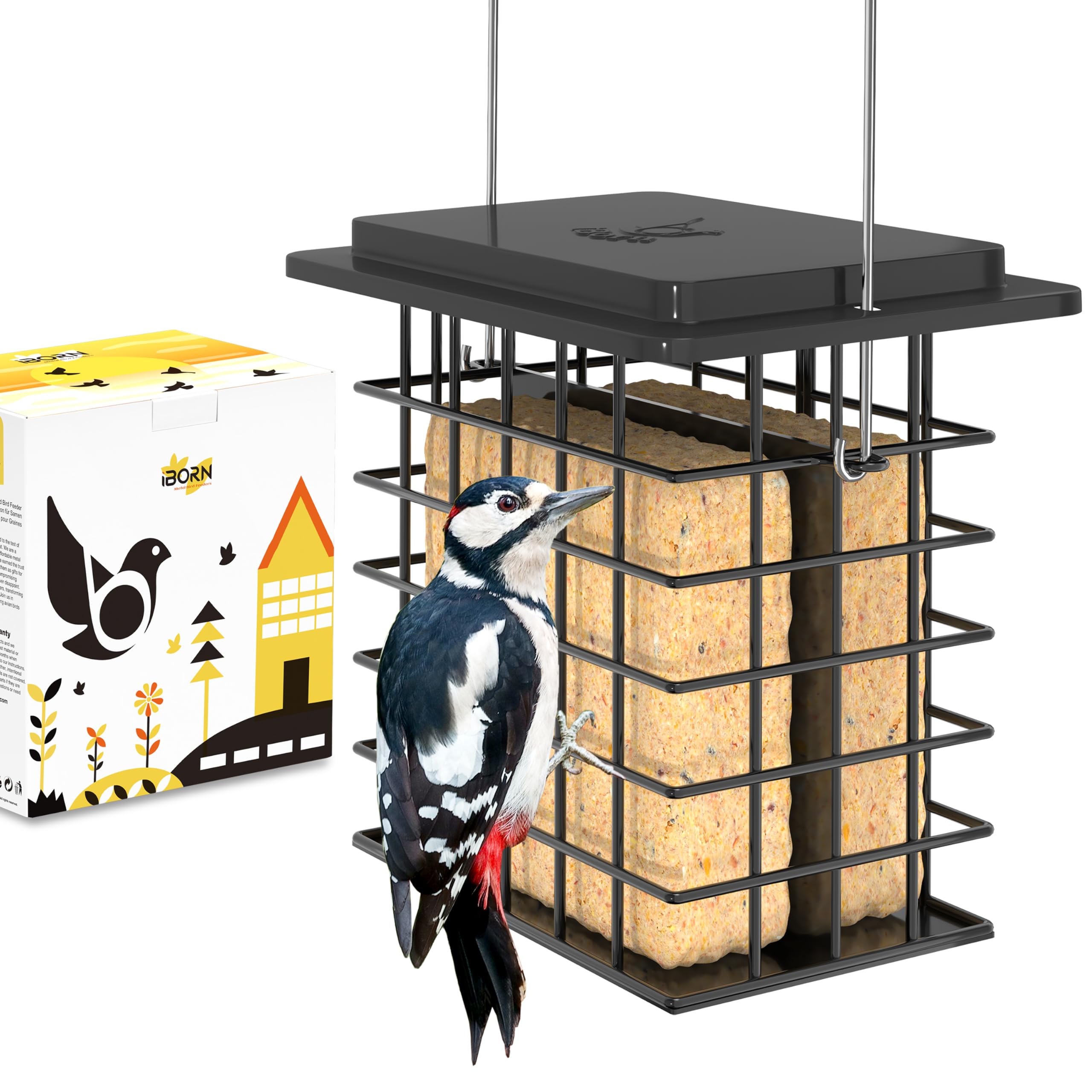
iBorn Double Suet Feeder

iBorn Double Suet Feeder

Fast refills

Our Score 9.2/10
Check Price

Worth Noting

  • Lid can lift off in a gust
  • Rust can start where droppings sit on the lid
Opening
Flip top
Dimensions
6.3 x 4.5 x 6.7 in
Construction
All metal
Suet Capacity
2 suet cakes
Read the full review

Loading a suet feeder in January is a two-glove job, and this is the fastest one here to do it. The whole top flips up and stays attached to the cage, so you can hold the feeder with one hand and drop two cakes in with the other without unhooking it from the branch.

The other design choice we noticed is the floor. Instead of letting the crumbs fall straight through to the lawn, the cage has a solid bottom board with a drainage hole, so bits of suet stay where a small bird can pick at them and less ends up on the patio underneath. The grid runs taller than most, too, which gives a woodpecker room to lean back instead of folding itself around the cage.

What holds it back is the fit of that lid. It sits over the cage rather than locking down, so a gust can lift it, and rust starts where droppings sit on top. On a sheltered hook neither is a problem; on an exposed pole in a windy yard, the Kingsyard's roof seats more firmly.

Bottom line: The quickest feeder here to reload one-handed, with a crumb-catching floor, and best where it hangs out of the wind.

5

SEWANTA Double Suet Feeder

SEWANTA Double Suet Feeder

Sheltered spots

Our Score 9.2/10
Check Price

Worth Noting

  • Doors can spring open without wire
Dimensions
4 x 4 x 5 in
Construction
Steel with plastic finish
Suet Capacity
2 suet cakes
Weather Protection
Metal roof
Read the full review

The roof is what drew us to this one. It overhangs on all four sides, does real work keeping sun and rain off the cake, and gives the feeder a neat lantern shape that looks better on a shepherd's hook than most of the bare cages here.

Loading is tool-free: each cake sits behind a side door that clips shut, and the square frame takes a standard cake flat without any fiddling. The steel body carries a plastic finish that resists rust, and the whole feeder is 4 by 4 by 5 inches, the most compact double in this set and easy to tuck under an eave.

That overhang cuts both ways. Jays and cardinals have to work to reach a cake from the side, which matters if the big birds are the point of the feeder for you. And the clips are the part that ages: a door that doesn't seat is an open invitation, and a twist of wire becomes the fix. Buy it for the shelter and the small footprint, and keep it where you can see it.

Bottom line: A compact double with the best roof in this group, though the side doors are the weak point, so hang it where you can keep an eye on them.

6

Squirrel Buster Suet Feeder

Squirrel Buster Suet Feeder

Squirrel-heavy yards

Our Score 9.0/10
Check Price

Worth Noting

  • Enclosed trays can let suet mold
  • Cakes can stall above the ports
Trays
Two suet cake trays
Dimensions
8.68 x 4.5 x 18.63 in
Suet Capacity
8 oz
Squirrel Defense
Weight-activated shroud
Read the full review

Nothing else in this group costs anything like this one, and the price is the whole question. If suet has been vanishing overnight and you have been restocking every few days, the arithmetic changes: a feeder that ends the losses can be cheaper than a season of cakes.

The mechanism is a metal shroud around the two suet trays. Openings in the shroud line up with the feeding ports so birds can reach the food; put a squirrel's weight on the feeder and the shroud slides down, closing the ports until the animal climbs off. It's the only design here that turns a squirrel away rather than just making the cake awkward to steal.

Day to day it is well thought out. Two trays load without grease on your fingers, crumb ports underneath catch the fallout, and the whole feeder comes apart by hand for cleaning, no tools. At 18.63 inches tall it is the biggest thing in this set, so hang it from something sturdy with room to swing.

Two things to know. The trays are enclosed and airflow is limited, so in humid weather a cake can mold before it is finished. And the cakes don't always slide down to the ports as they shrink, which leaves a half-eaten block sitting just out of reach until you nudge it down. Both are easier to live with than feeding the local squirrels.

Bottom line: The one feeder here that genuinely shuts squirrels out rather than slowing them down, and worth the outlay if you're currently feeding the whole neighborhood.

7

FORUP Single Suet Feeder

FORUP Single Suet Feeder

Small spaces

Our Score 9.0/10
Check Price

Worth Noting

  • Only one cake, so refills come often
Dimensions
6.1 x 1.97 x 5.1 in
Construction
Powder-coated steel
Suet Capacity
1 standard cake
Read the full review

One cake, one hanger, about the size of a paperback. If you have a single hook outside a kitchen window and no appetite for a feeder the size of a lantern, this is the one to start with. The little roof does more than it looks like it should, keeping the cake reasonably dry through a shower, and the coated hanger means it hangs quietly instead of clanking against a wall.

The catch is the bottom. It is a separate plate rather than part of the cage, and it is the joint to watch: if it separates, the cake goes with it. Hang it over grass rather than paving, give the plate a check whenever you refill, and it is a tidy, inexpensive feeder for a balcony or a window.

Bottom line: A tidy one-cake feeder for a balcony hook, though the bottom plate is the part to watch, so hang it over grass.

8

Heath Single Hanging Suet Feeder

Heath Single Hanging Suet Feeder

Under an eave

Our Score 9.0/10
Check Price

Worth Noting

  • Thin hanging chain is the weak point
  • Front panel can be stiff to open
Mounting
Hanging chain
Dimensions
5.5 x 4.63 x 1.5 in
Construction
Vinyl-coated metal
Suet Capacity
1 standard cake
Read the full review

There's no roof on this one, and that is the argument for it. Suet doesn't need a roof so much as it needs to be out of the weather: hang a bare cage under an eave, a porch overhang, or a covered pole, and the cake stays dry for the day or two it takes a family of woodpeckers to finish it. What you get in exchange is a smaller, cheaper, less conspicuous feeder.

The design is as simple as it looks — a vinyl-coated metal cage, a front panel that swings open, and a chain at the top. Birds feed from all four faces, and with no roof in the way a cardinal can get at the cake from the front. The coating matters more than it sounds: bare wire rusts, and a coated cage wipes clean.

It is the feeder we point at when someone wants to try suet without committing a hook to something large. There is nothing to assemble, nothing to adjust, and nothing to lose in the wind.

Bottom line: The bare-bones option: a coated cage with no roof, cheap enough to buy several, and best hung under an eave where the weather can't reach it.

What Five Months of Feeding Birds Taught Us

We started with a long list of roughly 40 suet feeders sold at hardware stores, garden centers, and wild-bird specialty shops, then narrowed it to 14 based on cage material, how the cake is held, mounting hardware, and whether the lid actually latches. Anything with a thin plastic hinge or no way to lock it onto a pole came off the list. From November through March, each feeder hung in one of three yards: mine, at the edge of a wooded lot with steady squirrel pressure, plus two teammates' yards — one an open lawn that catches wind, one a small garden where feeders hang close to a window.

Every refill happened the way it does in real life: standing outside before work, in gloves, often in the dark. I timed how long it took to open the lid, drop in a cake, and latch it again with cold hands, and noted whether the cake slid in or had to be forced. On weekend mornings we counted birds in 20-minute stretches, watching which species could actually reach the food — chickadees managed almost any cage, but the larger woodpeckers needed a tail prop or an open end to feed comfortably.

Each feeder went through at least one ice storm and a warm spell that softened the cakes; afterward we looked for rust, bent hinges, cracked cages, and chewed corners, and weighed that against what each one cost. Squirrels got a fair shot — some feeders went on baffled poles, others hung from branches — and we watched exactly where they gained purchase. We also noted sway in the wind, whether the hanger loop slid along a branch or the mount stayed put, how many standard cakes each one held, and how each one looked from the window.

How to Choose Suet Feeders

Start With How Often You Want to Refill

One cake keeps a busy yard going a day or two; two cakes roughly double that and let you hang a plain and a berry cake side by side. The doubles here — the Kingsyard, the More Birds, the iBorn — are only a few inches wider than the singles, so the extra capacity usually costs you hanging space rather than room on the wall. If you have one hook by a window and you look at it daily anyway, a single like the FORUP is simpler and lighter. If the feeder is out of easy reach, or you travel, buy the double.

Roof or Bare Cage

Suet softens in sun and spoils in rain, so shelter earns its keep — but a roof changes who can reach the food. A deep overhang can push jays and cardinals to approach from below, while a bare cage like the Heath opens all four faces to any bird. The answer depends on your yard rather than your budget: if you already have an eave, a porch, or a covered pole to hang from, spend the money on the cage and skip the roof. If the feeder goes out in the open, buy the roof.

What Squirrel-Proof Actually Means

On most cage feeders, squirrel-proof describes the doors, not the feeder. The locks stop a squirrel dragging a whole cake away; they don't stop it clinging to the mesh and eating whatever it can reach. Only a weight-triggered shroud, as on the Squirrel Buster, physically closes the food away. If you aren't paying for that mechanism, placement does more than any latch: a baffle, a smooth pole, and a few feet of clear air around the feeder beat a clever closure every time.

Perches, Grid Spacing, and Tail Props

Clinging birds — woodpeckers, nuthatches, chickadees — can feed from any mesh cage. Perching birds, cardinals and finches among them, want somewhere to sit, which is why the two perches on our top pick widen the guest list so much. At the other end of the scale, a taller grid and a tail prop let a pileated woodpecker brace itself properly instead of folding around the cage, and the Kingsyard two-pack is built around exactly that.

Hardware, Swing, and Where It Hangs

A loaded double catches wind like a sail, and a feeder banging against a window is a feeder nobody enjoys watching. Check the hanger before you buy: chain and coated cable outlast cord, and a clip that opens easily for refilling is also a clip a raccoon can learn. Hang it within comfortable reach, because refilling from a stepladder is how feeders get neglected, and clean the cage between cakes — old suet and droppings are where mold starts.

Frequently Asked Questions

Final Verdict

For most yards the choice is the Kingsyard double. It holds two cakes under a roof that comes off in one piece, the all-metal body stands up to weather, and the perches mean the feeder gets used by everything from titmice to woodpeckers rather than just the acrobats.

If squirrels are emptying your feeder rather than sharing it, put the money into the Squirrel Buster, the only one here that closes the food away instead of just locking the doors. And if your hook is already under cover and the budget is tight, the More Birds double does the same two-cake job for less.