Birding & Garden Decor

Best Bird Feeders of 2026

The first goldfinch lands about a week after you hang the feeder, and for a few days it's the best thing outside your window. Then a squirrel finds it, and the project becomes an arms race. A good feeder settles that in your favor: seed stays dry and reachable for the birds you want, and the climb stops being worth the effort. What surprised me is how much comes down to design — perch placement, port size, and how the seed sits relative to the weight of an animal that treats your yard as a buffet.

My team and I have spent six months with 12 of them — on hooks, clamped to deck rails, stuck to a second-story window — filling, cleaning, and refilling. Some emptied in three days; others sat untouched for weeks. The lesson: buy for the birds you actually have, and don't expect any feeder to be squirrel-proof — the good ones just make failure slow and obvious. The picks below held up on that count and on looks, capacity, and price, sorted by the yards they suit.

1

Kingsyard Platform Feeder

Top Pick
Kingsyard Platform Feeder

Multiple birds at once

Our Score 9.6/10
Check Price

Worth Noting

  • Not squirrel-proof
Material
Recycled poly lumber
Mounting
Hanging
Tray Size
11.4 x 11.4 x 2.1 in
Seed Capacity
3.5 lb
Read the full review

Eleven inches of open tray, reachable from every side, is the simplest way to feed a lot of birds at once. Nothing about this feeder asks a bird to cling or squeeze: cardinals, bluebirds, doves and jays land, take a seed and go, and several can be on it together without a squabble.

The tray is recycled poly lumber rather than plastic or stamped metal, which is why it doesn't crack, warp, fade or rot the way a thin plastic tray does after a summer in the sun. It's also heavier than it looks in photos, and that weight is why it hangs steady instead of swinging every time a jay launches off the rim.

The bottom is a ventilated mesh, so rain runs straight through and the seed on top dries instead of stewing in a puddle. That same mesh makes the feeder easy to read at a glance from the kitchen — you can see how much seed is left without walking out — and easy to hose down when it needs it. Three and a half pounds of seed is a sensible fill for a tray this size.

This is the feeder we suggest to anyone whose squirrel problem is already handled by a baffle or by a spot nothing can climb to. What it is, is the best feeder in this group for sheer bird volume, and the one that will still look like a garden object rather than a sun-bleached tub in year five.

Bottom line: Our pick for feeding a crowd: buy it where a baffle or a clear mounting spot handles squirrels, because nothing else here seats as many birds at once.

2

Brome Squirrel Buster Standard

Brome Squirrel Buster Standard

Squirrel-heavy yards

Our Score 9.2/10
Check Price

Worth Noting

  • Small hopper
Mounting
Hanging
Warranty
Lifetime limited
Seed Capacity
1.3 lb
Squirrel Defense
Weight-activated shroud
Read the full review

A feeder only earns its place once it stops feeding the squirrels. That was the test we set for this group, and the Squirrel Buster Standard kept passing it. The shroud's openings line up with the ports, and the spring underneath controls how much weight it will hold: set it for your heaviest regular bird, and anything heavier that lands on the ring drops the shroud and shuts every port. Squirrels climb it, sit on it and go hungry.

That spring is the part people skip and then blame the feeder for. We spent a couple of afternoons watching the tension, loosening it until a cardinal could settle on a perch without the shroud dropping, then checking that a squirrel's weight still closed it. It's a five-minute adjustment you make once, and it's what separates a weight-activated feeder that works from one that just markets itself as squirrel-proof.

The 1.3-pound tube is the specification that decides where this one goes. On a hook outside a kitchen window or over a small patio it's plenty; a station pulling a dozen birds an hour is the Squirrel Solution200's job. Brome's ventilated seed tube, which lets warmed air escape instead of condensing inside, is the quieter advantage — seed stays loose instead of clumping into a brick, and the ports keep flowing.

What settles it for us is that this is the feeder with the fewest ways to disappoint. It isn't the biggest, the cheapest or the best-looking one here, and it doesn't try to be. It's the one we hang first in a yard with squirrels, and the one whose mechanism we trust to still be working after a winter, which is more than most feeders at any price can offer.

Bottom line: We recommend it as the default bird feeder: the weight-activated shroud is the difference between feeding birds and feeding squirrels, and a lifetime limited warranty backs the mechanism.

3

Nature Anywhere Window Feeder

Nature Anywhere Window Feeder

Close-up viewing

Our Score 9.2/10
Check Price

Worth Noting

  • Small 15-ounce hopper needs frequent refills
Material
Polycarbonate
Mounting
Window, 4 suction cups
Dimensions
10 x 10 x 5 in
Seed Capacity
15 oz
Read the full review

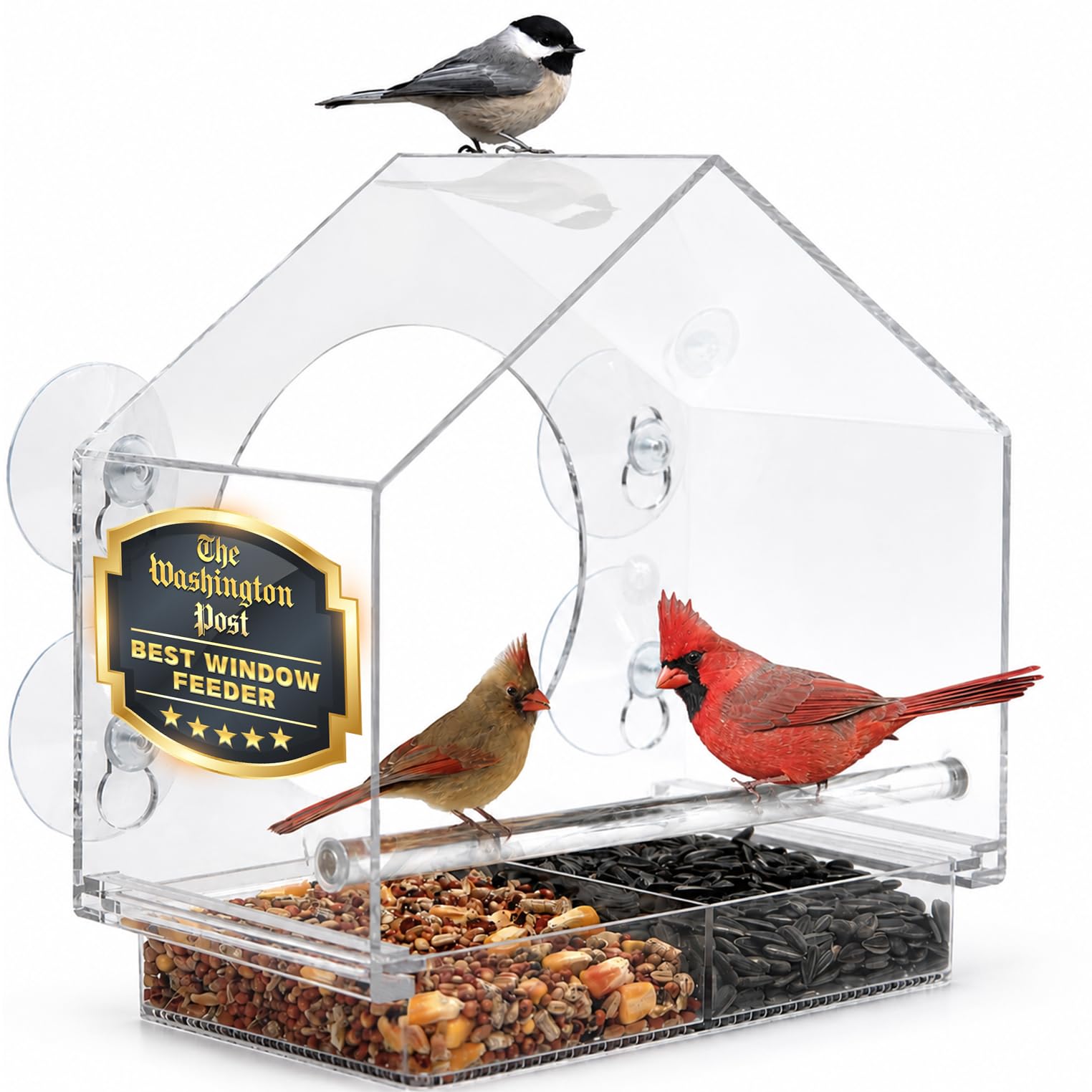
Nothing else here gets you this close. The viewing hole is large and the acrylic is genuinely clear, so a bird on the perch is a foot from your nose instead of across the yard, and the perch gives even a heavy bird somewhere to land. It's the feeder that turns a kitchen table into a birdwatching seat, and the one the cat will claim as its own.

Four suction cups do the holding, and the placement rule is part of the product. Squirrels can't climb glass, so a window feeder is the simplest squirrel solution there is — but only if it sits about ten feet from the nearest ledge, gable or branch. Hung beside a porch rail, the same feeder becomes a squirrel's eye-level buffet. Clean glass matters too, since a greasy window is where suction cups give up.

Day to day, the tray slides out rather than lifting, so you can fill it one-handed from inside without taking the whole box down, and it comes out entirely for a scrub. The air circulation and drainage holes are the underrated part: seed doesn't arrive at the bottom of the tray as a moldy brick after a wet week, which is the usual reason window feeders get taken down for good.

Bottom line: This is the one we hang when we want to watch birds rather than count them — a window feeder that puts a cardinal a foot from the glass.

4

DY-SKTY Window Feeder

DY-SKTY Window Feeder

A spare window

Our Score 9.2/10
Check Price

Worth Noting

  • Can crack if a cup lets go
Material
Acrylic
Mounting
Window
Dimensions
8 x 3.4 x 7.8 in
Suction Cups
5
Read the full review

Five suction cups rather than four is the first thing to know about this window feeder: the extra cup spreads the load, and on smooth, clean glass they do the job through wind and rain. It's also the smallest footprint of the window feeders here at 8 by 3.4 inches, so it fits a narrow casement or a kitchen window where a bigger box would crowd the frame.

The tray lifts out rather than sliding, which turns out to be easier one-handed when you're reaching over a sink, and the sloping roof and drainage holes keep the seed from sitting in water. The clear sides let you see the seed level from inside, so you're not guessing whether it needs topping up before you open the window.

The acrylic is the part to think about over the years, and the window is the part that decides whether this feeder works at all: give it clean glass, keep it out of a door's swing path, and it will hold. At the budget end of the window options, it's the one to try the idea with — a month at the glass tells you whether you're a window-feeder person before you spend more.

Bottom line: The cheapest way into window feeding we've found here: five suction cups, a lift-out tray and a clear view, as long as you can live with acrylic's odds.

5

Brome Squirrel Solution200

Brome Squirrel Solution200

Busy feeding stations

Our Score 9.0/10
Check Price

Worth Noting

  • Tall body needs clearance under the hook
Included
Seed funnel
Mounting
Hanging
Feeding Ports
6
Seed Capacity
2 quarts
Read the full review

Take the Squirrel Buster Standard's mechanism, stretch the seed tube to 24 inches and add two more ports, and you have this feeder. Six feeding ports instead of four, a hopper that holds about two quarts rather than 1.3 pounds, and the same weight-activated shroud that drops over the ports the moment a squirrel climbs aboard.

For a yard with real traffic, this is the version we point to. Seed lasts days instead of hours, and with six perches the cardinals, finches and chickadees feed at the same time instead of queuing for a spot. The weight adjustment works exactly as it does on the smaller feeder and matters just as much: set the spring for your heaviest regular bird and the squirrel meets a locked door.

The build is where the extra money goes. Every part a squirrel can reach is chew-proof, and the whole feeder comes apart by hand without tools, which turns a Saturday chore into a two-minute job at the sink. Brome also includes a seed funnel, which sounds like a gimmick until you've poured a five-pound bag of sunflower seed into a narrow tube without one. It's the most expensive feeder in this group, and the one that behaves like it.

Bottom line: If your feeder empties in a day, this is the upgrade we point to — the same squirrel-proof mechanism with six ports and a hopper that lasts through the week.

6

DesGully Solar Metal Feeder

DesGully Solar Metal Feeder

Garden decoration

Our Score 9.0/10
Check Price

Worth Noting

  • Not squirrel-proof despite its claims
Power
Solar rechargeable battery
Material
Metal
Dimensions
7 x 7 x 7.8 in
Seed Capacity
2.4 lb
Read the full review

Most feeders disappear when the light goes. This one turns into a lantern: the solar panel charges a battery through the day, and after dark the light comes through the hollow pattern, so the thing you hung for the birds also lights the border. It's the best-looking feeder in this group by a distance, and the only one still doing something after sunset.

Under the decoration is a competent feeder. Two and a half pounds of seed, six outlets around a circular platform, a gazebo roof that shades the seed from rain, and a tray that catches what the birds knock loose instead of dropping all of it on the lawn. It arrives assembled, chains and hook included, which is more than most here can say.

The finish is the risk. This is a metal feeder at a budget price, and rust and a snapped chain are the two failures to watch on the design; hung under a deep eave it will fare better than out in the open. Buy it for the light and the look, hang it where you'll see both from the house, and don't expect it to outlast a Brome.

Bottom line: We keep this one on the list for the look and the light: a metal feeder that becomes a lantern after dark, though rust and squirrels are both real risks.

7

iBorn Copper Tube Feeder

iBorn Copper Tube Feeder

Small songbirds

Our Score 9.0/10
Check Price

Worth Noting

  • Too small and narrow for cardinals
  • Lid needs a firm press to seat
Material
Metal
Tube Height
14 inches
Feeding Ports
6
Seed Capacity
1.4 lb
Read the full review

Four and a third inches across and 14 inches tall, this is a small-bird feeder by construction rather than by claim. Goldfinches, chickadees and titmice manage the short perches and the narrow tube; a cardinal will try, look awkward and leave. If jays and grackles have been emptying your feeders, that is exactly the point.

We liked the metal where it counts: a thick metal roof and base, a stainless steel hanger that won't rust through, and a copper-plated finish a cut above the plastic tubes at this end of the market. It's the best-looking of the budget feeders here, and the one we hang where the neighbors can see it.

Two things follow from the size. One and a half pounds of seed goes quickly once a flock finds it, so plan on topping up through a busy week. And the six ports suit a hook near a window rather than an exposed pole where the wind catches a light feeder — hung there, it swings more than a heavier tube would.

Bottom line: We reach for it when finches are the target: a copper tube that keeps jays off the seed and looks better than anything else at this end of the market.

8

Kingsyard 2-Pack Tube Feeders

Kingsyard 2-Pack Tube Feeders

A first setup

Our Score 8.8/10
Check Price

Worth Noting

  • Squirrels can chew through the plastic
Material
Plastic
Pack Count
2 feeders
Feeding Ports
6 per feeder
Seed Capacity
2 pounds each
Read the full review

Two six-port tube feeders for less than the price of one squirrel-proof hanging feeder is the whole pitch, and it's a good one if you're setting up from nothing. Two feeders also let you test two spots — one off the deck, one at the back of the garden — without committing to either.

Each tube holds two pounds and carries six ports with perches, so a small flock feeds without waiting. The enclosed housing keeps rain off the seed and the built-in drainage holes let it breathe, while the hanger is a coated steel cable rather than the rope that rots through on cheap feeders. Filling means lifting the lid and pouring; there's nothing to unscrew, and nothing to lose.

Plastic is the catch, and the honest way to buy these is as consumables: a couple of seasons of sun and knocks, then replace them. Buy that way and the value is hard to argue with. We treat them as the feeders that go up fast in spring, take the knocks, and get swapped out without guilt — two stations running for the money one good feeder would have cost.

Bottom line: We think the pair is the smart first buy: two six-port tubes for the price of one feeder, with the plastic durability you're paying for.

How We Tested the Best Bird Feeders

We started with roughly 60 feeders — brands we'd used before plus the ones that kept surfacing in reviews — and narrowed by seed capacity, materials, mounting type, and price until 12 were left to hang. Each went up in a real yard: one on a shepherd's hook out in the lawn, one clamped to a deck rail, one stuck to a second-story window. The test ran six months, from early spring into fall, and before anything went outside we weighed a full load of seed for each feeder so capacity translated into something concrete.

Attracting birds was easy to measure. We logged the first visitor and how long it took to arrive, then kept running notes on species and how often the feeder was hit through the week. For squirrels, we counted every attempt and recorded whether the animal got a perch, got a paw into the seed port, or dropped to the ground empty-handed; we also hung a one-and-a-half-pound sandbag on each weight-sensitive perch to confirm the port actually closed under load instead of only holding off a finch.

Every feeder stayed out through two storms and a week of steady rain, and afterward we looked for rust at the seams, fogged or cracked plastic, split wood, and clumped seed in the hopper. We cleaned each the way a buyer would — brush, mild soap, timed — and noted which parts came apart without a screwdriver. Then we hung them where we'd actually see them from the kitchen and left them there, since a feeder you resent looking at stops getting filled. Price factored in last, weighed against how much seed each one held and how many seasons it looked likely to survive.

How to Choose Bird Feeders

Match the feeder to your birds

Port size and perch length decide the guest list as much as the seed does. A narrow tube with short perches is a finch and chickadee feeder; cardinals and jays want a longer perch and more headroom, and bluebirds and doves want a flat tray they can stand on. This is where buyers get it backwards: if grackles and starlings are emptying you out, the cramped tube that frustrates them is exactly the feature you're paying for. If cardinals are the point, skip the narrow tubes and look at a tray or a wide hopper.

Treat squirrel-proof as a strategy

Every feeder here is squirrel-resistant in one of three ways: a weight-activated shroud that closes the ports, a baffle mounted on a pole below the feeder, or distance — a window feeder set about ten feet from the nearest ledge, branch or fence. All three fail the same way, by being hung within jumping distance of something. Set the spring on a weight-activated feeder for your heaviest regular bird, then watch it once with a squirrel on it. A shroud that doesn't drop is an expensive bird-only feeder.

Capacity sets your refill rhythm

Capacity is a convenience specification, not a quality one. A 15-ounce window tray is a few days of seed in a busy yard; a two-quart tube can run a week. Bigger hoppers also keep seed sitting longer, and seed that sits through warm, damp weather is worse for birds than seed you replace twice a week. Pick the smallest hopper that matches how often you'll actually walk outside, and if you want volume, run two feeders rather than one giant one.

Drainage and cleaning decide how long it lasts

Water is what kills seed and shortens a feeder's life. Look for a mesh or perforated base, drainage holes and a roof that sheds rain — the Kingsyard platform's ventilated tray and Brome's ventilated seed tube are two answers to the same problem. Then ask how it comes apart. A tray that lifts out or a body that splits by hand gets cleaned; one that needs a screwdriver gets ignored, and clumped, moldy seed is the fastest way to lose the birds you attracted.

Hang it where you'll watch it

Placement decides how much you get out of any feeder. Put it where you can see it from a chair you actually sit in, within a few feet of a shrub or tree edge that birds use as cover, and five or six feet off the ground — high enough to be out of a cat's reach and clear of a mower. Window feeders need smooth glass and a spot out of a door's swing; hanging feeders need a hook that won't let the feeder knock against a trunk in wind.

Frequently Asked Questions

Final Verdict

The Brome Squirrel Buster Standard is the feeder we point most people to. It solves the thing that makes people quit feeding birds — seed vanishing into a squirrel — with a mechanism you tune to your own birds, and it carries a lifetime limited warranty while doing it.

If your yard draws a crowd, the Squirrel Solution200 does the same job with six ports and a much bigger tube. If squirrels aren't your fight, the Kingsyard platform seats more birds at once than anything else here, and the Nature Anywhere window feeder buys you the closest view in the group.