Birding & Garden Decor

Best Window Bird Feeders of 2026

The first time a chickadee lands a foot from your coffee cup, you get it — glass-mounted feeders put birds at eye level instead of forty feet away. Then the whole thing slides down the window at 7 a.m., dumps a pound of seed on the sill, and you're scraping the siding before work. A window feeder has to do two things well: draw birds in, and stay put once they arrive.

We mounted 14 feeders on kitchen and office windows over four months, and the gap between one you keep for years and one you toss by March almost always came down to suction and drainage. Cups that go hard and cloudy let go in the cold; trays without drainage hold rainwater and turn seed to mush. Even at eye level, a squirrel can hang off the perch, and the sturdier frames shrug it off while the flimsier ones wobble or drop. The feeders that earned a permanent spot on my windows are below.

1

DesGully Metal Window Feeder

Top Pick
DesGully Metal Window Feeder

Windows that slip

Our Score 9.4/10
Check Price

Worth Noting

  • Pads are single-use; only two spares included
Body
Anti-rust coated metal
Mounting
4 adhesive hooks
Dimensions
9.5 x 4.3 x 7.3 in
Seed Capacity
1.7 lb
Read the full review

This one doesn't use suction cups at all. Four adhesive sheets hold it to the glass, and two positioning cards let you line the hooks up level before anything touches the window. On a pane where cups have slid before, that's a fix rather than another workaround.

The body is coated metal rather than acrylic, finished in a brushed antique copper that reads as garden hardware instead of plastic. It hoses clean, the tray lifts out, and the anti-rust coating is doing a job, stopping corrosion rather than just looking handsome. At 1.7 pounds of seed it sits mid-pack on capacity, and a storm is unlikely to be what ends it.

What we mind losing is the look of a clear box. Instead of an uninterrupted sheet of acrylic you get a frame, and a little of the close-up magic goes with it, because birds read as being behind something rather than pressed against your glass. What you gain is a feeder that doesn't yellow, doesn't crack, and doesn't need a spare set of cups in a drawer.

Bottom line: For a window where suction cups keep letting go, this hangs on adhesive hooks and a coated metal body that won't crack like acrylic.

2

Nature's Way Win-3 Window Feeder

Nature's Way Win-3 Window Feeder

Small panes

Our Score 9.4/10
Check Price

Worth Noting

  • Two-cup load means frequent refills
Body
UV-stabilized plastic
Mounting
4 side-mounted suction cups
Dimensions
7 x 10 x 10 in
Seed Capacity
2 cups
Read the full review

Ten inches tall and seven wide, this is the smallest feeder on our list, and the least expensive. If your only clear glass is a narrow kitchen sash or a bedroom window over a fire escape, the twelve-inch feeders here won't fit and this one will.

Four side-mounted cups hold it, the tray slides out for refilling, and the plastic is UV-stabilized rather than plain, so a summer of sun shouldn't leave it chalky. The two-cup tray turns seed over quickly, which keeps what's in front of the birds fresh, and the price reflects the size.

We liked it most on the window where we weren't sure we wanted a feeder at all. It's light, it comes off in one motion for a rinse, and it leaves most of the view alone. Check the height before you order: ten inches of clear glass, clear of the frame, is the measurement that decides whether it fits.

Bottom line: The one to start with: a small, inexpensive feeder that sticks to a narrow pane, holds two cups, and asks nothing of you.

3

Nature's Hangout Window Feeder

Nature's Hangout Window Feeder

Busy yards

Our Score 9.2/10
Check Price

Worth Noting

  • Widest body here; needs a wide pane
Body
1/4-inch cast acrylic
Mounting
3 suction cups plus 3 spares
Dimensions
12 x 4 x 5 in
Seed Capacity
2 lb (over 4 cups)
Read the full review

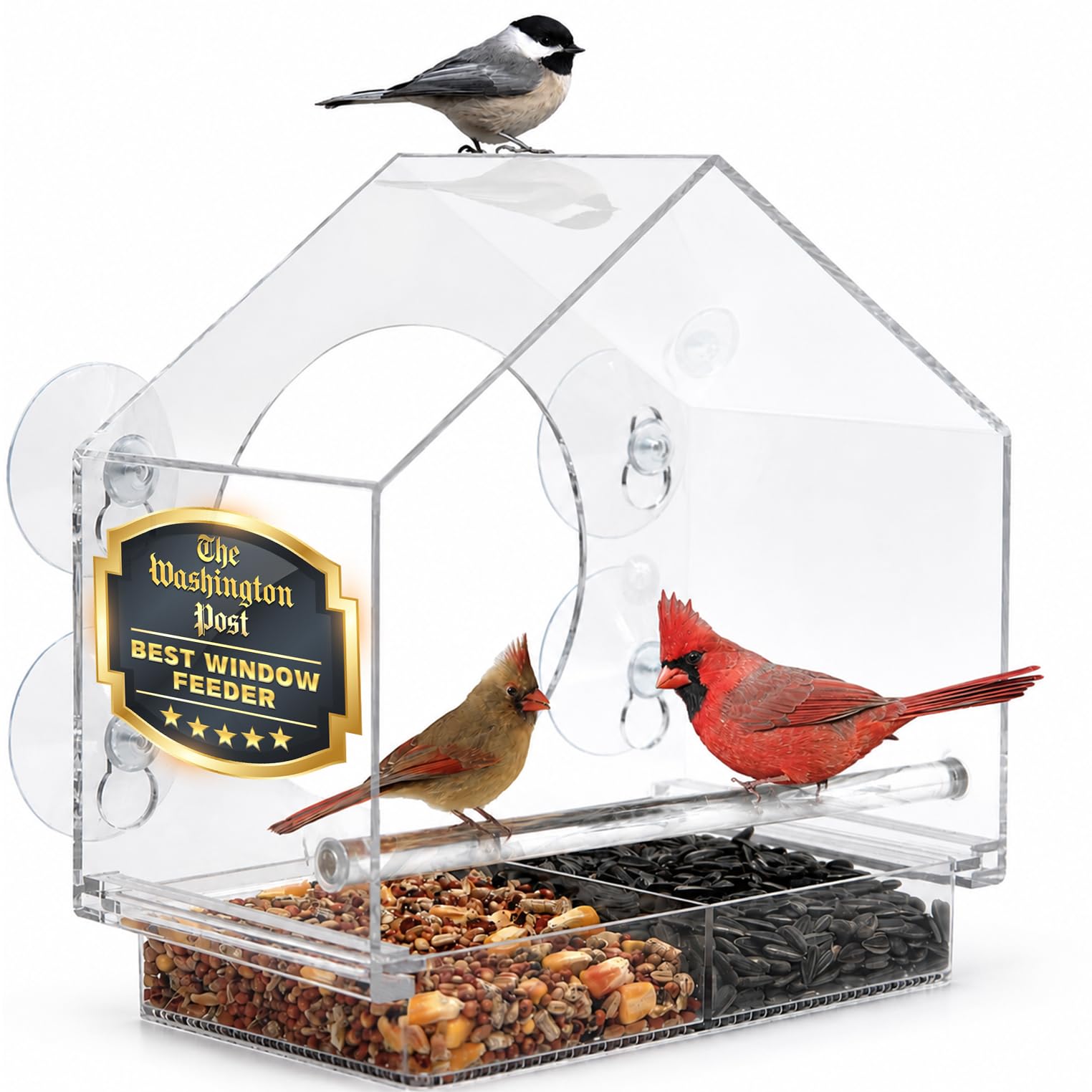
Over four cups of seed is the figure that decided this one for us. A window feeder that empties in a day stops being entertainment and becomes a chore, and this is the only feeder here that gets most households through the working week on a single fill. The body is quarter-inch cast acrylic, the thickest in this group, and it stays clear enough that you see feet and beaks rather than a smear.

Mounting is three cups, with three spares in the box and a lifetime guarantee behind them. We cleaned the glass, pressed, and left it alone; the spare set is the part we appreciate most, because one slipped cup doesn't retire the whole feeder. The tray slides out without the feeder coming off the window, which turns a refill into ten seconds at the sink.

A comfortable perch sounds like filler until you watch a cardinal try to balance on a narrow rail. This one runs the width of the tray and birds settle on it, which keeps them in frame long enough to actually look at. It also holds a crowd: three birds at once was common here, where the two-cup feeders ran one at a time.

Bottom line: If you want one feeder and no ongoing fuss, this is the one we recommend: more seed, more spare cups, and a smoother refill than anything else here.

4

Nature Anywhere Birds-I-View 2-Pack

Nature Anywhere Birds-I-View 2-Pack

Two windows

Our Score 9.2/10
Check Price

Worth Noting

  • Just 15 ounces of seed per feeder
  • Round viewing opening crops the tray
Body
Polycarbonate
Mounting
4 EVERGRIP suction cups
Dimensions
10 x 10 x 5 in
Seed Capacity
15 oz
Read the full review

Two feeders in one box is the whole idea, and it's a better one than it sounds. Most houses have a kitchen window and one other spot where somebody actually sits, and the pair works out cheaper than buying two singles from most of this list. Each unit is polycarbonate, ten inches square, and carries four EVERGRIP cups.

The viewing side is a round opening rather than a fully open back. That frames a bird beautifully, giving you a portrait rather than a wide shot, but it crops the tray, so you see the visitor and not the whole operation. We found the smaller aperture makes the feeder read as a little house on the glass rather than an open box.

Capacity is the compromise: 15 ounces, the smallest of the mid-size feeders we recommend, so a busy window needs topping up every other day. What earns it a place anyway is the hardware and the guarantee: big cups, lifetime cover on them, and bodies light enough that a stuck one peels off with a fingernail rather than a pry bar.

Bottom line: Buy it if you have two windows worth watching: strong cups, a clear body, and a second feeder to hang before the first one has been discovered.

5

LUJII Shatterproof Window Feeder

LUJII Shatterproof Window Feeder

Harsh weather

Our Score 9.2/10
Check Price

Worth Noting

  • Only a one-year warranty
Body
One-piece polycarbonate
Mounting
Suction cups rated to 22 lb
Dimensions
11.3 x 4.3 x 6.6 in
Seed Capacity
4 cups
Read the full review

Shatterproof is the claim that made us look twice, and the construction backs it up. LUJII molds the body in a single piece of polycarbonate rather than gluing or heat-bending acrylic sheet, so there are no seams to split and no sharp corners where a bird's feet land. Seams are where a clear feeder fails first, and there aren't any here.

The cups are rated to carry 22 pounds and two spares come in the box. That's overkill for four cups of seed, and exactly the margin you want on a sunny window or a pane that catches wind. The tray lifts out on its own, so you can refill without touching the cups, and touching the cups is when most window feeders come down.

The panoramic back is the widest clear view of the ones we mounted, and polycarbonate holds its clarity better than acrylic through a summer of sun. That's the trade against the cheaper feeders here: you pay more for a body that won't crack, and you get a warranty that is the shortest on this list.

Bottom line: For a window that takes weather or a squirrel's weight, this is the one: a one-piece polycarbonate body that won't crack and cups rated far beyond a tray of seed.

6

D.F. Omer Covered Window Feeder

D.F. Omer Covered Window Feeder

Mixed seed

Our Score 9.2/10
Check Price

Worth Noting

  • Shallow compartments empty quickly
Mounting
4 suction cups
Seed Tray
3 separate compartments
Dimensions
11.6 x 4.3 x 5.7 in
Seed Capacity
32 fluid ounces
Read the full review

Three separate compartments in one tray sounds like a gimmick until you use it. Fill one with black oil sunflower, one with a nut mix, and one with mealworms, and the feeder stops being scenery and becomes a small ongoing experiment. Nothing else here does that, and it costs about the same as the plain single-tray feeders on this list.

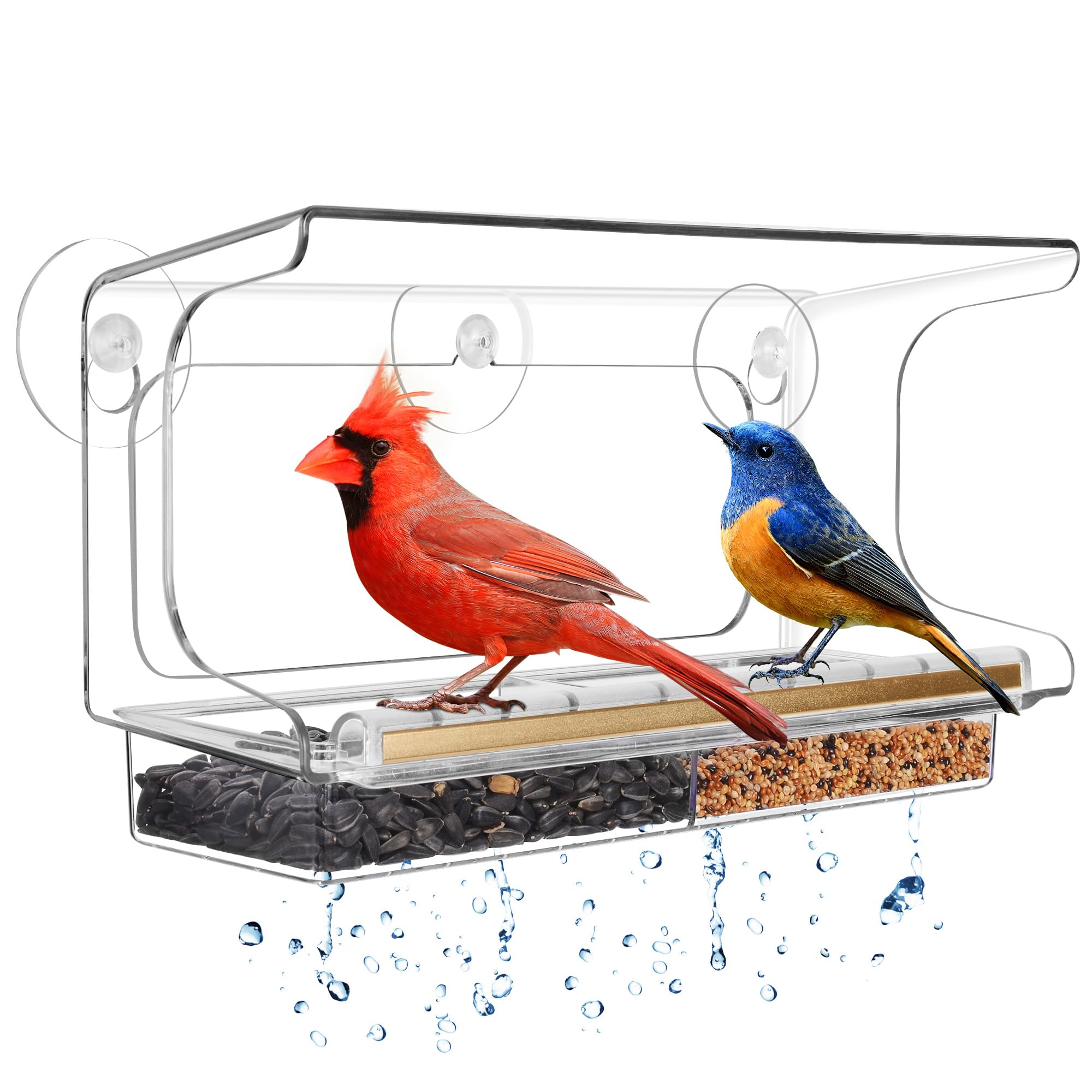
The roof earns its keep in wet weather. Seed stayed loose in each section instead of clumping into one damp block, and the drainage holes let water out rather than letting it pool around the seed. Four cups hold it steady, and we've had no reason to think about them since the day we pressed it onto the glass.

The compromise is depth. Each compartment is shallow, so a busy feeder empties faster than the capacity figure suggests: 32 fluid ounces spread across three sections is not the same as 32 ounces in one deep tray. Buy it to offer variety, not to refill less often.

Bottom line: Three compartments is the reason to choose it: load each with something different and you'll know within a week which seed your birds actually want.

7

Nature Gear Window Feeder

Nature Gear Window Feeder

Everyday feeding

Our Score 9.0/10
Check Price

Worth Noting

  • Sliding tray is fiddlier to rinse than a lift-out one
Body
Acrylic
Tray
Removable sliding tray
Mounting
Heavy-duty suction cups
Dimensions
7.9 x 4.13 x 7.9 in
Read the full review

Set this beside the LUJII and the difference is construction. Nature Gear uses a conventional acrylic body with a sliding tray rather than a single molded piece, and the clarity is a touch softer because of it. For daily use it's perfectly good: a wide perch, a tray that slides smoothly, and a whole feeder that comes off the glass in one pull when it needs a proper wash.

Drainage is the detail that surprised us. The tray sits proud of the base with holes drilled through, so water runs off instead of soaking the seed, and the seed was still dry after a week of rain. The cups are heavy-duty and set wide, spreading the load across the pane rather than pulling on one corner.

What holds it out of the top tier is that nothing about it is best here. The clarity is good rather than excellent, the seed load is modest, and the hardware is ordinary next to the six-cup approach on our top pick. It's a fine second feeder for a back window; it isn't the one to build a habit around.

Bottom line: The sensible middle: a sliding tray, drainage that works, and cups that hold, beaten here on clarity and seed load rather than on daily use.

8

DY-SKTY Window Feeder

DY-SKTY Window Feeder

Sheltered windows

Our Score 9.0/10
Check Price

Worth Noting

  • More likely to crack than polycarbonate if it falls
Body
Acrylic
Tray
Lift-out tray
Mounting
5 suction cups
Dimensions
8 x 3.4 x 7.8 in
Read the full review

The first thing we checked was the cups, because five small ones hold differently than three big ones. Seated on clean glass and given an hour before the tray went in, they held without drama. Five points of contact spread the load across the pane, and the sloping roof sheds rain away from the seed instead of letting it pool.

The lift-out tray and rounded corners are what earned their keep in daily use. Nothing sharp where a bird's feet land, the tray comes out in one motion, and the drainage holes do their job. They also let small seed through, so millet and finer mixes will trickle onto the sill, and this is a feeder for sunflower hearts rather than a bargain blend.

The honest caveat is what happens if it comes down. This is a conventional acrylic body, and a feeder that lets go in a gale can crack where the one-piece polycarbonate models here would survive. Keep it on a window out of the prevailing wind and press the cups again each time you refill, a few seconds that buys a lot of seasons.

Bottom line: Five cups and a sloping roof make this a lot of feeder for the money, as long as you seat the cups on clean glass and give it a sheltered window.

How We Tested Window Bird Feeders

We started with roughly 40 window feeders sold through garden centers and bird-supply shops, then ruled out anything with a shallow tray, no drainage holes, or suction cups that couldn't be replaced — three things that quietly doom a feeder. That shortlist went onto 14 kitchen and office windows in four homes over four months, including a couple of north-facing panes where birds are slow to show up.

Installation was timed with a stopwatch and attempted without the instructions first, mostly to see whether the mounting method was obvious. Once a feeder was up, I marked each cup's position with a strip of painter's tape and checked it a week later for creep down the glass; a few had visibly slid before the first bird ever arrived. Each tray also got a watering-can test and a stretch of hard rain, so I could see whether seed stayed dry or swelled into a mat.

Then the waiting started. We tallied visits on a sheet taped beside the window, noted how many days passed before the first arrival, and photographed each feeder from the same chair every morning — partly to judge how it looked from inside, and partly to be honest about how much of the day I spent watching it. Squirrels on the deck rail got their own notes: I recorded what happened when one hung off a perch or launched at the glass. Weekly vinegar-and-water scrubbing showed which cups hazed or stiffened, and we weighed price against seed capacity and how many seasons the acrylic and cups seemed good for.

How to Choose Window Bird Feeders

The mount matters more than the feeder

Suction cups need a smooth, clean, non-porous surface. Wipe the glass with cleaner, dry it with a lint-free cloth, and press each cup firmly for a few seconds before you let go. Skip that prep and even the six-cup models slide. Adhesive pads, as on the DesGully, hold harder but commit you to one position, so line them up with the supplied card before anything touches the window.

Temperature does the rest. Cups pressed onto glass in a cold snap are more likely to pop, and a pane that gets direct sun can soften the seal, so mount in mild weather and re-press each time you refill.

Capacity and the refill routine

Two cups of seed is a small feeder; four cups and up is one you can leave for a few days. In a yard with steady traffic, that's the difference between a daily job and a twice-weekly one, and it's the single most useful number on the box.

Access counts as much as volume. A tray that slides or lifts out without disturbing the cups saves you re-hanging the feeder, and re-hanging is when most feeders end up on the patio. Our top pick carries over four cups and slides out in one motion; the smallest picks here hold two.

What you can actually see

The window side of the feeder is the view. Open-back designs put the bird against your glass with nothing in the way; a feeder with a round viewing opening frames the bird but crops the tray. Clear acrylic gives the sharpest view when new, though it can yellow, while polycarbonate resists both yellowing and cracking and is the better bet for a sunny window.

Either way, insist on a body clear enough to see a bird's feet. That's the detail that turns a feeder into something worth stopping for.

Weather, drainage, and how it ages

Look for drainage holes in the tray and a roof or slope that sheds rain, because wet seed clumps, molds, and gets ignored. Fine drainage is a compromise: it keeps seed dry but lets small seed trickle through, so check the hole size against what you plan to pour in.

On material, thick cast acrylic is clearest but can crack on impact, polycarbonate bounces, and coated metal sidesteps cracking and yellowing altogether at the cost of a heavier frame around your view.

Placement decides the rest

Ten feet of clearance from the nearest branch, roof line, or deck rail is the number that keeps squirrels from using your feeder as a ladder, and it's the same guidance the makers of these feeders give. Pick a window you sit near but don't press against, since birds flush when movement is close to the glass.

Finally, choose a window you can reach with the sash closed or safely open. A feeder you dread refilling gets emptied once and forgotten, and an upper-floor window is the easiest win of all: squirrels can't get there and the view is better.

Frequently Asked Questions

Final Verdict

Most people should buy the Nature's Hangout. It holds more seed than anything else here, ships with spare cups, and the tray comes out without taking the feeder off the glass: the three things that decide whether a window feeder becomes a habit or a chore.

If your glass faces weather and you want the body that survives a fall, the one-piece LUJII is the better buy. On a narrow pane or a tight budget, the Nature's Way Win-3 does the same job in a smaller package for a fraction of the money.