Tree & Forestry Care

Best Splitting Axes of 2026

For all the talk about hydraulic splitters and tonnage ratings, most firewood still comes apart by hand — and the difference between a clean crack and a wedged, bouncing, swear-under-your-breath swing usually comes down to the tool. A splitting axe isn't a felling axe with a shorter handle; the head is a wedge built to drive through the round rather than cut across the grain. Match the head weight and handle length to the wood you're actually splitting, and a pile of rounds turns into an afternoon's work instead of a week of it.

I've swung a borrowed maul that weighed more than my leg and a stubby axe that bounced off every knot in the pile, and the lesson both times was the same: raw weight is the wrong thing to shop by. Over the past eight months we've run 12 splitting axes through ash, oak, and elm, judging how each one felt after an hour of steady work, whether the head stayed tight, how the edge held up, and what you genuinely get for the money. The ones below are the axes that earned a place beside the woodpile.

1

Fiskars X27 Super Splitting Axe

Top Pick
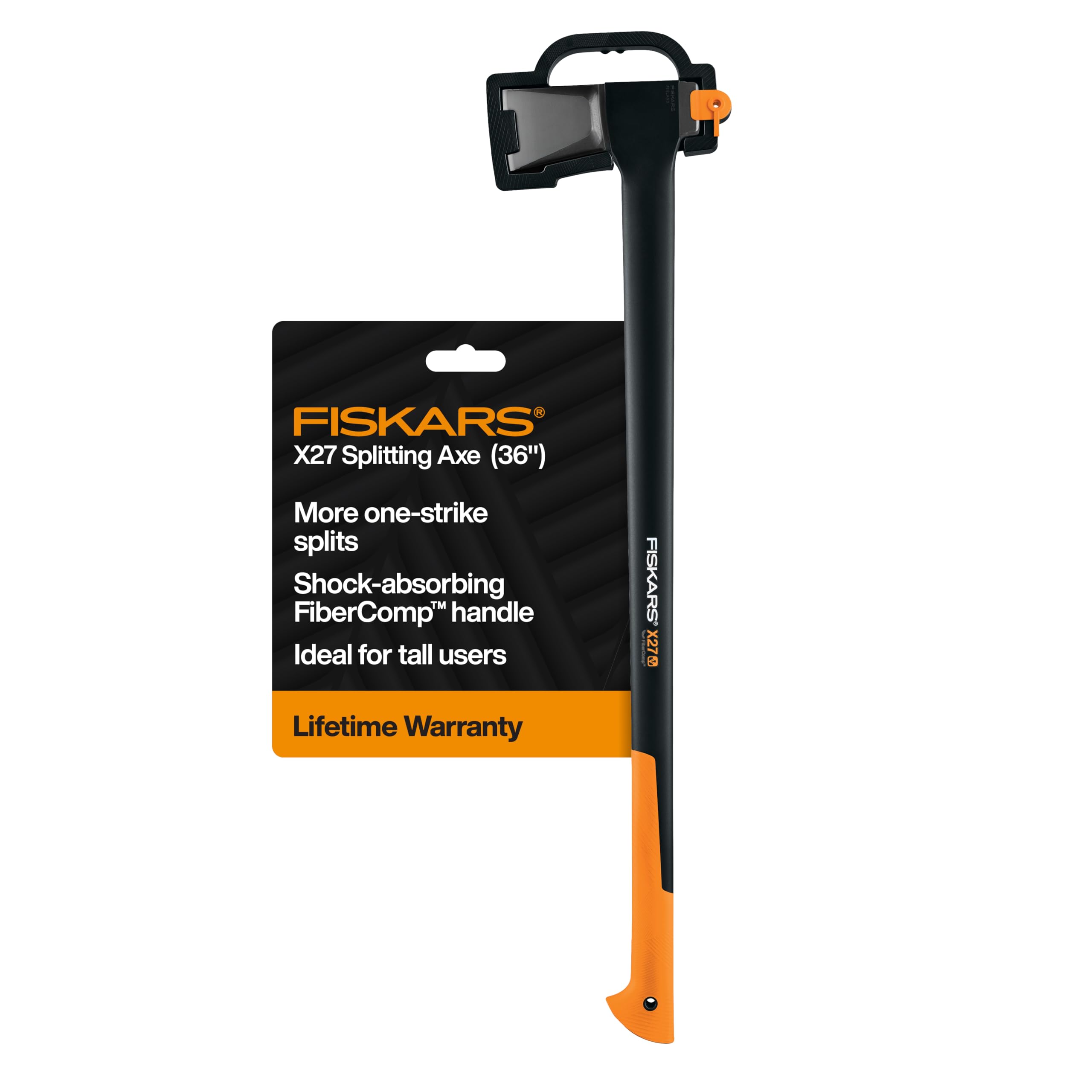
Fiskars X27 Super Splitting Axe

Full-size firewood

Our Score 9.6/10
Check Price

Worth Noting

  • Full 36-inch handle needs clear swing room
Warranty
Full lifetime
Head Weight
4.3 lb
Total Weight
6.3 lb
Handle Length
36 inches
Read the full review

A 4.3-pound head on a 36-inch handle looks unbalanced on paper. Swing the X27 once and the logic lands: the long handle builds the speed, the light head arrives fast, and a straight-grained round opens with a sound like a book snapping shut. It is the axe we hand people first, and the one we reach for when the woodpile is ordinary rather than heroic.

Ordinary is the operative word. Feed the X27 a knotty, cross-grained round and the light head stalls where a maul keeps driving, so we keep a heavier tool beside the block for the ugly pieces. On seasoned, reasonably straight firewood the trade pays for itself — the axe is light enough to swing for an hour without your shoulders resigning, and the convex bevel releases from the round instead of gripping it and needing to be worked free.

The handle is where Fiskars earns its reputation. The textured grip stays put in gloves, the overstrike zone absorbs the misses that ruin wooden hafts, and the sheath means you can carry it to the pile without treating it like an open blade. A full lifetime warranty covers what you cannot fix yourself, and sharpening is a file-and-patience job on a convex bevel rather than a session with a grinder — the only maintenance habit the X27 asks of you.

Bottom line: We tell most people to start here: the X27 turns ordinary firewood into one-strike splits and stays light enough to swing all afternoon.

2

Fiskars Pro IsoCore 8 lb Maul

Fiskars Pro IsoCore 8 lb Maul

Knotty hardwood

Our Score 9.6/10
Check Price

Worth Noting

  • Heavy enough to wear you down
Head Weight
6.4 lb
Blade Length
7.84 inches
Total Weight
10.4 lb
Handle Length
36 inches
Read the full review

Just over ten pounds is the number that decides whether the IsoCore is for you. Fiskars puts a 6.4-pound head on the same 36-inch handle it uses on the X27, and the extra mass is the whole point: you lift it, you let it fall, and the wood gives up.

That is a different job from the axe's, and it is the one we want for bad wood. Knotty rounds, crotch wood, anything with a swirl in the grain — the maul drives through where a thin edge stalls, and the blunt wedge profile pulls free instead of burying itself and needing to be levered out. We treat it as the second tool on the block rather than the only one, and the pile goes faster for it.

The handle is the reason to choose this over a wooden maul. The riveted head cannot work loose, the shock-absorbing core takes the sting out of a dead hit, and the overstrike collar protects the shaft where mauls usually fail. It ships with a sheath and a lifetime warranty. Ten pounds of steel arriving at speed is not a subtle tool, and the IsoCore is built like it knows that.

Bottom line: If your rounds are big and knotty, this is the maul we hand you — it drives through where a splitting axe stalls dead.

3

Husqvarna S2800 Splitting Axe

Husqvarna S2800 Splitting Axe

Tight spaces

Our Score 9.6/10
Check Price

Worth Noting

  • Premium price for a mid-length axe
Handle
Fiberglass composite
Head Weight
5 lb
Total Weight
6.2 lb
Overall Length
27.6 inches
Read the full review

Twenty-eight inches is an odd-sounding length until you have spent an afternoon with a 36-inch axe in a cramped yard. The Husqvarna S2800 puts a 5-pound head on a shorter fiberglass handle, which brings the swing closer to your body and keeps the arc inside a small chopping area. At 6.2 pounds it also carries easily between the stack and the block.

We found the shorter handle easier to place accurately than the full-size axes, and the splitting is honest work rather than magic: the coated head releases from wet rounds, the hardened edge bites instead of skating, and the trade is a little leverage for a lot of control. That is the right trade if you are shorter, working in a tight space, or swinging from an awkward angle beside a pile. A sheath and a lifetime warranty come with it, which is the sort of backup we like on a tool that lives outdoors.

Bottom line: The pick when a 36-inch axe is too much tool for your space: balanced, controllable and easy on the arms.

4

Estwing Fireside Friend

Estwing Fireside Friend

Kindling and camp

Our Score 9.6/10
Check Price

Worth Noting

  • Won't take on full-size rounds
Length
14.25 inches
Sheath
Ballistic nylon
Blade Length
5.83 inches
Construction
One-piece forged steel
Read the full review

The Fireside Friend is not trying to split your winter wood. It turns a split round into kindling, and it does that with a 14-inch handle and a weighted wedge head you can swing one-handed over a stove. Two or three strokes and a billet is in sticks.

The one-piece forging is why it feels so solid: no weld, no joint, no head to work loose, and the molded grip soaks up the shock that would otherwise go into your wrist. It doubles as a small hammer for driving tent stakes, and the nylon sheath means it can live in a camp box without guarding its edge. The short handle is also what makes it safe to use in a tight space — you are never swinging past your own knee.

The way to think about it is as an addition, not a replacement. Beside a fireplace or a fire pit, with a pile of splits to break down, it earns a place on the hearth that none of the big axes here can claim, and it is the one we grab on the way out to a campfire.

Bottom line: For kindling and camp hammering, nothing else here is this easy to control one-handed.

5

Gränsfors Bruk Splitting Maul 450

Gränsfors Bruk Splitting Maul 450

Heirloom quality

Our Score 9.2/10
Check Price

Worth Noting

  • The most expensive tool here by a wide margin
Length
31.5 inches
Sheath
Vegetable-tanned leather
Weight
7 lb
Made In
Sweden
Read the full review

The price is a lot for something you hit with a rock's worth of force, and the Gränsfors 450 earns it. A 7-pound head on a 31.5-inch hickory handle, a convex edge that arrives shaving-sharp, a vegetable-tanned leather sheath, a small axe book — everything about it is a step above the mass-market mauls here, and the fit is something you notice in your hands before you ever swing it.

On the block, balance is the thing. Seven pounds is heavy enough to carry through a knotty round and light enough that 31.5 inches does not feel short; the head does the work at the end of a relaxed swing rather than a muscled one. We ended up splitting longer than we meant to, which is not a sentence we write about many tools.

Two things to weigh before spending. The first is care: a hickory handle and a forged head want a dry store and an occasional wipe of oil, and the leather sheath is a piece of kit rather than a cover you leave in the dirt. The second is that this is a tool you will be reluctant to abuse, and there is no point owning one if it is going to sit out in the rain.

Bottom line: Buy it if the tool itself is part of the pleasure: beautifully made, beautifully balanced, and priced like an heirloom.

6

Edward Tools Splitting Maul

Edward Tools Splitting Maul

Budget kindling

Our Score 9.0/10
Check Price

Worth Noting

  • Edge may need sharpening before use
Handle
Fiberglass
Length
17 inches
Sheath
Rubber
Head Weight
3 lb
Read the full review

Seventeen inches and three pounds of head for the least money on this page — the Edward Tools maul is not a toy. It fits behind a truck seat, and the head flares behind the edge so it spreads a split rather than wedging in it.

Small work is where it earns its keep: breaking splits down to stove size, clearing kindling, knocking apart pallets and limbs. The rubber overmold grips in the wet, the balance is better than the price suggests, and the flat poll doubles as a light sledge when you need to drive a stake. It won't replace a full-size axe on a pile of big rounds, and it doesn't pretend to.

At this price the compromises show the moment you pick it up: it is light, it is short, and it stops at anything much wider than your hand. For the money you get a well-balanced little splitter, a rubber sheath and a lifetime warranty, and for kindling, camp wood and odd jobs that is plenty. We leave one in the shed as the loaner we don't worry about.

Bottom line: Our budget pick: a light, well-balanced splitter for kindling and camp wood that costs the least of anything here.

7

Purple Dragon Camping Hatchet

Purple Dragon Camping Hatchet

Camp and bushcraft

Our Score 9.0/10
Check Price

Worth Noting

  • Edge needs work before it splits well
Handle
Hickory
Length
14.7 inches
Blade Length
4.3 inches
Blade Material
High carbon steel
Read the full review

The Purple Dragon hatchet arrives looking like something a blacksmith made for himself: a hand-forged head with a lacquered face, an S-curved hickory handle with visible grain, a stitched leather sheath and a rubber edge guard underneath it. It is the best-looking tool in this group by a distance.

In the hand it is a camp axe rather than a firewood tool. The 14.7-inch handle leaves room for a two-handed swing on small stuff, the S-curve keeps your wrist from cramping, and the forged cheeks spread a split cleanly. At around two and a half pounds it clears kindling, limbs and camp wood, and leaves the big rounds alone.

The finish is where the money goes. The lacquered face is handsome and it will mark — rust creeps in wherever the coating wears, so this is a tool that wants a wipe of oil after a damp day. The hickory and the stitching are sound, and both should last longer than the novelty of how the thing looks.

You are paying for the look, the leather and the fact that it doesn't resemble anything else on the rack. A tool you enjoy picking up gets used more, and we keep this one by the woodstove in autumn, where looking good is half the job.

Bottom line: The pick for campers and kindling-splitters who want a hand-forged axe with real character rather than a plastic handle.

8

Estwing 8 lb Hickory Maul

Estwing 8 lb Hickory Maul

Traditional wood handle

Our Score 8.6/10
Check Price

Worth Noting

  • Wood handle needs periodic head-tightness checks
Handle
Hickory
Head Weight
8 lb
Total Weight
9.5 lb
Handle Length
36 inches
Read the full review

A hickory handle on a forged 8-pound head is the oldest design in this guide, and it has lasted for a reason. The Estwing 62444 gives you wood where the Fiskars maul gives you composite: a handle you can replace yourself rather than a molded shaft that retires the tool when it goes.

The head is hardened to 50 to 55 HRC and shaped like a proper maul wedge, and it does what 8 pounds should. Oak rounds that a lighter axe only bruises come apart, and the face is broad enough to aim with. The balance sits forward, so once the swing is started gravity finishes it.

It is a workmanlike tool rather than a refined one. The varnish on the handle is plain, the grip is bare wood rather than rubber, and there is no shock-absorbing core between your palms and the head. Nine and a half pounds is also a rhythm rather than a sprint — you split steadily or you don't split long.

Where we land: this is the maul for someone who wants a tool they can look after rather than one they maintain by replacement. Against the IsoCore it gives up convenience and gains a handle that can be renewed, which is a fair trade if you enjoy the upkeep and a pointless one if you don't.

Bottom line: For the traditionalist: a hard-hitting 8-pound maul with a hickory handle you can replace when the day comes.

How We Tested Splitting Axes

The shortlist came from a fairly narrow filter. We looked only at tools sold as splitters — not mauls, not hatchets — with heads between roughly three and six pounds and handles long enough to build real speed, then cross-checked spec sheets against owner reviews and dropped anything with a pattern of loose heads or handles failing at the eye. That left 12 axes, ranging from budget hardware-store models to traditional wooden-handled designs.

Every axe went through the same rotation over eight months, starting on straight-grained ash and maple and working up to knotty oak and elm rounds 16 to 20 inches across. We counted swings per round and recorded whether the bit drove cleanly through, bounced, or buried itself and had to be levered out. Each axe was used by two people of different heights, which is really the only way to tell whether a given handle length and head weight suit a swing.

Head tightness got checked constantly: we looked for gaps opening at the eye, tapped the head after sessions to listen for a change in pitch, and left several axes in an unheated shed through the winter to see what dry air did to the wood. We also watched edge condition after each cord, noted how much shock reached the hands during an hour of work, and weighed whether the factory grind held or needed a file. Value, in the end, came down to how much of that survived a full season at the price.

How to Choose Splitting Axes

Match the tool to your wood, not the price tag

A splitting axe and a splitting maul do different jobs. The axe carries a lighter head with a thin, convex bevel that bites and releases quickly, which is what you want on seasoned, straight-grained rounds where speed beats mass. The maul hangs a heavy wedge on the same handle: slower, but it drives through knots, crotch wood and big diameter instead of stalling halfway. If you split whatever the tree gave you, buy the maul. If your firewood arrives bucked and reasonably clean, the axe will outrun it all afternoon.

Handle length is leverage, and it is also swing space

Thirty-six inches is the standard for a reason: it accelerates the head over a longer arc, which is how a 4-pound axe hits like something much heavier. The catch is room. Pace out your chopping area before you commit, because a long handle needs clear space behind and above the block, and in a narrow yard it becomes a liability rather than an advantage. Below 30 inches you trade power for control, which suits shorter users and tight spots. Under 18 inches you are making kindling, not firewood.

Composite, hickory or steel: what the handle commits you to

Composite and fiberglass shafts ask nothing of you and shrug off the overstrikes that snap a wooden haft, but they cannot be replaced — when the handle goes, the tool goes with it. Hickory feels warmer in the cold, takes shock differently and can be rehafted, at the cost of checking the head for tightness before each session. That check matters: a loose head is the one failure mode on this list that can genuinely hurt you. Steel handles are the most durable and the least forgiving in the hands.

Edges: what to look for and how to keep one

A splitting axe should arrive sharp enough to bite end grain but not so thin that it chips on the first knot. A convex bevel is the shape to look for, because it puts more steel behind the edge and helps the head release from the round instead of gripping it. Sharpen with a file and a stone rather than a grinder; power tools draw the temper out of the steel and you will not get that edge back. Expect to touch up the edge every few sessions of real work.

Frequently Asked Questions

Final Verdict

For most woodpiles this is an easy call: the Fiskars X27 splits seasoned, straight-grained firewood faster and with less effort than anything else we tested, and it is light enough that an hour at the block doesn't finish you. Start there unless your wood tells you otherwise.

If your rounds are knotty, wide or cut from crotch wood, the IsoCore maul is the tool that keeps going where the axe stalls, and it is worth owning both. Working in a tight yard or swinging from an awkward angle changes the answer again — the Husqvarna S2800 gives up a little leverage and hands back control.