Tree & Forestry Care

Best Felling Axes of 2026

A felling axe has one job, and it's a job with a built-in contradiction: the head needs enough weight behind it to bite deep into green wood, but not so much that your shoulders give out before the tree does. Get that ratio wrong and you feel it by the fourth swing — the bit skates off a knot, the handle stings your palms, and you're resharpening instead of chopping. Balance and head alignment matter more than any spec sheet admits, and you can only judge both by swinging the thing.

My team and I spent the past eight months putting 10 felling axes to work on real trees: bucking firewood, limbing a storm-downed oak, and dropping two dying pines. A few made the work feel almost easy; a couple left us sore and unimpressed. Sharpness out of the box, weight in the hand, and value for the money separated the winners far more than any single spec, and the picks below are the ones I'd hand someone heading out to the woodpile.

1

Fiskars 28-inch Chopping Axe

Top Pick
Fiskars 28-inch Chopping Axe

Seasonal yard cutting

Our Score 9.6/10
Check Price

Worth Noting

  • Thin edge can chip on knots or grit
Head Type
Felling
Total Weight
3.8 lb
Overall Length
27.87 in
Handle Material
Fiberglass
Read the full review

The 28-inch handle and 3.8-pound total weight are the first things we noticed, and they explain why this Fiskars became our default felling axe. It is short enough to control in a yard or a tight trail clearing, yet long enough to build real head speed. The fiberglass handle keeps the swing lively, and the low-friction coating on the forged-steel head helps the bit clear chips instead of dragging.

The edge geometry is the other reason we keep reaching for it. This is a keen felling profile, not a wedge, so it bites across the grain and makes clean cuts in small and medium trunks. In our testing, the light head rewarded an easy, fast swing more than a hard, muscled one. That makes it a good match for someone who cuts a few trees a season and wants less fatigue at the end of the day.

The trade-off is that this is not the axe for every job. The 28-inch handle gives up leverage on big trunks, so it is happiest on small and medium trees. In exchange, it stays lively and easy to control in tight spaces. Keep a splitting maul for firewood rounds and use this one for felling, limbing, and clearing.

For the reader who wants one capable axe without a premium-tool budget, that balance is hard to beat in this group. It is the one we grab when the job is small enough to finish before lunch and we want to carry less weight to get there.

Bottom line: The Fiskars is the one we recommend first for seasonal yard cutting: light, sharp, and easier to live with than the premium axes here.

2

Helko Werk Forester

Helko Werk Forester

Traditional full-size felling

Our Score 9.4/10
Check Price

Worth Noting

  • Head can loosen on the wood handle
Head Weight
3.5 lb
Total Weight
5.5 lb
Overall Length
31 in
Handle Material
American hickory
Read the full review

The first thing we noticed on the Forester is the finish: the head is cleanly forged, the hickory handle is sanded smooth, and the leather sheath and oil make it feel like a tool that was meant to be kept. That matters in a premium axe, but the working numbers matter more. A 31-inch handle and a 3.5-pound head put it squarely in full-size felling territory, and the 5.5-pound total weight gives it real authority in the cut.

We think this is the premium choice for someone who wants a traditional axe and is willing to let the weight do the work. The C50 carbon steel takes a keen edge, the hickory handle is comfortable in the hand, and the long handle lets you make deliberate, powerful swings rather than frantic ones. It is the opposite of the Fiskars in feel: slower to start, but harder to stop.

The cost is in the maintenance and the mass. A 5.5-pound axe is a lot to carry and swing for an afternoon of limbing, and the wood handle will need occasional oiling to stay happy. It is also not a splitting maul; the felling edge is for cross-grain cuts, not forcing through knotty rounds. For bigger trees, that mass and solid edge are exactly the point.

For dropping larger trees and doing traditional axe work, the Forester earns its premium place. The character is part of the appeal, but the 31-inch handle and 3.5-pound head are what make it more than a pretty tool.

Bottom line: Our pick for traditional full-size felling: the Forester gives you a 31-inch hickory handle and a 3.5-pound head in a beautifully finished package.

3

Helko Werk Hessen

Helko Werk Hessen

Lighter traditional work

Our Score 9.2/10
Check Price

Worth Noting

  • Edge may need a touch-up out of the box
  • Premium price for a midsize axe
Head Weight
2.75 lb
Total Weight
4 lb
Overall Length
28 in
Handle Material
American hickory
Read the full review

If you want a traditional axe that does not feel like a workout, the Hessen is the one to pick. Its 28-inch handle and 2.75-pound head keep the total weight around 4 pounds, which is light enough for repeated swings but still substantial enough to cut cleanly. It sits between the compact Kisa and the full-size Forester, and that middle ground is useful.

The convex edge and hickory handle give it a smooth, controlled feel. We found it happiest on smaller trees, limbs, and green wood where you can keep the swing accurate. The lighter head lets you steer the cut instead of wrestling the axe, and the leather sheath and oiled handle make it feel like a traditional tool should.

The 2.75-pound head is the reason the Hessen is so manageable, and it is also the reason big trunks are not its job. If you regularly drop large trees, the Forester's extra head weight and longer handle are the better tools. The Hessen is for the buyer who values control and a traditional feel over maximum authority.

We think it is the premium pick for all-day work, where a heavy axe becomes a burden before the woodpile is finished. The beautiful handle and leather sheath make it a pleasure to own, but the lighter head is what keeps it in your hands.

Bottom line: The Hessen is our lighter traditional choice for smaller trees and all-day control, with a hickory handle that feels worth the care.

4

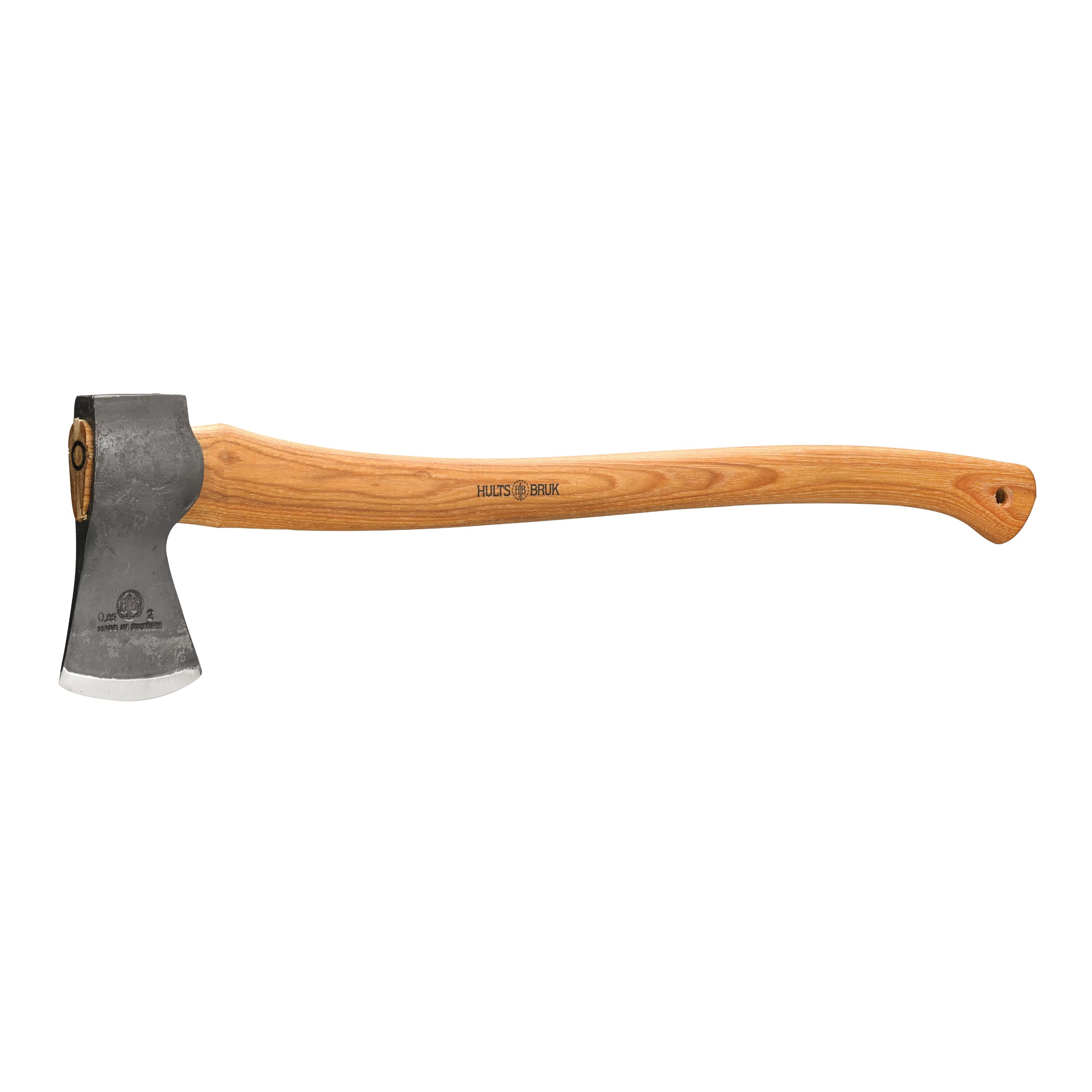
Hults Bruk Kisa

Hults Bruk Kisa

Compact felling

Our Score 9.2/10
Check Price

Worth Noting

  • Premium price for a compact axe
Head Weight
2 lb
Total Weight
3.2 lb
Overall Length
26 in
Handle Material
American hickory
Read the full review

The Kisa is not a full-size felling axe, and that is the first thing to understand. Its 26-inch handle and 2-pound head put it in compact territory, with a 3.2-pound total weight that is easy to carry. If you are expecting the authority of a 31-inch Helko, you will be disappointed; if you want a felling axe that disappears into a pack, this is the one.

We like it for light felling and limbing, where a full-size axe is more tool than you need. The Swedish steel takes a very sharp edge, the hickory handle is curved and comfortable, and the leather sheath and storage box make it feel like a proper tool. It cuts above its weight on small trees, but the short handle runs out of leverage quickly.

The head is the part we watch. A 2-pound head on a slim handle is sensitive to a loose fit, and the Kisa can develop a loose head. Check the eye and wedge before you rely on it, and keep the handle oiled. The 26-inch length also means it is not the axe for larger trunks, no matter how sharp the edge is. For light felling, a quick check before each trip keeps that trade manageable.

It is the one we take when the job is a handful of small trees and the walk in is longer than the cutting. On those days, the light package is worth more than the extra authority.

Bottom line: We keep the Kisa for compact felling and travel, where its light Swedish-steel head and short handle make a full-size axe feel like overkill.

5

INTERTOOL 36-inch Felling Axe

INTERTOOL 36-inch Felling Axe

Larger tree leverage

Our Score 9.0/10
Check Price

Worth Noting

  • Head fit can loosen under heavy use
Head Weight
2.8 lb
Total Weight
4.8 lb
Overall Length
36 in
Handle Material
Fiberglass
Read the full review

The INTERTOOL is the longest axe in this group, and that is the reason to consider it. A 36-inch fiberglass handle gives you more reach and leverage than the 28-inch Fiskars, while the 2.8-pound carbon-steel head keeps the total weight at 4.8 pounds. That is still a manageable axe, but it swings more like a lever than a light chopper.

The head comes pre-sharpened, and the long handle lets you build speed without crowding the cut. We found the textured rubber grip secure in dry conditions, and the shock-absorbing fiberglass takes some of the sting out of a missed blow. For clearing a fence line or dropping medium trees, the extra length is useful.

The handle is also the limitation. Thirty-six inches needs a wide, clear swing path, and it feels clumsy in tight brush where a shorter axe can move freely. This is not the axe for a cramped woodlot or a thicket. Out in the open, that is a fair trade for the reach.

The extra reach is the reason to choose it, and the shorter Fiskars is the easier tool to live with in tight brush. In open ground, the long handle does most of the work.

Bottom line: We see the INTERTOOL as the budget long-handle pick for medium trees, with leverage that makes bigger trunks feel less intimidating.

How We Tested the Best Felling Axes

We started with more than 30 felling axes from brands with actual forestry and forging backgrounds, then narrowed by the things that decide whether an axe is worth owning: a head between roughly 2.5 and 4 pounds, a handle long enough for a two-handed swing without turning into a splitting maul, a head properly wedged and seated on the eye, and a price that made sense for someone cutting a few cords a year rather than clearing land for a living. That left 10 axes, which we used for eight months.

Out of the box, we checked every edge the boring way — paring paper, shaving a patch of forearm hair — then moved to counting swings. Each axe went into green pine and seasoned oak, and we logged how many hits it took to sever a six-inch log and whether the bit sank in or bounced off the end grain. Between sessions we touched up each edge with a stone and noted how much steel it took to bring the sharpness back, which told us more about the steel than anything printed on the box.

In the yard, we swung each axe choked up and at full extension, paying attention to where the weight sat and whether the head pulled the handle through the cut or fought it. We sighted down every handle to check head alignment, looking for a canted head or a visible gap at the eye, and we deliberately caught a few knots off-center to see what that did to the handle. Durability showed up in smaller ways too: cracks forming near the shoulder, a finish that blistered palms, whether the factory sheath actually kept the edge off your leg on the walk back.

Value came last, and it had less to do with the lowest price than with what came in the box — a sheath you'd keep using, a handle that could be rehung, a maker who sells replacements. Eight months of firewood later, the shortlist reflects all of it.

How to Choose Felling Axes

Match the Handle Length to the Work

Handle length is the first choice because it sets how much leverage you get and how much room you need. A 28-inch axe like the Fiskars or Hessen is easy to control around a yard, a fence line, or a crowded trail; a 31- or 36-inch handle, as on the Forester and INTERTOOL, lets you put more energy into the cut on larger trunks. Longer is not automatically better. If you cannot swing it cleanly, the extra reach is wasted, so pick the longest handle you can control through a full swing.

Separate Head Weight from Total Weight

Head weight and total weight are related but not the same decision. The head does the cutting; the total weight is what your shoulders and lower back carry all afternoon. A 3.5-pound head on a 5.5-pound axe has authority, but it is a lot to swing for limbing. A 2.75- or 3-pound head on a 4-pound axe is easier to keep on line. Choose the heaviest head you can swing repeatedly with control, not the heaviest one you can lift once.

Choose Fiberglass or Wood for the Handle

Fiberglass handles are the low-maintenance choice: they shrug off weather, do not need oiling, and usually come with a molded grip. The trade-off is feel. Fiberglass can transmit more shock and has less give than hickory, and the head-to-handle connection deserves a check. Wood handles absorb vibration and feel warmer in the hand, but they need occasional oil and can dry out or loosen. If you leave an axe in a shed or truck, fiberglass is easier to live with; if you like tuning a traditional tool, hickory is worth the care.

Read the Edge Geometry, Not Just the Steel

A felling axe should have a keen, relatively thin edge that cuts across the grain. A splitting axe or maul has a wedge-shaped bit for driving rounds apart; forcing a felling axe through knotty firewood is how edges chip. Steel quality and hardness matter, but so does the grind: a 53-56 HRC head with a clean bevel is a working tool, not a guarantee. A leather sheath and a small bottle of oil are useful extras, but the edge geometry and handle fit matter more than the box contents.

Frequently Asked Questions

Final Verdict

For most people, the Fiskars 28-inch is the felling axe we recommend first. It is light enough to swing with control, sharp enough to make short work of small and medium trees, and it costs less than the traditional wood-handled picks here. If you regularly drop larger trees, the Helko Forester's 31-inch handle and 3.5-pound head are worth the extra weight and money. For a compact axe that travels well, the Hults Bruk Kisa is the specialist, but it is not a full-size replacement.