Outdoor Power Equipment

Best Self-Propelled Lawn Mowers of 2026

A self-propelled mower is supposed to feel like a helping hand, not another workout. On a flat quarter-acre, almost anything will do; on a slope, in thick spring grass, or around a dozen garden beds, the difference between a well-sorted drive system and a clumsy one shows up fast. The right mower takes the strain off your arms and legs, keeps a steady cut through damp grass, and doesn't make you dread the next pass. It should also be quiet enough that you don't wait until noon to start—and solid enough that it doesn't rattle loose after a season.

I've mowed enough lawns to know that the spec sheet rarely tells you how a mower will feel after 20 minutes. So we spent six months with seven self-propelled mowers, cutting the same rough patches, slopes, and narrow side yards week after week. What separated the good ones wasn't a single headline number but how they handled real grass, how much charge they demanded, and whether they felt worth the money. These are the mowers that earned a spot.

1

Greenworks 60V 21-Inch Self-Propelled

Top Pick
Greenworks 60V 21-Inch Self-Propelled

Most suburban lawns

Our Score 8.8/10
Check Price

Worth Noting

  • Runtime falls off in thick, wet grass
Drive
Rear-wheel, variable speed
Run Time
Up to 3/4 acre per charge
Warranty
4 years, tool and battery
Cutting Width
20.28 inches
Read the full review

Two batteries rather than one is the whole argument for this Greenworks, and the handoff between them is what we watched for on the first lap: whether the mower stumbles halfway down a row when one pack runs flat. It doesn't. Greenworks rates the pair for up to three-quarters of an acre, and that matches the shape of the machine. A normal suburban lot finishes with charge to spare, and a bigger one gets done without a mid-mow swap.

The drive is where this one earns its keep. Rear-wheel drive puts the push under the weight, and the speed lever adjusts as you walk, so a careful pass along a flowerbed doesn't have to be a careful pass down the whole lawn. At 65 pounds it's light enough to steer with one hand and to stand on end in the corner of a garage. The rear-drive habit takes a session to learn: with the bail held, the drive wheels hold their line, so you release it to pivot at the end of a row and pull the mower back by hand.

Four cutting modes is more than most decks offer, and the turbo setting with leaf pickup is the one we didn't expect to care about. It turns a fall cleanup into a couple of passes instead of an afternoon with a rake. Mulch, bag, and side discharge cover everything else. It's quiet enough that ear protection feels optional, and the four-year coverage extends to the batteries, which is the longest warranty here.

What it asks in return is patience with runtime. Thick, wet spring grass drinks charge faster than the rated figure suggests, so on a long lot in May plan a break and a top-up. From June on, the second battery simply absorbs it.

Bottom line: For a lawn measured in fractions of an acre, this is the mower we point you to: two batteries, four cutting modes, and the longest warranty in the group.

2

Greenworks 80V 21-Inch Self-Propelled

Greenworks 80V 21-Inch Self-Propelled

Small yards

Our Score 8.6/10
Check Price

Worth Noting

  • Shortest cordless run time in this group
  • Self-propel drive is the least consistent part
Deck
21-inch steel
Drive
Rear-wheel, variable speed
Run Time
Up to 45 minutes
Cutting Height
7 positions, 0.14 to 3.38 inches
Read the full review

The deck is the first thing you notice: 21 inches of steel where our top pick uses a composite shell. That's the part of a mower that scrapes driveways and fence posts, and it's the part we worry about least on this machine. The 80V platform is shared with more than 75 other Greenworks tools, so the battery has a life after mowing season ends.

Forty-five minutes is the rated run time from the single 4.0Ah pack, and the rapid charger refills it in about an hour, which is enough to turn a big yard into a two-session job rather than a no-charge job. SmartCut reads the load on the blade and shifts power to match, the right approach for a one-battery mower: it spends current where the grass is thick and holds back where the lawn is thin. We had no complaints about the cut itself.

Second place, then, and a close one. It cuts as well as our top pick, carries the tougher deck, and asks less of your budget. Three things hold it back. The single battery gives it the shortest cordless run time in this group, and heavy grass eats that number quickly, so on a quarter acre or more the two-battery Greenworks is the safer buy. The self-propel drive is the least consistent part of the machine, which makes a slow test run worthwhile before the return window closes. And stock has been intermittent, so check before you plan a Saturday around it.

Bottom line: Our value pick: a steel deck, 80 volts of torque, and a fast charger make this the cordless mower we recommend when the yard is small and the budget is firm.

3

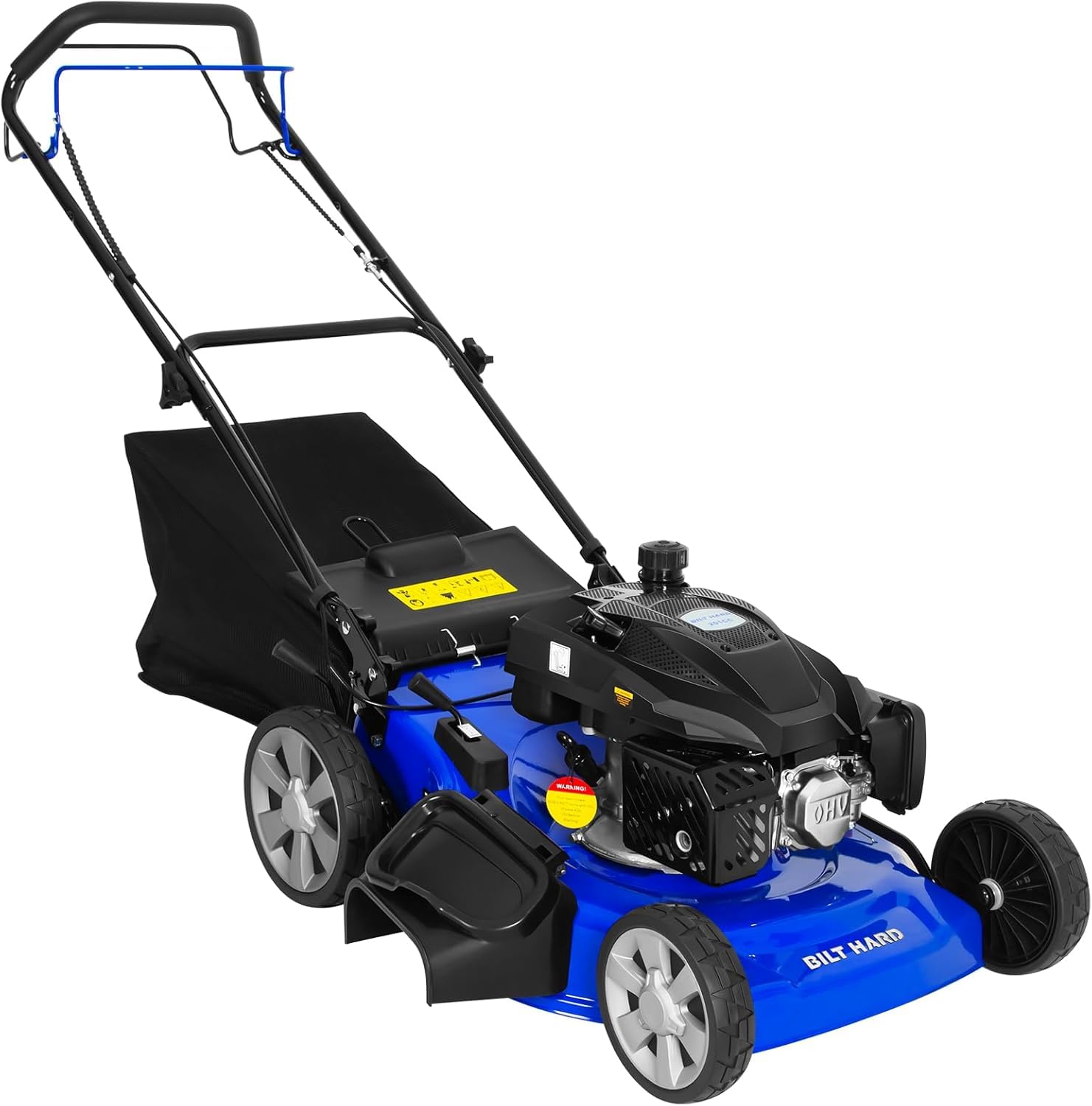
BILT HARD 21-Inch 201cc Self-Propelled

BILT HARD 21-Inch 201cc Self-Propelled

Simple gas mowing

Our Score 8.2/10
Check Price

Worth Noting

  • Single fixed drive speed, no pace adjustment
Drive
Self-propelled, fixed speed
Engine
201cc OHV, 9.0 ft·lb
Cutting Width
21 inches
Cutting Height
8 positions, 1.2 to 3.75 inches
Read the full review

Start with the drive, because it decides whether this mower suits you: the self-propel runs at one fixed speed. There's no lever to slow it for a tight corner or open it up on a straight, so you set your pace by how fast you walk. On an open, level lawn that's a non-issue. Around beds, a shed, and a swing set, we think it's the difference between steering a mower and chasing one.

What it does well is the plain work. We started it cold and the 201cc engine turned over on the first pull without priming, and its 9.0 ft·lb of torque pulled through the tall grass along the fence without bogging. Height changes come from a single lever moving all four wheels through eight positions between 1.2 and 3.75 inches, which is the right way to do it, with no crouching at each corner with a pin. The 3-in-1 deck covers mulch, bag, and side discharge.

At 89.2 pounds it's the lighter of the two gas mowers here, and it's a simpler machine than either cordless pick: a carburetor, a pull cord, and a blade. Nothing to age out on a shelf, nothing to recharge. That's the trade, a fixed speed in exchange for fewer systems that can leave you pushing.

Bottom line: We reach for this one when simplicity matters more than pace: it starts on the first pull, cuts cleanly, and asks only that you walk at its speed.

4

YARDMAX 22-Inch 201cc Self-Propelled

YARDMAX 22-Inch 201cc Self-Propelled

Wide, flat lawns

Our Score 8.0/10
Check Price

Worth Noting

  • Front-wheel drive loses grip on slopes
  • 95.7 pounds to push if the drive quits
Drive
Front-wheel, 6-speed CVT
Warranty
2-year residential
Rear Wheels
11 inches
Cutting Width
22 inches
Read the full review

Twenty-two inches of deck and 11-inch rear wheels are what set the YARDMAX apart here. The width means fewer passes over a big lawn, and the tall rear tires with their aggressive tread roll over soft ground that swallows smaller wheels. The six-speed CVT is the more interesting piece: rather than one walking pace, you pick from six gears to match your stride.

On wide, flat ground we rate it the best gas mower in this group, and the transmission is why, because you set the pace instead of chasing the machine or waiting on it. The deck cleanout port is a small thing we appreciate more than we expected: rinse the underside without tipping the mower on its side, which on a gas engine is how you end up with oil in the air filter. Front-wheel drive is the compromise. The driven tires sit under the lightest end of a 95.7-pound machine, so a slope or wet grass is exactly where they lose grip.

The drive is also the least consistent of the mowers we're covering, and that's a lot of steel to push when it isn't helping. The six speeds are steps rather than a continuous sweep, so there's a gear near your pace rather than an exact match. Buy it for a flat lot with room to turn, and give the self-propel a real workout in the first week.

Bottom line: We like it best on wide, flat ground, where the 22-inch deck and six-speed CVT cover a lot of lawn quickly, but the drive is the compromise.

How We Tested Self-Propelled Mowers for Six Months

We started with about two dozen self-propelled mowers from the major brands, comparing cutting widths, drive systems, battery platforms, weights, and warranty coverage before narrowing the list to seven. Those seven came home with me and my team for six months of weekly mowing—not one clean, dry afternoon of it.

Each mower ran the same route: a sloping front yard, a narrow side pass, a rough patch of tall grass, and tight turns around beds and a shed. I mowed after rain when the grass was damp and heavy, let one section go an extra week to see how each deck handled overgrowth, and ran them early on a Saturday to judge noise from the porch and across the yard. After every cut I checked for ragged tips, clumps, and missed strips. We timed each battery from full charge to the last useful burst, noted recharge time, and tracked how much lawn it finished before the indicator went red.

Ease of use got checked with cold hands and a stopwatch: how quickly the drive engaged, whether the speed control was smooth, how hard the mower pulled on a slope, and whether I could turn at the top without skidding or leaving ruts. We folded and unfolded handles, adjusted cutting heights, emptied bags, and cleaned decks after each session. Quality and reliability showed up in smaller ways—loose fittings, wheel wobble, a drive that surged, or a battery that lost its punch. By the end, durability meant finishing the season without rattles, cracks, or a repair-shop trip, and value meant the mower earned its keep in charge time, upkeep, and effort as much as in the cut.

How to Choose Self-Propelled Lawn Mowers

Pick the Drive Before the Engine

Rear-wheel drive puts the powered tires under the heavier end of the mower, which is why it holds traction on slopes and in thick grass; both Greenworks picks here use it. Front-wheel drive turns more easily at the end of a row, but the driven wheels carry less weight, so expect slip on a hill or after rain. Rear-wheel drive brings its own habit: the wheels hold their line when the drive is engaged, so you release the handle to pivot and pull the mower back by hand.

Just as important is whether the speed changes while you walk. A variable lever, or the YARDMAX's six-speed transmission, lets you match the pace to your stride. A single fixed speed, like the BILT HARD's, turns every corner into a negotiation. If your lawn has beds and trees rather than long open runs, put variable speed ahead of deck width.

Treat Run Time as an Estimate, Not a Promise

Every cordless runtime figure is measured in grass that mows easily, and spring growth is not that. Halve the advertised number for a wet May and you'll be close. That arithmetic decides how many packs you need: our top pick's two batteries are the reason it finishes a big lot in one go, while a single-battery mower can still get there if you're willing to break.

Check the charger before you decide. A rapid charger that refills in about an hour, as the 80V Greenworks does, turns one battery from a compromise into a workable plan. A slow charger plus one pack is the combination that makes people give up on cordless.

Width, Weight, and the Modes You'll Actually Use

A 22-inch deck cuts more per pass than a 21-inch one, but only if you can turn it at the end of each row and thread it between the fence and the shed. Wider also usually means heavier, and weight is what you feel on a slope and when lifting the machine into a truck. The YARDMAX's 95.7 pounds is the price of that extra inch.

Mulch, bag, and side discharge are all worth having. Leaf pickup, which the 60V Greenworks adds, is a real autumn bonus if your yard drops a lot. On height adjustment, the number of positions matters less than the mechanism: a single lever that moves all four wheels beats four separate pins every time.

Gas or Battery: The Ownership Side

Gas hands you unlimited runtime and a quick refill in exchange for fuel, oil changes, a spark plug, and a carburetor that objects to sitting full all winter. Battery hands you instant starts and no fumes in exchange for packs that lose capacity over the years, and a purchase price that is largely battery.

The tiebreaker is usually the platform. A mower that shares packs with a trimmer and blower you already own is worth more than its spec sheet suggests, which is why the Greenworks 60V and 80V families are worth checking against your shed. Then read the warranty: four years on both tool and battery is the strongest coverage in this group, against two years residential on the YARDMAX.

Frequently Asked Questions

Final Verdict

Two batteries, four cutting modes, and a warranty that covers the packs as well as the tool: the Greenworks 60V is the mower we point most suburban households to, because it finishes the job without a swap and doesn't ask you to learn a new maintenance routine.

Change one requirement and the answer moves. A wide, flat lawn and no interest in battery care point to the 22-inch YARDMAX, which covers more ground per pass, provided you accept the least settled drive here. A small yard and a firm budget point to the 80V Greenworks, which cuts just as well and refills in about an hour.