Outdoor Power Equipment

Best Electric Lawn Mowers of 2026

The gas mower left my garage on a Tuesday, along with the half-empty can I'd been tripping over for two years. What surprised me wasn't the quieter mornings — it was how little I missed the pull cord and the ear protection. Electric mowers cut the same grass with a fraction of the fuss, but they bring their own tradeoffs. The real question isn't gas versus electric anymore; it's whether a battery will outlast your yard, and whether you can comfortably push the thing for the 45 minutes it takes.

Over the past nine months, I've mowed with eight electric mowers on my quarter-acre and a few of my team's yards, and weight turned out to matter more than horsepower. Deck size mattered less than I expected, and the mowers that chewed through tall, wet spring grass weren't the loudest or the priciest. A few of these fold up and hang on a wall; others are a two-person lift. The picks below are the ones I'd hand to a friend.

1

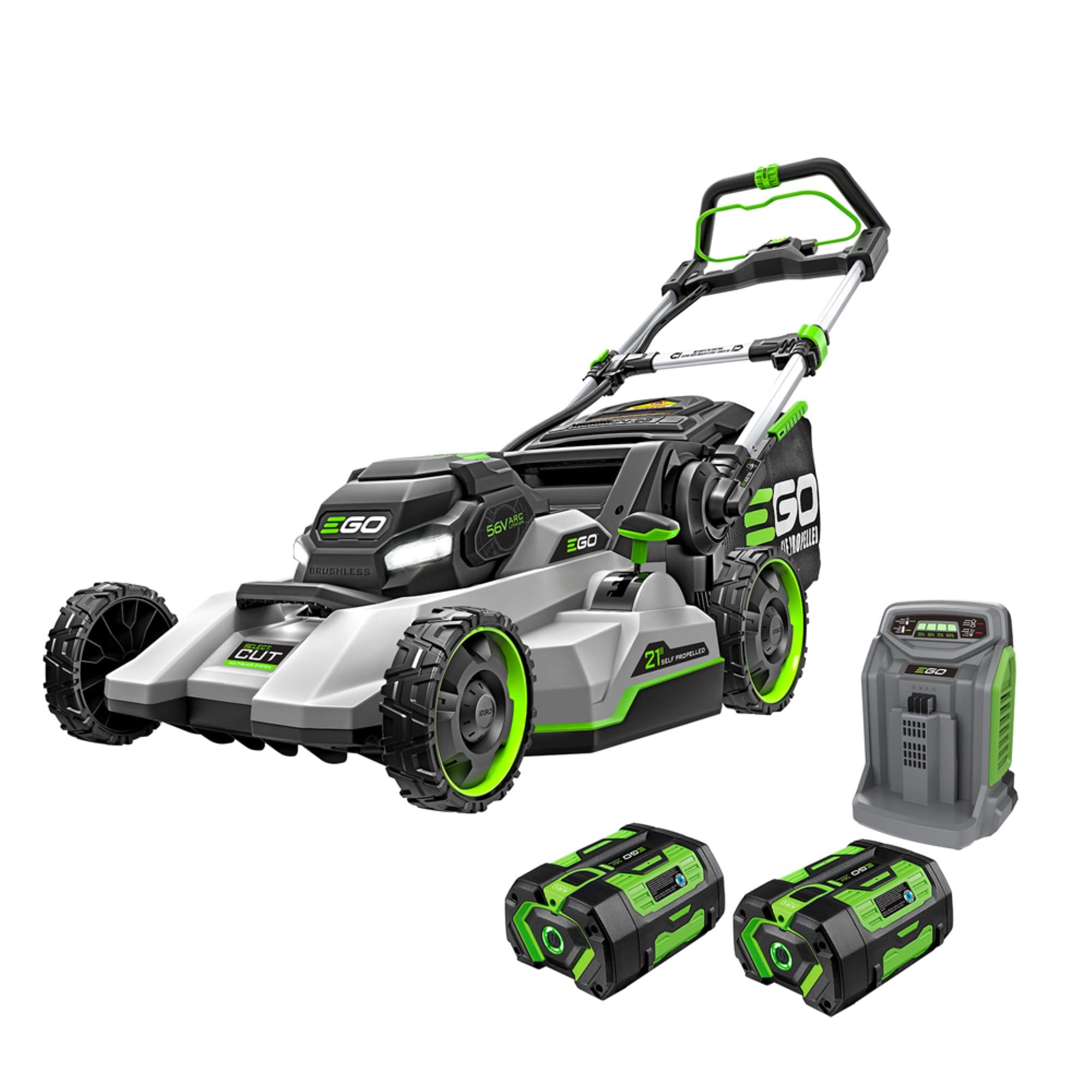
EGO Power+ LM2114

Top Pick
EGO Power+ LM2114

Most lawns

Our Score 9.0/10
Check Price

Worth Noting

  • No self-propel, so slopes are manual work
  • One 6.0Ah battery in the box
Cutting Width
21 inches
Cutting Heights
7 positions, 1.25 to 4 inches
Battery Included
56V 6.0Ah
Runtime Per Charge
Up to 55 minutes
Read the full review

Twenty-one inches is the widest cut in this group, matched only by the self-propelled 800 Series, and it is the single best argument for this mower: fewer passes, less walking, and a finish that does not depend on how patient you are feeling. Behind the deck sits 6.0 foot-pounds of cutting torque from a brushless motor, a figure that matters most in the grass you neglected for two weeks. That is where cheaper electrics bog down and start leaving a ragged stripe.

At 82 pounds it is the heaviest push mower here, and most of that is the steel deck and the battery sitting low over the blade. We noticed the weight lifting it into a shed and almost never while pushing it. The trade for a lighter and less expensive machine than the self-propelled 800 Series is that you supply the forward motion yourself, which is fine on flat ground and less fine on a bank.

Seven height positions run from 1.25 to 4 inches on one lever, which covers everything from a quick trim before a dry spell to a longer cut in July. The bag fills from the rear and comes off with one hand. Let the lawn go long and the deck will leave clumps, so take a first pass at a higher setting, wait a few days, then drop it, the torque is there, the deck is just asking you not to take a foot of grass at once.

The 6.0Ah pack charges in 80 minutes on the included charger, quick enough that a second pass after lunch is a plan rather than an ordeal. What we appreciated most over a season of weekly cuts is how little there is to do between them: no oil, no filter, no choke, and a hose and a scraper have the underside clean in a few minutes in the fall.

Bottom line: The one we recommend to most people: a 21-inch cut, gas-like torque, and a battery that refills in 80 minutes.

2

Greenworks 60V 21-Inch Self-Propelled

Greenworks 60V 21-Inch Self-Propelled

Sloped yards

Our Score 8.8/10
Check Price

Worth Noting

  • 65 pounds to lift and store
  • Drive bar must be released to reverse
Cutting Width
20.28 inches
Cutting Heights
7 positions, 1 to 4 inches
Batteries Included
Two 60V 4.0Ah
Coverage Per Charge
Up to 3/4 acre
Read the full review

Rear-wheel drive with a variable-speed bar is the reason to look here: on a slope the mower pulls and you steer. Two 4.0Ah packs ride on the machine and switch over on their own, so a long cut does not stop for a battery swap halfway up the yard.

The rest of the package is what makes it our value pick among the self-propelled machines. Twenty and a quarter inches of cut, seven height positions from 1 to 4 inches, and four modes: mulch, bag, side discharge, and a turbo setting for leaf pickup in the fall. The headlight is a genuinely useful addition if you mow after work, and we used it more than we expected to.

Sixty-five pounds is the price of the drive and the bigger deck, and it is a two-hand lift into a truck bed. The drive engages through a bar you hold, and reversing means letting it go and pulling the mower back, the one habit worth learning in the first week rather than the fifth.

Charging is the other half of the story: two packs, one charger, and a four-year warranty that is the longest in this group. If your lawn is flat and small, the lighter push mowers here are easier to live with. If it is not, this is where the money belongs.

Bottom line: Our pick where the ground is not flat: rear-wheel drive, two batteries, and a 21-inch deck for less than the EGO push mower.

3

EGO Power+ LM2134SP-2

EGO Power+ LM2134SP-2

Large lots

Our Score 8.8/10
Check Price

Worth Noting

  • 96 pounds, the heaviest mower here
  • Bag chute can clog before the bag is full
Drive Speed
0.9 to 3.1 mph
Cutting Width
21 inches
Batteries Included
Two 56V 6.0Ah
Runtime Per Charge
Up to 100 minutes
Read the full review

A hundred minutes is the number that matters, and it comes from two 6.0Ah packs plus a low-runtime blade in EGO's Select Cut system. On a property where a single battery quits halfway, that is the difference between one session and three.

Select Cut is worth understanding before you buy. The lower blade unbolts, and you fit the mulching blade, the high-lift bagging blade, or the extended-runtime blade depending on the job, a quick swap with the mower tipped on its side. It changes the machine's appetite for grass and for charge, and it is the sort of thing you use twice a season once you know your lawn.

Touch drive is the feature we did not expect to like as much as we did. Push your palm against the handle and the mower moves at whatever speed you have set between 0.9 and 3.1 mph, slow enough to follow a bed edge and quick enough to finish a long strip. At 96 pounds it is the heaviest machine here, and that weight is exactly why the drive matters.

What keeps it from being the default recommendation is the money and the bag: the chute can pack up before the bag is full in damp grass, and you will clear it. On a half acre with a slope and a few trees, those are annoyances you forgive. On a small flat lawn they are reasons to buy something simpler.

Bottom line: For a big, uneven property, this is the mower that finishes the job: two 6.0Ah packs and up to 100 minutes of cutting.

4

Greenworks 40V 16-Inch Push

Greenworks 40V 16-Inch Push

Small yards

Our Score 8.4/10
Check Price

Worth Noting

  • Runtime drops off in tall or wet grass
  • Small bag fills fast in fall leaves
Weight
37.5 lb
Cutting Width
15.67 inches
Battery Included
40V 4.0Ah
Runtime Per Charge
35 minutes
Read the full review

Sixteen inches of deck and one 4.0Ah battery tell you most of what this mower is for. Aim it at a half acre of thick spring grass and you will spend as long charging as cutting. Aim it at the kind of lawn that takes fifteen minutes, and it is the least fussy mowing you will do all summer.

Lightness is the thing we kept noticing. At 37.5 pounds it is a mower you can lift with one hand onto a step, steer around a birdbath with a palm on the handle, and hang on two hooks once the handle folds. A single lever drops the deck through five positions from 1.25 to 3.75 inches, which is the adjustment you will actually use between a dry spell and a wet week.

The 40V platform is the other argument: the same pack runs Greenworks trimmers, blowers, and saws, so a second battery bought for the mower does double duty. Mulch or bag, your choice, and the mulch plug goes in without tools, which is where ours stayed for most of the season.

Two practical notes: the bag is small enough that a leafy fall cut means a couple of empties, and the 35 minutes on the label is a fair-weather figure. On a small lot neither costs you more than a minute, and on a large one they are the reason to look at the 21-inch machines here instead.

Bottom line: For a lawn you can cross in five minutes, this is the smart buy: 37.5 pounds, one lever for height, and a handle that folds flat.

5

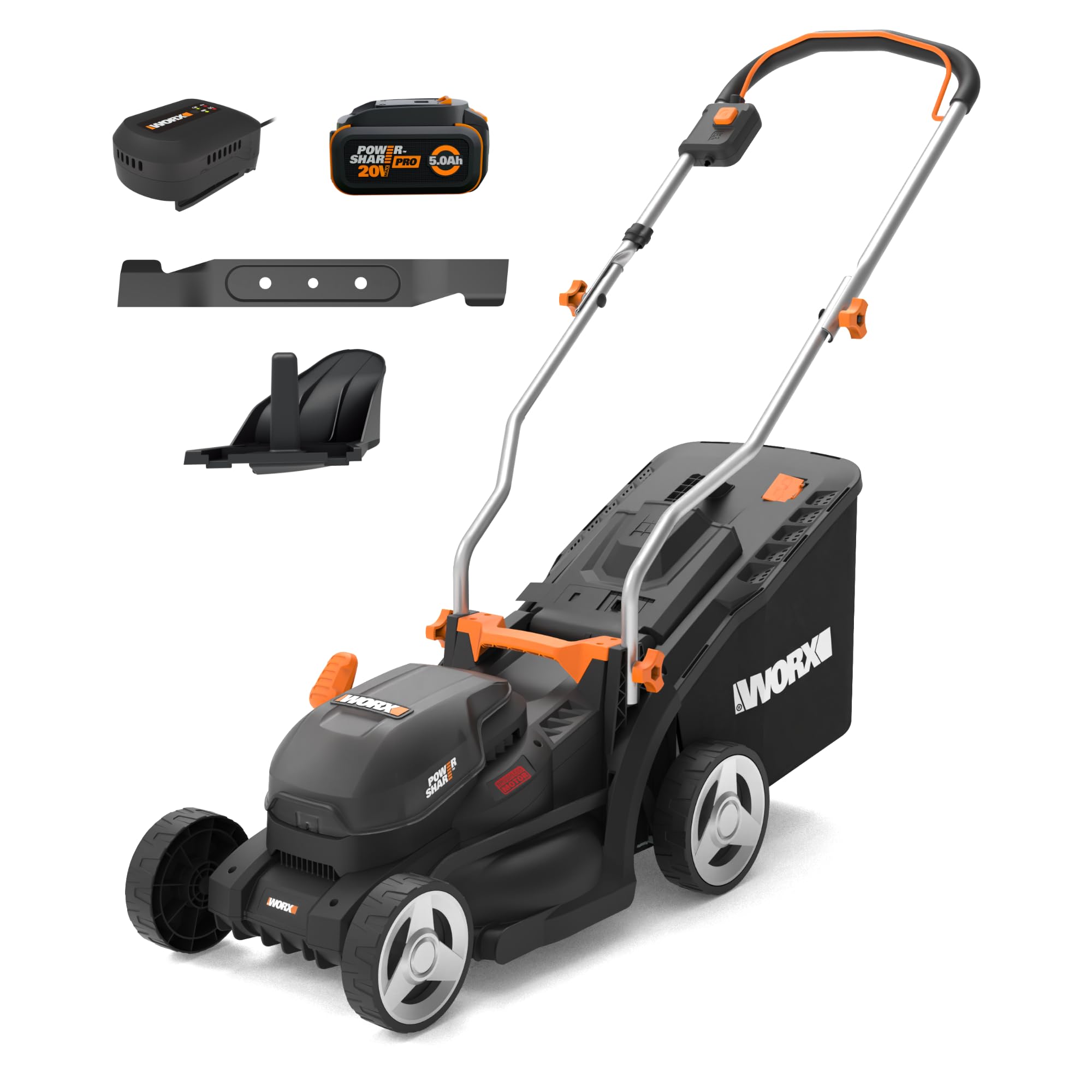
WORX WG733.1 14-Inch

WORX WG733.1 14-Inch

Tight borders

Our Score 8.4/10
Check Price

Worth Noting

  • Small bag needs emptying often
  • 14-inch cut means more passes on open lawn
Weight
21.7 lb
Cutting Width
14 inches
Cutting Heights
6 positions, 1 to 3 inches
Battery Included
20V 5.0Ah
Read the full review

Fourteen inches is the smallest deck here, and on the right lawn that is a feature rather than a compromise. The deck is offset so the blade reaches the edge of the housing, which means you can run it along a fence line or a flower bed and skip the string trimmer pass afterwards. On a townhouse lot that saves more time than the extra passes cost.

At 21.7 pounds it is the lightest cordless mower in this group, and it folds down to something you carry in one hand and stand in a corner of a shed. Six height positions from 1 to 3 inches move on a single lever, and the brushless motor holds its speed in grass taller than it has any right to be.

The 5.0Ah pack is part of Worx's PowerShare line, so it runs the brand's other 20V tools, and the 2-in-1 setup switches between bagging and mulching. The bag is small, a couple of front-lawn passes and it is full, which is the trade for a deck this size.

Where it falls down is an open lawn. At 14 inches you walk more passes than with anything else here, and 3 inches is the lowest maximum height in the group, so a lawn that gets away from you in June is work. Buy it for borders, gates, and a courtyard rather than for the whole property.

Bottom line: Small, light, and built to get close: the mower for a courtyard, a strip of lawn, or the edges a wide deck cannot reach.

6

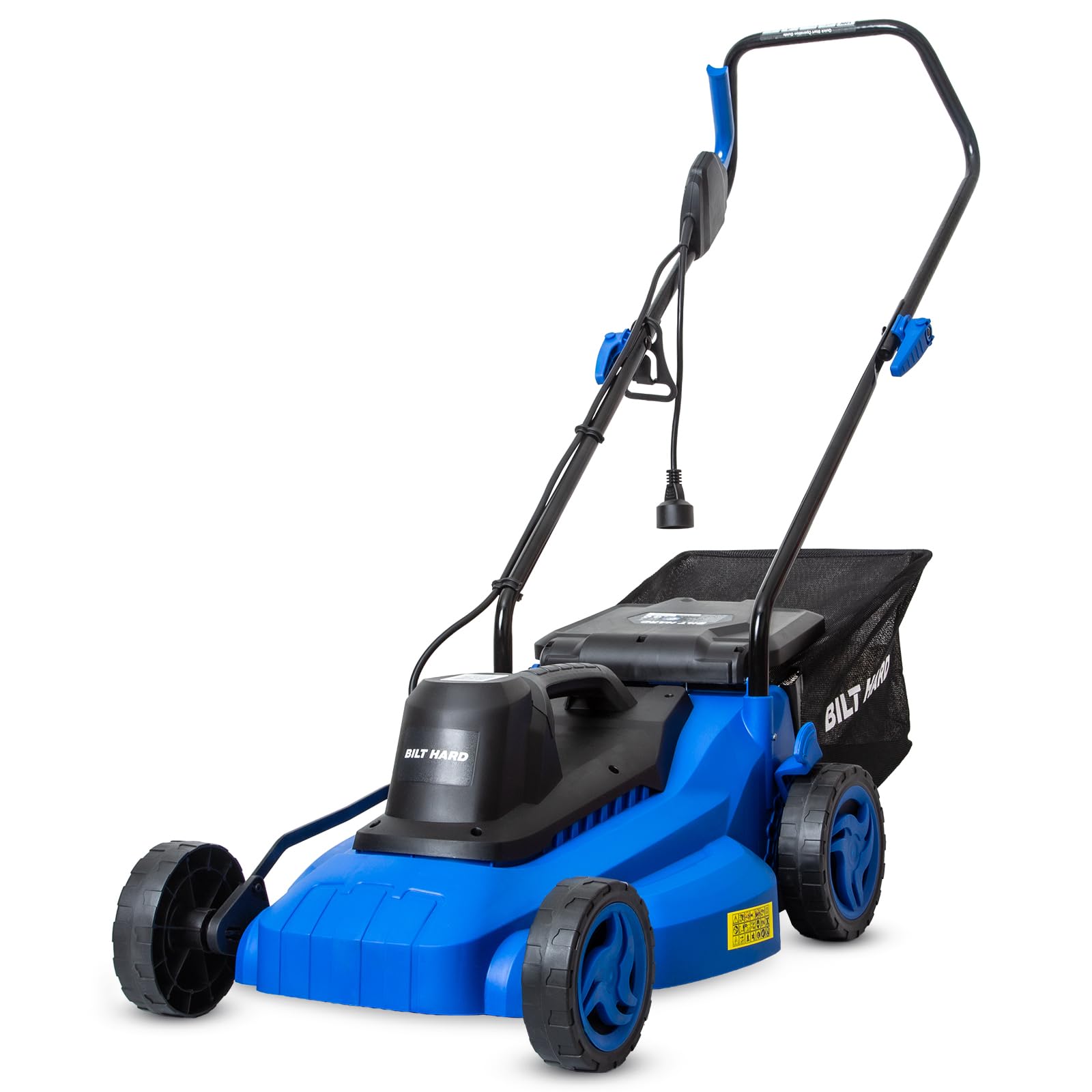
BILT HARD 15-Inch Corded

BILT HARD 15-Inch Corded

Small flat yards

Our Score 8.2/10
Check Price

Worth Noting

  • Tied to the reach of an outdoor outlet
Motor
11 amps, 3,300 RPM
Weight
21 lb
Grass Bag
9.2 gallons
Cutting Width
15 inches
Read the full review

The cord is the whole proposition. Plug it into an outdoor outlet and the mower runs until you stop, which means no pack to recharge, no pack to replace in a few years, and no watching the last bar while you finish the back strip. What you give up is the freedom to start anywhere: the route has to keep the cord behind you, trailing over grass you have already cut.

At 21 pounds it is the lightest machine here by a wide margin, and a 15-inch deck makes it nimble along a fence line. The 9.2-gallon bag is unusually large for a mower this size, where most small-deck machines make you empty something half as big, so a courtyard and a front strip can be one trip to the compost. Height adjusts in five steps from 1 to 3 inches.

Where it makes sense is the lawn you can see all of from the back door, with an outlet on the wall of the house. On that lawn it is the least expensive way to stop buying gas, and the 11-amp motor holds blade speed through damp spring growth that would have a small battery mower stuttering. Push it onto a quarter acre and the arithmetic changes: three-foot passes, a cord to mind, and a lot of walking.

The safety layout is the part that surprised us. A lock-out button and a hold-to-run lever mean the blade stops the instant your hand comes off, which is the behavior you want on a machine with a cord attached to it. Check the reach from your outlet to the far corner before you order; that distance is the real specification here.

Bottom line: Plug it in and mow until you are done: no battery to replace, no gas, and 21 pounds to push, provided your outlet is close.

7

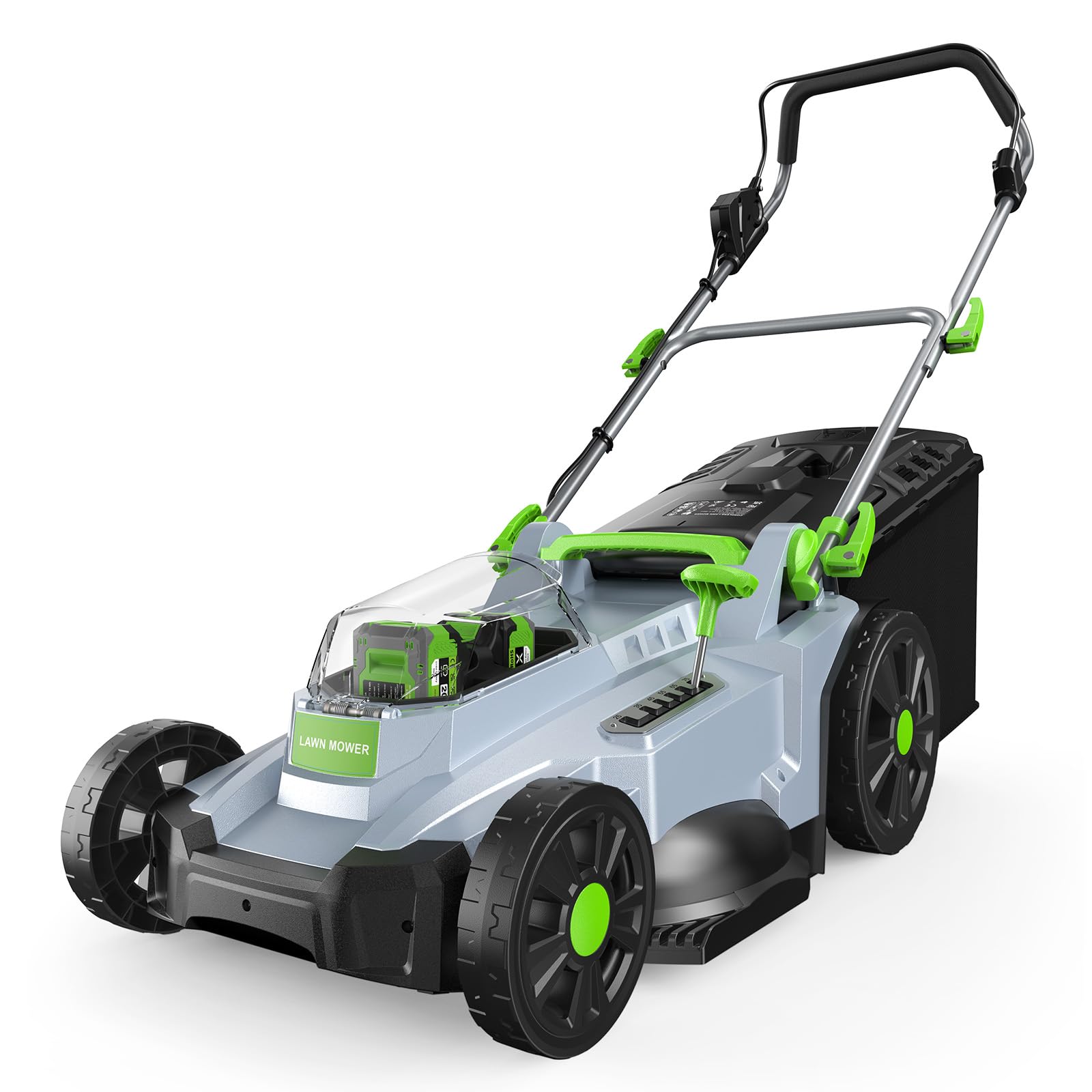
Casince 17-Inch Cordless

Casince 17-Inch Cordless

Tight budgets

Our Score 8.0/10
Check Price

Worth Noting

  • One-year warranty, the shortest in this group
  • Cutting height tops out at 3 inches
Grass Bag
50 liters
Cutting Width
17 inches
Batteries Included
Two 20V 4.0Ah
Runtime Per Charge
Up to 40 minutes
Read the full review

Two 20V 4.0Ah batteries, a charger that takes both, a 17-inch deck, and a 50-liter bag: the parts list reads like mowers that cost a good deal more. At 30 pounds it is the second lightest machine here, light enough that the mower goes where you point it rather than where the camber of the lawn wants it to go.

The six-position lever runs from 1 to 3 inches, and 17 inches is the sensible middle of this group, narrow enough for a side gate and wide enough that a small front lawn is four or five passes. Clippings travel up the chute into the bag without clogging on us, and the bag lifts off with one clip.

The dual charger is the detail we did not expect at this price. Both packs charge at once rather than one after the other, so the pair is ready in the time a single-battery mower takes to top up one, and on a small-to-medium lot that matters more than the 40-minute label suggests.

Here is the trade: a one-year warranty, where the Greenworks push mower here carries three years and the 60V self-propelled carries four. That is the difference between this and a first-tier machine at a lot more money, a shorter safety net on a mower with a short record. As a light second mower for a rental or a first mower for a small lot, it is a reasonable bet. As a machine to keep a decade, it is not.

Bottom line: The least expensive way into a two-battery cordless mower here: 17 inches, 30 pounds, and enough runtime for a small lot.

How We Tested (and Lived With) Eight Electric Mowers

We started with about 30 electric mowers pulled from spec sheets and retail listings, then narrowed by deck size, cutting-height range, whether a battery and charger came in the box, and how easy and cheap spare batteries were to find. Eight made the cut, corded and cordless, from 14-inch trim models to 21-inch self-propelled machines. Testing ran nine months — one full growing season, from the first spring flush through leaf drop.

Every mower was assembled by one person with a stopwatch running, then weighed on a bathroom scale and carried up and down a flight of basement stairs. We mowed the same quarter-acre stretch with each one, once on light dry grass and once a week after rain, timing battery life from full charge to cutoff and noting where the deck bogged down. In fall we ran them over wet leaves and raked behind to see how evenly clippings were thrown.

Noise was measured with a decibel meter at the operator's ear and again from 50 feet away. We adjusted cutting height one-handed (or failed to), pushed every self-propelled model up the same slope at its slowest and fastest settings, and folded each handle to see what storage in a cramped garage actually involved. After nine months we went back over the wheels, handles, and decks looking for cracks, wobble, and rust.

How to Choose Electric Lawn Mowers

Start With Deck Width, Not Motor Specs

Twelve passes or twenty? A 14- or 16-inch deck is fine for a courtyard and a nuisance on anything larger, because every extra inch of width takes a few minutes off the job and a little less walking. The 20- and 21-inch machines here, the EGO LM2114 and both self-propelled mowers, cross a suburban lawn in noticeably fewer laps.

The trap is assuming wider is always better. A wide deck is heavier and clumsier around beds and gates, which is exactly where the 14-inch Worx earns its place. Pick the deck for the open lawn, then decide whether a second, smaller machine or a string trimmer covers the edges.

Count Batteries, Not Runtimes

Every runtime on a box is measured in grass shorter and drier than yours. The more reliable guide is what comes in the carton: one 4.0Ah pack realistically covers a small city lot, while two packs, as on the Greenworks 60V or the EGO 800 Series, are what let you finish half an acre without a break.

If you are anywhere near the edge, price a second battery at the same time as the mower rather than discovering the need in July. A spare pack also means one can charge while you mow, which turns a two-session job into one.

Push or Self-Propelled Is a Question About Your Ground

Rear-wheel drive earns its keep on a grade. The Greenworks 60V's drive bar and the EGO 800 Series' palm-pressure touch drive both pull the mower up a slope you would rather not push, and both let you set a pace you can walk behind.

On flat ground a drive mostly adds weight, cost, and one more thing to maintain, and a light push mower pivots more easily at the end of a row. Know one habit before you buy: a driven mower resists being pulled backward, so you release the bar to turn or reverse. It takes a lap to feel natural and a season to stop noticing.

A Cord Still Makes Sense for a Small, Close-In Lawn

If the lawn is small and the outlet is near it, a corded mower is the simplest machine you can own: no battery to age out, no charger, and the same power on the last strip as the first. The BILT HARD weighs 21 pounds and carries a bag big enough to skip constant emptying.

The limits are real. You plan a route that keeps the cord behind you, and a 15-inch deck is slow work once the lawn is bigger than a courtyard. Measure the distance from the outlet to the far corner before you commit; a cord that will not reach is not a mower.

The Details You Handle Every Week

Three things decide whether you resent the mower by August. The height lever: one lever worked with one hand beats four separate wheel clips. The bag: a small deck fills a small bag quickly, so read capacity against deck size rather than on its own.

And storage. A handle that folds so the mower can stand or hang against a wall is worth more in a one-car garage than an extra feature on the motor. Check the folded footprint, not the working footprint, if space is the reason you are replacing what you own.

Frequently Asked Questions

Final Verdict

For a normal suburban lawn, the EGO Power+ LM2114 is the mower we recommend. The 21-inch deck and the torque behind it do the work a gas mower used to do, and an 80-minute charge is short enough that finishing in two sittings is a coffee break rather than a lost afternoon.

The exception is ground with real slope to it. There, the Greenworks 60V self-propelled is the better buy for less money, and the lighter Greenworks 40V is the sensible answer if the whole lawn takes less time than emptying the dishwasher.