Outdoor Power Equipment

Best Lawn Mowers of 2026

There's a particular satisfaction in a freshly striped lawn, but the path there is often paved with frustration: a mower that won't start, a battery that quits halfway through, or a machine so heavy you feel it in your shoulders. I've spent seven months with eight different mowers—gas, battery, push, and self-propelled—and the difference between a chore and a tolerable ritual comes down to a few basics. A good one starts reliably, cuts evenly without clumping, maneuvers easily around flower beds, and doesn't wake the neighbors on a Saturday morning.

Match the machine to your yard, not the other way around: a lightweight push mower is easier to store and start, but slopes may call for self-propelled. Battery life claims are optimistic—we timed every one—and we noted how often chutes clogged and whether a mower felt sturdy after months of use. Size matters if your shed is tight, and value isn't just the sticker price but how many seasons it will run. The eight that made the cut are below, each suited to a different set of priorities.

1

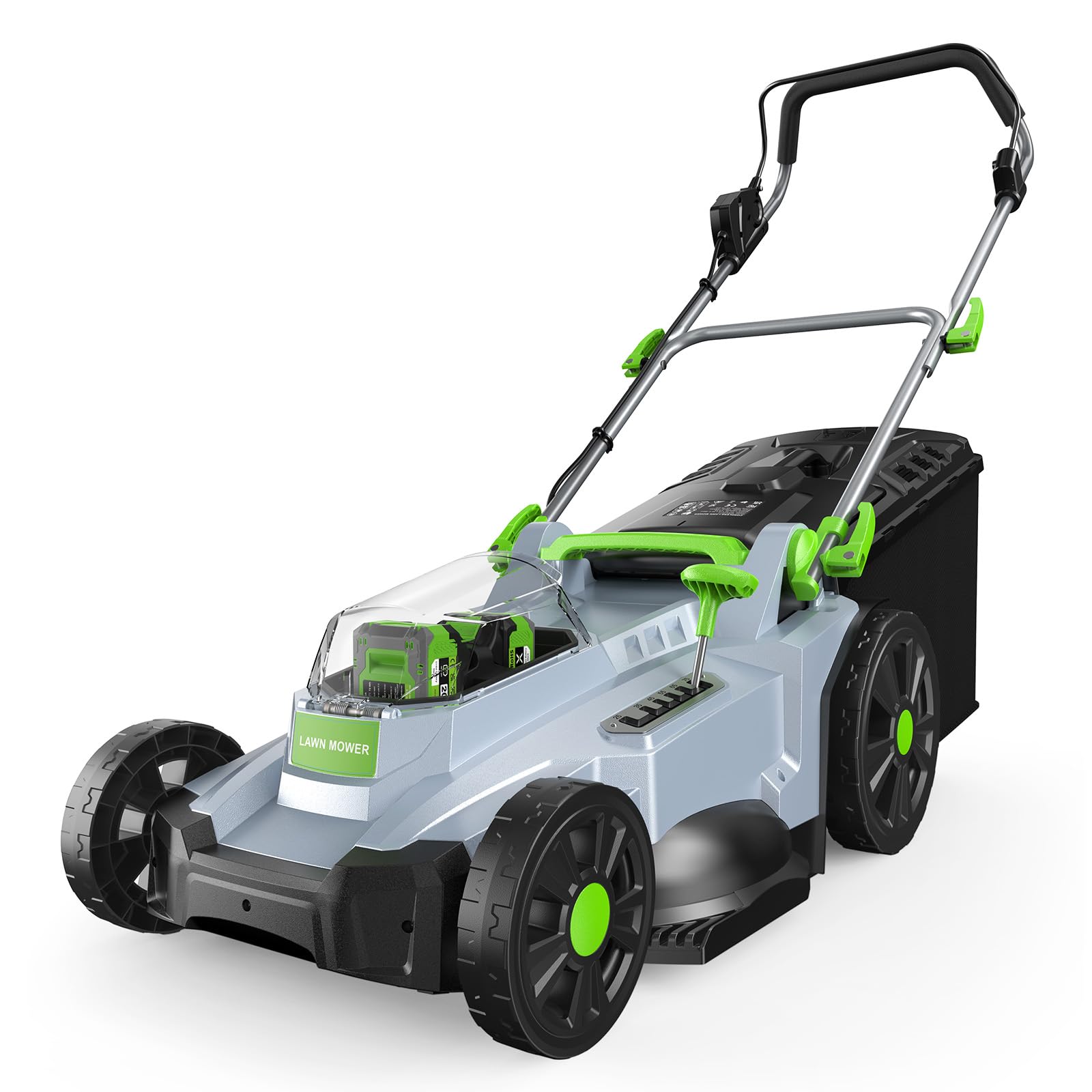
Greenworks 60V 21" Self-Propelled

Top Pick
Greenworks 60V 21" Self-Propelled

Large yards

Our Score 8.8/10
Check Price

Worth Noting

  • Heavy at 65 pounds to lift
Mower Weight
65 lb
Power Source
60V battery
Cutting Modes
Mulch, bag, side discharge, turbo leaf pickup
Cutting Width
20.28 inches
Read the full review

The 21-inch deck is the first thing that separates this Greenworks from the smaller push mowers here. It covers more grass per pass, and the rear-wheel drive pulls the machine along on a slope or through a thick patch where a light push mower starts to feel like work. We noticed the difference most at the end of a long stripe, when the mower was still moving at our pace instead of waiting for us to shove it.

Two 4.0 Ah batteries are the other reason it earns the top spot. Greenworks lists up to three-quarters of an acre per charge, which we treat as a best-case figure: long, wet grass and a low cutting height will eat into it. Having two packs is the real convenience, because one can charge while the other runs. For a half-acre lawn, that buffer matters more than a single bigger battery.

The 4-in-1 system gives you mulch, bag, side discharge, and turbo leaf pickup. We like that flexibility because the right answer changes with the season: mulch in summer, bag when the grass is long, side discharge when you just need to get through. Seven height positions from 1 to 4 inches cover the seasonal range. The 65-pound weight is the price of the bigger deck and drive; the rear wheels make it manageable on grass, but lifting it into a truck bed is a two-person job. The LED headlight is a small thing until you are finishing the last edge at dusk.

This is a premium mower, and it makes sense only if you have the lawn to justify it. On a small, flat yard, the 40V push is easier to pull out and store. On a bigger lot, the extra width and self-propulsion are worth the effort they save every week.

Bottom line: For larger lawns, this is the mower we recommend first: the 21-inch self-propelled deck and two batteries make long passes feel efficient.
2

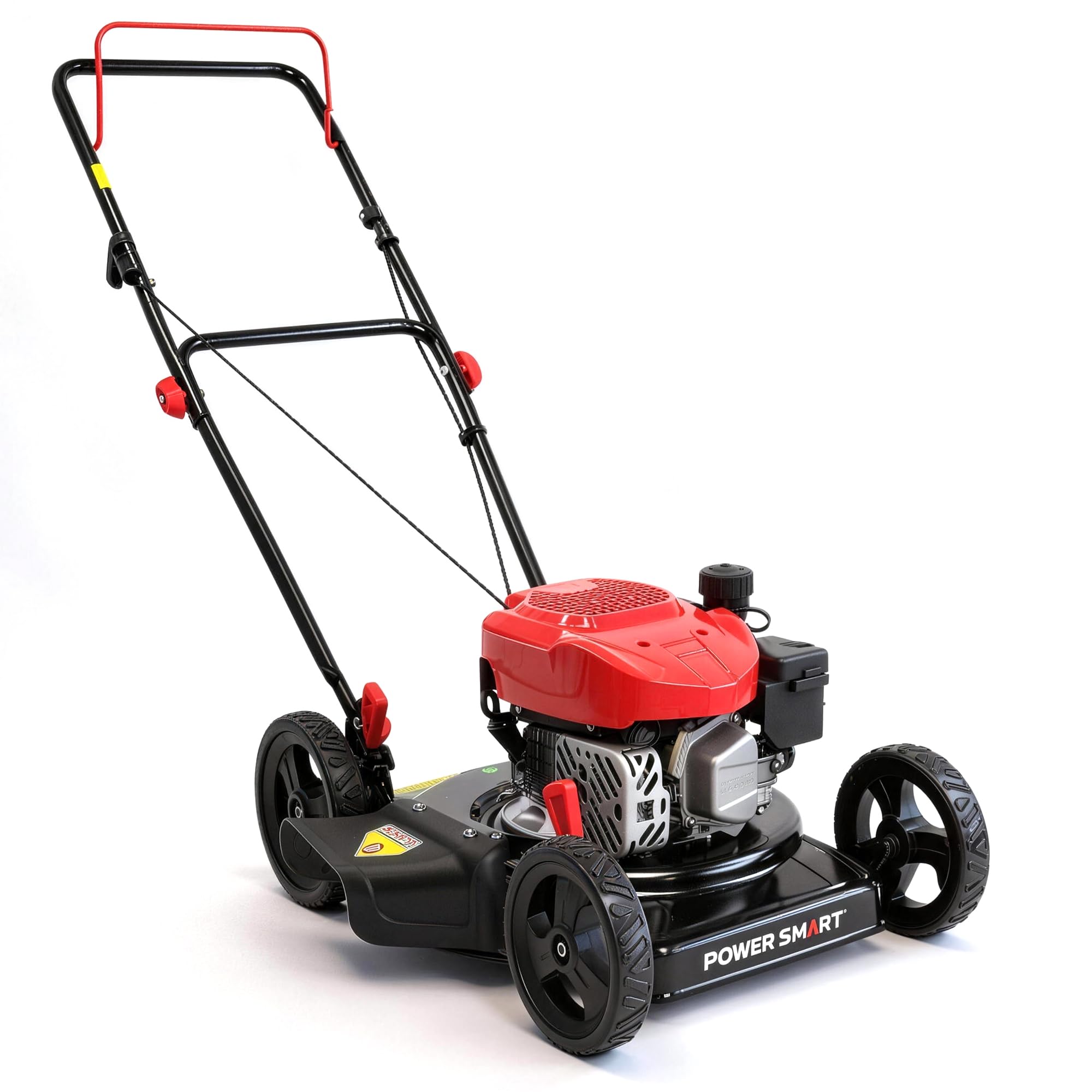
PowerSmart 18" Gas

PowerSmart 18" Gas

Thick grass

Our Score 8.6/10
Check Price

Worth Noting

  • Side-discharge only; no bagging
  • Needs fuel, oil, and seasonal upkeep
Engine
144cc 4-cycle
Mower Weight
58.4 lb
Cutting Width
18 inches
Cutting Heights
1.5 to 3.9 inches
Read the full review

The PowerSmart is the mower for the lawn that gets away from you. Its 144cc engine and side-discharge chute are built to throw clippings clear, so tall, thick grass does not clog the deck the way it can on a small battery mower. We like the auto-choke and primer for cold starts, and the 18-inch steel deck feels more substantial than the plastic decks on the battery models here.

Steel adds weight: 58.4 pounds, which is more than the 40V Greenworks but less than the big self-propelled model. The 8-inch rear wheels and 7-inch front wheels roll over rough ground without digging in, and the 1.5-to-3.9-inch range covers a normal seasonal cut. The side discharge is the whole clipping system, so there is no bag to empty and no mulch plug to lose. If you want clippings collected, this is the wrong mower.

Gas brings the usual chores: fresh fuel, oil changes, a spark plug, and a carburetor that does not like to sit all winter. We think that is a fair trade for a machine that never needs a charging break, especially on a lot with a rough back corner or grass that gets ahead of you. The height lever is easy to find with a foot, and the deck washes off without trapping water.

The PowerSmart is not the cleanest way to make a manicured lawn, and it is not the quietest. It is the simple, tough gas answer for a small-to-mid lawn where the grass is often taller than you planned.

Bottom line: Buy this if you want gas power and a low-fuss side-discharge deck without paying for a premium battery platform.

3

Greenworks 40V 16" Push

Greenworks 40V 16" Push

Small yards

Our Score 8.4/10
Check Price

Worth Noting

  • Narrow 16-inch cut means more passes
  • 35-minute runtime is a best-case figure
Mower Weight
37.5 lb
Power Source
40V battery
Cutting Width
15.67 inches
Listed Runtime
35 minutes
Read the full review

At 37.5 pounds, the Greenworks 40V is the mower we hand to someone who has to carry it up a step or hang it on a wall. The plastic deck keeps the weight down, and the folding handle lets it stand in a corner of the garage. That matters more than the spec sheet suggests: the mower you can pull out without groaning is the one you use before the grass gets away from you.

The 16-inch cut is the trade-off. On a small front-and-back lawn it is fine; on a bigger lot it means more passes and more turns. We found the light body easy to push with one hand on flat ground, and the single lever for the five height positions is simple to work with gloves on. The listed run time is 35 minutes, and that is a best-case number. For a quarter-acre with thick grass, plan on a second battery or a break.

The 2-in-1 mulch-and-bag setup covers the basics. We like the rear bag because it comes off without a fight, and the mulch plug is easy to seat. The 1.25-to-3.75-inch height range is enough for a regular suburban cut, though it will not leave a close, putting-green finish. The 40V battery also fits the wider Greenworks tool line, which is a real bonus if you already own a trimmer or blower.

This is not the mower for an overgrown lot or a lawn with a long slope. It is the one for a tidy yard where storage is tight and the job is manageable in one go. We came back to it for quick cuts because it is quiet enough to use early and light enough to move without thinking.

Bottom line: We recommend this one when light weight and simple storage matter more than wide coverage; it is the easiest push here.

4

LawnMaster 18" Reel

LawnMaster 18" Reel

Flat, small lawns

Our Score 8.2/10
Check Price

Worth Noting

  • Jams in tall grass and weeds
  • Manual effort on slopes and thick patches
Blade Type
5-blade reel
Mower Weight
28.5 lb
Power Source
Manual reel
Cutting Width
18 inches
Read the full review

A reel mower is a different bargain: no gas, no battery, no cord, and no motor noise. The LawnMaster 18-inch model is the one we point to for a small, flat lawn that gets cut often. The five steel blades snip the grass against a bedknife instead of tearing it, which is the reason a reel can leave a cleaner finish than a rotary when the lawn is dry and not too tall.

The catch is that you have to use it before the grass gets away from you. In tall grass or weeds, the reel can jam or simply push the stems down instead of cutting them. We found the 18-inch deck and 10-inch front wheels easy to steer around beds, and the body is light enough to lift over a curb. The nine height positions run from 0.75 to 2 inches, so this is a close-cut tool, not a rough-cut brush hog.

Assembly is simple enough to do without a toolbox, and the handle folds for storage. We appreciate that there is no fuel to buy and no battery to remember to charge, but the trade-off is effort: you provide the power, and a slope or a thick patch will remind you. The mower also sits low, so sticks and rocks need clearing before you start.

This is not the mower for a big, uneven yard or for grass that you cut every other week. It is for a small, flat lawn that you enjoy tending, and for a household that wants the quietest possible cut. If that is your yard, the simplicity is the point; if not, a battery push mower will be less frustrating.

Bottom line: This is the reel mower we suggest for a small, flat, frequently cut lawn, where quiet, tool-free mowing matters more than speed.

5

Casince 17" Cordless

Casince 17" Cordless

Budget small yards

Our Score 8.0/10
Check Price

Worth Noting

  • One-year warranty is the shortest here
  • Assembly instructions take patience
Mower Weight
30 lb
Power Source
Two 20V 4.0 Ah batteries
Cutting Width
17 inches
Listed Runtime
40 minutes
Read the full review

The Casince does the obvious budget-battery things well: two 20V 4.0 Ah packs, a 17-inch deck, and a body that weighs 30 pounds. We like the one-button start and the pull-bar, and the plastic deck will not rust if it gets left out in the rain. For a small yard, that combination is easy to live with.

The two batteries are the selling point. The claimed 40-minute run time is a best-case number for light grass. We treat two packs as the real runtime: one runs while the other charges, and you are less likely to finish the lawn on a half-charged battery. The 17-inch cut is wider than the Greenworks 40V, so it needs fewer passes on a small lot.

The finish is where the Casince feels its price. The height adjuster and handle are functional, but assembly takes a little patience and the instructions are not as clear as the Greenworks manuals. The one-year warranty is shorter than the three- and four-year coverage on the bigger brands. The 50-liter bag is a useful size, and the six height positions from 1 to 3 inches cover a normal cut. We also noticed the mower is narrow enough to fit through a garden gate without folding the handle.

This is not the mower we reach for on a rough or overgrown lot. It is a sensible small-yard battery mower for someone who wants two batteries and light weight without stepping up to a premium platform. Keep it on a flat, regular lawn and do not ask it to be a workhorse.

Bottom line: The Casince is worth a look when two batteries and a 30-pound body matter more than a long warranty or a polished finish.

Our Testing Process: Eight Mowers, Seven Months

We started by gathering more than two dozen models—gas, cordless, push, and self-propelled—and filtering them by cutting width, weight, price, and storage footprint. From that list, we selected eight mowers that represented the range of yards and budgets shoppers actually have. Each one arrived at the same half-acre test lawn with a mix of flat grass, a steep bank, a narrow gate, and a shed with limited floor space.

Testing ran from April through October—seven months of weekly cuts, plus a handful of sessions on tall, wet grass to see what would jam. We mowed in the morning before dew dried and in the afternoon heat, on flat ground and up the slope, and we emptied bag after bag.

We weighed every mower before the first cut and noted how hard it was to push across a slope or lift into a shed. We measured storage footprint with the handle folded. For noise, we took decibel readings at ear level and asked a neighbor at the property line if they could hear it. For ease of use, we timed start-up, height adjustments, and bag emptying.

For cordless models, we ran a continuous cut until the battery died, then timed the recharge. We checked each pass for stragglers, torn blades, and clumps, and we logged every clog during the wet-grass sessions. After seven months, we inspected each mower for wobble, rust, and loose hardware. Finally, we compared price against the performance notes to judge value.

How to Choose Lawn Mowers

Match the Deck to the Lawn

A 16- or 17-inch deck slips through narrow gates and around beds, but it makes more passes; a 20- or 21-inch deck covers open ground faster and is heavier to lift and store. For a typical quarter-acre lot, either can work. Count the tight corners first. If your lawn is one open rectangle, go wider. If it is chopped up by beds and paths, a smaller deck saves more time than it loses. We treat listed battery runtime as a ceiling, not a promise: thick, wet grass can cut it sharply. For a half-acre or more, choose a 20- or 21-inch self-propelled mower and plan on a spare battery.

Choose a Power Source You Can Live With

Battery mowers are quiet, start instantly, and need little beyond a charged pack; the trade-off is that batteries age and replacements cost money. Gas gives you more energy per tank and no charging break, but it brings fuel, oil, noise, and seasonal maintenance. Corded electric is the simplest way to guarantee power, provided your lawn is small and an outlet is within cord reach. A manual reel is the quietest option of all, but it only makes sense on a flat, regularly cut lawn. For most suburban lawns, we think battery is the right default.

Decide Whether Self-Propulsion Earns Its Weight

Push mowers are lighter and simpler; self-propelled models add a drive system and usually weight. The 40V Greenworks here weighs 37.5 pounds, while the 21-inch self-propelled model is 65 pounds. On flat ground, that difference is small. On a slope or in thick grass, rear-wheel drive is the feature that keeps you mowing instead of wrestling. We put more value on self-propulsion than on a wide deck if the lawn has a grade. If your lawn is flat and small, keep the mower light.

Look at Clipping Handling and Cutting Height

Mulching returns clippings to the lawn, bagging gives a cleaner surface, and side discharge clears tall grass without clogging. A 4-in-1 mower lets you switch; a side-discharge-only model is simpler but leaves clippings where they fall. Height range matters too: 1 to 4 inches covers most suburban grass, while a reel mower's 0.75-to-2-inch range is for a close, frequent cut. If you want clippings collected, do not buy a side-discharge-only mower and plan to add a bag later. We like a 4-in-1 system for the flexibility, even if we use the mulch setting most of the time.

Check the Warranty and Service Life

Battery and motor failures are the expensive ones, so the warranty matters more than a folding handle. Greenworks backs the 60V mower for four years and the 40V model for three; the Casince carries one year. A longer warranty is not a guarantee, but it changes what a failure costs you. Look at whether the battery is covered, not just the deck, and whether service is handled locally or by return shipping. For a gas mower, check engine and deck coverage separately.

Frequently Asked Questions

Final Verdict

For most residential lawns, the Greenworks 60V 21-inch self-propelled is the mower we recommend first. Its 21-inch deck, two batteries, and rear-wheel drive turn a half-acre into a manageable weekly job; the trade-off is weight and a premium price.

If your lawn is smaller, flat, and tight on storage, the 37.5-pound Greenworks 40V push is the easier everyday choice. The reel and budget battery picks make sense only when their specific limits fit your yard.