Soil & Fertilizer

Best Rain Gauges of 2026

A rain gauge sounds like a simple piece of gear until you actually need the number: the tomatoes are wilting, the sprinkler schedule is a guess, and your neighbor swears the storm dropped an inch while your gauge shows a muddy blur. What you're really buying is a local rainfall record you can trust without squinting or doing math in your head. I've kept 12 rain gauges going in my yard over the past eight months, from basic tubes to bracket-heavy designs, and the useful ones all get two things right: accuracy and readability.

The rest comes down to details that don't show up in a product photo. A good gauge has to mount solidly enough to stay level in wind, survive a season of sun and frost without cracking, and be simple enough to empty without losing the scale. At this price, value isn't about the cheapest option—it's about paying once for something that still reads clearly next spring. I've sorted through the quirks; the picks below are the ones I'd actually leave bolted to a fence post.

1

Headwind EZRead 26-Inch Rain Gauge

Top Pick
Headwind EZRead 26-Inch Rain Gauge

Reading from indoors

Our Score 9.4/10
Check Price

Worth Noting

  • Tubes can split or leak within a season or two
  • Some readings come in off target
Weight
5.6 oz
Collector
Debris-blocking funnel
Dimensions
4 x 4 x 26 inches
Reading Distance
Up to 50 feet
Read the full review

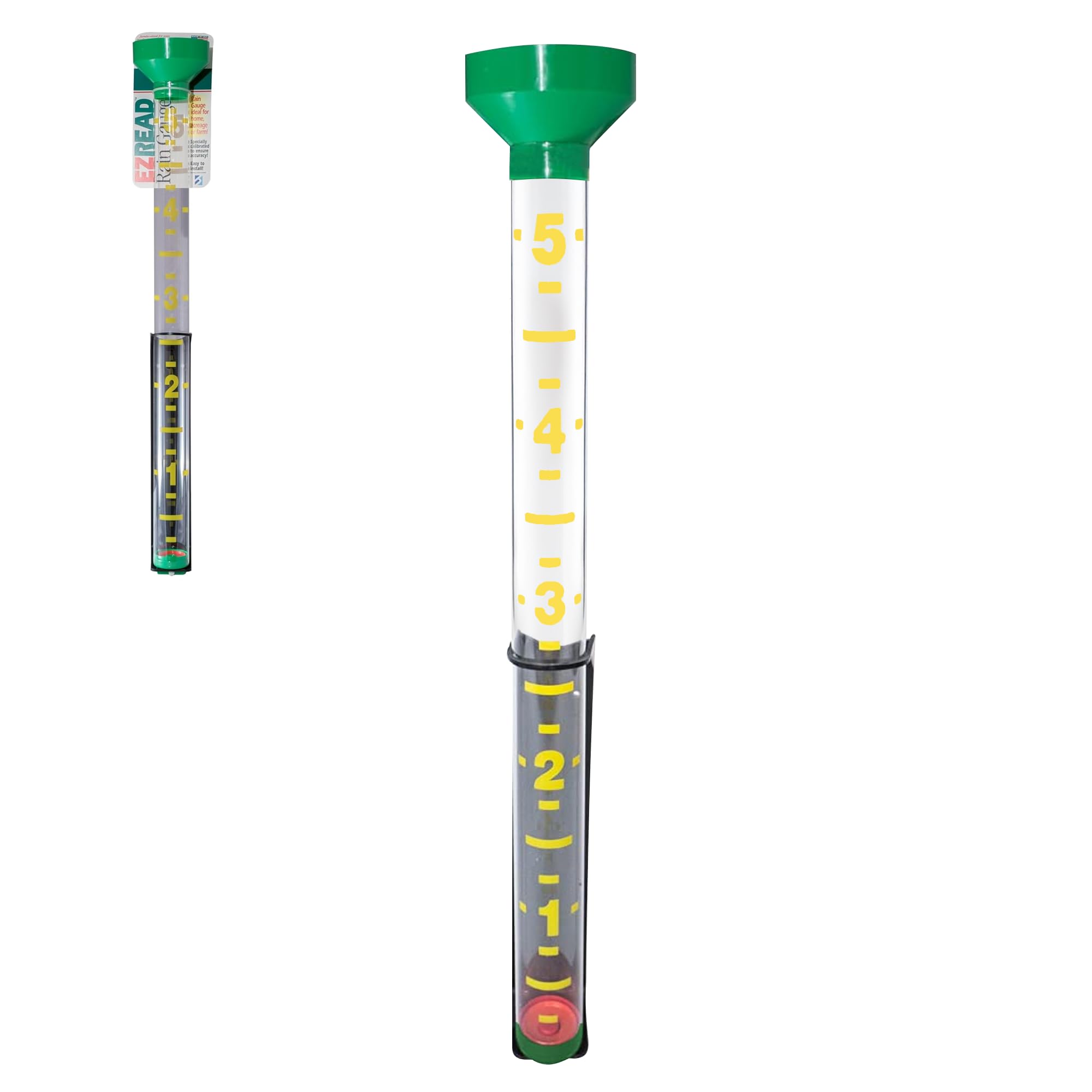
Fifty feet is the figure that makes this gauge worth its place. Stand at the kitchen door, look at the post at the end of the garden, and you can read the rainfall from there. It stands 26 inches tall, the scale is stretched so an inch of rain fills roughly two inches of tube, and a bright float with a magnified water line does the rest. We stopped walking out in the rain to check totals, which is the whole point of a gauge like this.

The funnel over the mouth is the detail we came to appreciate most. Leaves, grass clippings, and seed heads stay out of the tube, so the float keeps riding free and the reading stays clean right through fall. It hangs from a plastic hanger that takes one screw on a post or fence, and at under six ounces the whole gauge is light enough to hang from a cup hook.

What we do not love is how long it lasts. Longevity is the soft spot — a tube that splits or leaks quietly under-reads, and the float only tells the truth while the gauge hangs plumb. Mount it dead vertical on a sheltered post, take it in over the winter, and check the tube for splits each spring.

Then again, a gauge you can read from the house gets checked every day, and one you have to walk out to gets checked when you remember.

Bottom line: If you want to know how much rain fell without walking out to look, we think this is the one to buy: 26 inches of easy-reading gauge with a float and a debris-blocking funnel.

2

Holdly Professional Rain Gauge

Holdly Professional Rain Gauge

Precision storm totals

Our Score 9.4/10
Check Price

Worth Noting

  • Storm totals past an inch need pouring in stages
  • Plastic hazes after several years in direct sun
Capacity
11 inches
Material
UV-resistant polycarbonate
Mounting
Removable bracket
Graduations
0.01 inch
Read the full review

One hundredth of an inch is finer than anything else in this group, and it turns the gauge from a yes-or-no into a record you can keep. A tenth of an inch of drizzle shows clearly on the inner tube, and the outer cylinder takes storm totals up to 11 inches: you read the first inch on the fine scale, then pour off and refill to measure the rest in stages.

That two-stage routine is the price of the precision, and we think it is worth paying when you are comparing a wet week against a sprinkler schedule. The bracket is the better half of the design — screw it to a post, lift the gauge off to read at the kitchen table, then set it back. We take ours down to empty rather than tipping it in place, which keeps the outer cylinder from spilling down the post.

Polycarbonate is the right choice for something that sits in the sun all day, and the clear tube should hold its clarity far longer than the acrylic gauges here. Two things to accept: the top collector seats rather than locks, so an exposed site wants a wrap of tape or a sheltered post, and the plastic will haze and need replacing after several years of direct sun.

For anyone who writes the numbers on a calendar, this is the closest thing here to an instrument rather than an ornament.

Bottom line: For gardeners who record rainfall, we recommend this without hesitation: hundredth-inch graduations, an 11-inch storm capacity, and a bracket that lets you read it at the table.

3

Taylor Silicone Rain Gauge

Taylor Silicone Rain Gauge

Freezing winters

Our Score 9.2/10
Check Price

Worth Noting

  • Single-screw bracket can leave the tube leaning
Capacity
7 inches
Material
Freeze-resistant silicone
Mounting
Ground stake and brackets
Graduations
1/10 inch
Read the full review

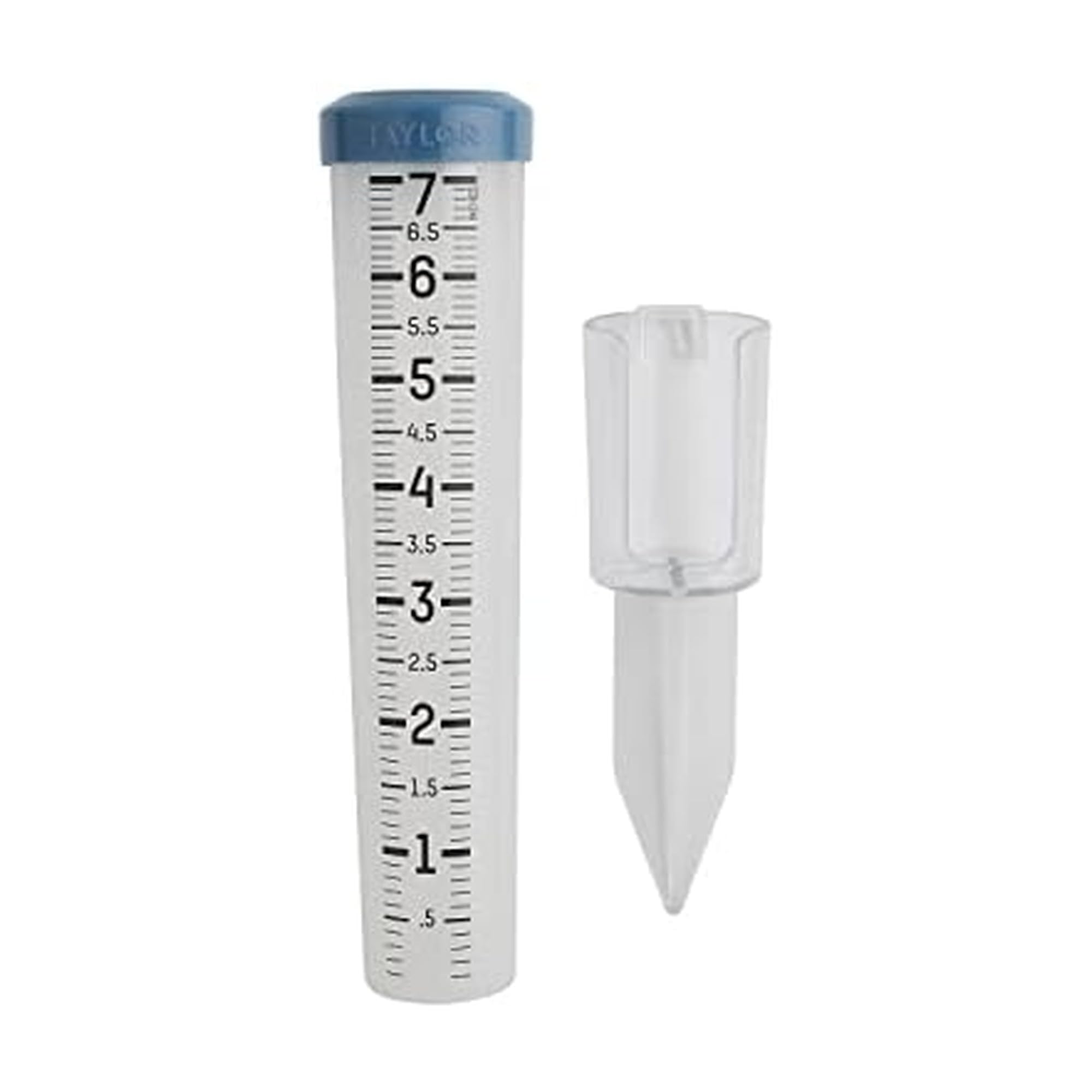
The first hard freeze is usually the end of a plastic rain gauge, and that is the reason to look at this one. Water expanding inside a flexible silicone tube pushes the walls outward instead of splitting them, so the gauge comes through a January night intact and keeps measuring at the thaw. If you have ever pulled a cracked tube full of ice off a post, that one property justifies the step up in price.

The rest is well judged. Seven inches of capacity with tenth-inch markings handles a normal storm without emptying, the numerals are big enough to read from the porch, and you get both a ground stake and brackets for a post or fence, so the same gauge can move from a flower bed to a rail as the season changes.

The bracket is where it stumbles. One screw per bracket lets the tube hang off vertical on a fence rail, and a leaning gauge reads high on one side; add a second fastener or shim behind the bracket, then check the plumb line once a season. A flexible tube also asks more of its mount than a rigid one does, since it follows a sag rather than resisting it.

Leaving a gauge out all year is the ambition here, and this is the one built for it.

Bottom line: Our pick for anyone whose gauge has cracked in a freeze: the silicone tube flexes instead of splitting, and seven inches of capacity covers a normal storm.

4

AcuRite 5-Inch Magnifying Rain Gauge

AcuRite 5-Inch Magnifying Rain Gauge

Budget garden tracking

Our Score 9.2/10
Check Price

Worth Noting

  • Cracks when water freezes inside it
Capacity
5 inches
Material
Acrylic
Mounting
Hang hole or ground stake
Magnification
Over 35%
Read the full review

There is nothing complicated to justify: this is the cheapest gauge here, and it does the job most people actually want, which is telling you how much rain fell last night. Five inches of capacity, an acrylic tube about a foot tall, and numbers magnified by more than a third so the level reads from a few paces back without your glasses.

The magnifying strip is the smart part. The scale sits behind the water column, and the printing is large, white, and widely spaced, so a tenth of an inch is a real line rather than a hair. We hung one from a single screw on a fence post using the integrated hang hole; the tapered base pushes into soil if you prefer it standing in a bed.

It is also the most disposable thing in this article, and we mean that as a buying note rather than a complaint. Acrylic this thin cracks when water freezes inside it, so empty it before a cold night or accept that you will replace it after a winter or two. Plenty of gardeners do exactly that and keep a spare on the shelf — two of these still cost less than most of the picks here.

If you hang it, hang it on a hook rather than screwing the body flat to a post. The whole gauge lifts off in one hand, which is how emptying a five-inch tube stays a ten-second job instead of a chore with a screwdriver.

Bottom line: Spend the least, measure the most ordinary rain: we keep this one as the default first gauge and the spare on the shelf.

5

JMBay 37-Inch Rain Gauge

JMBay 37-Inch Rain Gauge

Tall borders

Our Score 9.2/10
Check Price

Worth Noting

  • Mast can lean in wind on soft ground
Tube
Thickened transparent plastic
Scale
10 divisions per inch
Height
Up to 37 inches
Mounting
H-leg metal ground stake
Read the full review

The problem with most gauges in a real garden is that the planting wins: a foot-tall tube disappears behind coneflowers by July and you stop checking it. This one answers with height. Four metal sections join into a frame that stands 37 inches, and you can leave the middle sections out to run it around 19 inches for a spot where height gets in the way.

Height is only worth having if the scale carries. The tube has large numerals, ten divisions to the inch, and a colored strip behind the water column that lifts the level out of a bright sky. We read ours from the patio door at about 15 feet, which is exactly the distance the short gauges lose.

Wind is the weak point. On soft ground the four-section mast can lean, and a leaning gauge reads the water line on one wall of the tube rather than a true level. Drive the H-shaped stake deep, pack the soil around it, and keep the frame out of the corner where wind funnels between buildings.

The plastic tube is thickened and sold for cold weather, and we still empty it before a hard freeze. Rigid tubes and ice are a bad pairing whatever the label promises.

Bottom line: The answer for tall borders and big lawns: 37 inches of frame puts the scale above the planting, and the numerals read from the patio.

6

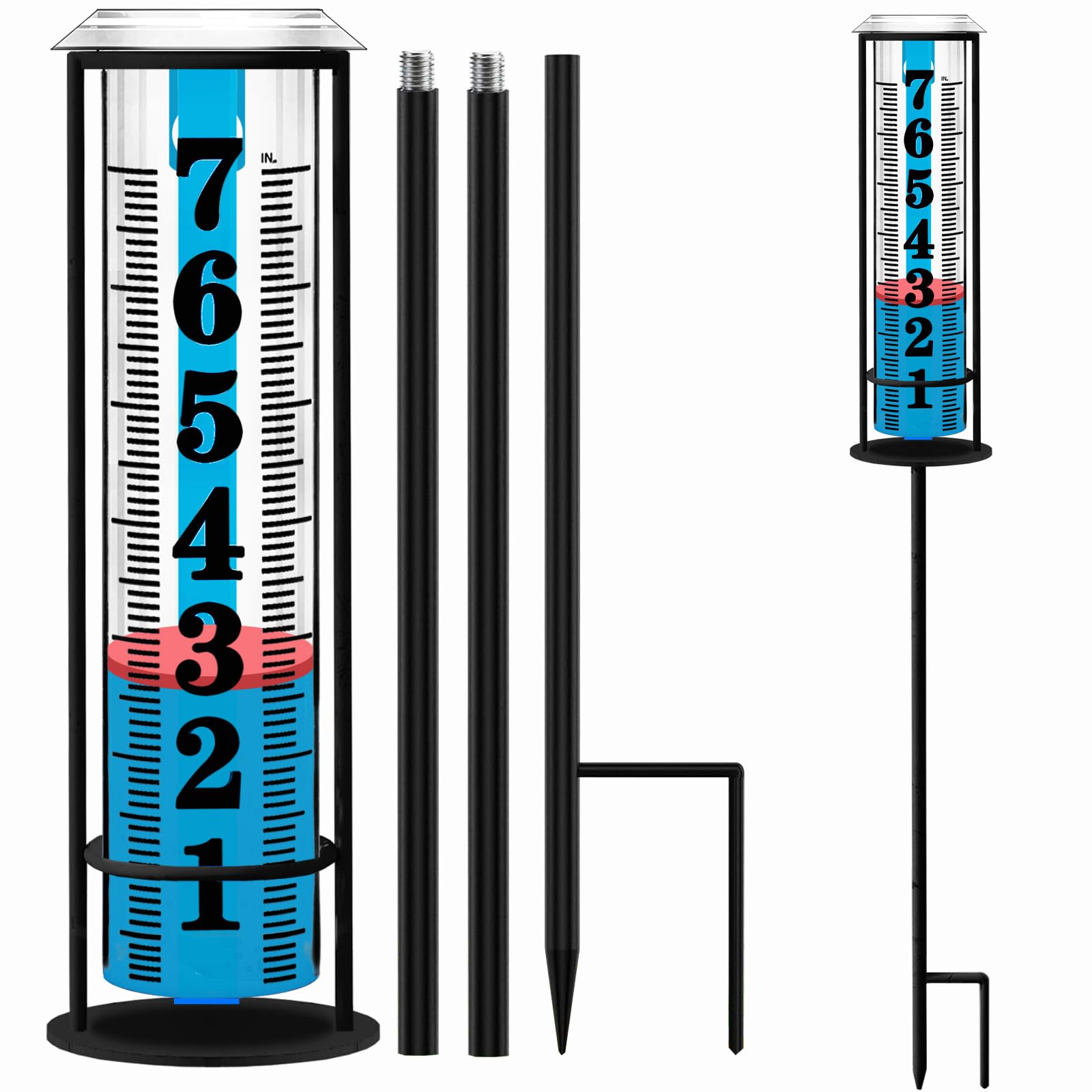
HOBYLUBY Bird Rain Gauge

HOBYLUBY Bird Rain Gauge

Garden gifts

Our Score 9.2/10
Check Price

Worth Noting

  • Glass tube can break in a freeze
Tube
Detachable glass
Frame
Metal bird design
Capacity
7 inches
Dimensions
6 x 2 x 25 inches
Read the full review

Most rain gauges look like plumbing. This one looks like garden art — a metal holder topped with a bird, in copper tones, with a detachable glass tube inside the frame that reads to 7 inches. If you are buying for someone who gardens, that difference matters more than any specification on this page.

It is genuinely functional rather than just decorative. The glass is thick, the graduations are clear, the frame stands 25 inches tall so the tube sits at a comfortable reading height above a border, and assembly is a few minutes with nothing more than a screwdriver. Ours was standing in a bed ten minutes after the box was open.

The trade for glass is fragility. Water left in the tube through a freeze can break it, and the tube is the part that takes knocks from a string trimmer or a boisterous dog. Set it back from the edge of the bed rather than at the corner where the mower turns.

As a measuring tool it trails the precision picks here — a 7-inch tube with ordinary graduations tells you what you need for watering and nothing finer. As an object to look at every day, it is the nicest thing in this group, and the gauge that gets looked at is the one that gets used.

Bottom line: The one we give as a gift: a glass tube in a bird-topped metal frame that reads well enough and looks good enough to leave in the border.

7

La Crosse Waterfall Rain Gauge

La Crosse Waterfall Rain Gauge

Deck rail mounting

Our Score 9.0/10
Check Price

Worth Noting

  • No ground stake included
Capacity
5 inches
Cleaning
Sliding collector and lid
Mounting
2-hole bracket with screws
Dimensions
3.5 x 8.36 x 8 inches
Read the full review

The view from a kitchen window is where this gauge earns its keep. Mounted on a deck rail or a fence, the red float and the big numerals put the level in sight without opening the door, and the wide, shallow body — roughly eight inches square and three and a half inches deep — sits at eye level instead of on top of a post.

The two-piece build is the part we appreciate most. The collector slides off the bracket and the lid slides off the collector, so emptying and rinsing takes seconds at the rail, and two screws hold the bracket to a deck or fence while the gauge itself lifts away in your hand.

Budget for one piece of upkeep: the red float fades toward pink within a season of strong sun. A dab of red paint brings it back and takes minutes. What it will not do is stand in a bed — there is no stake in the box, so this is a post, rail, or fence gauge, fine for a deck and wrong for a border where the nearest mounting point is a long walk from the planting.

Five inches of capacity and a two-year limited warranty round it out. Neither is remarkable, and neither needs to be for a gauge whose job is to be looked at from indoors.

Bottom line: Made for a deck rail and a window view, this is the gauge we point at anyone who wants to read the rain from indoors without a climb.

8

Toiclebor Glass Rain Gauge

Toiclebor Glass Rain Gauge

Clear glass readings

Our Score 9.0/10
Check Price

Worth Noting

  • Printed markings fade in strong sun
  • Glass can break at the base
Tube
Glass with red float
Capacity
7 in / 17 cm
Mounting
Ground stand or wall mount
Graduations
10 per inch and centimeter
Read the full review

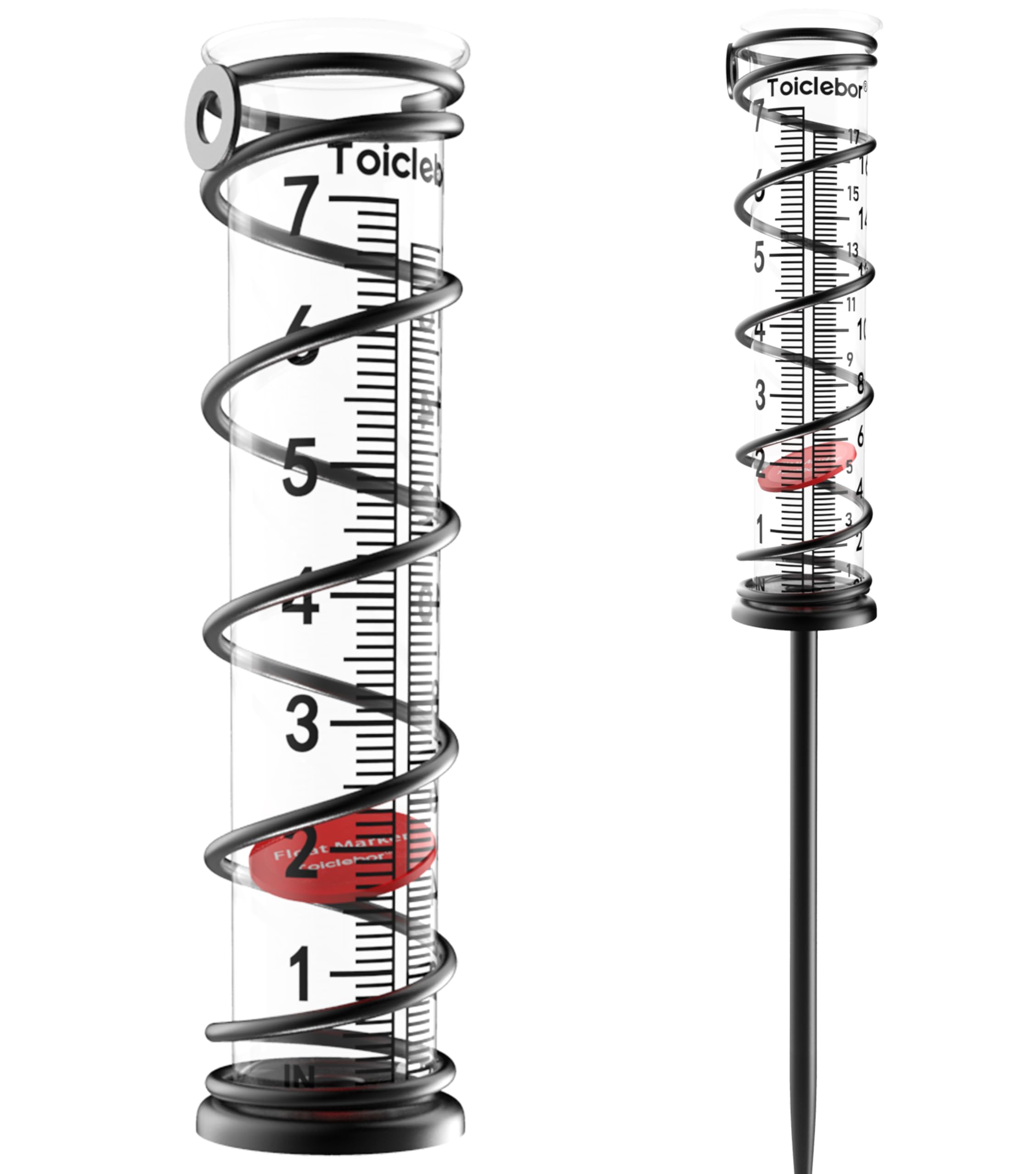
Glass is the reason to look twice at this one. Where the plastic tubes here haze and yellow after a couple of summers, glass holds its clarity, and clarity is most of what a rain gauge is for. The tube runs to 7 inches on a dual scale marked in inches and centimeters with ten divisions to the inch, and a bright red float marks the level.

The stand is more useful than it looks. A metal spike pushes into a bed, and the same bracket can be fixed to a wall or fence, so the gauge can follow the sun or move nearer the window as the season turns. Assembly took us a couple of minutes, and the whole thing sits tidily in a herb bed without shouting for attention.

Two glass-specific costs to weigh. Ultraviolet light takes the printing before it takes the tube — the markings are the part that fades — and a hard freeze with water in the tube can crack it at the base seam. Bring it in for winter, or empty it after every rain once overnight temperatures start dropping.

The red float is what we miss when we go back to a plain tube: it puts the level in view from the far side of the yard, and it is the reason this one gets checked daily rather than weekly.

Bottom line: A glass tube that stays clear and a red float you can see across the yard: worth it if you will bring it in before the first freeze.

How We Tested 12 Rain Gauges Through Eight Months of Weather

We started by pulling together the gauges shoppers actually consider—simple plastic tubes, glass collectors, and a few digital models—then filtered the list by mounting hardware, replacement parts, and whether the markings looked like they'd survive a season outdoors. Price mattered, but only as part of the value question: a cheap gauge that fogs over or loses its numbers by July isn't a bargain. We ended up with 12 units and put them through eight months of real weather, not a lab bench.

Each gauge went up in my backyard, mounted on fence posts and shed walls at the height the instructions specified. I checked them after every storm, sometimes at dusk with a flashlight, and noted whether I could read the water line from a few feet away without crouching. I emptied and rinsed them weekly, watching for debris traps, awkward spouts, and scales that wiped away. To judge accuracy, I poured measured amounts of water into each collector and compared the reading, then set several side by side during the same downpours to see which ones disagreed.

Durability got the slow test: sun, frost, and a few windy weeks that tipped over the weakest brackets. I noted cracks, clouded plastic, fading numbers, and mounts that loosened or required tools to level. At the end, we weighed all of that against price—because the best rain gauge is the one that stays accurate and legible long enough to justify what you paid.

How to Choose Rain Gauges

Decide how far away you will be standing

Before anything else, walk to the window, porch, or gate where you check totals and pace out the distance to the post. Under about 10 feet, almost any gauge with big numerals works. Past 20 feet you want a stretched scale, a colored float, or magnified print, which is why the tall pick here claims readings from 50 feet and a 12-inch tube does not.

The trap is buying capacity when you needed legibility. A five-inch gauge and an eleven-inch gauge look identical from the kitchen if you cannot resolve the lines, and an unreadable gauge becomes a decoration you stop checking by June.

Match the scale and capacity to your rain

Five inches of capacity covers nearly every single storm; seven to eleven inches is for people who want a storm total without emptying mid-way. For record keeping, graduations matter more than capacity: tenth-inch marks answer whether the garden got enough, while hundredth-inch marks let you compare one day against the next.

Know what big capacity costs. Gauges with an outer cylinder typically read the first inch on an inner tube and require pouring off and refilling to measure the rest — fine at a table, annoying in a downpour.

Mount it plumb, high, and clear of splash

Height and level decide whether the number is right. A gauge that leans reads the water line on one wall of the tube and overstates it, and one set too low catches splash from soil, decking, or a roof edge. As a rule of thumb, keep the gauge at least twice the height of the nearest fence, shrub, or wall away from it, and set the base level in both directions.

A removable bracket is worth paying for. Lifting the gauge off to read and empty it beats unscrewing it from a post every time it rains, and it is the difference between a routine you keep and one you abandon.

Plan for the first hard freeze

Water expanding inside a rigid tube is what ends most rain gauges, and it happens on the first cold night after a rainy afternoon. Silicone is the one material here that flexes instead of splitting; acrylic, glass, and thin plastic will crack.

If you prefer not to spend more, treat an acrylic gauge as a two-season item and empty it whenever a freeze is forecast. A spare tube or a second gauge in the shed is cheap insurance against a January morning with no reading.

Frequently Asked Questions

Final Verdict

Eight gauges in, our recommendation has not moved: the Headwind EZRead is the one we put on the post in most yards, because reading 26 inches of magnified float from the kitchen door beats walking out to squint at a tube.

Winter is the exception. If your gauge lives outside through hard frost, the Taylor silicone is the better buy at about the same money — it flexes where rigid plastic splits. Between those two, nearly every yard here is covered.