Soil & Fertilizer

Best Fertilizer for Roses of 2026

A rose that sulks through June is usually telling you something about the soil, not the weather, because roses are heavy feeders and the gap between a few timid blooms and a bush that keeps pushing new canes is often consistent feeding. I learned that with a patio rose that went pale and stingy until I stopped treating fertilizer as an afterthought. What you're buying is a season of stronger growth, more buds, and flowers that hold their color instead of frying in the first hot week. Over one full growing season, we fed 14 rose fertilizers to established bushes, bare-root newcomers, and container roses, watching for what earned its shelf space.

Bottle size is the quiet decider: a concentrate that looks expensive can win on value if it stretches through the season, while a giant jug may lose potency in the shed. Odor matters too—some mixes smell like damp earth, others like a barnyard when opened. Those practicalities shaped our picks, along with one standard: did the roses grow stronger, bloom more, and ask less of us?

1

Osmocote Smart-Release Plus

Top Pick
Osmocote Smart-Release Plus

Set-and-forget feeding

Our Score 9.6/10
Check Price

Worth Noting

  • Two pounds covers only about 75 square feet
Form
Resin-coated granules
Coverage
Up to 75 sq. ft.
Nutrients
11 essential nutrients
Feed Duration
Up to 6 months
Read the full review

Six months of feeding from one application is what makes this the easiest product on the page to live with. A capful — three tablespoons — goes into two gallons of potting soil or over four square feet of bed, and then you're finished until next spring. For a rose you've just planted into a container, that's the difference between a plant you feed and a plant you own.

We think the resin coating earns its keep. Each granule is wrapped in a shell that meters out the eleven nutrients inside, so a rose gets a steady supply instead of a spike and a fade, and the no-burn pledge covers the mistake most people make with granules, which is pouring on more than the label says. Steady is also the limit: this is not the product that rescues a starving rose in July.

Coverage is the number to check before you order. Two pounds treats about 75 square feet — a generous bed of bush roses, or a patio's worth of containers, but not a long border. Count your square footage and buy two containers if that's your garden. It's also the pick here for pots, because it goes in at planting time and never needs mixing in a can.

Bottom line: If you want roses fed without a fortnightly routine, this is the pick: one application meters out nutrition for up to six months, containers included.

2

Miracle-Gro Rose Plant Food

Miracle-Gro Rose Plant Food

All-round rose feeding

Our Score 9.4/10
Check Price

Worth Noting

  • Feeding every 7 to 14 days is real work
Form
Water-soluble powder
Application
Watering can or garden feeder
Feed Interval
Every 7 to 14 days
Target Plants
Roses
Read the full review

A rose food that asks you to feed every 7 to 14 days sounds like a chore, and that's the honest trade with our top pick. It's also why it works: roses throw a flush, rest, then throw another, and a soluble feed on that rhythm keeps nutrients arriving through each one instead of dumping a season's worth into the ground in April. The mix is 1 1/2 tablespoons per 1 1/2 gallons of water for garden roses, or 1/2 teaspoon per gallon for pots.

What sold us is how little friction there is between opening the tub and feeding. It dissolves in a watering can, and it's built to run through a hose-end feeder, which turns a dozen bushes into one pass with the hose instead of twelve trips with a can. Because it's water-soluble, the nutrients are there immediately — no waiting on granules to break down, which is exactly what you want when you're pushing a rose toward a second flush before the season turns.

What we watched for was new basals, bud count and color, and this is a feed that produces visible movement rather than a slow maybe. It's also gentle at the label rate — it's guaranteed not to burn when used as directed, and nothing we saw argued otherwise — and it's labeled for miniatures and container roses as well as big garden shrubs, so one tub covers the whole collection.

The schedule is the whole catch, and it's worth being honest about: every two weeks is easy in May and hard in July. If the can is going to sit in the shed from midsummer on, buy the Osmocote granules below instead — a fertilizer you actually apply beats a better one you don't. If you'll keep at it, this is the rose food that rewards the habit.

Bottom line: Feeding every two weeks is the price of the best results here, and this is the rose food we reach for when someone will actually do it — cheap, fast-acting and simple to mix.

3

FoxFarm Big Bloom

FoxFarm Big Bloom

Organic liquid supplement

Our Score 9.4/10
Check Price

Worth Noting

  • A pint goes fast at 4 tablespoons per gallon
NPK
0-0.5-0.7
Form
Liquid concentrate
Mix Rate
4 tablespoons per gallon
Key Ingredients
Earthworm castings and bat guano
Read the full review

The numbers on the front of a bottle of Big Bloom — 0-0.5-0.7 — look like a misprint next to a bloom booster's 10-52-10, and anyone buying fertilizer by the biggest number walks straight past it. That would be a mistake for roses, as long as you understand what this is: not the main course, but a liquid supplement of earthworm castings and bat guano that goes on between feedings.

The rate is four tablespoons per gallon every other watering, so a pint disappears faster than the bottle suggests — that's the one thing to weigh before you buy. What you get for it is a feed gentle enough to use that often without burning, and quiet enough for a patio: the smell that usually follows organic liquids around simply isn't here. It's a genuinely different input from a salt-based feed too, bringing organic matter along with the nutrients, which is why it suits containers and raised beds where soil life is thin.

Where we think it earns its place is as a partner to a proper rose feed rather than a replacement for one. Run it every other watering alongside a rose-specific or slow-release feed and the flowering response is real — more buds, fuller heads, color that holds. Run it alone on a hungry rose and the low analysis shows.

Bottom line: We think of it as the supporting act rather than the star: an organic liquid that keeps roses flowering between feeds of something stronger.

4

Miracle-Gro Bloom Booster

Miracle-Gro Bloom Booster

Pushing more blooms

Our Score 9.4/10
Check Price

Worth Noting

  • A supplement, not a complete season-long feed
NPK
10-52-10
Form
Water-soluble powder
Feed Interval
Every 2 weeks
Target Plants
Roses, annuals and perennials
Read the full review

10-52-10 is not a balanced diet and it isn't meant to be. It's a bloom-stage push, and we think it's the right buy for a rose covered in healthy leaves and stubbornly short on buds: the nitrogen keeps the plant running, but the phosphorus is doing the heavy lifting, and that's the lever to pull when a rose has size and no flowers.

Treat it as a supplement rather than a season-long feed. A tablespoon per gallon every two weeks through the bud-forming stretch, applied from a watering can or a hose-end feeder, is the schedule on the box and the one we followed. The plants we watched set more buds per stem and opened them with better color, which is the entire point of a booster.

This is a concentrated powder, so measure it: the one-tablespoon scoop is not a suggestion, and overdoing it on a small rose is easy. The upside is how far a four-pound box goes — bloom-stage feeding only takes a few weeks of the season, and the same mix works on hydrangeas, hibiscus and other heavy-flowering shrubs, so nothing sits in the shed if the roses finish early.

Where it fits is established roses in their second season or later, and any rose that grows well but flowers poorly. A newly planted or struggling rose needs a balanced feed first; pushing blooms onto a weak plant is the wrong order of operations.

Bottom line: Buy this one when the roses are big, healthy and refusing to bud — it is a bloom-stage booster, not a season-long feed.

5

Dr. Earth Bud & Bloom

Dr. Earth Bud & Bloom

Organic soil building

Our Score 9.4/10
Check Price

Worth Noting

  • Slower to act than a soluble feed
NPK
3-9-4
Form
Granules
Bag Size
4 lb
Mycorrhizae
Eight strains
Read the full review

Eight strains of mycorrhizae in a bag of 3-9-4 bloom food is the detail that separates Dr. Earth from every other granular here, and it's why we reach for it when someone wants to feed the soil rather than just dose the plant. The bag's promise is steady, consistent growth without the spikes a hard soluble feed produces, and for roses in a mixed border that's the behavior you want.

It goes on the soil and gets watered in — at planting, or as a top-dress scratched into the surface around the drip line. We ran it alongside a liquid feed rather than instead of one, and the roses responded the way a phosphorus-forward organic feed should: heavier buds, good color, and no burn even where we were generous with it. It earns its keep across the rest of a flower border too, dahlias and hydrangeas and hibiscus included, which matters when one bag has to cover everything.

Two practical notes. It smells like a farm supply store when you open the bag, and the smell is gone a day after you water it in, so open it outdoors and don't let it put you off. And it's slower than a soluble feed: this is something you apply before the roses need it, not after they've gone yellow. Where the Osmocote beats it is convenience; where it beats the Osmocote is what it does for the soil.

Bottom line: For a gardener who wants to build soil rather than dose a plant, this is the granular we point to, and the only one here with mycorrhizae in the bag.

6

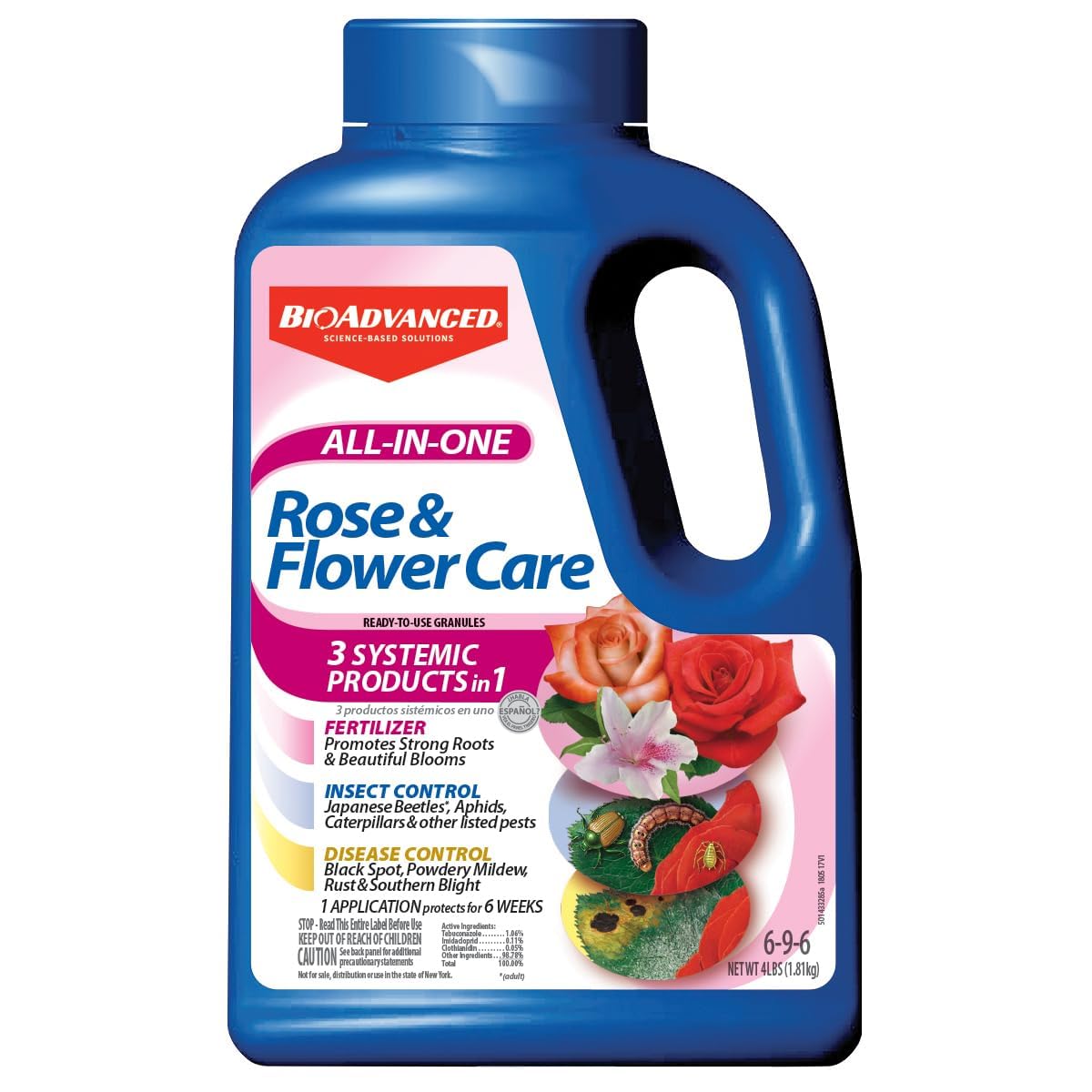
BioAdvanced All-In-One Rose Care

BioAdvanced All-In-One Rose Care

Pest-prone gardens

Our Score 9.4/10
Check Price

Worth Noting

  • Feed and pest control can't be separated
Form
Granules
Insect Control
Aphids, Japanese beetles, scale
Disease Control
Black spot, powdery mildew, rust
Protection Window
Up to 6 weeks
Read the full review

There's a particular rose garden where the question stops being which fertilizer and becomes how few bottles you can get away with: black spot every June, Japanese beetles every July, and a shrub that never quite gets ahead of either. This is the one product here that answers all three at once — a granular rose feed with a systemic insecticide and a fungicide built into the same granule, applied every six weeks.

We think that's good value for a garden under that kind of pressure, because it trades three separate chores for one. What you give up is precision: the feed and the spray arrive together, so you can't stop the insect control once the aphids are gone while the roses still want feeding. The systemic side also means it doesn't belong on roses in open bloom while bees are working — apply it around a flush, not through one.

The label covers up to six weeks of rainproof protection against black spot, powdery mildew, rust and southern blight, plus listed insects including aphids, Japanese beetles, leafhoppers, caterpillars and scale. If your roses have none of those problems, buy a straight fertilizer and keep the chemistry out of the bed. If they have them every year, this replaces three jobs with one, and the roses look better for it.

Bottom line: The best choice here for a garden that fights black spot and beetles every year — one granule feeds, kills and protects, at the cost of doing all three whether you need them or not.

7

Farmer's Secret Fruit & Bloom

Farmer's Secret Fruit & Bloom

Mixed beds and pots

Our Score 9.2/10
Check Price

Worth Noting

  • Eight-ounce bottle is smaller than expected
Form
Liquid concentrate
Mix Rate
1 teaspoon per 2 gallons
Bottle Size
8 fluid ounces
Feed Interval
Every 2 to 4 weeks
Read the full review

One teaspoon per two gallons of water is a dilution that makes you read the label twice, and it explains the appeal of this bottle: it's an eight-ounce concentrate that goes much further than its size suggests. A garden with roses, tomatoes and a few hanging baskets all wanting fed can be covered from the same bottle at the same rate.

It's a liquid, so it goes on with your regular watering — mix and pour, or mix and spray — and the interval is every two to four weeks rather than every week. Roses are named on the label alongside petunias, citrus and cane fruit, and the formulation is built around root strength and nutrient uptake rather than a headline NPK number, which is the right shape for a garden that's already growing well and just needs to flower harder.

Where we think it fits is as the second feed in a mixed garden, the bottle you reach for when the roses, the tomatoes and the pots all need a lift and you don't want three products to do it. The dose is easy to get right once you own a quarter-teaspoon measure, and a two-to-four-week interval leaves room for a missed week.

A teaspoon is fiddly for a single watering can, so halve it for a gallon and use a real measuring spoon rather than the cap. Once that's a habit, this is about as low-effort as feeding gets — one bottle, one scoop, every couple of weeks.

Bottom line: A bottle that goes much further than its size suggests, and a sensible single product for a mixed garden of roses, fruit and pots.

How We Tested Rose Fertilizers

We started with a shortlist of about 30 rose fertilizers sold as liquids, granules, and spikes, then narrowed it to 14 based on label directions, nutrient ratios, package size, and whether the product was meant for established roses or new plantings. I wanted a mix of concentrates, ready-to-use bottles, and slow-release granules because feeding a container rose on a patio is not the same job as feeding a bed of established bushes.

Testing ran through one full growing season, from the first leaf-out in spring to the last flush in early fall. Each fertilizer was assigned to roses in three settings: established in-ground bushes, bare-root plants going into their first year, and container roses on a patio. We followed the label dose rather than guessing, then noted whether it was easy to measure, mix, and apply without clogging a watering can or leaving granules stuck to wet leaves.

Every two weeks we counted new canes and checked leaf color, then tracked buds and open blooms at peak flush to see which fertilizers actually pushed the plants rather than just keeping them alive. We also weighed bottle size against the number of feedings it delivered, so a smaller concentrate that stretched a few extra weeks could beat a cheaper jug on value. Odor got noted at mixing and again an hour later, since a fertilizer that smells like a barnyard is a different proposition on a patio than at the back of a border. Quality showed up in small ways: granules that dissolved instead of crusting, liquids that did not separate, and doses that stayed consistent to the end of the bottle.

How to Choose the Right Fertilizer for Roses

Match the form to your calendar

Water-soluble powders and liquid concentrates are available to the plant almost immediately, which is why they're dosed every week or two. You get control, and you get repeat bloom on roses that flower in waves. Granules and resin-coated slow-release feeds trade that control for time: one application runs for months, and you can't dial it up when a rose starts to sulk.

Our rule of thumb is soluble for a garden you walk past daily, slow-release for containers and beds you see on weekends. Either way, feed a container rose more often than a bed rose — water running through the pot takes nutrients with it.

Read the three numbers, then read them again

Roses want nitrogen for canes and leaves, phosphorus for roots and flower development, and potassium for overall strength. Where gardeners go wrong is assuming the biggest middle number wins. A 10-52-10 bloom booster is a stage-specific tool for bud set, not a season-long diet, and running it every feed for four months gives you a tired plant with great flowers.

Choose a rose-specific or balanced feed as your base, then switch to a high-phosphorus booster when buds start forming and ease off once they open.

Containers are a different job

A rose in a pot has a fraction of the soil volume of one in the ground, so it runs through its nutrients faster and suffers more when you overdo it. That argues for smaller, more frequent doses — the rose-specific powder here lists a separate, weaker mix for indoor and container plants — or for a resin-coated granule blended into the potting mix at planting, which meters feed out and can't be washed away in a week.

Organic, synthetic, and what you'll smell

Organic rose foods — castings, guano, meals — break down slowly and feed soil life along with the plant, which pays off in containers and tired beds. They also smell like what they are, at least until they're watered in, and they're harder to use as a quick fix.

Synthetic feeds are precise, cheap per feeding and fast, but they add salts and do nothing for soil structure, which matters more in a pot than in a border. A combination many rosarians land on: organic granules at planting, a soluble feed through the season, and a high-phosphorus booster at bud set.

Buy for your rose count, not the shelf

Concentrates look expensive and go a long way; big boxes look like value and get used up. Before comparing container sizes, find the mix rate — a product dosed at a teaspoon per two gallons is a different purchase from one dosed at a tablespoon per gallon, and the smaller bottle is often the better buy.

Coverage figures deserve the same attention. A two-pound slow-release container treats roughly 75 square feet, which is a modest bed, so measure before assuming one will do.

Frequently Asked Questions

Final Verdict

For most rose growers, Miracle-Gro's Water Soluble Rose Plant Food is the one to buy: a dedicated rose feed, a mix that works in any watering can, and visible results in new growth and repeat bloom. It asks for a feed every week or two, and it's the budget pick here.

If that schedule won't survive your summer, buy Osmocote's slow-release granules instead — six months from one application is worth more than a better ratio you never get around to applying. And if black spot and beetles arrive every year like clockwork, BioAdvanced's all-in-one handles feed, insects and disease in a single granule.