Soil & Fertilizer

Best Fertilizer for Citrus Trees

A citrus tree that sulks is rarely a mystery for long. Leaves yellow between green veins, blossoms drop before they set, and the fruit that does hang on stays small and pale — all signs the tree has run through whatever was in the potting mix. Fertilizer is the fix, but citrus is fussier than a lawn: it wants steady nitrogen and potassium plus the micronutrients, iron, zinc and magnesium, that keep leaves dark and fruit sweet. Feed it wrong and you'll grow a leafy tree that never hands you a lemon.

I've done more damage with too much fertilizer than too little, so I read labels now the way I read seed packets. Over the past eight months, my team and I fed 14 citrus fertilizers to potted Meyer lemons, a patio lime, and two in-ground orange trees, and the differences showed up in leaf color long before they showed up in fruit. The best ones were patient. The worst greened everything up fast and then went quiet. Every pick below earned its place over a full growing season, in pots and in the ground.

1

Miracle-Gro Shake 'N Feed Citrus

Top Pick
Miracle-Gro Shake 'N Feed Citrus

All-round feeding

Our Score 9.4/10
Check Price

Worth Noting

  • Shaker top can clog mid-application
Form
Granular
Analysis
8-2-10
Package Size
4.5 lb
Feeding Interval
Every 3 months
Read the full review

Three months of feeding from one pass around the drip line is why this is our default pick for citrus. The granular formula runs 8-2-10 and carries magnesium, sulfur and potassium alongside the big three, which is the combination a fruiting tree draws on through a long season — and the schedule is short enough that you will actually remember it. Shake, water in, and the jug goes back on the shelf until the season turns.

Applying it takes a couple of minutes: shake the granules evenly inside the spread of the branches, keep them off the trunk and the foliage, then water. That sounds like a small thing and it isn't. Most citrus feeding fails on frequency rather than formulation, and a product that asks for a watering can and a measuring spoon every week gets skipped by midsummer. This one feeds the tree whether or not you feel like gardening that weekend.

Bud set comes fast after the first application, and the leaves behind it are a deeper green; a container tree responds the same way on a lighter dose. Our one gripe is mechanical. The shaker top clogs, and when it does you uncap the jug and broadcast by hand — a small annoyance on a bag that otherwise does exactly what it promises for lemons, limes, oranges and avocados alike.

Bottom line: We recommend Shake 'N Feed as the default citrus fertilizer: one application feeds for three months, it carries the magnesium and sulfur citrus runs short of, and it works in beds or containers.

2

Espoma Organic Citrus-Tone

Espoma Organic Citrus-Tone

Organic gardens

Our Score 9.4/10
Check Price

Worth Noting

  • Slower to show than a liquid feed
Calcium
5%
Analysis
5-2-6
Package Size
4 lb
Organic Listing
OMRI-listed
Read the full review

Organic certification is easy to print on a bag and harder to stand behind. Citrus-Tone is registered as an organic input material and approved for organic gardening, which is the part that counts when you're feeding fruit you plan to eat, and the analysis is built for citrus rather than borrowed from a tomato feed: 5-2-6 with 5% calcium and the company's Bio-tone microbial blend.

We rate it the organic choice here because the feeding calendar is honest about how citrus grows. Apply late winter before the bloom, again after the spring flush, and once in fall, spreading the granules around the drip line and watering them in. Three dates a year is a rhythm you can keep, and they land on the moments a tree is actually spending energy rather than on an arbitrary schedule.

What the patience buys you is color — leaves noticeably greener a few weeks in, then bloom that keeps coming through the warm months. It's labeled for avocado and nut trees too, so one bag covers more of the yard than the name suggests. Where it loses ground to the liquids is speed: a tree in visible trouble wants a fast correction, and granules that break down on the soil's schedule aren't it.

Bottom line: We choose Citrus-Tone when organic matters: OMRI-listed granules, 5% calcium and a three-date feeding calendar built around bloom, for lemons, limes, oranges and avocados.

3

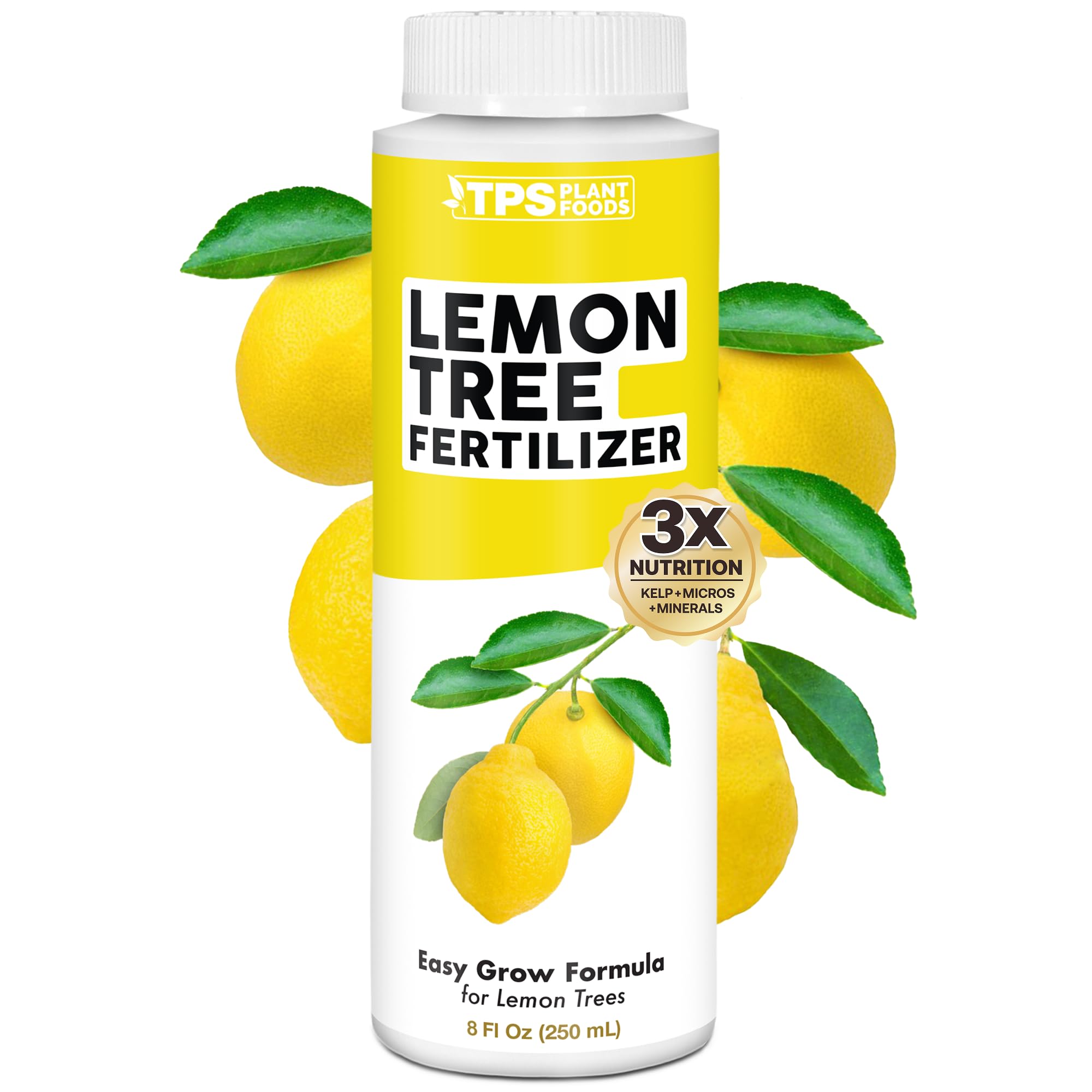
TPS Nutrients Lemon Tree Fertilizer

TPS Nutrients Lemon Tree Fertilizer

Potted trees

Our Score 9.2/10
Check Price

Worth Noting

  • Small bottle empties fast in a full season
Form
Liquid concentrate
Dilution
1:200
Package Size
8 fl oz
Read the full review

Strip the lemon off the label and this is a straightforward liquid plant food at a 1:200 dilution — a small measure in a full watering can, mixed in seconds. It's sold for lemon and citrus trees, the directions cover patio pots as readily as trees in the ground, and there's no smell to speak of and a bottle small enough to live under a sink between feedings.

We reach for it when everything is in containers. Eight ounces lasts a couple of potted trees through a warm season, and the same mix feeds the houseplants on the same shelf, which is the flexibility that earns it a place here — the leaves come in darker and the growth flushes are obvious within a couple of weeks. Endurance is the limit: a weekly program across six or eight pots empties the bottle well before the season ends. One good Meyer lemon and a windowsill is exactly its size.

Bottom line: For one or two potted citrus trees, we reach for this liquid: it mixes in seconds, carries no smell, and doubles as a houseplant feed.

4

Farmer's Secret Citrus Tree Booster

Farmer's Secret Citrus Tree Booster

Small collections

Our Score 9.2/10
Check Price

Worth Noting

  • Weekly mixing is a real commitment
Form
Liquid concentrate
Dilution
1 tsp per gallon
Package Size
8 fl oz
Feeding Interval
Weekly
Read the full review

One teaspoon to a gallon, once a week, is the whole instruction — and at that rate the little eight-ounce bottle delivers more weekly waterings than the size suggests. We like the dose itself: a teaspoon is easy to measure, easy to halve for a pot, and hard to get badly wrong, which is not true of every concentrate on this list.

The label is clearer than most about the two cases that trip people up. A tree in its first season gets one teaspoon a week, and anything in a container gets half the dose or every other week. Keep to that and the response shows up as new leaves and heavier flowering rather than as fertilizer burn on a young tree. The trade is the calendar — this is a weekly habit, not a set-and-forget granule, and a dozen pots turns it into a chore.

Bottom line: We point budget-minded growers to this concentrate: a teaspoon per gallon makes it the most economical feeding per watering can here, with clear dosing for young and potted trees.

5

Down to Earth Organic Citrus Mix

Down to Earth Organic Citrus Mix

Small gardens

Our Score 9.2/10
Check Price

Worth Noting

  • Strong smell, especially when wet
  • Costs more per pound than bulk bags
Form
Granular
Analysis
6-3-3
Package Size
1 lb
Organic Listing
OMRI-listed
Read the full review

Most organic citrus feeds arrive in four-pound bags that take a full season to work through. This one comes in a one-pound box, which is the entire point: it's sized for two or three containers, or for trying an organic program before committing to a larger bag.

The formula is 6-3-3 built from feather meal, fish bone meal, alfalfa meal, kelp and humic acids, with calcium, sulfur, iron and zinc along for the ride, and it's OMRI-listed. Apply three to four times a year — late winter, late spring, early fall — around the drip line, or mixed into fresh soil at repotting.

We keep it in the rotation for a potted Meyer lemon because the response on tired, yellowing leaves is the most convincing thing about it: two applications in, the foliage comes back dark and the tree starts pushing new growth. Two honest caveats. It smells like a fish market, especially after watering, so open it outdoors and store it sealed. And per pound it costs more than the four-pound organic bags, which is what you pay for a size that fits a small garden.

Bottom line: We keep this small organic box for a couple of containers or a first try at organic feeding, where a pound is plenty and a four-pound bag would be waste.

6

GARDENWISE Professional Citrus Fertilizer

GARDENWISE Professional Citrus Fertilizer

Slow, steady feed

Our Score 9.2/10
Check Price

Worth Noting

  • Premium price against the mid-range granules
  • Release depends on consistent watering
Form
Coated granules
Analysis
6-4-6
Package Size
4 lb
Micronutrients
Magnesium, zinc, copper, iron
Read the full review

Coated granules are a different proposition from a plain meal or a soluble powder: the coating melts a little with each watering, so the tree gets a trickle of nutrients across weeks instead of one dose that leaches away. That's the design behind GardenWise, and for a container tree on a regular watering schedule it's a good match.

The analysis is 6-4-6 with magnesium, zinc, copper and iron folded in. That micronutrient list is what separates it from a basic granular feed and the reason the foliage results hold up. It's labeled for indoor and outdoor trees, and the four-pound bag is a two-quart measure, so it stores without turning into a brick.

Application is broadcast and water, same as any granular, and the trees answer it: dense dark foliage, heavy bloom, and fruit that holds on the tree instead of dropping. Nothing about the granule itself is fussy — no mixing, no measuring cups, no smell worth mentioning.

We place it in the premium tier and we're comfortable there. The micronutrient package and the coated release are worth the extra if your citrus lives in pots and you water on a routine, because consistent moisture is what makes the coating work. Water erratically and the granules simply sit there; feed trees in the ground and cheaper mid-range granules do the same job for less.

Bottom line: We like GardenWise for growers who want micronutrients in a slow-release granule and don't mind paying more for that combination.

7

Miracle-Gro Fruit & Citrus Spikes

Miracle-Gro Fruit & Citrus Spikes

No-mix feeding

Our Score 9.0/10
Check Price

Worth Noting

  • Stakes snap at the top in dry or heavy soil
  • One fixed dose, nothing to adjust for pot size
Form
Spikes
Count
12 spikes
Analysis
10-15-15
Feeding Interval
Twice a year
Read the full review

A spike is a fixed dose in a single spot, for better and worse. What you get in exchange is the shortest feeding routine on this page: twelve stakes pushed into the soil around your trees in early spring and again in mid-fall, with nothing to measure, mix or water in.

The 10-15-15 analysis is the most phosphorus-heavy here, and the spikes are also labeled for palm trees, which is handy if your yard mixes the two. Practical note: dry soil and heavy clay are where the stakes snap at the top, so water the ground first and push rather than hammer. Even then, expect some breakage — the stakes are brittle, and the broken pieces still feed.

We treat these as the established-tree option. In the ground, a twice-yearly push is roughly the right amount of feeding, and the convenience is genuine. In a container, the same fixed dose sits in a small volume of soil close to the roots, which is where a spike can do harm rather than good; keep it out toward the rim and water normally. For a lemon in a pot, a granule or a liquid gives you more control.

Bottom line: We suggest these spikes for established trees in the ground, where a twice-a-year push is all the feeding a mature citrus tree really needs.

8

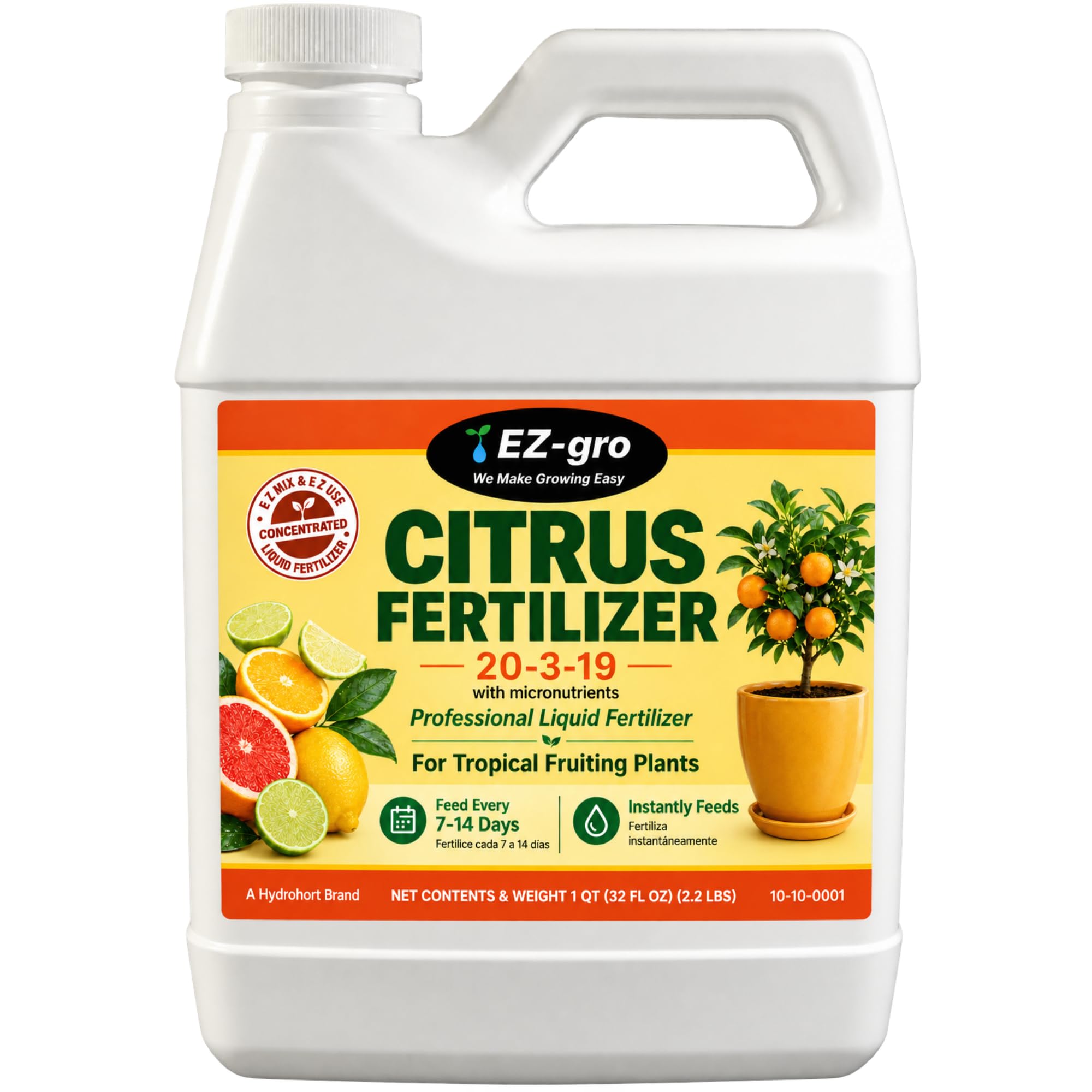
EZ-GRO Liquid Citrus Fertilizer

EZ-GRO Liquid Citrus Fertilizer

Yellowing leaves

Our Score 8.8/10
Check Price

Worth Noting

  • A quart covers relatively few waterings
Iron
Three chelated forms
Analysis
20-3-19
Package Size
32 fl oz
Feeding Interval
Every 7-14 days
Read the full review

Pale leaves with green veins are the classic signature of iron chlorosis, and it's the deficiency citrus develops first in alkaline soil or hard tap water. EZ-GRO's answer is three chelated irons including EDDHA, the form that stays available when pH is working against you. If you've watched a lemon flush yellow every spring and green up only after a struggle, that ingredient list is the one you want.

The analysis is unusual in this group: 20-3-19, heavy on nitrogen for leaf and shoot growth and just as heavy on potash for fruit. It's a liquid concentrate at 1:32, fed every seven to fourteen days, and it's labeled for potted trees as well as outdoor ones, plus mango and avocado.

The new leaves come in green within a couple of weeks, older yellow foliage follows, and flower buds usually aren't far behind. The liquid itself is dark and nearly odorless, and the bottle is a full quart — which sounds generous until you work through the dilution: four ounces go into every gallon of water.

We keep this one for the tree that yellows each spring rather than as the base ration for a row of trees. At its dilution the quart disappears faster than the bottle size suggests, and that is the trade for the fast response. Use it as a corrective, let a granular feed handle the routine, and the math works out.

Bottom line: If your citrus has pale leaves with green veins, we start here: three chelated irons and a high-nitrogen analysis aimed squarely at the problem.

How We Tested Citrus Fertilizers

We started with roughly 40 formulas sold for citrus, in granular, liquid, spike, and foliar form, and cut anything that was a general-purpose lawn feed with a citrus label added, anything whose guaranteed analysis skipped the micronutrients citrus actually needs, and anything priced so high per feeding that it only made sense for a commercial grove. That left 14, from a budget box of spikes to a couple of premium liquids.

Every one went onto the same trees: six Meyer lemons in containers on my patio, a lime in a half-barrel, two in-ground navel oranges, and a row of seedlings I could afford to sacrifice. We fed on the same weekend each time, at the rates on the label, watered in identically, and kept one control tree that got nothing but water.

Ease of use got judged on a Saturday morning with a watering can in one hand — whether the granules dissolved or clogged the rose, whether the scoop matched the dose the label called for, whether the spikes crumbled on the way in. We smelled each product at opening and again two days later, since a fish-based formula that lingers on a patio is a real cost in a small yard. New growth got measured against a marked stake, leaf color got held up to a color card, blossoms and set fruit got counted, and fruit got calipered at harvest. We also tracked how long a container lasted per tree, whether the granules caked solid in the bag between feedings, and how many weeks passed before leaves started to pale again — the fast liquids pushed a flush in two weeks and faded by week eight, while the slow granular feeds held color for a full season.

How to Choose the Right Fertilizer for Citrus Trees

Pick the format you'll actually keep up with

Three formats cover almost every citrus situation. Granules broadcast around the drip line are the easiest thing to live with: one pass feeds for weeks or months and there's nothing to mix. Spikes are the same idea with less precision — a fixed dose in one spot, best for established trees in the ground. Liquids suit containers, where you're watering anyway and can dilute a feed straight into the can.

The trap is buying a liquid because it says lemon on the front. Plenty of them are general houseplant foods, which is fine for a patio pot and thin on the minerals a fruiting tree actually runs short of.

Read the analysis, then look for magnesium and iron

The three numbers are nitrogen for leaf and shoot growth, phosphorus for roots and bloom, and potassium for fruit size and quality. Citrus uses plenty of nitrogen and potassium and less phosphorus than the bloom-booster shelf implies. The deficiencies you'll actually see are magnesium, which draws a green V across a yellowing leaf, and iron, which leaves the veins green and the tissue between them pale.

Before you worry about the ratio, check that the label carries magnesium and iron — chelated iron if your water is hard. That pair matters more on citrus than another point of phosphorus.

Match the schedule to the tree and the season

A mature tree in the ground wants two or three feeds a year, timed around the spring flush and the weeks before bloom. A container tree wants more, because every watering leaches a little away — which is the real argument for a dilute liquid in pots, where a small dose often beats a big one twice a year.

Feed while the tree is growing and pull back when it stops for winter. Indoors, slow growth and wet soil turn an extra feeding into root damage faster than most people expect.

Organic or synthetic, and how big a bag to buy

Organic meals release as soil life breaks them down, which makes them slower and gentler, and they bring calcium and trace minerals many synthetic blends skip. Synthetic granules are predictable, cheaper per feeding and faster on a tree that's already struggling. Neither is a moral choice — it's a question of how much patience you have and what the fruit is for.

The size question is more practical. A one-pound box handles two or three containers for a season, a four-pound bag handles a small orchard, and buying the big bag for one patio lemon usually means storing fertilizer until it cakes.

Frequently Asked Questions

Final Verdict

For most citrus growers the bag to buy is Miracle-Gro Shake 'N Feed: three months of feeding per application, magnesium and sulfur in the mix, and a format that works whether the tree is in a bed or a container. Water it in and the schedule takes care of itself.

If the fruit goes on the table and you want the bag to say organic, Espoma Citrus-Tone is the swap, with calcium and a three-date calendar built around bloom. And if every tree you own lives in a pot, start with the TPS liquid instead — it's the one you'll measure out without resenting it.