Ponds & Water Gardens

Best Pond Waterfall Pumps of 2026

A waterfall pump is doing two jobs at once: lifting water up the height of your spillway and pushing enough volume over the lip to make the sound you actually wanted. Most of the disappointment I hear about comes from shopping the flow rate alone — a pump rated for thousands of gallons an hour at zero lift can barely dribble over a two-foot drop. Get that pairing right and the payoff is a clear pond, a waterfall that sounds like one, and a pump you forget about until the leaves drop.

I've kept a pond for years and replaced enough seized and clogged pumps to be picky. My team and I ran 11 pumps through eight months of real pond duty — a spring algae bloom, a summer of heavy feeding, the first weeks of leaf fall. The ones that held up share a few traits: an impeller that sheds debris instead of jamming on it, a strainer you can rinse in under a minute, and a flow control that dials back without stalling the motor. Below are the ones that survived, matched to the ponds they suit best.

1

Pond Boss Waterfall Pump 2300 GPH

Top Pick
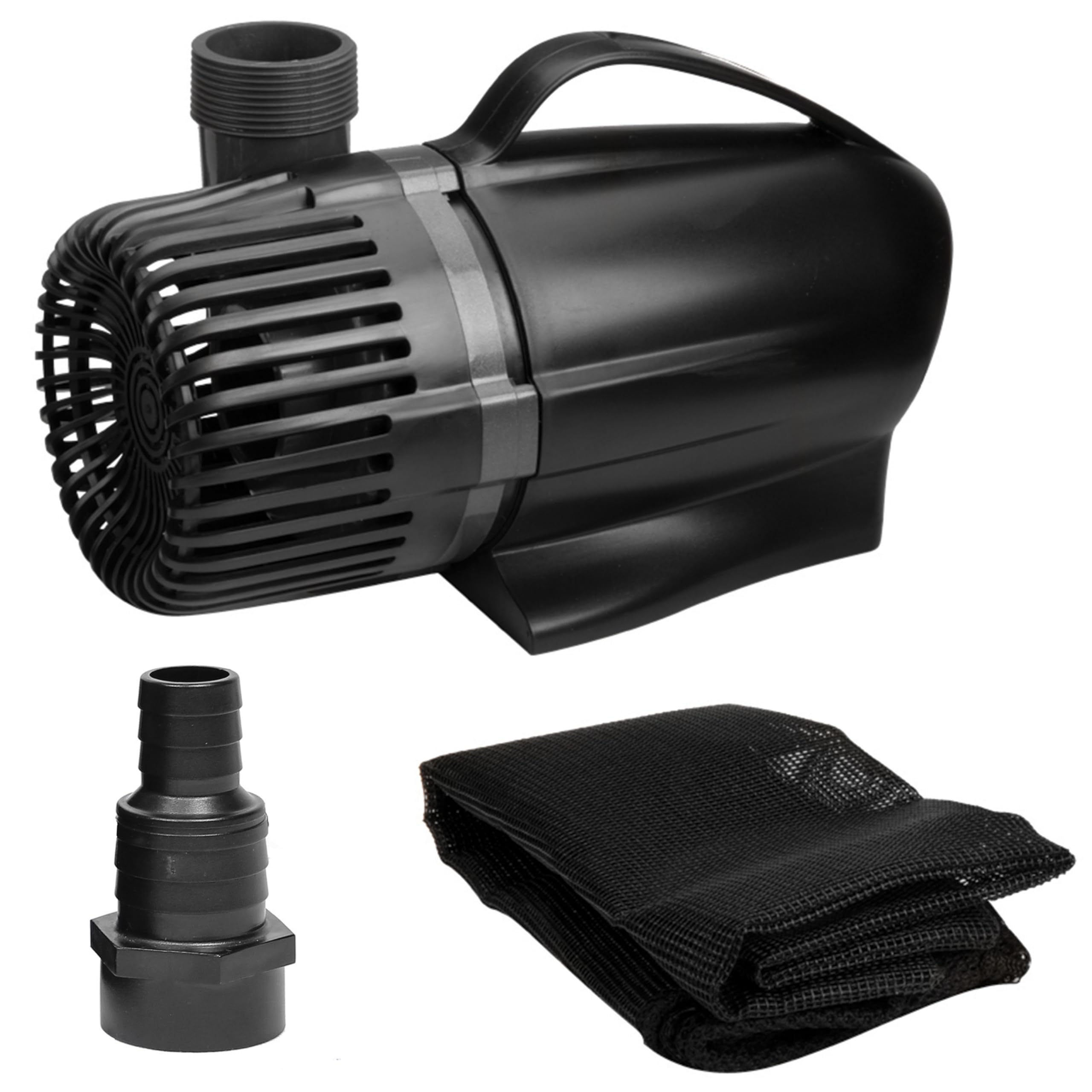
Pond Boss Waterfall Pump 2300 GPH

Garden pond falls

Our Score 9.2/10
Check Price

Worth Noting

  • Audible hum when the falls go quiet
  • Intake guard can break before the motor does
Weight
5 lb
Max Flow
2,300 GPH
Max Lift
16 ft
Body Size
9.25"L x 4.75"W x 6"H
Read the full review

Waterfall duty isn't fountain duty. A falls pump has to move real volume up a rise and keep doing it through leaves, algae and a summer of round-the-clock running, and the Pond Boss is the pump here built around that brief rather than adapted to it. It's rated at 2,300 GPH with 16 feet of maximum lift, which is the right shape for the two- and three-foot cascades most garden ponds actually have.

That 16-foot figure is doing more work than the 2,300. Maximum lift is the height at which a pump stops moving water altogether, and flow tapers off the whole way up, so a pump rated at 2,300 GPH at zero lift delivers a fraction of that at the top of a rock cascade. Sixteen feet leaves comfortable margin for a short climb plus the friction of a long hose run. Push it toward the top of that range and you'll have a sputter, not a waterfall.

Setup is genuinely simple: screened intake, a netted bag over the body to catch the big stuff, hose onto the outlet, and it's running. At five pounds it comes out for a rinse one-handed, which matters more than it sounds when you're doing it every few weeks through the season.

The flow is strong enough that a small, delicate falls can look like a washing machine rather than a waterfall. If you want a quiet trickle over a single rock, plan on a tee or a gate valve to bleed some of it off, and leave yourself the option of running the pump wide open for the rest of the year.

Bottom line: Our pick for most garden waterfalls: 2,300 GPH, 16 feet of lift and an anti-clog intake that keeps a leaf-filled pond running instead of choking.

2

TONGCHANT 1800 GPH Adjustable

TONGCHANT 1800 GPH Adjustable

Tunable waterfalls

Our Score 9.2/10
Check Price

Worth Noting

  • Flow knob only works fully submerged
  • Newest design here, so longevity is unproven
Wattage
100W
Max Lift
13 ft
Cord Length
20.3 ft
Adjustable Flow
700–1,800 GPH
Read the full review

The dial on the TONGCHANT's intake cover runs from 700 to 1,800 GPH, and that range is the whole pitch. You build the falls, decide it looks like a fire hose, and turn it down. No gate valve, no re-plumbing, no second pump.

The rest of the design is sensible in the same practical way. A 180-degree outlet rotates to aim water at the rock without moving the body, the mesh cover and nylon barrier bag both lift off without tools, and the box includes two nozzles, stainless clamps and a 20.3-foot cord. At 100 watts it's the equal of the other 1,800 GPH pumps here, with one exception: 13 feet of maximum lift is the shortest reach in this group, so a falls at the top of a slope is out of its range.

Two things to know before ordering. The knob only does anything with the pump fully submerged, so you set your flow in the pond rather than on the bench. And this is the newest design here, which makes longevity the question mark. What we can say is that it runs quietly, it's UL listed, and it's the easiest pump in this article to tune to a waterfall you actually like.

Bottom line: The pump we suggest when you want to shape the falls by feel: a 700-to-1,800 GPH dial, quiet running and tool-free cleaning for a mid-size pond.

3

Alpine PAL3100 3100 GPH

Alpine PAL3100 3100 GPH

Tall cascades

Our Score 8.8/10
Check Price

Worth Noting

  • 276W draws close to three times the 100W pumps
  • Weakest longevity showing among the big pumps here
Wattage
276W
Max Flow
3,100 GPH
Max Lift
21.5 ft
Cord Length
33 ft
Read the full review

Twenty-one and a half feet of maximum lift is the highest figure here, and it is the only reason you need to read this card. If your falls sit at the top of a bank and the hose has to climb with two elbows in it, this is the pump that still has pressure when the water arrives. Where the Pond Boss runs out around sixteen feet, the Alpine keeps going.

We rate it the pick for tall or long-plumbed cascades, and 3,100 GPH means it can feed a wide weir as well as a high one. The outlet mounts vertically or horizontally with the included adapters, the 33-foot cord is the longest in this group, and the 8 by 5 by 6 inch body tucks behind a rock without a struggle.

The trade is power. At 276 watts it draws close to three times what the hundred-watt pumps here use, and a pump that runs day and night from spring into autumn makes that difference visible on the bill. Cleaning is easy enough — the plastic guard lifts off and the impeller is right there — and it settles to a low hum once the falls are running. On a three-foot cascade this is more pump than you need; on a slope, it's the one that fits.

Bottom line: Buy this one when the falls climb more than fifteen feet — 3,100 GPH and 21.5 feet of head make it the tallest-reaching pump we recommend, if you can live with the wattage.

4

VIVOHOME 1600 GPH Pond Pump

VIVOHOME 1600 GPH Pond Pump

Small koi ponds

Our Score 8.8/10
Check Price

Worth Noting

  • Value is debatable against 1,800 GPH rivals
Wattage
100W
Max Flow
1,600 GPH
Max Lift
15 ft
Cord Length
20.3 ft
Read the full review

Most garden ponds don't need three thousand gallons an hour. They need turnover, a believable curtain of water over the rock, and a pump that doesn't announce itself, and the VIVOHOME 1600 is sized for exactly that pond. It's the one we point to for a koi or goldfish pond where a 3,000 GPH pump would be more spectacle than the garden can absorb.

The hardware is sensible: a five-position outlet you can aim at the falls, a mesh shield over the intake, a carry handle, four suction mounts, two adapters, a filter bag and a 20.3-foot cord. Inside, the motor runs on a ceramic shaft with a silicon carbide drive ring, the wear surfaces that decide how long a pump lasts, and it carries a one-year warranty.

It's quiet in service and easy to live with. The shield keeps leaves and big debris out, though the bag is coarse and fines still get through, so plan on pulling the pump and rinsing it every few weeks in a murky pond. Fifteen feet of lift is the ceiling: plenty for a low cascade over rock, not enough for a falls at the top of a slope.

Bottom line: For a koi pond that needs turnover rather than spectacle, we think the 1600 hits the size, the noise and the warranty without paying for flow you can't use.

5

Hurmovae 1800 GPH Pond Pump

Hurmovae 1800 GPH Pond Pump

Low cascades

Our Score 8.8/10
Check Price

Worth Noting

  • 14 ft lift leaves little margin on tall falls
Wattage
100W
Max Flow
1,800 GPH
Max Lift
14 ft
Cord Length
20 ft
Read the full review

A 180-degree rotating outlet sounds like a footnote until you're kneeling on a liner trying to aim a hose at a rock. The Hurmovae's outlet spins to point where you need it while the body stays put on four suction cups, one of those small design decisions that saves an hour of swearing.

It's also the compact end of the 1,800 GPH class: eight and a half inches long, six and a half pounds, and 100 watts for 1,800 GPH with 14 feet of lift. We rate it the best value of the hundred-watt pumps here, and the mesh cover plus nylon barrier bag mean the intake strips and rinses without tools.

The boundary is the lift. Fourteen feet is plenty for a low cascade and not enough for a falls at the top of a bank, which is Alpine territory. Within its range it runs quietly, hides easily and is simple to clean, and the thermal cut-off and IPX8 sealing are the kind of protection that matters on a pump living outdoors all year.

Bottom line: Compact, quiet and 1,800 GPH from 100 watts — this is the hundred-watt pump we suggest when the falls are low and the budget is tight.

6

OYO Water 3000 GPH

OYO Water 3000 GPH

Large ponds

Our Score 8.6/10
Check Price

Worth Noting

  • Bulky body is hard to hide in a small pond
  • Durability doesn't match the price point
Wattage
155W
Max Flow
3,000 GPH
Max Lift
17 ft
Cord Length
32.8 ft
Read the full review

Three thousand gallons an hour for 155 watts is the number that makes the OYO worth a look. It moves roughly what the Alpine does on a little over half the current, and it does it with 17 feet of lift, which is enough for a two-tier cascade on a big pond.

The build is aimed at dirty outdoor water: an epoxy-sealed IPX8 motor, a mesh strainer plus a barrier bag over the intake, and a 32.8-foot cord that reaches an outlet on the far side of a patio. The outlet rotates, and there is a flow adjustment for tuning the falls without touching the plumbing.

What you give up is subtlety. The body is the biggest here, nearly eleven inches long and close to eight pounds, so hiding it behind a rock takes planning. The manual is thin enough that you will be scanning a QR code for the real instructions with the pump half-submerged, which is exactly when you don't want to be holding a phone over water.

For a pond of a thousand gallons or more, where the falls climb several feet and the outlet is a distance away, the combination of flow, headroom and low draw is the best balance in this group. It's the pump for big water, and it doesn't ask you to feed it like a small power station.

Bottom line: We point big-pond owners here: 3,000 GPH on 155 watts with 17 feet of lift and a cord long enough to reach the far side of the patio.

How We Tested 11 Pond Waterfall Pumps

We began with roughly 40 pumps sold for pond and waterfall duty and narrowed the field by matching published flow to head height — reading the top of the curve, not the flashy number at zero lift. From there we filtered by cord length, whether replacement impellers and seals are sold separately, and price against rated wattage, since a cheap pump that runs all season can cost more than a good one.

The 11 finalists ran continuously for eight months in two working ponds: a koi pond with a two-foot spillway and a smaller preformed pond feeding a short rock cascade. Every two weeks we timed how long each pump took to fill a five-gallon bucket at the top of the waterfall, so flow was measured after the lift rather than trusted from the box. We watched the lip, too: pumps with high output but weak lift give you a thin sheet of water, not a fall. On the smaller pond we ran each at full, half, and its lowest setting to see whether the flow control slipped or the motor chattered when turned down.

Reliability showed up as the absence of emergency cleaning. Once a week we pulled each intake screen and foam prefilter to see what it caught — blanket weed, koi food, maple seeds — and noted whether debris had wrapped the impeller or passed through. A pump that jams on a single leaf is one you'll be kneeling in mud over. At the end of the run we shut everything off and inspected impellers and housings for wear, chalky UV damage, and hairline cracks, and checked which parts could be bought on their own. For value, we metered the watts each pump drew at its working setting and ran the math on a season of electricity against what it cost up front.

How to Choose Pond Waterfall Pumps

Start with the climb, not the gallons per hour

Every foot you raise the outlet costs flow, and the rated maximum lift is the height at which a pump stops moving water entirely. That is why a 3,000 GPH pump can look feeble at the top of a four-foot cascade. Measure the vertical rise from the water surface to the top of the falls, add a little for elbows and a long hose, and then buy a pump whose lift rating clears that figure by a comfortable margin.

In this group the spread is wide: the TONGCHANT tops out at 13 feet, the Alpine at 21.5. If your cascade is two feet, almost anything here works; if the falls sit at the top of a bank, pay for the headroom.

Match the flow to the look you want

Two pumps with the same rating produce very different waterfalls. A wide weir wants volume; a narrow rock spout wants pressure and will look like a pressure washer if you overdo it. Adjustable flow is the feature buyers underestimate — the TONGCHANT's dial and the OYO's adjustable outlet let you shape the falls after installation instead of adding a gate valve.

If you are between sizes, buy the bigger pump and a valve rather than the smaller one and a regret. The Pond Boss at full output is more than a delicate single-rock falls wants, and bleeding some of that off is a five-minute plumbing job.

Watts are a season-long bill

A waterfall pump runs around the clock from spring into autumn, so wattage matters more than the purchase price suggests. The 100-watt pumps here use roughly a third of the electricity of the Alpine's 276-watt motor for the same running hours, and the OYO proves you can have 3,000 GPH for 155 watts.

Work out the flow you need at your head height first, then take the lowest wattage that delivers it. A cheap pump that is twice as thirsty stops being cheap by midsummer.

Debris handling and the parts that fail

Pond water is dirty water. Mesh covers, filter bags and screened intakes are what keep leaves and blanket weed out of the impeller, and the pumps that are easy to live with are the ones you can strip by hand — the TONGCHANT, Hurmovae and VIVOHOME all come apart without tools.

Failure in this category is unpredictable: well-liked pumps here have quit inside a season, and the intake guard is often the first thing to break. Buy from a seller with a real return window, keep the intake out of the silt, and rinse the rotor whenever the flow starts to drop.

Cord length decides where the pump can live

Twenty feet covers most pond-side outlets. If yours is at the far end of a patio, the Alpine's 33 feet and the OYO's 32.8 feet save you an extension cord and a wet connection at the end of it.

Set the pump on a flat base or its suction cups rather than pushing it into the silt, and leave enough slack in the cord to lift the pump out for cleaning without unplugging anything.

Frequently Asked Questions

Final Verdict

For most garden ponds the Pond Boss is the pump to buy. It has the flow, the lift headroom and the debris handling a rock cascade actually needs, and it stays usable without a valve. The Alpine is the exception that earns its higher wattage: when the water climbs more than fifteen feet, nothing else here reaches.

If you are moving a thousand gallons or more and would rather not feed a 276-watt motor, the OYO delivers nearly the same flow on a little over half the power.