Ponds & Water Gardens

Best Solar Pond Pumps of 2026

A solar pond pump does one job with no cord and no outdoor outlet: a panel collects light, a controller turns it into current, and a small impeller pushes water up a hose and over the liner's edge. What separates a pump you forget about from one you resent isn't the concept — it's panel wattage, the height it can genuinely push water against, and whether a battery keeps a trickle going after the sun drops behind the fence. Done right, it keeps water moving and oxygenated so a pond doesn't become a still, algae-slick puddle by midsummer.

I've kept a lined pond in my backyard for years, and I've learned that the flow rating on the box is measured at zero lift — a pump sold as 200 gallons per hour may barely wet a two-foot spillway. Over the past eight months, my team and I have run 12 solar pumps in stock tanks and garden ponds, and the winners rarely had the biggest number on the box. Below are the ones that earned their place, sorted by what they're actually good at.

1

My Natural Pond 50W Solar Pond Pump Kit

Top Pick
My Natural Pond 50W Solar Pond Pump Kit

Pond circulation

Our Score 9.2/10
Check Price

Worth Noting

  • No battery, so output fades without sun
  • Two large panels need a sunny mounting spot
Max Flow
898 GPH
Max Lift
9.86 feet
Solar Panels
Two 25 W
Read the full review

Eight hundred ninety-eight gallons an hour. That figure is why this kit takes the top spot: it's the only pump here that moves pond-sized volume, and volume is what actually turns water over and pushes it up a waterfall. The lift rating tells the same story — 9.86 feet, against 65 inches for the fountain pumps on this page.

The package is genuinely complete: the submersible pump, two 25 W panels, and the hose to join them. Each panel measures 21 by 15 inches, so this isn't a rig you tuck behind a shrub — you need a fence, a shed wall, or a stand with room for both, aimed at the same patch of sky. Assembly is plug-and-play, and we appreciated that there's no controller to program or schedule to set before the water starts moving.

Sun is the entire fuel supply. There's no battery in this kit, so a grey morning means a slow pump and dusk means silence; the description is clear that it needs sunshine or very hazy cloud to run. If your pond is a daytime view and you want turnover rather than a light show, that's an easy trade to accept. If you're buying for the sound of water on the patio after dinner, it isn't the right pump and the battery-backed model below is.

It also doesn't spray. This is a circulator: water goes out through the hose and appears where you point it, and fountain duty is deliberately a different product in the same range. For a pond of any real size, that's the honest way to build one.

Bottom line: If you have a real pond to turn over, this is the kit we point you to: 898 gallons an hour, a 9.86-foot lift, and panels and hose in the box.

2

POPOSOAP 6.5W Solar Fountain Pump

POPOSOAP 6.5W Solar Fountain Pump

Bird baths

Our Score 8.0/10
Check Price

Worth Noting

  • Plan on a season or two of service
Panel
6.5 W
Tubing
5 feet
Max Lift
65 inches
Battery Backup
3000 mAh
Read the full review

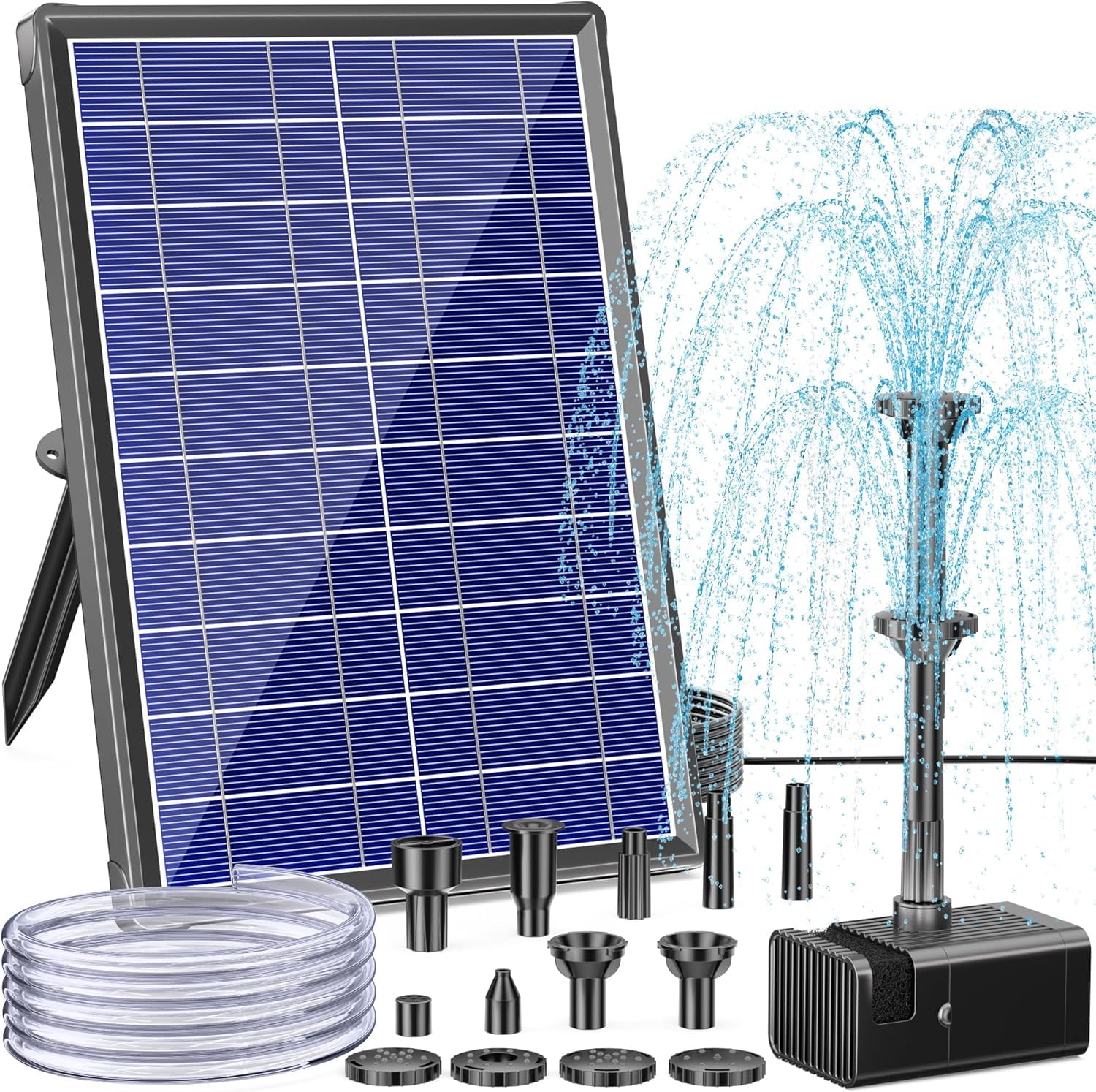
A 3000 mAh battery inside a fountain pump is the reason this one makes the list. It charges through the day and keeps the spray going as the light drops, which is exactly when a bird bath earns its place in the garden — the evening, when you're actually sitting outside. The panel tilts through 180 degrees, so you can chase the sun without reaching into the water to move the pump.

Setup takes a couple of minutes: float it, or run the 5 feet of tubing to a small return, then angle the panel. Eight nozzles take you from a low burble to a tall jet, and the dry-run cutoff proves itself in July, when a shallow bath can lose an inch of water a day to evaporation and splashing. A pump that shuts itself off beats one that burns out while you're at work, and that protection is what we'd point to first if you're choosing between this and a cheaper head.

Where it runs out of road is volume. Sixty-five inches of lift and a fountain-sized impeller won't turn over a pond of any size, and if you're hoping to feed a waterfall this is the wrong tool entirely. For a bath, a half barrel, or a small preformed basin, it's ample — and it's the only pick here that keeps going once the sun has gone.

Bottom line: For a bird bath or small basin where you want water moving at dusk, this is our pick — the battery does real work and the nozzle kit covers everything.

3

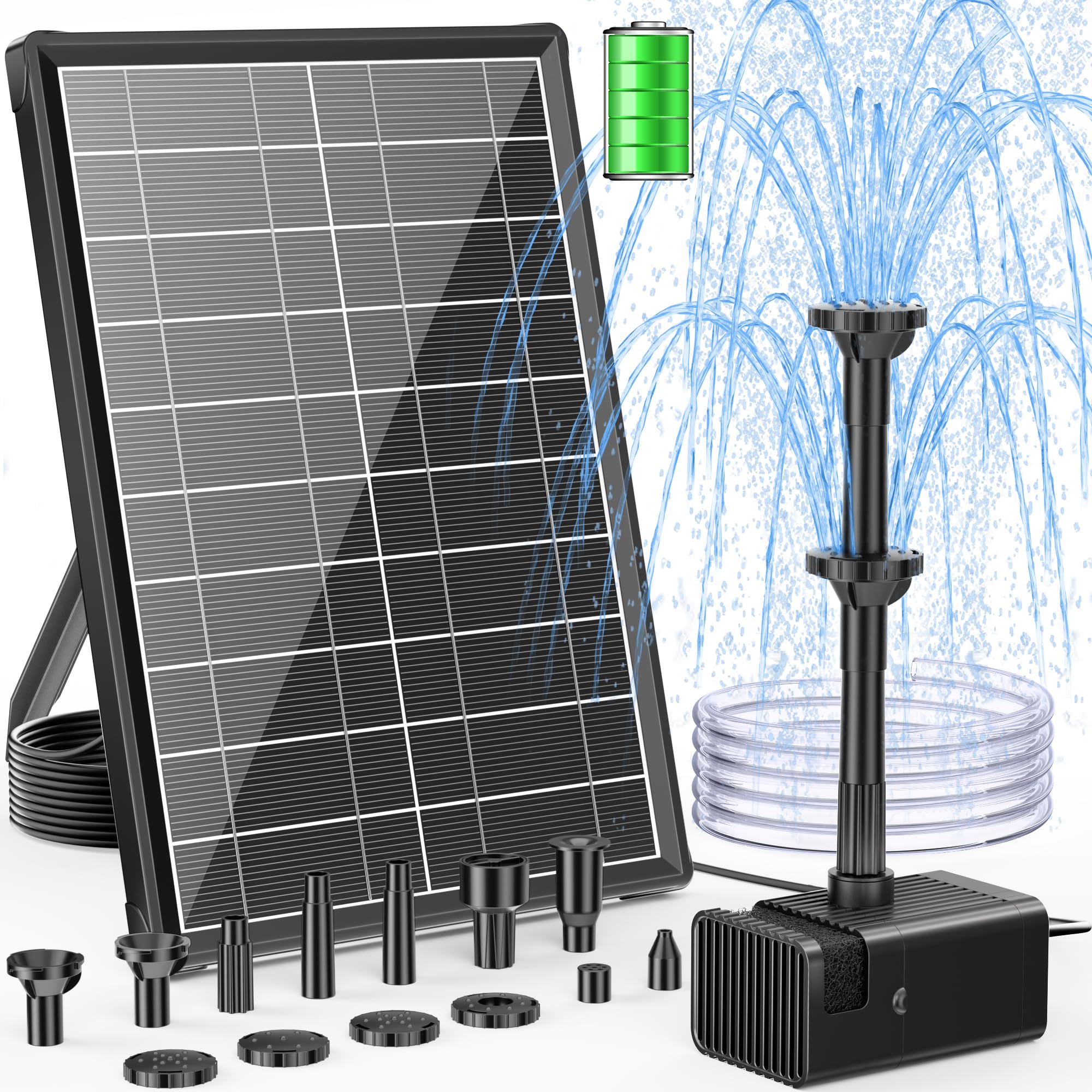
Antfraer 8W Solar Fountain Pump

Antfraer 8W Solar Fountain Pump

Small water features

Our Score 8.0/10
Check Price

Worth Noting

  • Shortest service record of the picks
Panel
8 W
Tubing
5 feet
Warranty
1-year replacement
Spray Nozzles
8
Read the full review

This is the least expensive pick here, and it doesn't read like a penalty box: an 8 W panel, eight spray heads, 5 feet of tubing, and a ground stake for the panel. Set against the battery-backed model above, you're giving up the after-dark running and keeping a little money in your pocket.

The mounting hardware is more than we expected at this end of the range. A 180-degree stake lets the panel stand out on the lawn while the pump sits in the water, and suction cups cover the case where you'd rather fix it to a submerged surface. That flexibility matters more than it sounds, because panel position decides how well the whole thing performs. It also carries the only stated warranty in the group — a one-year replacement promise, with 60 days to send it back — and for something that sits outdoors running all day, that counts.

What holds it back is history. There's far less of it behind this pump than behind the two POPOSOAP models, and for a device that lives in water year-round, that's the one thing we can't shortcut. Buy it when the budget is the deciding factor and a replacement promise is the reassurance you want.

Bottom line: The budget pick that doesn't feel like one: 8 watts, eight nozzles, flexible mounting, and the only stated one-year replacement warranty in this group.

4

POPOSOAP 8W Solar Fountain Pump

POPOSOAP 8W Solar Fountain Pump

Bigger basins

Our Score 8.0/10
Check Price

Worth Noting

  • After-dark runtime is brief
Flow
290 L/h
Panel
8 W
Max Lift
65 inches
Battery Backup
3600 mAh
Read the full review

The bigger battery in this version buys less than the number suggests. Where the 6.5 W model keeps a bird bath going into the evening, the extra capacity here works better as a cushion for cloudy spells — and we wish the battery came with a runtime figure, because milliamp-hours alone don't tell you whether you get minutes or an evening.

What the extra panel does buy is recovery. Eight watts against six and a half means the pump climbs back to full output sooner when a cloud passes and holds a stronger spray in thin light, which is worth having if your feature sits where the sun only reaches it for part of the day. Flow is quoted at 290 liters per hour and lift at 65 inches, the same as its smaller sibling.

We came away seeing this as a light upgrade rather than a different pump: same eight nozzles, same 5 feet of tubing, same floating install. If you want more headroom for a bigger basin or a spot that only gets half a day of sun, it's a reasonable step up. If evening water is the whole point, the smaller model gets you there for less.

Bottom line: Worth the small step up if your feature sits in thin light: more panel, more battery, and the same eight nozzles and 65-inch lift as its smaller sibling.

How We Tested the Best Solar Pond Pumps

We started by gathering every solar pond pump we could find from brands with a track record in water gardening, then cut the list by panel wattage, battery capacity, rated head height, price, and what actually ships in the box. That left 12 pumps, which we ran for eight months — from the first warm weeks of spring into fall — in a 150-gallon stock tank and two lined garden ponds.

Setup happened on the lawn, bare-handed, with only what came in the box. We timed how long each pump took to assemble and get water moving, and noted whether the fittings matched a standard hose and fountain head or sent us digging for adapters. Each one then ran at zero lift and again with the outlet raised three feet, because a flow rating printed on a panel rarely survives contact with a real waterfall.

From there we logged the unglamorous things that decide whether you keep a pump. We watched how fast flow dropped on hazy mornings, how long the battery kept a trickle going after sunset, and whether the pump restarted on its own the next day. Every unit stayed outside through rain, a week of 95-degree heat, and the first frost to see how housings, seals, and panel coatings held up. We also looked at them the way a visitor would — a glossy black panel floating in the middle of a lily pond is a very different sight from a pump tucked under a rock — and counted it against a model when it needed extra fittings or a bigger panel to do the job we'd bought it for.

How to Choose Solar Pond Pumps

Circulator or fountain topper?

A pond pump's job is turnover: draw water in, push it through a hose to a waterfall or return, and keep the surface moving. A fountain pump's job is display: sit it in a basin and let it spray. The My Natural Pond kit is the only true circulator here, with 898 GPH and a 9.86-foot lift. Everything else is a fountain head that can push a hose a few feet at most.

If your feature is a bird bath, a half barrel, or a small preformed basin, a circulator is overkill and you'll pay for capability you can't use. If you're trying to feed a waterfall or turn over a pond, no fountain pump on this page will do it, however generous its nozzle count looks.

Read flow and lift together

Flow figures are quoted at zero lift, and they fall away as the outlet climbs. A pump rated at 898 GPH delivers a fraction of that at the top of a three-foot waterfall, because every inch of rise costs volume. That's why a 65-inch maximum lift and a 9.86-foot maximum lift describe two different jobs, not two points on one scale.

Measure from where the pump will rest to the highest point the water has to reach, add a little for the hose run, and compare that number with the lift rating first. Then look at flow. Buyers who compare flow alone usually end up with a pump that sputters at the top of a rise.

What a battery actually buys

A battery smooths out passing cloud and carries the pump into the evening, which is when most of us are actually outside looking at the water. The 3000 mAh pack in the POPOSOAP 6.5 W does real work in a bird bath. What it doesn't do is run all night.

So buy the battery for the hour after sundown, not for darkness. If your pond is a daytime view, put the money into panel wattage instead — more watts recover output faster in thin light, and that's a benefit every day rather than for twenty minutes.

Panel placement decides whether it works

Every pump here is direct-sun equipment, and a panel in a shrub's shadow will disappoint you whatever the wattage claims. Work out the sunniest spot first and the water feature second; the tubing and the panel lead decide how far apart they can live.

The 50 W kit ships two panels, each 21 by 15 inches. That's real surface area on a fence or a stand, and both panels need aiming at the same patch of sky. A single small panel is easier to hide, but it also gives you far less to work with on a hazy afternoon.

Grit, filters, and how long it lasts

These pumps live in dirty water. Leaves, blanket weed, and silt clog an intake fast, and a clogged pump runs hot and dies young. A dry-run cutoff is genuinely worth having — it stops the motor when the basin runs low instead of burning it out — but it doesn't replace rinsing the intake every week or two through summer.

Treat any pump at this scale as a wear item rather than a fixture, and look at the warranty before you decide. One pick here carries a one-year replacement promise, and that's a more useful reassurance than a longer nozzle list.

Frequently Asked Questions

Final Verdict

For a pond that needs turning over, the My Natural Pond 50 W kit is the clear answer: it's the only pump here with the flow and the lift to feed a waterfall, and it arrives as a complete package you can have running in an afternoon.

If your water feature is a bird bath or a half barrel, though, it's more machine than you need. Take the POPOSOAP 6.5 W when you want water moving after sundown, or the Antfraer 8 W if the budget is the deciding factor and a one-year replacement promise is the reassurance you're after.