Ponds & Water Gardens

Best Pond Deicers of 2026

The first hard freeze turns a pond into a sealed lid. Gases from decaying leaves build up under the ice, oxygen can't get in, and fish that were fine in October are suddenly in trouble. A deicer isn't a pond heater — it holds a small circle of open water so the pond can breathe, and that circle is often the difference between a spring full of fish and one that never wakes up. The failure is usually the same: a unit that quits during the one cold snap that matters.

I've chipped enough ice off a skimmer to be picky. Over a full winter, we ran 11 deicers on ponds from a few hundred gallons up to a full koi setup. The ones that held up shared two things: honest wattage for the size of the pond, and a thermostat that cycles instead of running flat out. Buy for the coldest week of your year, not the average one — a unit that's merely adequate in a mild January ices right over in a real freeze. The picks below are the ones that kept a hole open.

1

Kasco 2400D De-Icer

Top Pick
Kasco 2400D De-Icer

Large ponds

Our Score 9.4/10
Check Price

Worth Noting

  • Requires a sturdy mount and 120V service
Motor
1/2 hp
Weight
25 lb
Cord Length
50 feet
Open-water Area
30 to 65 ft diameter
Read the full review

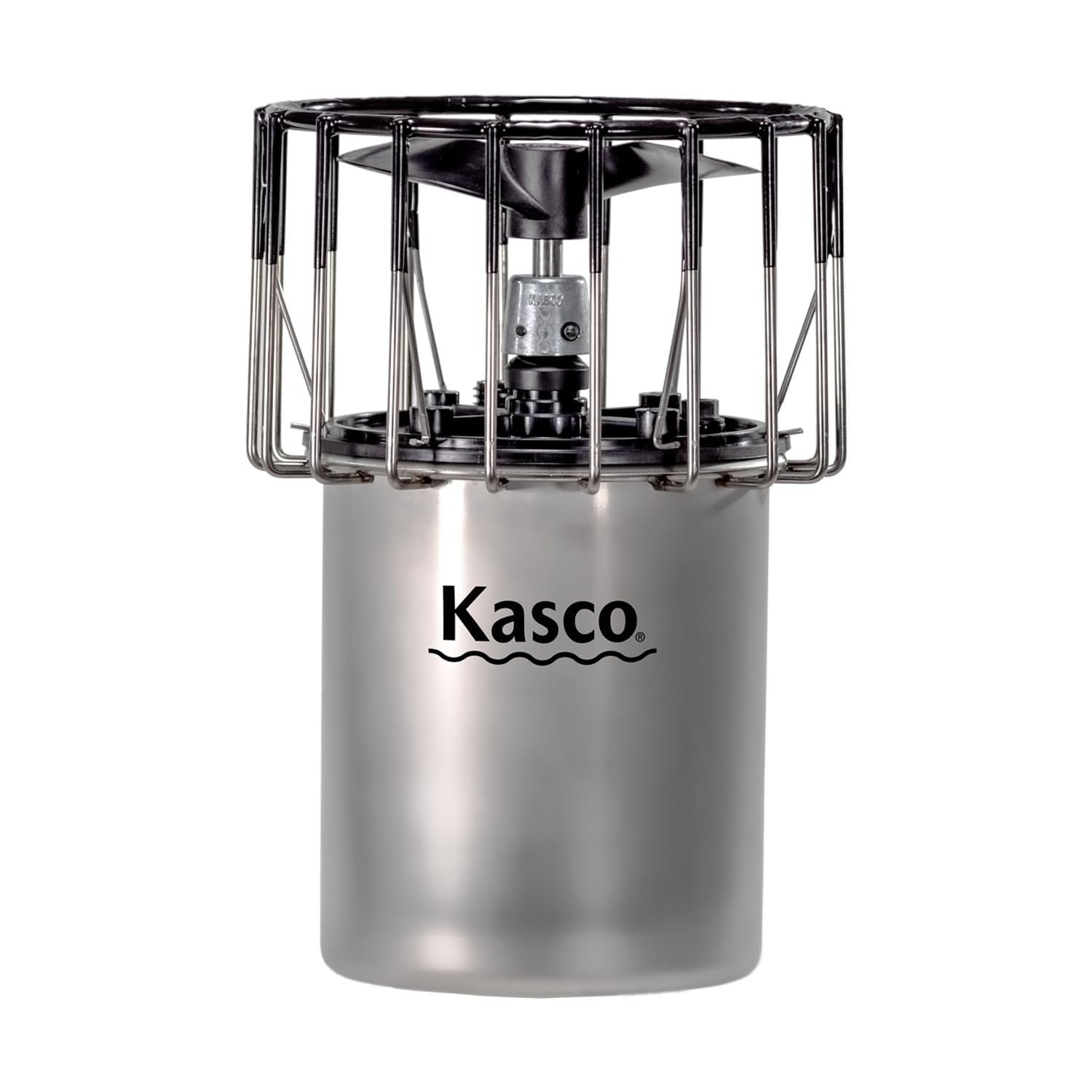
A 30- to 65-foot opening is a different job from keeping a 12-inch vent hole in a garden pond, and the Kasco is built for that bigger job. This is a half-horsepower propeller deicer, not a heating element: its 1,750-rpm motor pushes warmer bottom water to the surface, which is why it can clear a wide area around a dock or in a large pond. The 50-foot cord and 25-pound stainless body tell you it is a serious piece of waterfront equipment.

We were struck by how much the Kasco is a piece of waterfront equipment rather than a pond accessory. It moves a lot of water, and the ETL and UL listings are reassuring for something that runs continuously in cold water. The propeller needs enough depth to work cleanly, so it is not a drop-in float. Set up correctly, it keeps a broad area open and doesn't rely on a thermostat cycling a heating element.

For a small garden pond, it is simply too much: too much power, too much cord, and too much hardware. For a dock, a boat lift, or a large pond where ice damage is the concern, the scale is the point. We keep it on our short list for those buyers and not for anyone else.

Bottom line: We keep the Kasco on our short list for docks and large ponds; its half-horsepower circulator opens a wide area that no floating heater here can match.
2

Farm Innovators P-418 4-Pack

Farm Innovators P-418 4-Pack

Multiple ponds

Our Score 8.8/10
Check Price

Worth Noting

  • Short cord limits placement
Cord
Chew-proof protector
Guard
Caged barrier
Pack Size
4 units
Thermostat
Self-regulating
Read the full review

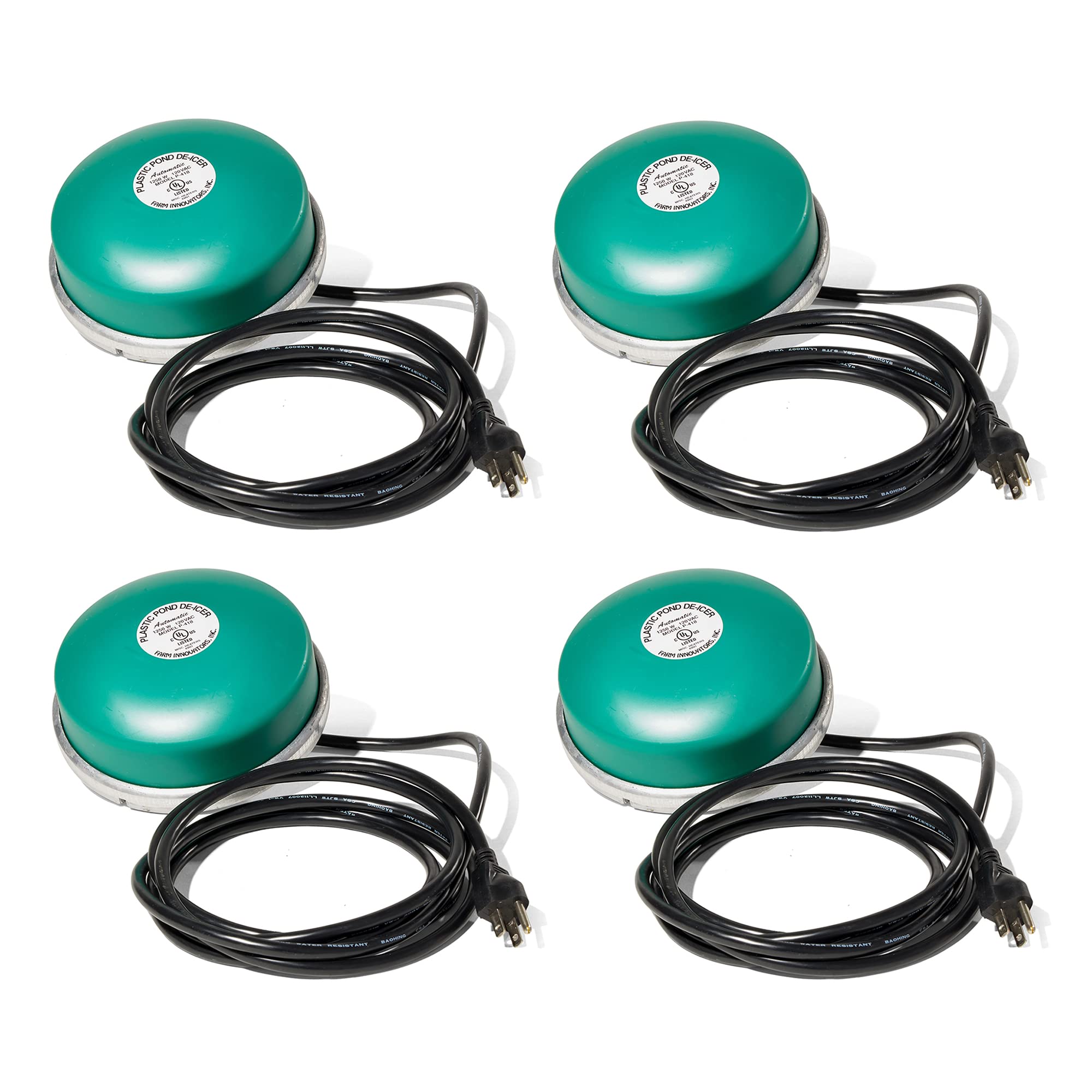
Four deicers in one box is the reason this pick exists. The Farm Innovators P-418 is a floating, thermostatically controlled unit with a caged barrier and a chew-proof cord protector, and the four-pack makes sense for someone running several small ponds, a koi setup with a spare, or a farm with multiple water features. The cage is the detail we appreciate most: it keeps the heating element away from fish and plants while still letting water circulate.

We see it as a multi-pond kit rather than a single-pond upgrade. Each unit maintains a vent hole, and the thermostat is designed to operate only when needed. The chew-proof cord protector is a practical answer to wildlife and dogs that mistake a dangling cord for a toy. In our testing, the cage made the unit feel less exposed than a bare element, and the floating body was easy to see and reposition.

The catch is that one pond rarely needs four units. If you have several ponds or want spares on the shelf, the pack turns a chore into a rotation; if you have one small pond, a single unit from another pick is the cleaner buy. The extra units also give you a cushion because these floating heaters do not last forever.

Bottom line: We like the Farm Innovators four-pack for anyone running several small ponds, with caged, chew-resistant units that can be rotated or kept as spares.

3

Allied Precision 7521 De-Icer

Allied Precision 7521 De-Icer

High-output ponds

Our Score 8.8/10
Check Price

Worth Noting

  • Short six-foot cord
Power
1,500 watts
Listing
CSA and UL listed
Cord Length
6 feet
Heating Element
Stainless steel
Read the full review

The 1,500-watt rating is the first thing to understand: this is a high-output heater for a big, exposed pond, not a sipper for a patio water garden. The Allied Precision 7521 is a floating unit with a buoyant enclosure and a stainless-steel heating element, and it weighs only about a pound, so it rides high and is easy to reposition.

We appreciate the stainless element because rust and scale are constant companions in pond water. The enclosed float is designed to withstand the elements, and the CSA and UL listings are the right baseline for an outdoor electrical product. This is a brute-force design: it puts heat into the water without the thermostat cycling you get on some other picks.

We choose it when the pond is large, exposed, and close to an outlet. For a small garden pond, it is more heater than you need; for a big, windy pond, that is the point. The simple float and stainless element are easy to inspect at the end of the season, which matters when a unit has been working hard.

Bottom line: We reserve the Allied Precision for large, exposed ponds near an outlet, where its 1,500-watt output earns its keep despite the short cord.

4

TURBRO PD400A Pond De-Icer

TURBRO PD400A Pond De-Icer

Most garden ponds

Our Score 8.6/10
Check Price

Worth Noting

  • No stated pond-gallon rating
Power
400 watts
Housing
Stainless steel
Cord Length
32.8 feet
Water And Safety
IP68; GFCI plug; UL cord
Read the full review

The 32.8-foot cord and GFCI plug are the first things we noticed, because they solve the two chores that make a pond deicer annoying: reaching an outlet and worrying about water near the electronics. The TURBRO PD400A is a 400-watt floating heater with a full stainless-steel casing and an IP68 rating, and it feels more like a sealed appliance than a plastic puck. We also appreciate the red and green indicator lights, which let you check from a window whether it is heating or resting.

In our testing, the long cord gave us far more placement freedom than the short-cord units here. You can set the float where the ice tends to form and still reach a house outlet without an extension cord. The stainless body resists rust and scale, and the built-in overheat protection and GFCI plug are the kind of details that matter when the unit sits in water for months. The thermostat cycles the heater on and off rather than leaving it at full draw.

For most backyard ponds, 400 watts is a sensible middle ground: enough to keep a usable vent hole without the current draw of a 1,500-watt brute. We reach for it first when we want one less thing to worry about in January.

Bottom line: We recommend the TURBRO PD400A as the default for most garden ponds: its sealed stainless housing, long cord, and GFCI plug make winter setup safer and easier.

5

Danner Pondmaster De-Icer

Danner Pondmaster De-Icer

Small ponds

Our Score 8.6/10
Check Price

Worth Noting

  • Bright red housing stands out
  • Fixed thermostat isn't adjustable
Housing
High-impact ABS
Thermostat
Fixed thermostatic control
Cord Length
18 feet
Pond Capacity
Up to 250 gallons
Read the full review

The 18-foot cord is the reason this Danner unit earns a place: it reaches a house outlet from most small garden ponds without an extension cord. The Pondmaster is a floating deicer with a thermostat, a high-impact ABS body, and a 250-gallon rating. That combination points to a compact lined pond rather than a big, exposed expanse.

We like the epoxy-sealed electronics because water intrusion is the failure mode that takes floating heaters out of service. The thermostat keeps it from heating constantly, and the 250-gallon rating gives you a clear line for matching it to a small pond. In our testing, it sat high and was easy to retrieve, and the long cord made it simple to move between two spots as the ice shifted.

It is not the unit for a deep, exposed pond or a big koi setup, and the high-impact ABS body is not the sealed stainless design of our top pick, so check the housing for water after the first hard freeze. But for a compact pond close to the house, the long cord and epoxy-sealed electronics make it easy to live with.

Bottom line: We choose the Danner Pondmaster for compact lined ponds because its 18-foot cord and epoxy-sealed body simplify placement, though it's not a big-pond heater.

6

Ribgwo 500W Pond De-Icer

Ribgwo 500W Pond De-Icer

Shallow ponds

Our Score 8.6/10
Check Price

Worth Noting

  • No stated pond-size rating
Power
500 watts
Weight
1.76 lb
Housing
Cast aluminum
Thermostat
Automatic
Read the full review

This one doesn't float, and that's the first thing to know. The Ribgwo is a cast-aluminum submersible heater with a 500-watt element and a thermostat, designed to sit in the water rather than ride at the surface. It weighs about 1.76 pounds, so it is easy to lower into a tub or a shallow pond, and the cast body is meant to heat quickly and resist rust.

We see it as a shallow-water tool. In a small, shallow pond or a tub-style water feature, a submersible heater can warm the water around it and keep a patch open; in a deep pond, you want a different design that puts heat at the surface. The thermostat is a plus for a unit sold for livestock tanks and bird baths as well as ponds, because it keeps the element from running flat out.

The cast-aluminum body is the detail that makes it interesting: it is a different approach from the plastic floating boxes, and the anti-rust coating is aimed at the scale and minerals that build up over a winter. It is not a substitute for a cage or a guard around the element.

For a small, shallow pond or a livestock tub, the Ribgwo is a budget option that does a modest job. For a deep garden pond, choose a floating deicer with a sealed housing and a long cord instead. The cast-aluminum body is the reason to consider it, not the shape of the hole it leaves.

Bottom line: We suggest the Ribgwo for shallow tubs and small ponds where a submersible cast-aluminum heater fits better than a floating unit.

7

Dreyoo 100W Pond Heater

Dreyoo 100W Pond Heater

Tight budgets

Our Score 8.4/10
Check Price

Worth Noting

  • Short 9.84-foot cord
Power
100 watts
Thermostat
Thermostatically controlled
Cord Length
9.84 feet
Ice Opening
12-inch target hole
Read the full review

The 100-watt rating is the whole pitch: this is a small, low-draw heater aimed at keeping a 12-inch hole open, not at turning a pond into open water. The Dreyoo is a floating unit with a thermostat, a 9.84-foot cord, and a red monitor light that tells you it is working. The gray body is less conspicuous than the bright red Danner, which matters if the pond is part of the view.

We like the anti-sinking claim in principle, because a floating heater that takes on water is useless. The thermostat is set to start when the surrounding water is below 60 degrees Fahrenheit and shut off at 77, which is a wide band but keeps it from running constantly in mild weather. In our testing, the red light was the most useful feature: you can glance outside and know whether the unit is on without lifting it out of the water.

For a small pond in an ordinary winter, the low wattage is a virtue. In a hard freeze, the 12-inch target is the limit, and you should not expect it to match a 400-watt unit for opening size. We see it as a budget pick for a compact, sheltered pond.

Bottom line: We see the Dreyoo as a budget pick for small ponds in ordinary winters, where its low wattage and 12-inch target hole are enough.

How We Tested Pond Deicers

We started by pulling spec sheets for roughly 30 deicers sold for backyard ponds and narrowing from there: wattage against the pond size each maker claims it will handle, thermostat type, housing material, cord length, and whether it's built to float or sink. Price came last, not first. We wanted a spread from small water-garden units to heaters for ponds holding a dozen koi, and landed on 11 to test.

Testing ran from late October through March — the whole ice season — on real ponds, not stock tanks. Some units floated at the surface, some sat weighted near the bottom, and I checked them every morning before coffee: tape measure across the open circle, a note on whether it had shrunk overnight, and a look at whether ice had crept over the housing itself. On the mornings after a hard freeze we timed how quickly each one reopened a hole that had skimmed over, logged run time on a plug-in energy monitor to see whether the thermostat was genuinely cycling, and took water temperature just outside the housing to find out which units were adding heat and which were only churning.

By March the differences were physical. We checked housings for cracks and seams for water intrusion after a season of freeze-thaw, and left cords outside through the coldest stretches to see whose jackets went stiff and whose cracked. Cord length got measured for real — outlet to pond edge — because a deicer that won't reach without an extension cord is a different purchase. Then we weighed what each one cost against the seasons it should survive, and how honestly its rating matched the pond it was sitting in, since a shallow water garden and a stocked koi pond with aeration ask very different things of the same machine.

How to Choose Pond Deicers

Match the heater to the pond, not the other way around

A 100-watt floating heater is sized to hold a small hole in a compact, sheltered pond; a 400-watt unit gives you more margin in a bigger or more exposed pond; a 1,500-watt heater or a propeller deicer is for large water where ice damage is the concern. The gallon rating, when a maker gives one, is more useful than wattage alone. The trap is assuming more watts automatically means a better result: a big heater in a small pond can be overkill, and a small heater in a windy pond can lose the hole.

Choose floating heat, submersible heat, or moving water

Most garden ponds do best with a floating heater that puts warmth at the surface and maintains a small opening. A submersible cast-aluminum unit can work in a shallow tub or a shallow pond, but it doesn't put heat at the surface the way a float does. A propeller deicer like the Kasco is a different tool: it moves warmer bottom water up and clears a wide area around a dock. Decide whether you need a vent hole or open water, then choose the design.

Treat the electrical package as a feature

A deicer sits in water for months, so the housing, cord entry, and plug matter as much as wattage. Look for a sealed housing, a cord long enough to reach a GFCI-protected outdoor outlet, and a listing from UL, CSA, or ETL. The TURBRO's 32.8-foot cord and GFCI plug are the most complete package here; the Allied's 6-foot cord is the cautionary example. A long cord is not a substitute for a safe outlet, and an indoor extension cord has no place near a pond.

Thermostats and running cost

A thermostat cycles the heater when the water is cold enough, which can trim running cost compared with a unit that stays on. Fixed thermostats are common; some units let you see the cycle with an indicator light. The Allied Precision does not state a thermostat, so treat it as a brute-force heater and factor in the electricity. A 100-watt unit running continuously uses far less current than a 1,500-watt unit, but the smaller unit also opens a smaller hole.

Plan for animals, ice, and end-of-season care

Cords attract chewing animals, and ice can crack a housing that takes on water. A chew-proof cord protector and a caged barrier, like the Farm Innovators pack, are worth having if dogs, raccoons, or livestock share the area. Check the float for water before storage, clean scale with a soft cloth, and store it dry. A unit that has cracked or filled with water should be replaced, not dried out and reused.

Frequently Asked Questions

Final Verdict

Our default is the TURBRO PD400A because it combines the three things that matter most at a winter pond: a sealed stainless housing, a cord long enough to reach a real outlet, and a GFCI plug that makes the electrical side less of a worry. If your pond is compact, the Danner Pondmaster's 18-foot cord and 250-gallon rating are a better fit. For a dock or a large pond, the Kasco is the only pick here built for that scale.