Ponds & Water Gardens

Best Pond Thermometers of 2026

A pond thermometer looks like the simplest thing you'll buy for your water garden, which is exactly why a bad one is so irritating — you'll base feeding decisions and cold-snap prep on the number it shows you. What it actually fixes is guesswork: it tells you when the water has warmed enough that your fish are interested in food again, and when autumn nights are starting to pull the temperature down. The reading you want is about a foot below the surface and out of direct sun; a thermometer bobbing in a bright patch will read a few degrees warm and quietly mislead you.

I've lost a couple of these to algae and one to a raccoon, and over the past four months my team and I have floated 14 thermometers in water of very different sizes and temperaments. What separated them rarely showed up on a spec sheet: whether the dial stayed legible after a month of green water, whether the float kept the readout above the surface in a breeze, and whether the casing still looked like something you'd leave out. The picks below are the ones we'd keep in year-round.

1

PRASBURR Polar Bear

Top Pick
PRASBURR Polar Bear

Small garden ponds

Our Score 9.2/10
Check Price

Worth Noting

  • 104°F ceiling rules out hot-tub use
  • Display can wash out in direct sun
Length
7.5 inches
Tether
String included
Display
Analog, °F and °C
Upper Range
104 °F
Read the full review

The polar bear is the rare pond thermometer that does not look like pool equipment, but the shape earns its keep: it floats upright, so the dial faces you when you walk to the bank. We liked that there is nothing to switch on or charge. Drop it in, tie the string to a post, and read the temperature in Fahrenheit or Celsius. The numerals are large enough for a quick check at close range.

For a small garden pond, the 7.5-inch body is easy to spot, and the float stays visible without being a nuisance. We checked the Polar Bear against a second pond thermometer when we first placed it, and the readings lined up. That is the check we do with any analog dial before trusting it for a seasonal trend. The string gives you a way to keep it near the bank instead of fishing it out of the skimmer.

What makes it our top pick is the balance: simple enough to leave in the pond, visible enough to read from the bank, and priced like a spare rather than a gadget. Tie the string with a little slack so the float can turn, and keep the line away from pump intakes. If your pond is deep or you want a reading below the surface, the SplashTech Pocket is the better tool.

Bottom line: We recommend the Polar Bear as the default pond thermometer: it floats upright, reads in both scales, and needs no batteries, which makes it the easy one to leave in a garden pond.
2

TempPro TempAir Solar

TempPro TempAir Solar

Remote monitoring

Our Score 9.2/10
Check Price

Worth Noting

  • Surface float misses deeper water
Power
Solar with rechargeable battery
Range
500 feet
Accuracy
±0.9 °F
Waterproof
IPX8
Read the full review

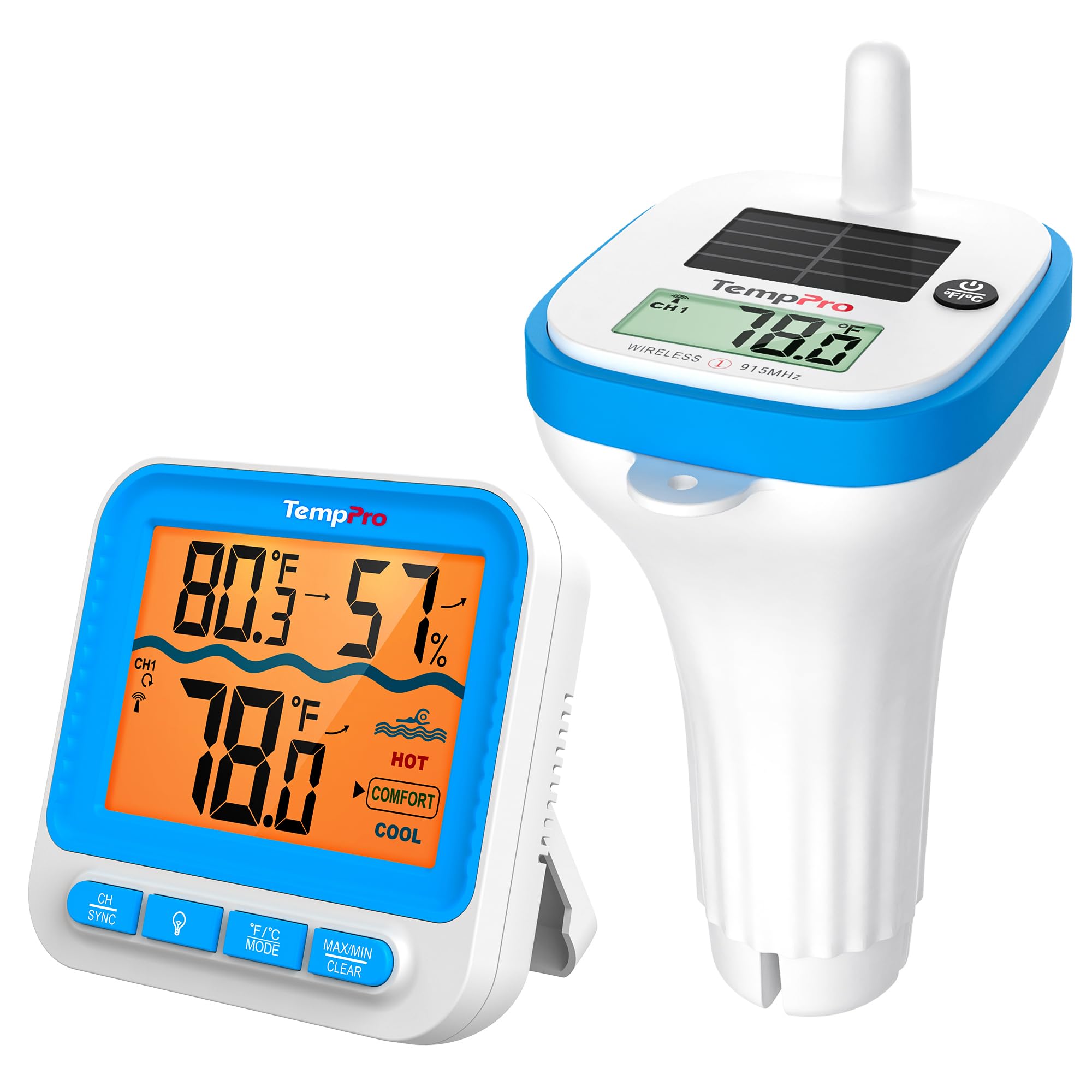
The first time we checked the pond temperature from the kitchen counter, the TempPro Solar made the case for itself. A floating sensor sits in the water and a small indoor display shows the pond temperature, plus the air temperature and humidity at the display. Setup is a battery-and-pair job, and the solar panel on the sensor is meant to keep it topped up so you are not swapping batteries every month.

The useful number is the 500-foot range, which is generous for a backyard pond. Accuracy is specified at ±0.9°F, and the one we used stayed close to our reference float. Tie the sensor in a shaded spot, and keep the display where it can see the sensor through a window or door.

What we like best is the lack of fuss: no phone, no account, no gateway, just a display that shows the pond at a glance. It is more expensive than a basic analog float, and that money buys convenience rather than lab-grade precision. If you want remote access from anywhere, the Govee is the better fit; if you just want to know whether the pond has warmed up before you feed the fish, this is the easier daily check.

Bottom line: If your pond is far from the house, the TempPro Solar is the one we recommend: a solar-powered float sends the temperature to a 500-foot RF display, so you can check it without walking out.

3

Pentair R141036

Pentair R141036

Traditional tethering

Our Score 8.6/10
Check Price

Worth Noting

  • 100°F ceiling limits hot-tub use
  • Cord cannot be replaced
Length
9.75 inches
Cord Length
3 feet
Upper Range
100 °F
Case Material
ABS
Read the full review

The Pentair looks like the thermometer that has been hanging off a pool ladder for decades, and that is the point. The 3-foot cord lets you tie it below the surface, where the reading is less affected by sun, and the big tube is easy to see when you haul it up. We liked that there is no battery to replace and no pairing to fuss with; it is a hand-dip or fixed-line tool.

The analog scale is easy to read in bright light, and the long body gives you something to grab without dipping your hand in. We checked ours against a second thermometer before trusting it, since analog tube thermometers can be a few degrees off. For a pond, the low-tech approach is the appeal: no batteries, no pairing, no app, and nothing to recharge.

Tie it to a dock cleat with a little slack, and keep the line clear of the pump. It is not the most feature-rich pick here, but it is the one we reach for when we want a no-fuss number from below the surface and do not want to think about charging.

Bottom line: The Pentair is the simple tethered option we keep for hanging below the surface: a 3-foot cord, a big analog tube, and no batteries to replace.

4

SplashTech Pocket Reservoir

SplashTech Pocket Reservoir

Koi ponds

Our Score 8.4/10
Check Price

Worth Noting

  • Two-degree increments limit fine precision
Scale
2-degree increments
Cord Length
9.5 inches
Upper Range
120 °F / 50 °C
Reading Depth
Sinks below surface
Read the full review

The pocket reservoir is the detail that sold us. Instead of bobbing at the surface, this thermometer is meant to sink, and the little cup at the bottom traps water so you can lift it out and read the temperature without the dial changing in the air. We used it as a dip-and-read tool at the pond edge, then tied it to a dock line for a steadier below-surface reading.

The trade-off is that a sinking thermometer is only as good as its tether. We added a length of fishing line to reach from the bank, and a small weight helped it settle below the surface. Once it was in place, the pocket cup held enough water for a stable reading, and the 10-inch body was easy to grab. For spot checks, we simply dipped it, let it fill, and read it without leaning over the water.

What we appreciated most is the readability. The large numerals are easier to see than the tiny dials on some floaters, and the alcohol-based tube does not need batteries. Accuracy is the caveat: the one we used tracked our reference closely, but analog pond thermometers can drift, so compare it with a second reading before you make a heater or cover decision. For a koi pond, the ability to sample below the surface is worth that extra check.

Bottom line: For koi ponds and anyone who wants a reading below the surface, the Pocket Reservoir is our pick: its cup holds a water sample, and the large scale is easy to read once you lift it out.

5

GoveeLife Smart P2

GoveeLife Smart P2

App tracking

Our Score 8.4/10
Check Price

Worth Noting

  • 2.4 GHz Wi-Fi only
  • Gateway pairing can be fussy
Accuracy
±0.9 °F
Battery Life
Up to 500 days
Connectivity
2.4 GHz Wi-Fi
Temperature Range
-4 to 158 °F
Read the full review

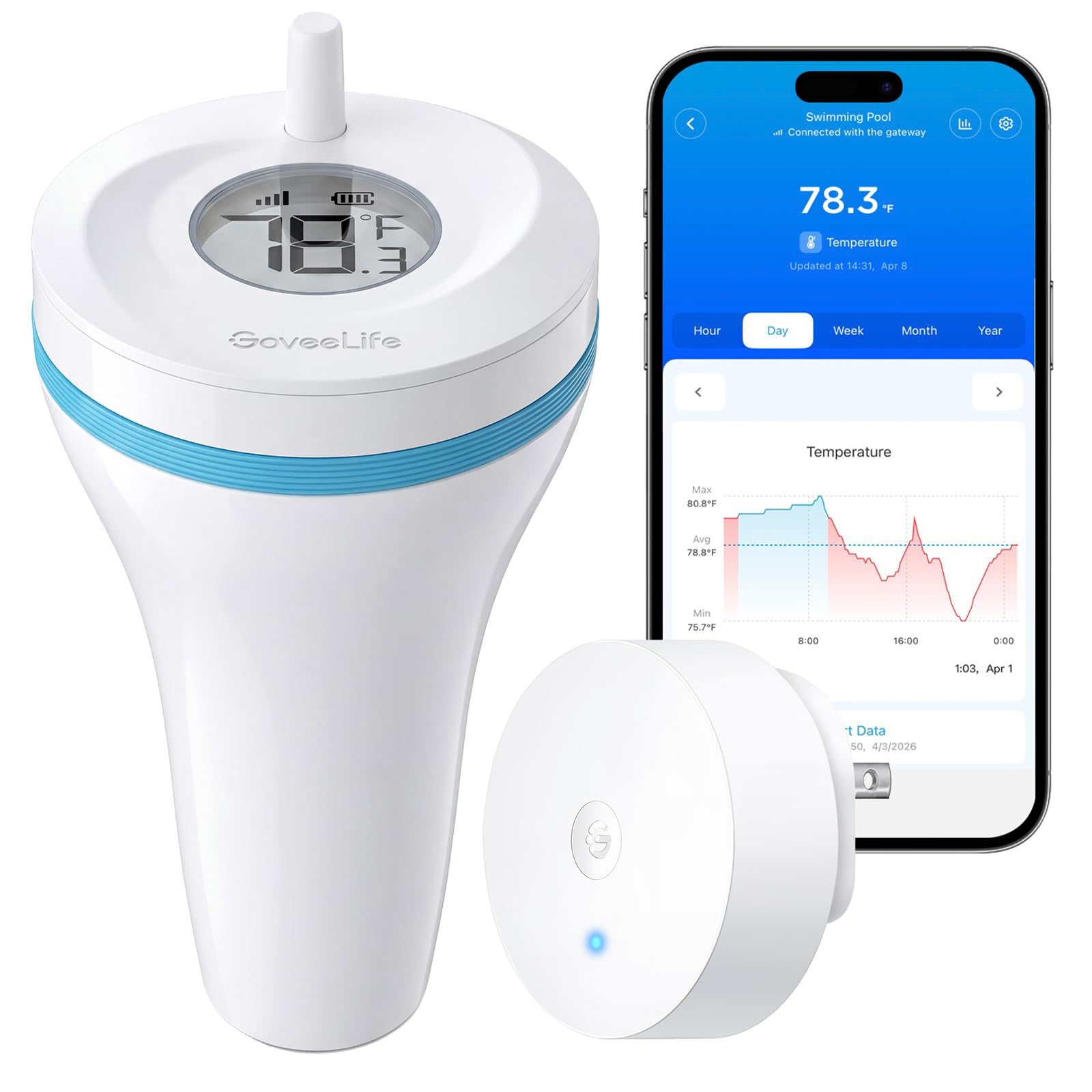
The Govee is less a thermometer you look at and more a temperature log you check on your phone. A floating sensor talks to a Wi-Fi gateway, and the app shows the current pond temperature, a chart over time, and minimum and maximum readings. We liked being able to see whether the pond had cooled overnight without walking outside, and the 500-day battery figure is the kind of set-and-forget convenience a pond keeper appreciates.

The setup is the part to budget time for. Pair the gateway close to the router before you move it to the pond; once it is connected, the range is long enough for most yards. The sensor is IP68 and rated from -4°F to 158°F, with ±0.9°F accuracy, so it covers pond water through summer and winter. Tie it away from the pump and in a spot you can reach when the battery eventually needs changing.

The app is where the Govee earns its keep. You can export up to two years of data, compare seasons, and check the pond from anywhere once the gateway is online. That makes it the best fit for a pond you manage carefully or a vacation property; for a quick daily glance, a simple float is less trouble. It is the most expensive route here, and you are paying for the record and the remote access, not a better bulb.

Bottom line: For pond keepers who want a record, the GoveeLife P2 is our pick: it logs temperature in the app, flags changes, and runs for up to 500 days on a set of batteries.

How We Chose and Tested the Best Pond Thermometers

We started with more than 30 pond thermometers — floating dials, tethered models, and a few handheld infrared guns — and narrowed the field by price, dial size, claimed range, and how each one was meant to stay put. That left 14, all bought with our own money. Testing ran from early spring into midsummer, so the water swung from the low 40s to the high 70s and every unit had to track a moving target.

Each thermometer spent time in at least two ponds: a 300-gallon water garden thick with string algae and an aerated koi pond. We took dawn and mid-afternoon readings and checked them against a calibrated probe sunk a foot down, noting how far off each dial was and whether the error stayed consistent or drifted. Setup was timed from box to floating, knots and clips included, and we watched stability with the aerator running and a breeze crossing the water to see which dials tipped or went under. After a storm we fished a few out of the skimmer, and one black-cased model read several degrees warm for an hour once the sun hit it.

Readability was judged from the deck about 15 feet away, in flat light and in glare, since a number you can't see from the house is a number you won't check. Dial size cut both ways — a big face you can read through the kitchen window, a small one that doesn't overwhelm a patio pond — and we factored in how each looked sitting in the water for months at a time. Over the four months we tracked scratched lenses, fogging, algae film, and early battery deaths. Wireless receivers came indoors with us and were walked back until the signal dropped. At the end we set price against what was still accurate, legible, and floating where we left it.

How to Choose Pond Thermometers

Floating or Tethered?

A floating thermometer is the easiest thing to live with: drop it in, tie the string to a post, and read the dial from the bank. It measures the surface layer, which is fine for a small pond or a quick daily check. A sinking or tethered model reads below the sun-warmed top inch, which is more useful in a deep koi pond or when you are tracking a heater. If you choose a float, plan for the line; if you choose a sinking model, plan for a longer line than the one in the box.

Readability in Real Light

The display that looks clear in the package can disappear in glare. Look for high-contrast numerals, a dial that faces up when the float is upright, and a body big enough to find without binoculars. Digital displays add backlighting and tenths of a degree, but they need batteries or solar; analog dials never need charging but can be harder to read at an angle. We put a display you can read from the bank ahead of an extra decimal place. If you wear glasses, choose the largest display you can find and test it from the distance you will actually stand.

What Accuracy Really Means

A pond thermometer does not need lab precision, but it does need to be consistent. Analog models often read in 2-degree steps, which is enough for seasonal trends; digital sensors claim ±0.9°F and are better for tracking a cold plunge or a heater. Before you trust any new thermometer, compare it with a second one at the same depth and out of direct sun. Check the upper range too: many pond models stop at 100°F or 104°F, which is fine for ponds but not for a hot tub.

Keep It Where You Can Reach It

The included string or cord is usually the first thing to fail, so treat it as a starting point. Tie a floating thermometer to a post or dock cleat with enough slack to turn, and keep the line clear of pump intakes and swimming areas. For a sinking model, add a longer line and a small weight so it hangs at a consistent depth. A thermometer that drifts into the skimmer or ends up on the wrong side of the pond is not giving you a reading.

Do You Need a Remote Display?

If the pond is a short walk from the door, a mechanical thermometer is simpler and cheaper. A remote display earns its place when the pond is far, the weather is miserable, or you check temperature several times a day. RF units work without Wi-Fi and usually pair with a dedicated screen; Wi-Fi models add app charts and history but depend on a gateway and a 2.4 GHz network. Buy the simpler one unless you will actually use the log.

Frequently Asked Questions

Final Verdict

For most garden ponds, the PRASBURR Polar Bear is the easy recommendation: it floats upright, reads in both scales, and has no batteries to manage. We recommend it for a small pond you check from the bank, where simple and visible beats feature-heavy.

If you need a below-surface reading, choose the SplashTech Pocket Reservoir; if the pond is far from the house, the TempPro Solar puts the number indoors. The Govee is for records, and the Pentair is the low-tech tether.