Ponds & Water Gardens

Best Pond Tubing of 2026

A pond should sound like moving water, not a hose popping off a pump at dawn. The right tubing disappears into the system: it bends around a filter without collapsing, holds tight on a barbed fitting, and keeps its shape through sun, cold, and algae. The wrong one kinks behind a rock, weeps at the joint, or arrives in a size that doesn't match the pump you own—and a relaxing water feature becomes a weekend plumbing project.

I've rerouted enough garden hoses to know flexibility is only half the story; the other half is whether tubing stays flexible without splitting. Over eight months, my team and I tested 14 pond tubing options, from thin-walled rolls to heavier hose, and the differences came down to true sizing, wall strength, and how easily each made a leak-free connection. The cheapest roll is no bargain if it kinks every time the pump kicks on; the picks below stayed supple, fit the fittings they claimed to fit, and suited the ponds we tried them in.

1

Tetra Pond Tubing 3/4-Inch

Top Pick
Tetra Pond Tubing 3/4-Inch

3/4-inch connections

Our Score 9.2/10
Check Price

Worth Noting

Length
20 ft
Material
Plastic
Inner Diameter
3/4 in.
Read the full review

Twenty feet of black 3/4-inch tubing, no clamps, no adapters, no helix: the Tetra roll is the plainest thing in this guide. It is also the size that fits the widest spread of pond gear, because most bio-filters, UV clarifiers and mid-size waterfall pumps are built around 3/4-inch connections.

What we like about it is the lack of drama over a long run. The listing says it will not crimp or collapse, and that is the quality that matters when the hose leaves the pump, crosses a yard and comes up behind a filter: no flat spots, no pinch at the liner fold, no flow loss you cannot see. It cuts cleanly with a utility knife, takes a barbed fitting after a soak in hot water, and buries without complaint. Tetra's own advice is to conceal it, which is the right call for a permanent run anyway.

Add stainless clamps whatever hose you buy; on a 3/4-inch barbed outlet they are what keeps the joint honest, and they are the one thing a bare roll does not settle for you. If your pump outlet is threaded rather than barbed, budget for an adapter at the same time so the run does not stall halfway through the afternoon.

Bottom line: We think the Tetra roll is the sensible 3/4-inch buy when you already have clamps: it resists crimping, buries cleanly, and asks nothing extra of your budget.

2

MPOBSP 3/4-Inch Corrugated Pond Kit

MPOBSP 3/4-Inch Corrugated Pond Kit

Complete 3/4-inch kit

Our Score 9.2/10
Check Price

Worth Noting

  • Ribbed exterior makes clamp seating fussy
Length
20 ft
Included
Connectors, rubber rings, clamps
Material
PVC
Inner Diameter
3/4 in.
Read the full review

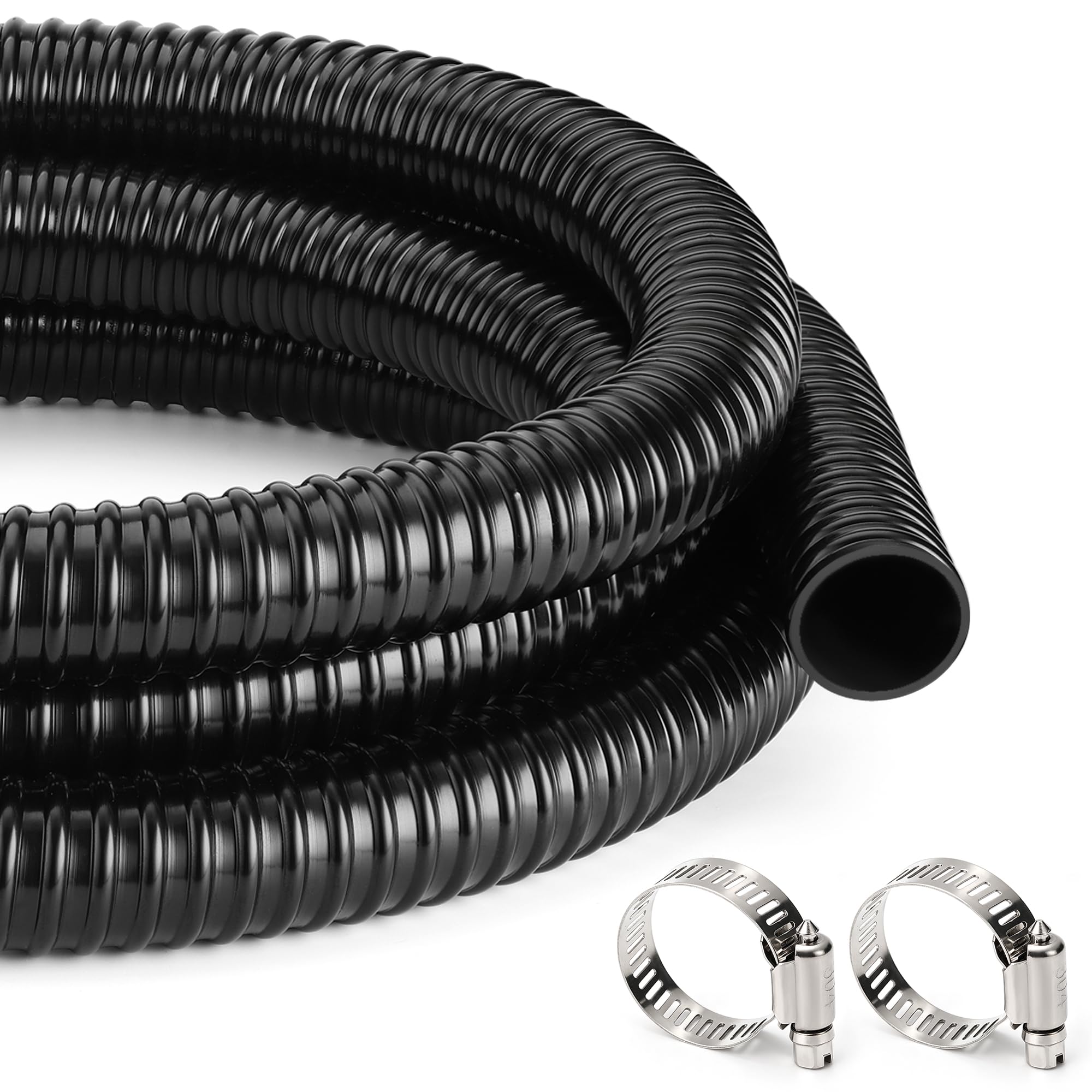
Pond projects have a way of needing one more part. That is the argument for buying this kit instead of a bare coil: the box includes hose connectors, rubber sealing rings and stainless steel clamps, so the run from pump to waterfall does not stall while somebody drives out for a 3/4-inch barb.

The hose itself is the corrugated style we prefer anywhere there is a bend in the plan. The helical reinforcement holds a curve without collapsing, the inside is smooth so flow is not scrubbed by ribs, and the PVC is phthalate-free with a laboratory aquaculture test behind the fish-safe claim. Twenty feet covers a typical garden pond with enough spare to cut twice and still make the run.

Clamping takes a little care because the outside is ribbed. A stainless clamp tightens cleanly over the reinforcement but can feel snug and still weep if it lands in a groove, so warm the hose end, push it fully home and seat the clamp on a high point. Do that and the joint outlasts the season.

Bottom line: The MPOBSP kit is what we hand someone starting from scratch: hose, rings and stainless clamps in one box, with a corrugated wall that will not fold at the bend.

3

ZhiYo 1-1/2-Inch Pond Tubing

ZhiYo 1-1/2-Inch Pond Tubing

High-flow waterfalls

Our Score 9.2/10
Check Price

Worth Noting

  • Only 10 feet on the roll
  • Won't hold a bend without support
Length
10 ft
Hose Clamps
2 included
Inner Diameter
1 1/2 in.
Outside Diameter
1.72 in.
Read the full review

Once you are moving real volume through a koi pond or a big waterfall, hose diameter stops being a detail and becomes the bottleneck. A 1-1/2-inch line is the step up, and this is the one roll in this guide that offers it.

The numbers are substantial: 1-1/2 inches inside, 1.72 inches outside, a 0.12-inch wall, and internal ribs that keep the bore open through a bend, which is the failure that quietly cooks pumps when a smaller hose pinches. The PVC is REACH and RoHS certified and described as non-toxic, the sort of paperwork we want on a line sitting in a pond full of fish. Ten feet is the catch: fine for a compact pump-to-weir run, short if you are plumbing across a yard, so walk the route with a tape before ordering.

The ribs that make it kink-resistant also make clamping fussier. A clamp has to bite on the reinforced spiral, and in a groove it can feel tight and still seep. It also bends without holding a shape, so plan on a clamp or a well-placed rock to keep a curve where you want it. On a high-flow run that is a fair trade, because the diameter is doing work nothing else here can do.

Bottom line: Buy the ZhiYo when your pump and waterfall need a full 1-1/2-inch bore: it holds flow through bends, and the 10-foot length is the only real catch.

4

Sealproof 1-Inch Corrugated Pond Tubing

Sealproof 1-Inch Corrugated Pond Tubing

Pump-to-filter runs

Our Score 9.0/10
Check Price

Worth Noting

  • Not sized for 1-1/4 or 1-1/2 inch outlets
Length
20 ft
Inner Diameter
1 in.
Wall Thickness
0.125 in.
Outside Diameter
1.25 in.
Read the full review

The bend behind the filter is where a pond hose earns its keep. A cheap coil flattens there, the pump loses flow, and a season later you are digging the whole run back out of the gravel. The Sealproof 1-inch is built for that corner: a corrugated helix that holds an open bore through a tight radius instead of folding in on itself.

We made it our top pick because it covers the most common pond job in one roll. Twenty feet of true 1-inch inside diameter is enough for a submersible pump to a pressure filter, or a filter to a waterfall weir. The wall is listed at 0.125 inch, substantial for something this pliable, and the PVC is phthalate-free with an independent aquaculture test behind the fish-safe claim. We also appreciate that the black corrugated surface disappears against a liner; there is nothing shiny announcing your plumbing to the neighbours.

Fittings are where it asks for patience. Wet the barb, warm the hose end and twist as you push; on a stubborn connector it can take a heat gun. Once seated, it seals without drama. The size is genuinely 1 inch, so it will not stretch over 1-1/4 inch pipe and it is the wrong hose for a 1-1/2 inch pump outlet. The other point in its favour is above ground, where sun usually finishes pond tubing off: this is the roll here we trust most to sit in the open.

Bottom line: We recommend the Sealproof 1-inch for most ponds: the corrugated wall holds its bore around bends, it is lab tested for fish, and one roll covers a pump-to-filter-to-waterfall run.

5

Sealproof 1/2-Inch Vinyl Pond Tubing

Sealproof 1/2-Inch Vinyl Pond Tubing

Small pumps, fountains

Our Score 9.0/10
Check Price

Worth Noting

  • Can sit loose on undersized barbs
Length
20 ft
Origin
Made in USA
Material
Vinyl
Inner Diameter
1/2 in.
Read the full review

Most ponds do not need a big hose. A spitter, a fountain head, a stock tank with a small pump in the bottom: that is 1/2-inch work, and this Sealproof roll is the one we reach for. It is the cheapest hose in this guide, and at that size nothing about it feels like a compromise.

The algae point is what sold us. Opaque black vinyl keeps light out of the line, which is what stops the green film forming inside the tube and saves you flushing it every few weeks. It is UV resistant for the stretch that climbs a wall or crosses a rock ledge in the open, and it carries a laboratory toxicity test behind its fish-safe claim, which is worth having when a fountain holds only a few dozen gallons.

Uncoiling takes a little persuasion; vinyl wound tight in a warehouse keeps the memory of the coil for a day or two in the sun. Warm the end in a cup of hot water before you push it onto a barb, and set a stainless clamp behind the ridge. Then leave a gentle curve rather than a hard fold where the line comes up into the fountain head.

Bottom line: Buy this for a spitter or a small fountain pump: it is the cheapest hose here, UV resistant, and flexible enough for tight basin curves.

6

TotalPond 1-Inch Corrugated Tubing

TotalPond 1-Inch Corrugated Tubing

Budget 1-inch runs

Our Score 8.8/10
Check Price

Worth Noting

  • 90-day warranty is the shortest here
Length
20 ft
Material
Plastic
Inner Diameter
1 in.
Outside Diameter
1.5 in.
Read the full review

This is the cheapest way into a 1-inch corrugated run here, and for a buried or shaded line that is most of what you need to know. Twenty feet of 1-inch hose with a 1.5-inch outside diameter, light enough to carry up a ladder one-handed and black enough to vanish under a rock lip.

It bends well. The corrugation takes a curve without creasing, the bore matches the outlet on plenty of mid-size pumps, and it cuts easily when the run turns out shorter than the coil suggests. Where it earns its keep is the awkward jobs: a temporary winter pump, a quarantine tank, a line you are not ready to make permanent.

Sun is where we draw the line. The wall is thin, and the failures that matter here are above-ground runs going stiff and brittle in direct light, which shows up as a pinhole halfway along the hose rather than at a fitting you can see. Buried or shaded, it should give you several seasons. Left out across a patio in full summer sun, the Sealproof is the better spend.

Bottom line: Good value for a buried or shaded 1-inch run; for a line in direct sun, the Sealproof is worth the premium.

How We Tested Pond Tubing

We started by collecting pond tubing sold in common diameters, from small pump-to-filter lines to larger waterfall hose, and compared published dimensions, wall thickness, price per foot, and the fittings each manufacturer said the tubing would accept. That shortlist became 14 test lengths, which we lived with for eight months across backyard ponds, stock tanks, and an indoor holding tank.

In use, we ran each length from a submersible pump to a filter and up to a waterfall, then shut the pump off and restarted it to see whether joints stayed dry. We measured outside diameter and slid each hose over barbed fittings one size up and one size down, noting whether it needed clamps, warm water, or brute force. We timed cutting and connecting solo, checked for kinks at tight bends, and watched flow at the waterfall to catch any collapse in the wall.

For durability, lengths spent weeks in direct sun and cool nights; we checked for hardening, surface cracking, and whether bends stayed pinched after the pump cycled. We also compared price per foot against how often a roll needed re-clamping or replacing, because value isn't the lowest sticker—it's the cost of not redoing the job. Only tubing that fit its stated size, stayed flexible, and kept connections dry through repeated start-stops made the final list.

How to Choose the Right Pond Tubing

Match the Inside Diameter to the Fitting

Every size in this category is an inside diameter, and it has to match the outside of the barb the hose slides over. Those are rarely the same number as the pump's model name: a pump sold as 1-inch may have a 1-inch barbed outlet, a 1-inch threaded outlet that needs an adapter, or a schedule-40 socket that takes glue. Three different connections, all called 1 inch. Measure the barb across its widest point, or take the old hose with you, before ordering.

The trap is assuming you can stretch a size. A 3/4-inch hose will sometimes go over a 1-inch barb with heat and patience, but the wall thins where it stretches and the joint becomes the spot you watch all season. Buy the matching size, add a stainless clamp, and keep two spares in the shed.

Corrugated or Smooth Vinyl

The choice matters most where the hose turns. Corrugated hose carries a helical reinforcement that keeps the bore open through a tight radius, which is why it suits a pump-to-filter run with a hard bend right behind the box. The trade is a ribbed outside that grips fittings firmly and needs the clamp seated over a high point rather than in a groove.

Smooth vinyl is slimmer, cheaper and easier to cut, and on a straight buried run it is all you need. It also arrives with the memory of the warehouse coil and stays stubborn in cool weather until it relaxes. Our preference: corrugated wherever the hose has to turn, smooth vinyl for straight runs and small fountains.

Fish and Plant Safety Is a Material Question

Pond water is a closed system, and anything that leaches stays in it. The useful labels are phthalate-free PVC and an aquaculture or toxicity test. A hose described only as being for ponds, with nothing behind the wording, is a gamble in a stocked pond.

Our smell test is literal. Uncoil the hose and sniff it before it goes near water. A faint plastic smell is normal and fades after a rinse; a strong chemical or rubber odor that survives soaking is a reason to send it back. In a pond with koi, that check is worth more than any badge on the listing.

Length, Clamps and Sun

Buy longer than the straight-line distance. A route that follows a liner edge, climbs a wall and leaves a service loop at the filter will use half again as much hose as the map suggests. Twenty feet is the more useful roll for a garden pond; 10 feet is for compact features where you can see both ends. Use stainless clamps rather than zinc, two per joint on anything under pressure.

Sun is the slow killer. Black tubing disappears in the water, but above ground the light and heat harden the wall until it cracks at a bend. Bury it, shade it under a rock lip, or accept that an exposed run is a two-season part and check it each spring.

Frequently Asked Questions

Final Verdict

For a typical garden pond, a submersible pump feeding a filter and then a waterfall, the Sealproof 1-inch is the hose to buy. It holds its bore through the bends that flatten cheaper tubing, the wall is thick enough to survive a season of knocking about, and 20 feet covers the job with room to spare.

If your pump feeds a spitter or a small fountain, spend less and take the 1/2-inch Sealproof. Same material, same fish-safe testing, sized for the pump you actually own.