Ponds & Water Gardens

Best Pond Pumps of 2026

A pond is supposed to be the part of the yard that takes care of itself — right up until the water goes pea-soup green in July and you're standing at the edge trying to work out what failed. The pump is the circulatory system back there: it pushes water through the filter, feeds the waterfall, keeps the surface moving so mosquitoes don't settle in, and puts oxygen in the water for the fish. Miss on flow rate, or buy something that clogs every third day, and you'll spend the summer scooping instead of sitting.

I've kept a small koi pond for years and killed more pumps than I care to admit, so my team and I ran 12 of them side by side over the past 10 months, from compact units for patio water gardens to models sized for a few thousand gallons. The differences showed up fast, and most had nothing to do with the flow rate printed on the box. One thing nobody tells a first-time buyer: that number is measured with zero lift, and every foot of rise and every elbow in the hose eats into it. The picks below are matched to the ponds they actually suit.

1

Danner Pondmaster 700

Top Pick
Danner Pondmaster 700

Small ponds, filters

Our Score 9.0/10
Check Price

Worth Noting

  • Premium price for 700 GPH
Max Flow
700 GPH
Max Lift
11.66 ft
Power Draw
70W
Installation
Submersible or inline
Read the full review

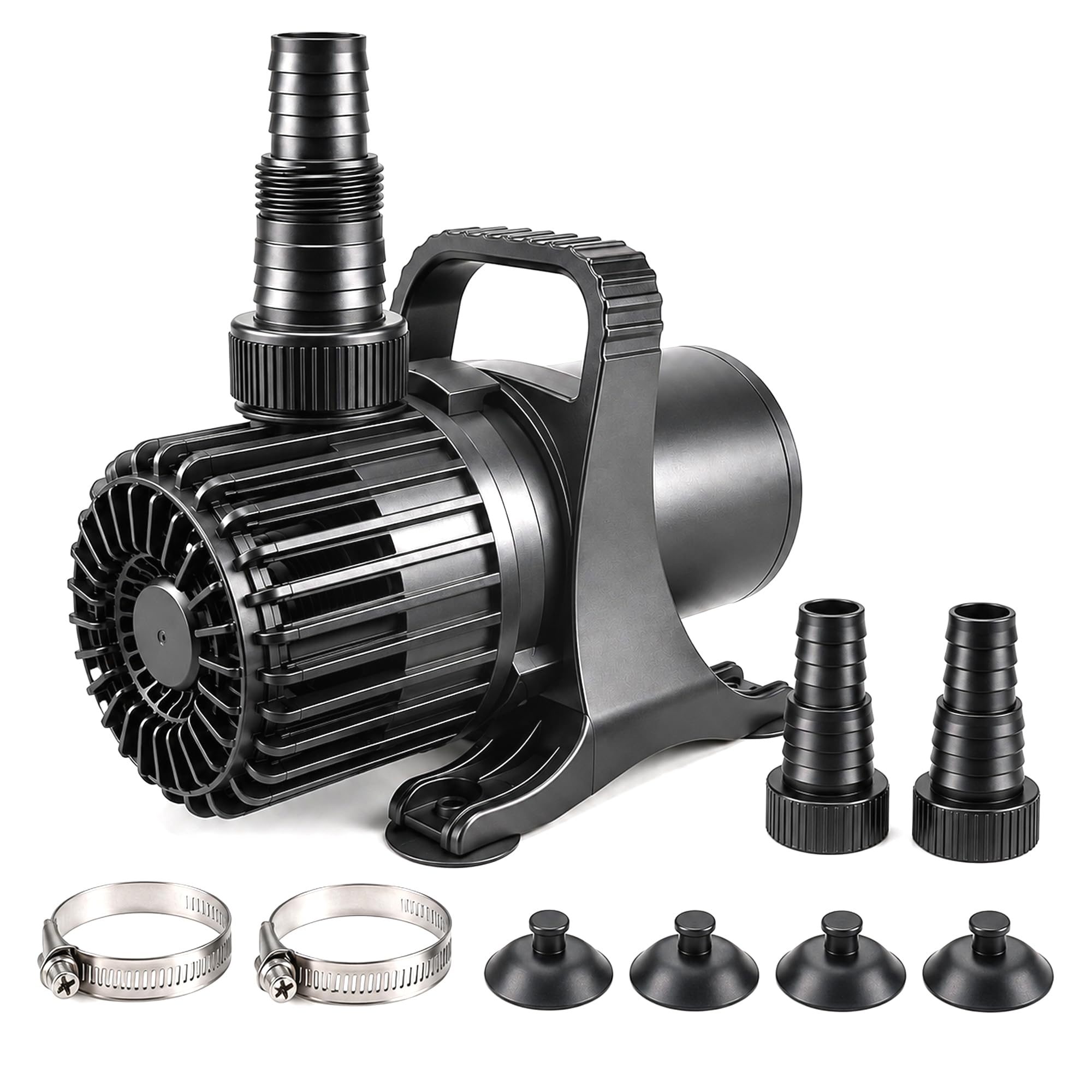
Running a pump inline or fully submerged is the choice that makes the Pondmaster 700 our default for small-to-medium ponds. It can hide in the pond or sit beside a filter, which is rare flexibility at this size. The 18-foot cord also gives you more room to reach a GFCI outlet without an extension cord.

Magnetic drive is the other reason. There are no mechanical seals to wear out, and the pump is built for continuous duty. The 700 GPH rating will not wow anyone shopping by headline flow, and 11.66 feet of lift is modest next to the Alpine. But for a modest waterfall or a filter loop, it is the right shape: 70 watts, half-inch threaded fittings, and a rigid pre-filter that keeps big debris out of the impeller.

What you give up is headroom: 700 GPH is modest for a big koi pond or a tall spillway. For a small-to-medium pond, though, the five-year limited warranty and magnetic-drive design make it the pump we choose when reliability matters more than the biggest number on the box. If your feature is taller or your pond is larger, the VIVOHOME or Alpine is the better fit.

Bottom line: For a small-to-medium pond that runs every day, we trust the Pondmaster's magnetic-drive design and inline-or-submerged setup more than the higher-flow budget pumps.

2

VIVOHOME 1600 GPH

VIVOHOME 1600 GPH

Larger ponds, waterfalls

Our Score 8.8/10
Check Price

Worth Noting

  • Long-term durability is mixed
Max Flow
1600 GPH
Max Lift
15 ft
Power Draw
100W
Cord Length
20.3 ft
Read the full review

A big jump in flow for midrange money is the reason the VIVOHOME 1600 earns a place here. At 1600 GPH and 15 feet of lift, it moves roughly twice the water of the Danner, and the 20.3-foot cord gives you more placement freedom. It is still a submersible pump, so it hides in the pond rather than sitting on an equipment pad.

We think the mesh shield is the detail that makes it a pond pump rather than a fountain pump. It keeps leaves and large debris out of the intake, and the five-position outlet lets you aim the flow instead of fighting it. We also appreciated the ceramic shaft and silicon-carbide drive ring; those are the kind of parts that matter when a pump runs all day.

The 100-watt motor is reasonable for this much flow, and the long cord helps on a larger pond. The 5.7-pound body is manageable when you need to lift it out for cleaning. If your pond is small, the Danner is the more efficient choice; if you need more volume, this one earns its place.

Bottom line: We recommend the VIVOHOME when your water feature needs more push than the top pick but you still want a midrange price and a long cord.

3

Alpine PAL3100

Alpine PAL3100

Big waterfalls

Our Score 8.8/10
Check Price

Worth Noting

  • Heavy at 8.2 pounds
Max Flow
3100 GPH
Max Lift
21.5 ft
Power Draw
276W
Cord Length
33 ft
Read the full review

A 21.5-foot lift and 3100 gallons per hour put the Alpine PAL3100 in a different class from the rest of this group. It is the pump for a tall spillway or a long run to a filter, and the 33-foot cord is the longest here by a wide margin. That cord matters if your outlet is on the house and the pond sits at the back of the yard.

We liked the multi-angle setup more than we expected. The pump can sit vertically or horizontally, and the adapters let you point the flow where the feature needs it. That matters on a wide waterfall where a fixed outlet throws water against the liner. But the 276-watt motor is the trade-off: it draws nearly four times the power of the Danner, so this is not the pump for a small fountain you run for ambience.

We see it as a specialist for large ponds and serious waterfalls, not a default for every garden. The 8-inch body is compact for the flow, but it still wants a solid, accessible base, and it is overkill for a patio bubbler. When the feature is the point, though, the Alpine has the volume and lift to make it work.

Bottom line: If your waterfall needs serious volume and lift, the Alpine's 3100 GPH output makes it the specialist we pick for large ponds.

4

WaterRebirth 1700 GPH

WaterRebirth 1700 GPH

Listed pond setups

Our Score 8.8/10
Check Price

Worth Noting

  • Needs monthly rotor cleaning in dirty water
Max Flow
1700 GPH
Max Lift
14 ft
Power Draw
100W
Safety Listing
UL Listed
Read the full review

A UL listing is a useful detail on a pump that spends its life in water, and the WaterRebirth 1700 has one. It also has anti-dry protection and a 20.3-foot cord, and the 6.5-pound body is easy enough to lift out for service. That combination gives it a clear place in the group.

The anti-dry protection is useful in a pond where the water level can drop, and the inlet mesh keeps large debris away from the impeller. The 1700 GPH and 14-foot lift are enough for a medium pond or a tall fountain, and the 100-watt motor is easier to live with than the Alpine's 276 watts. The silicon-carbide shaft and drive ring are also built for wear.

We see it as the smart alternative for a buyer who wants a UL-listed pump and does not need the Alpine's extra flow. Durability is the open question, so we treat it as one to check regularly rather than bury and forget. If you want the longest warranty, go Danner; if you want the most flow, go Alpine.

Bottom line: We see the WaterRebirth as the smart alternative for shoppers who want a UL-listed pump with anti-dry protection and don't need the Alpine's extra flow.

How We Tested 12 Pond Pumps Over a Season

We started with roughly 40 pumps sold by established manufacturers, then cut the list using the specs that decide whether a pump survives: the claimed flow at real head heights, the style of intake screen, cord length, footprint, wattage, and — the one most shoppers skip — whether replacement impellers and filter pads are sold separately. A pond pump is a wear item, so anything with no parts support behind it came off the list regardless of how it performed on paper. We finished with 12, spread across small water gardens, mid-size goldfish ponds, and units built for a few thousand gallons.

For 10 months those pumps ran in three real ponds: a 500-gallon backyard koi pond, a patio stock tank with a couple of goldfish, and a small preformed water garden tucked against a fence. They went through a spring algae bloom, a run of 90-degree weeks, and fall leaf drop, which is the stretch that separates the pre-filters from each other. We timed how long each pump took to fill a 5-gallon bucket at the discharge, then repeated the test with three feet of lift and a 90-degree elbow in the line, because that is where the water pressure actually goes. We stood two feet away at dusk and listened — a hum you stop noticing versus a rattle you can hear from the patio. Every week we pulled the intake screens and noted how much string algae and leaf litter had collected and how long each took to rinse.

Fittings and hose clamps were checked after the first week and again a month in, with a dry paper towel run under every joint to catch a weep we'd otherwise have missed. At the end of the season we opened each pump, looked at impeller wear, seal condition, and whether the housing plastic had gone chalky, and compared the final flow reading to the first one. We also tracked wattage against output, since a pump that moves more water on less power is the better value over years, not months.

How to Choose Pond Pumps

Size by Flow at Lift, Not Just GPH

Every pump's maximum flow is measured at zero head. Add a waterfall, a filter, or a long hose and the number falls, so a pump that looks generous on paper can trickle at the top of a tall spillway. Measure the vertical distance from the water surface to the outlet, then add the horizontal run and any fittings. Choose a pump whose maximum lift is comfortably above that total, and expect to move up a size if you want a visible sheet of water.

Flow rate and lift are linked, so compare pumps at the height you will use. The Danner's 11.66 feet of lift suits a modest waterfall; the Alpine's 21.5 feet is the one for a tall spillway. Neither will deliver its full rated flow at that height.

Put Continuous-Duty Reliability First

Pond pumps often run 24 hours a day, which makes service life more important than a few hundred extra gallons per hour. Magnetic-drive designs, sealed motors, and a warranty you can actually use are worth more than a low purchase price. The cheap end of this category is full of pumps that trade durability for flow; we left those out because a pond pump that fails early is not a bargain.

The Danner Pondmaster is the clearest reliability-first pick in this group, with a magnetic drive and a five-year limited warranty. If your pond is near a patio, also listen for vibration: a pump on a hard liner can transmit hum even when the motor itself is quiet.

Choose Submersible or Inline Installation

Submersible pumps sit in the pond and are easy to hide. Inline pumps can be plumbed outside the water, which keeps maintenance dry and lets you place the pump beside a filter. If you have an external filter or a remote equipment pad, inline flexibility is worth paying for. Otherwise, a submersible pump with a long cord is simpler.

Check the cord reaches a GFCI-protected outlet without an extension cord, and match the fittings to your hose. The Danner can run either way and has an 18-foot cord; the VIVOHOME, Alpine, and WaterRebirth are submersible-only, with cords from 20.3 to 33 feet.

Plan for Debris and Cleaning

Most pond pumps fail at the intake before the motor gives up. A pre-filter, mesh shield, or filter sponge buys time, but it also needs cleaning. In a pond with leaves, algae, or fish waste, check the intake every few weeks and clean the impeller when flow drops. A pump with tool-free disassembly makes that job much easier.

WaterRebirth's inlet mesh and anti-dry protection are useful in a pond with fluctuating water levels, but the manufacturer still recommends monthly rotor cleaning in dirty water. If you want the least fuss, choose a pump with a large shield and a base that keeps the intake off the bottom.

Frequently Asked Questions

Final Verdict

For most pond owners, the Danner Pondmaster 700 is the safe buy: 700 GPH, 11.66 feet of lift, and the option to run it inline or submerged. It costs more than the budget pumps, but it is the one we trust for continuous duty. If your water feature needs more volume, the VIVOHOME 1600 is the next step; for a big spillway, choose the Alpine 3100.