Ponds & Water Gardens

Best Pond Lights of 2026

Pond lights ask you to pick a side: solar fixtures go in without a single wire and cost nothing to run, but too many of them dim to a weak glow by the time the koi come up for their evening feed. Plug-in models throw real light across the water, though you are the one out there at dusk with a spade and a cable reel. What a good set actually fixes is the stretch of evening when the pond goes black and the whole thing stops being the best part of the yard. The right ones turn it back on, cleanly, without turning your Saturday into a landscaping project.

I have had lights in my own pond for years, and the ones I kept all share a habit of looking unremarkable at noon and disappearing into the rock edge, which is exactly what you want. My team has now lived with 12 sets across a full season, everything from thumb-sized solar pucks to metal halide-style spotlights on stakes, and the differences showed up fast. Two things first-time buyers rarely think about: a wide beam at modest brightness reads better on moving water than a narrow spotlight, and a harsh cool white will make a clear pond look like a swimming pool. Warm white almost always wins out there. The picks below are what survived.

1

MIK Solutions Underwater 113

Top Pick
MIK Solutions Underwater 113

Focal water features

Our Score 9.0/10
Check Price

Worth Noting

  • Transformer required and not included
  • Single light only
Build
Solid brass
Power
12V low voltage (transformer required)
Light Output
490 lumens
Color Temperature
3000K
Read the full review

The solid brass body and 490-lumen output are what put the MIK Solutions 113 at the top of this list. Most pond lights here are plastic pucks sold in sets, and the MIK is the opposite: one heavy fixture, a warm 3000K beam, and a three-year warranty on the housing. We chose it first because it feels like a permanent piece of landscape equipment rather than a seasonal accessory.

The brass matters beyond looks. It will not rust or corrode like a painted metal housing, and the 3.2-pound weight lets it sit on a stone ledge without a stake. The MR16 bulb is replaceable, so a failed LED does not scrap the whole fixture. Output is strong enough to wash a fountain wall or light a path across a small pond; for a wider expanse, plan on two.

The catch is the system. This is a 12V fixture, and the transformer is not included, so you need an existing low-voltage setup or a new one. It is also a single spot, not a kit, and it is the priciest way here to light one area. For a focal waterfall or a koi pond viewed from a favorite seat, that focus is worth it. We keep coming back to it because the light itself is clean, warm and easy to live with.

Bottom line: For a focal water feature with a 12V transformer, the MIK 113 is our first choice: a brass body, a 490-lumen warm beam and a replaceable bulb make it the most convincing long-term fixture here.

2

Aquascape 1-Watt Waterfall

Aquascape 1-Watt Waterfall

Waterfall accents

Our Score 8.6/10
Check Price

Worth Noting

  • Only 45 lumens
  • Proprietary connection
Voltage
12V
Wattage
1W
Light Output
45 lumens
Color Temperature
3000K
Read the full review

One watt and 45 lumens is not much light, and that is the first thing to understand about the Aquascape 84032. It is a tiny warm-white uplight built for the lip of a waterfall, the inside of a fountain, or a tight pocket of a pond where a full-size spotlight is overkill. The 3000K color matches much of Aquascape's landscape lighting, so it blends in rather than calling attention to itself.

We like the sealed, fully submersible housing and the proprietary quick-connect system if you already run Aquascape 12V components. Installation is simple: mount it, aim it up, and connect it to the system. The 4-inch round body is small enough to hide behind a rock, and the warm beam brings out the texture of falling water without washing out the whole pond.

The limitation is reach. At 45 lumens, this is an accent, not a primary light, and it will not illuminate a large pond on its own. The proprietary connection also means it is not the light to buy if you are building a generic 12V system. Those are real constraints, but they come with a clear use: a waterfall edge that needs one more pocket of warm light.

We think of the 84032 as a finishing piece. It is the light we reach for when the broad strokes are already handled and one dark corner needs attention. If you are lighting a whole pond, start elsewhere; if you are making a waterfall look intentional after dark, this small fixture is a tidy, purpose-built answer.

Bottom line: The Aquascape 84032 earns our recommendation for one narrow job: a warm waterfall accent in an existing Aquascape 12V system, not broad pond lighting.

3

T-SUN Solar 5-in-1

T-SUN Solar 5-in-1

Solar color

Our Score 8.4/10
Check Price

Worth Noting

  • No true white light
  • Needs direct sun for full run time
LED Count
30
Light Color
RGB color-changing
Power Source
Solar
Number Of Lights
5
Read the full review

The absence of a cord is the whole appeal of the T-SUN solar set. Five heads, six LEDs each, and a separate solar panel mean you can put light on a pond at the far end of the yard without trenching power or hunting for an outlet. The heads adjust through 90 degrees, so you can fan them across the surface or aim a few at a spout.

We like the five-head layout because it covers more water than the usual three-head solar kits without looking cluttered. The RGB mode cycles through red, blue, green and blends; it is decorative rather than natural, and that is fine for a backyard feature. What you give up is white light. There is no true white setting, and the colors are at their best when the pond is dark and the display is the point.

Solar performance is the variable to plan around. The panel needs direct sun, and run time drops in shade or on short winter days. The 30 LEDs are spread across five small heads, so each one is an accent rather than a spotlight. For a small pond, a barrel fountain, or a rental garden where wiring is out of the question, that is a fair trade. For a large pond that needs real reach, a wired fixture is the better route.

Bottom line: We choose the T-SUN solar set when there is no power at the water; five adjustable color heads and a cordless install outweigh the lack of a true white beam.

4

Jebao Submersible 6-Light

Jebao Submersible 6-Light

Budget setups

Our Score 8.4/10
Check Price

Worth Noting

  • No remote, timer or light sensor
  • Cool, almost blue white light
Cable
16 ft to first light
Wattage
4.8W
Color Lenses
Red, green, yellow and blue
Number Of Lights
6
Read the full review

The box of colored lenses is the first clue that the Jebao kit is old-school in a useful way. You get six submersible heads, each with a white LED and four snap-on lenses in red, green, yellow and blue. There is no remote, no app and no color-changing sequence. You pick a lens, twist it on, and the pond stays that color until you change it. We like that simplicity for a budget setup: fewer electronics to fail, and no controller to lose.

The six heads run off one 12V plug, with 16 feet to the first light and 3 feet between heads. That spacing is tighter than some kits, which makes it better for a fountain ring or a small pond edge than a long stream. The lights are bright for their size, and the interchangeable lenses are genuinely fun to experiment with. You do have to take the fixture apart to change a lens, so this is not a set for someone who wants to switch colors from the couch.

The trade-offs are real: no timer, no light sensor and no remote, so you will be plugging and unplugging it or adding an outdoor timer. The white LED also runs cool, almost blue, which is not the warm glow we want near stone. But six bright heads and a choice of colors is a sensible way to light a pond without committing to a control system. It is the kit we suggest when simple and serviceable matters more than polished.

Bottom line: Our budget pick for a pond or fountain is the Jebao six-light kit: bright colored accents, swappable lenses and no controller to fail.

5

GZKANFUL 8-Light RGB

GZKANFUL 8-Light RGB

Large ponds

Our Score 8.2/10
Check Price

Worth Noting

  • Decorative RGB, not warm white
  • Mounting screws not included
Control
Remote
Wattage
7.5W
Number Of Lights
8
Waterproof Rating
IP68
Read the full review

Eight light heads in one set is the reason the GZKANFUL kit exists. If your pond is large enough that a three-light set disappears into the dark, the extra coverage is worth more than any single feature. Each head has 36 LEDs, tilts through 180 degrees, and the remote handles 16 fixed colors, dimming and four color-changing modes. We like that the brightness can be pulled back; a lot of colored pond lights only have one loud setting.

The removable suction cups are the detail we appreciate most. You can use the cups on a smooth fountain wall, or take them off and screw the bases to a deck or ledge. That flexibility matters because suction cups and algae are not friends. The screws are not included, and the cups are not a long-term fix on rough stone, so plan the mount before the box arrives.

On a big pond, the eight-head spread is the selling point: you can light a fountain, a waterfall edge and a stretch of bank from one controller. The trade-off is that this is a decorative RGB kit, not a warm-white fixture. The colors are bright and varied, but they will not mimic natural landscape lighting, and the 7.5-watt total is spread across all those heads. For a lively evening display, we think it earns its place. For subtle uplighting, the MIK brass spot is the better tool.

Bottom line: When a large pond needs broad color coverage, we reach for the GZKANFUL eight-light set; its remote dimming and flexible mounts make the extra heads worth managing.

6

POPOSOAP 3-Head Solar

POPOSOAP 3-Head Solar

Small solar features

Our Score 8.2/10
Check Price

Worth Noting

  • Color can reset to red nightly
  • Modest output for the size
Battery
2200mAh
Power Source
Solar
Number Of Lights
3
Waterproof Rating
IP68
Read the full review

The small solar panel and three floating heads make the POPOSOAP kit the easiest light here to live with. There is no wiring, no transformer and no mounting hardware: the heads are weighted enough to sit in the pond, and the panel goes wherever it catches sun. We like it for a barrel fountain, a small wildlife pond or a patio water bowl that has no power nearby.

The 2200mAh battery and 800-lumen maximum sound generous for a solar light, but the output is spread across three small heads, so treat it as ambience rather than a spotlight. The color options are the main event: 12 fixed colors plus a cycling mode, all from a remote. We did find that the lights can default back to red each night, so if you want a set color, expect to reselect it. The cycling mode is also quick enough to feel busy; a fixed color looks better on a quiet pond.

For a small feature in full sun, the trade-offs are easy to accept. For a large pond, or one shaded by trees, the panel will struggle and the output will feel thin. The plastic housings are light, which helps placement but does not feel as substantial as brass. We think of this as a seasonal accent: easy to move, easy to store, and good enough to make a small water feature feel finished after dark.

Bottom line: For a small, sunny water feature, we like the POPOSOAP solar kit: easy placement, remote color control and no wiring, as long as you accept modest output.

7

TENSUL Warm White 3-Light

TENSUL Warm White 3-Light

Warm-white fountains

Our Score 8.0/10
Check Price

Worth Noting

  • Modest brightness for large ponds
  • Bulky plug needs a protected outlet
Voltage
5V DC
Light Color
2500K warm white
Number Of Lights
3
Waterproof Rating
IP68
Read the full review

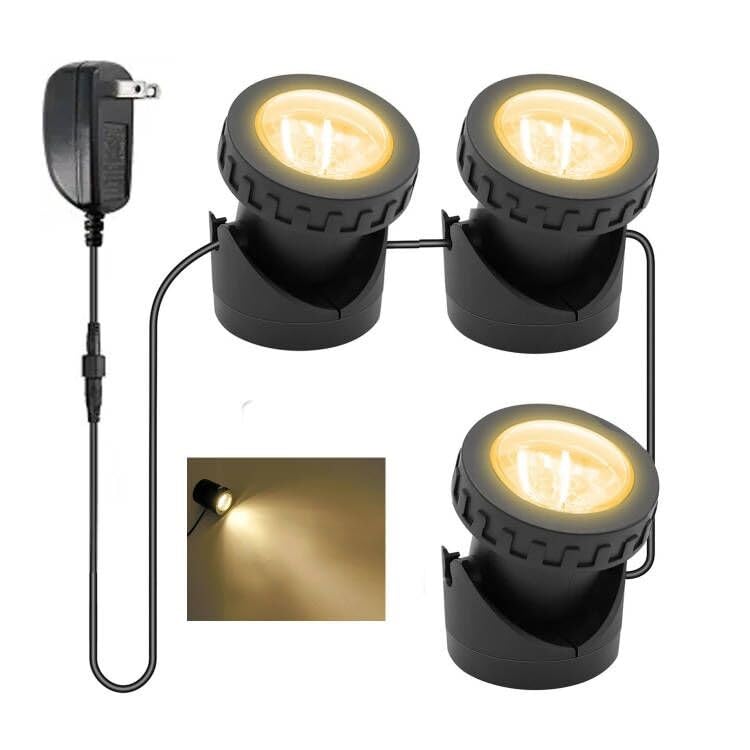
The fixed 2500K warm-white color and three-head layout make the TENSUL set a quieter choice than the RGB kits here. Each head has 12 LEDs, and the light is soft and slightly amber, the kind that flatters stone and moving water without turning the pond into a display. If you want a natural look, this is closer to landscape lighting than to a color-changing fountain show.

We like the three-head format for a small fountain because it covers a basin without looking busy. The heads adjust through 90 degrees, and the whole set runs on 5V DC with IP68 sealing, which is about as reassuring as pond wiring gets. One plug feeds all three lights, so there is only one connection to protect. The spacing is fixed, though, so measure the run before you buy; and the plug is bulky, so check that it fits your outdoor outlet cover.

Brightness is the compromise. These are accent lights, not floodlights, and they can read dimmer than expected on a large pond. On a small pond or a fountain close to the house, the softness is the point. We also appreciate that the warm color stays consistent across all three heads, which is more than we can say for some color-changing kits that drift toward red or green. For a natural evening glow, that consistency matters more than raw output.

Bottom line: The TENSUL warm-white set is what we point to for small ponds and fountains where a soft 2500K glow matters more than raw brightness; the low-voltage wiring is a bonus.

How We Tested Pond Lights, From First Dusk Check to First Frost

We started with roughly 40 sets sold by retailers we trust and cut anything with a vague water-resistance claim, fewer than three fixtures in the box, or a price that worked out absurd per light. That left 12 sets, which ran for six months, from the first warm week of spring through the first hard frost.

Most went around a koi pond, with the rest split between a stock-tank pond on a patio and a shallow wildlife pond. At dusk we walked the perimeter and noted how far each beam actually carried across open water, whether it reached the far bank, and whether the light turned the water green or tea-colored. We also looked at every fixture in daylight, since a light that sits proud of the liner edge bothers you all day, not just at night.

Installation got timed, one person, stopwatch running: how long to stake, bury, or float each one, and whether the job needed a ladder, an outlet, or an extension cord run across a walkway. For the solar-powered sets, we logged charging on three consecutive overcast days and checked whether a thin film of algae on the panel quietly killed the output.

After every heavy rain we opened the housings and looked for water inside, and we swapped every colored lens and filter to see whether the tints held up or just washed the beam out. Value came down to cost per fixture and whether spare stakes, filters, or replacement heads were sold separately. Two sets failed outright within the six months; the rest earned their place.

How to Choose Pond Lights

Start With the Seal and the Power

Waterproofing is the first thing we check, because a pond light that takes on water is done. Look for an IP68 rating for fixtures that sit below the surface, and a sealed cable exit rather than an open strain relief. Low voltage is your friend: 12V systems like the MIK and Jebao kits, or 5V like the TENSUL warm-white set, are safer around water than a 120V fixture. If you already have a 12V transformer, stay in that system; if you don't, price the transformer and wiring before you fall for the light.

Match the Beam to the Feature

Brightness is not a single number to chase. A 45-lumen Aquascape uplight is plenty for a waterfall lip and useless across a large pond; a 490-lumen brass spot can carry a focal feature on its own. Warm white in the 2500K to 3000K range flatters stone and plants, while RGB sets are for color and spectacle. We prefer one strong warm beam for a natural pond and a multi-head color kit for a playful fountain. If you want both, run separate fixtures rather than asking one set to do everything.

Think in Coverage, Not Just Heads

Three heads can be right for a small fountain; eight make more sense around a large pond. The spacing matters as much as the count: the Jebao kit gives you 3 feet between heads, so it suits a compact ring, while the GZKANFUL set spreads eight heads over a wider run. Sketch the pond, mark where you want light, and measure the cable path before ordering. A set with the wrong spacing leaves dark gaps that no amount of extra brightness fixes.

Plan the Mount

Suction cups work on smooth, clean fountain walls and fail on rough stone or algae. We treat them as a convenience, not a permanent fixing. Weighted heads, like the POPOSOAP solar set, are easiest in a small pond because you can set them down and adjust them. For a larger fixture, a heavy brass body or a screw-down base is more trustworthy. Clean the surface, press the cup firmly, and route the cable with slack so it does not pull the light off line.

Decide How Much Control You Want

A remote is handy for dimming and color changes, but it adds another battery and another thing to lose. Timers are the feature we use most: set the pond to come on at dusk and go off before bed, and you stop thinking about it. The Jebao kit has no timer or sensor, so pair it with an outdoor timer; the GZKANFUL and T-SUN sets include remotes. If you want set-and-forget, buy for the control you will actually use, not the longest feature list.

Frequently Asked Questions

Final Verdict

For a pond we care about, the MIK Solutions 113 is the light we recommend first. Its brass body, 490-lumen warm beam and replaceable bulb make it the most convincing long-term fixture here, provided you have a 12V transformer.

If there is no power at the water, choose the T-SUN solar set instead; it gives up the white beam and some brightness, but it gets light onto the pond without an electrician. For a small warm-white fountain on a budget, the TENSUL three-light set is the quieter choice.