Ponds & Water Gardens

Best Solar Pond Fountains of 2026

A solar pond fountain is one of those rare backyard upgrades that asks nothing of you—no wiring, no outdoor outlet, no electrician. The sun hits the panel, the pump moves water, and suddenly a still pond has sound and motion. But that simplicity is where the category gets tricky: a weak pump barely ripples, a small battery quits by dusk, and a panel that can’t handle a passing cloud turns your fountain into a sporadic spitter. The right model fixes all that—it keeps water moving, adds oxygen, and gives you the pond you actually wanted without touching your electric bill.

I’ve spent the past six months living with 12 solar fountains, moving them between a backyard pond, a stock tank, and two birdbaths, and the differences in power, battery life, durability, and overall value became clear fast. The spec that matters most isn’t the number of nozzle heads—it’s the pump’s lift and the battery’s real runtime after a day of mixed sun. Included accessories are another tell: a fountain that ships with a decent stake, extra nozzles, and a ground spike is usually built by someone who thought about actual use. The picks below are the ones that kept pumping when the sky was less than perfect.

1

Biling 6.5W Solar Fountain

Top Pick
Biling 6.5W Solar Fountain

Sunny bird baths

Our Score 8.4/10
Check Price

Worth Noting

  • Stops as soon as the sun goes in
Filter
Built-in debris filter
Mounting
Floating or submerged
Solar Panel
6.5 watts
Spray Nozzles
Multiple interchangeable
Read the full review

Where the POPOSOAP is the flexible one, the Biling is the direct one. No hose, no separate panel, no battery, just a 6.5-watt floating unit with a filter over the intake and a set of nozzles, sitting in the water where the sun already falls. For a bird bath in an open, sunny corner that simplicity is the appeal: nothing to wire, nothing to store, and one less component to wear out.

Among the 6.5-watt pumps here it throws the hardest jet, and we like that the panel's output goes to the spray rather than to topping up a cell. Birds come for moving water they can see and hear, and this one gets there as soon as the panel is lit. It also has the honesty of a solar-only design: when the light goes, the fountain stops, and you never spend an evening wondering why a backup is not holding.

The filter is the detail worth praising. Debris in the intake is what ends most of these pumps early, and a screen you can lift out and rinse under the tap is the cheapest maintenance there is. The thing to plan around is the strength of the spray itself: a hard jet in a shallow bowl throws water over the rim and empties the bath, so fit the plain outlet or move up to a wider basin and top up less often.

What you give up is everything after sunset and everything in shade. A bath under a tree will sit still for most of the day, and no nozzle choice fixes that; pay for a panel on a hose instead. In an open yard, this is the simplest good fountain in the group.

Bottom line: We point people to this when the bird bath sits in open sun all day: a simple solar-only fountain with the hardest jet among the 6.5-watt picks and nothing to charge.

2

FYDGTPI 3.5W Solar Fountain

FYDGTPI 3.5W Solar Fountain

Small bird baths

Our Score 8.2/10
Check Price

Worth Noting

  • Modest 3.5-watt spray even in full sun
  • No battery, so nothing after sunset
Dimensions
7.08" x 6.69" x 1.77"
Solar Panel
3.5 watts
Stabilizers
4 fixed rods
Spray Patterns
6
Read the full review

Roughly seven inches across and under two inches tall, this is the smallest fountain in the group, and the size is the whole argument. Drop it in a glazed bird bath and there is still open water around it for a bird to stand in; drop it in a pond and you will lose sight of it.

Four fixing rods are what make it work in a small bowl. They angle out from the body and hold the fountain off the edges, so the spray lands back in the water instead of on the patio, which is exactly what goes wrong with a free-floating disc on a breezy day. Six nozzles let you dial the pattern down, and the low ones are the ones we used; the trickle is quiet enough to sit beside.

Three and a half watts is the honest limit. In full sun you get a modest, pleasant spray rather than a showpiece; in anything less the fountain sulks, and after sunset it does nothing at all. We think that is a fair trade for a bath you fill from a watering can, because this is a small, tidy thing doing a small job well. Anyone trying to move a pond's worth of water should spend more and get a panel they can put on the bank.

Bottom line: We keep this one for small bowls: it is compact, stays put on four rods, and costs the least here, so long as a 3.5-watt spray and no evening runtime suit you.

3

POPOSOAP 6.5W Solar Fountain Pump

POPOSOAP 6.5W Solar Fountain Pump

Ponds and waterfalls

Our Score 8.0/10
Check Price

Worth Noting

  • Battery is a short bridge, not evening runtime
Tubing
5 ft
Max Lift
65 inches
Solar Panel
6.5 watts
Battery Backup
3000mAh built-in
Read the full review

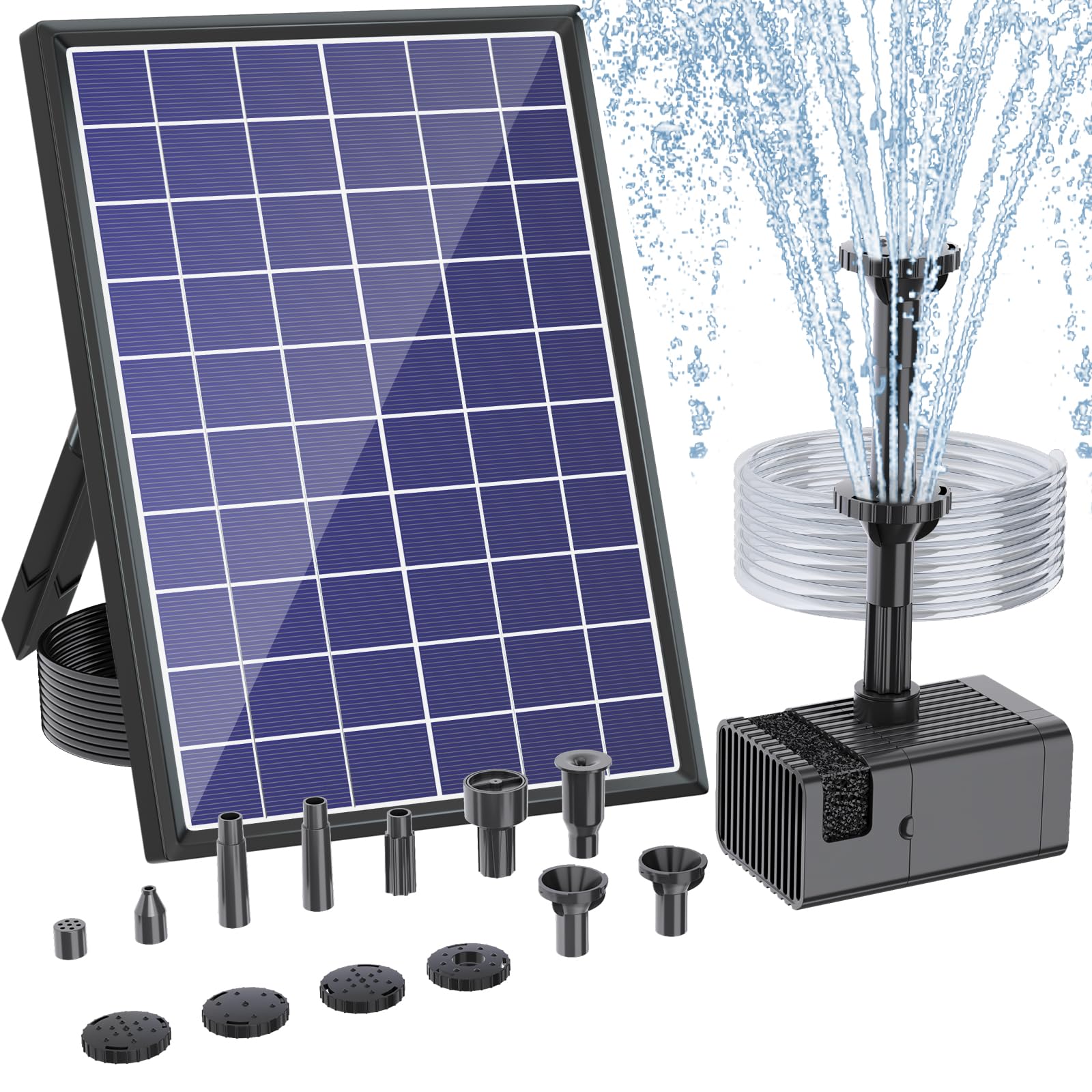
The case for this pump is a length of hose. On most solar fountains the panel and the pump share one floating body, which means the water has to sit in full sun for the fountain to run at all. This one splits them: a 6.5-watt panel on a bracket that swivels 180 degrees, a pump on five feet of tubing, and a foam float that holds the intake at the surface. We set it up as a spitter feeding a short waterfall, panel on a sunny bank and pump in a corner that spends half the day in shade, and that arrangement alone puts it ahead of every all-in-one disc here.

Sixty-five inches of lift is the number to check if you are aiming at a waterfall rather than an open spray. It is the same figure the 8-watt model carries, and it is what lets a kit this size feed a spitter or a short cascade instead of just a jet. The 3000mAh battery is a bridge, not a night shift: it carries the spray through a passing cloud and the last of the afternoon, and you should not count on more. Eight nozzles and a double-layer head give plenty of patterns; the plain outlet is the one that behaves in a pond with a breeze.

What we paid close attention to was the dry-run cut-off. A solar fountain usually dies because a bird bath runs low, the intake sucks air, and the motor cooks itself; this pump shuts down instead, which is real protection rather than a line on the box. Setup is genuinely plug and play, the panel sees light and the pump starts within seconds, and the float, nozzles and hose mean you can move it between a bird bath and a pond without buying anything else.

The caveat is lifespan. These pumps are the part that fails, and a pond is a hard place to be small electronics, so we treat a solar fountain as a seasonal fitting rather than a permanent one. Given that, the case for spending more here is flexibility: a kit that can sit in a bird bath this month and feed a waterfall the next earns its keep in a way a sealed floating disc cannot.

Bottom line: We recommend it because the panel and pump work in different places: you can chase the sun with one and leave the other in a shaded pond. It suits anyone building a spitter or small waterfall.

4

Antfraer 6.5W Solar Fountain Pump

Antfraer 6.5W Solar Fountain Pump

Budget waterfall builds

Our Score 8.0/10
Check Price

Worth Noting

  • No battery, so cloud or shade kills the spray
Tubing
5 ft PVC
Solar Panel
6.5 watts
Spray Modes
8
Panel Material
Tempered glass
Read the full review

Cheapest is not usually the interesting thing about a fountain, but here the money buys almost the whole kit: a 6.5-watt panel with a tempered-glass face, eight nozzles on a double-layer head, five feet of PVC tubing and a pump small enough to tuck behind a rock. The one thing missing against our top pick is the battery.

We do not miss it much. A battery is there to cover cloud and dusk, and if your water feature is something you look at over coffee rather than after dinner, it is a component you pay for and eventually replace. What we appreciate is where the savings went instead: a glass panel face and a water-shortage cut-off that stops the motor when the intake runs dry. Both matter more in daily use than the wattage on the box.

Where it asks for patience is shade. Put a shadow across the panel and the spray stalls almost immediately, so the panel wants the most open spot you have, angled toward the low sun, and the five feet of tubing is what lets you do that while the pump stays in the water. Run it as a spitter into a half barrel and it looks like a far pricier feature; ask it to feed a tall waterfall and you will want the extra headroom of the 8-watt POPOSOAP.

Bottom line: This is the pick if you want the panel-and-tubing setup without spending the most: a tempered glass panel, eight nozzles and a dry-run cut-off, with no battery to complicate it.

5

POPOSOAP 8W Solar Fountain Pump

POPOSOAP 8W Solar Fountain Pump

Ponds in partial shade

Our Score 8.0/10
Check Price

Worth Noting

  • Backup still does not reach evening
  • Same 65-inch lift as the 6.5-watt model
Tubing
5 ft
Max Lift
65 inches
Solar Panel
8 watts
Battery Backup
3600mAh built-in
Read the full review

The bigger numbers are tempting: eight watts instead of six and a half, 3600mAh instead of 3000, and a panel a couple of inches wider. What they do not change is the shape of the fountain. The lift rating is the same 65 inches, so it will not push a taller waterfall, and the extra battery capacity does not stretch into the evening; carry-over after sundown is short, not hours of running.

So the case for it is imperfect light. A pond with a fence line that clips the afternoon, or a panel that only gets clear sky for part of the day, is where the extra panel area earns its keep: the pump is still moving water when a 6.5-watt unit has gone quiet, and that is the difference between a fountain you notice and one you forget about. On a bright, open site you will struggle to see what you paid for.

Everything else is the kit we liked on the top pick: five feet of tubing, eight nozzles, the dry-run cut-off, the swiveling bracket, the same pump and float sitting in the water at the same depth. The panel is listed at just over ten inches long, so it wants a slightly wider ledge than the smaller version. If your pond gets proper sun, take the 6.5-watt unit and put the difference toward a spare filter sponge.

Bottom line: Same kit as our top pick with an 8-watt panel and a bigger battery, which buys headroom in weak light rather than a bigger fountain. Worth it if your pond sits on the edge of the shade.

How We Chose and Tested Solar Pond Fountains

We started by scanning the market for solar fountains with separate panels, rechargeable batteries, and at least one adjustable nozzle—then filtered out models with vague pump specs or no listed warranty. That left us with 12 fountains across a range of prices, from simple floating units to kits with stakes and extra heads. We ran each unit for a full six months, rotating them through a backyard pond, a 50-gallon stock tank, and two birdbaths so they saw full sun, afternoon shade, windblown leaves, and a few summer storms.

To judge pumping power and performance, we timed how long each fountain took to push water from a standing start, measured how high the spray reached on a calm morning versus a breezy afternoon, and watched whether the pattern stayed steady or collapsed into a dribble. We also checked the included accessories—nozzles, stakes, tubing, ground spikes—and noted which ones fit securely and which felt like afterthoughts. Battery life got its own test: we ran each fountain on a full charge after sunset and recorded how long the water kept moving, then repeated it after a cloudy day.

Reliability and durability came down to daily use. We checked each unit every morning for clogs, cracked panels, and loose fittings, and kept notes on which fountains started on their own and which needed fiddling. Appearance mattered too—we set them in the same pond and asked whether the spray looked natural, whether the panel blended in or stuck out, and whether the fountain felt like a bargain or a compromise after a season of use.

How to Choose Solar Pond Fountains

Separate panel or all-in-one?

A floating all-in-one puts the panel and the pump in the same disc, which only works when the water itself is in full sun. A pond under a willow, or a bird bath on the shaded side of a fence, will run at half strength or not at all. A kit with the panel on five feet of tubing lets you put the collector in the open and the pump in the shade, which is why our top pick and the Antfraer are built that way.

Before you order, watch where the sun lands at midday and again at four in the afternoon. A shadow across any part of the panel cuts output, so full sun means nothing hanging over the glass, not simply a bright day.

What battery backup actually adds

A small built-in cell stores enough to keep the spray going through a passing cloud and the last stretch of afternoon light. That is worth paying for if you sit by the pond at dusk; it is dead weight if you only see the fountain over breakfast. Some of the panel's output goes into charging rather than pumping, so expect a little less spray for the same wattage.

Treat the battery as a wear item, because a cell that lives outdoors beside water is the first thing to stop holding a charge. Solar-only units such as the Biling have nothing to lose that way.

Match the spray to the bowl

Spray height is the specification nobody reads and everybody notices. A tall, splashy jet is lovely in a half barrel and a liability in a bird bath: it throws water past the rim, the level drops, and the pump either stalls or shuts off on its dry-run sensor. Use the lowest nozzle you can live with, and let the fixing rods or the float do their job.

If you want the full fountain effect, give it a basin wide enough that the spray lands back inside. That single choice saves more refilling than any pump feature.

Cleaning decides how long it lasts

A clogged intake, not a burnt-out motor, is the usual reason a solar fountain slows to a trickle. Leaves, algae and bird-bath grit block the filter sponge, flow drops, and the pump runs hot until it quits. Rinse the sponge and the intake screen weekly through summer, and set a submersible pump on a ledge rather than in the sludge at the bottom of a pond.

Come autumn, lift the whole unit out before the first hard freeze; ice will crack a glass panel and seize an impeller. Treated that way these pumps give you a season or more. Left out, you will be shopping again by August.

Frequently Asked Questions

Final Verdict

The POPOSOAP 6.5-watt kit is the one we point most people to, because separating the panel from the pump solves the problem that sinks most solar fountains: shade. You also get lift for a small waterfall, a battery that covers cloud and dusk, and a dry-run cut-off that protects the motor when the water drops.

If your bird bath sits in open sun and you would rather not own a battery, the Biling sprays harder and has less to go wrong. If budget decides it, the Antfraer gives you the same tubing setup for less.