Planters & Plant Supports

Best Plastic Garden Edging of 2026

Fresh mulch against a crisp edge is one of the few garden upgrades you can see from the kitchen window. Three weeks later, the lawn creeps back over the line and the string trimmer chews a trench where your border used to be. Plastic edging is the fix: a buried strip that gives the mower a line to follow and keeps mulch where you put it.

I've spent the past five months installing 12 different edging kits, curving them around shrub beds, running them along a walkway, and burying them in a slope that drains toward the street. The ones that held share three things: enough stakes to go all the way around, a thickness that doesn't kink when you bend it, and a low profile the mower deck glides over. Cheap edging isn't permanent hardscape, so think of it as a five-to-ten-year line in the sand, which is exactly why the flimsy ones aren't worth the hour you'll spend on your knees. The picks below earned their place.

1

LXVOOEE Landscape Edging 60 ft

Top Pick
LXVOOEE Landscape Edging 60 ft

Slopes, wet soil

Our Score 9.2/10
Check Price

Worth Noting

  • Ripples slightly on uneven ground
Run Length
60 ft
Board Height
4 in
Staple Gauge
8 gauge
Stakes Included
75 metal staples
Read the full review

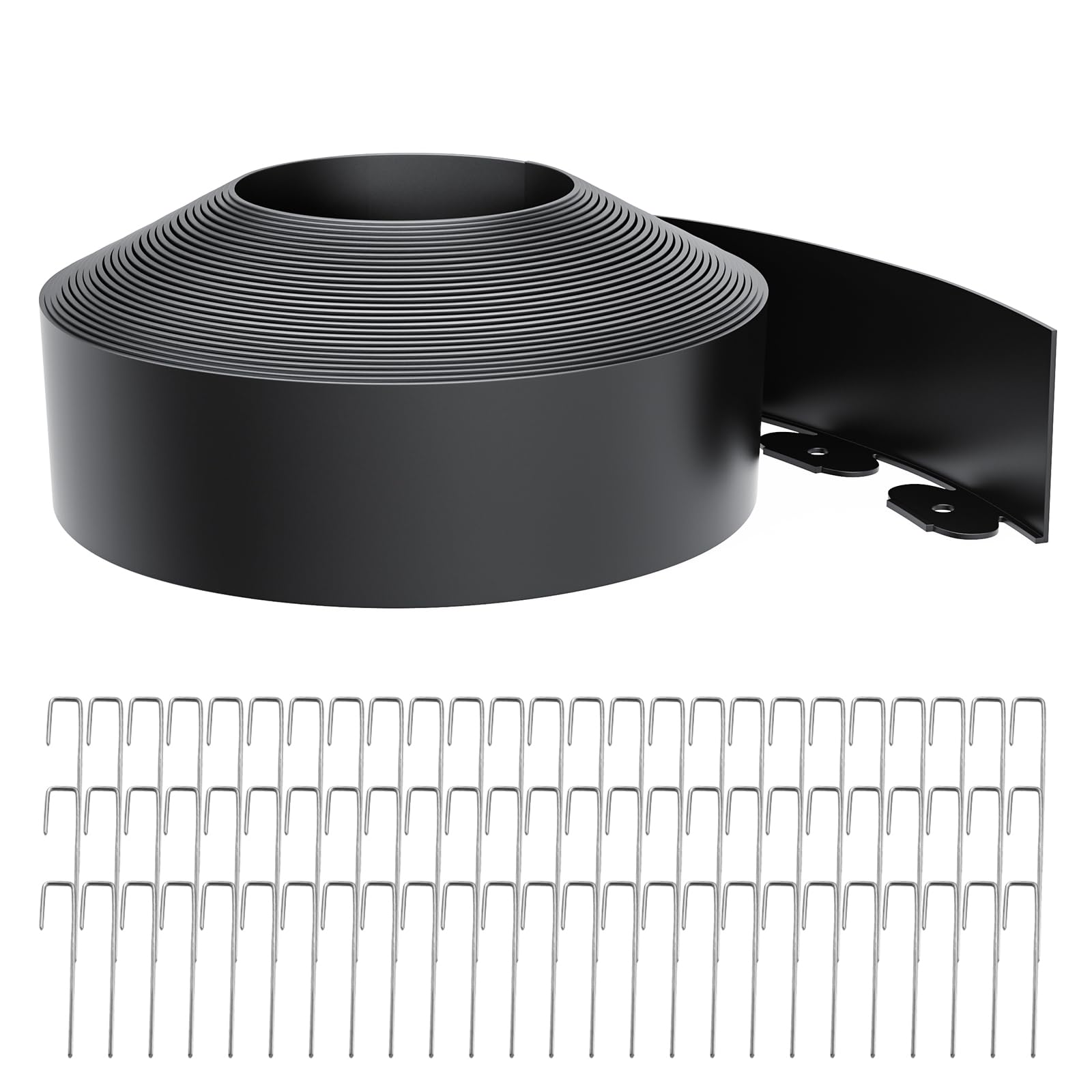
The stakes are the part that fails first on plastic edging. A spiral spike hits a stone, the head shears off, and you finish the run with a border held at the ends and waving in between. This kit ships 75 eight-gauge metal staples instead, each with two anchor points rather than one, so a staple resists rocking in wet soil instead of pivoting on a single leg.

The board is four inches of high-density polyethylene, thick enough to hold a line between staples and still bend around a corner by hand. Sixty feet covers a couple of large beds or one long boundary, and it cuts with a utility knife where a run needs to stop.

We think this is the kit for ground that fights back: a slope, a gravel path, soil that stays wet into spring. You're paying for the staples more than the board, and on soft level loam a cheaper coil with plastic spikes does the same job. But if you have already bent a pack of plastic spikes this season, the extra buys you an afternoon back.

Bottom line: Our pick for ground that fights back: metal staples that hold in wet soil and a four-inch board that stands on its own.

2

Beuta Polyrock Edging

Beuta Polyrock Edging

Front-yard beds

Our Score 9.2/10
Check Price

Worth Noting

  • Premium price for about 16 feet of edging
Section Height
2.25 in
Section Length
48 in
Spikes Included
12
Sections Included
4
Read the full review

From a few feet away the Beuta sections read as stacked stone, and that is the entire reason to pay for them. We think this is the best-looking edging in this group and the one to choose when the border sits in front of the house where people actually look at it.

Each section is six interlocking bricks with a light resin feel that belies how firmly they sit once spiked. Twelve spikes for four sections is generous, and the joints let you bend a run around a shrub or open it into a shallow curve without cutting anything at all. They stand up to weather and a trimmer without showing damage, which is more than the thin coils manage.

The catch is arithmetic. Extending the run means buying another pack, and a long bed turns into a stack of them. What you get in return is a border that looks installed rather than bought, and one you can add to a section at a time as a bed grows.

Bottom line: The best-looking edging we tested, and the one to buy when the border is on show — just budget for several packs.

3

MIXC Garden Edging 100 ft

MIXC Garden Edging 100 ft

Long curved borders

Our Score 9.0/10
Check Price

Worth Noting

  • Coil arrives tight and needs sun to relax
Run Length
100 ft
Board Height
2 in
Stake Length
6 in
Stakes Included
150 spiral
Read the full review

A hundred and fifty stakes for a hundred feet of edging is the number that won us over. Most kits here hand you ten or thirty and leave you to discover the shortfall halfway along the run, so the border ends up pinned at the ends and loose in the middle. MIXC gives you enough to drive one every eight inches, and that spacing is what keeps a line true through a winter of freezing and thawing or a dog that takes the same corner every morning. It's the reason this is the kit we tell people to buy first.

The 2-inch height is the other half of the decision. Set an inch above the soil and the board holds a mulch bed in place while the mower deck passes over it without scalping the plastic or the grass. It isn't a wall, though. If the job is stopping a running grass that has been creeping into a bed for years, two inches of flexible board gives it something to climb, and a taller board does that work better.

Installation is dig-free in the way the label promises: unroll it, shape it by hand or with a mallet, and hammer the six-inch spiral stakes through the tabs. On ground that has baked hard, start each stake with a screwdriver and you save yourself a handful of bent plastic. Cutting to length takes a utility knife and a couple of passes.

What you trade for all that flexibility is crispness. This is a soft board, and a long straight run can read as faintly wavy from across the yard in a way a stiffer HDPE plank does not. For curved beds, tree rings and borders meant to disappear into the lawn, that's the right trade to make; for a ruler-straight edge along a driveway, look at one of the thicker boards here.

Bottom line: We recommend it as the default: 100 feet of edging with a stake for every eight inches, so the whole run stays where you put it.

4

EasyFlex No-Dig 100 ft

EasyFlex No-Dig 100 ft

Hard, clay ground

Our Score 9.0/10
Check Price

Worth Noting

  • Can go wavy in sustained heat
Connectors
5
Run Length
100 ft
Board Height
1.5 in
Stakes Included
30 spiral
Read the full review

A 1.5-inch lip barely announces itself. At that height the edging all but disappears into the grass, and what you see is the shape of the bed rather than a strip of black plastic running alongside it.

Ground you cannot dig is where this kit earns its keep. Clay, gravel, roots, the packed strip beside a driveway: the no-dig promise is only as good as what the coil does when a mallet drives a stake through it, and this one takes the hit, holds the shape you gave it, and stays. Thirty spiral stakes and five connectors come in the box, enough to join two runs cleanly at a corner.

A hundred feet in one coil means fewer seams, so you can run the whole front of a property without a joint. Curves are easy while the plastic is warm, and a utility knife takes it down to size where a bed turns sharply. At 1.5 inches, though, this is a mowing line and a mulch stop rather than a grass barrier; if creeping grass is the problem, you want four or five inches of board instead.

Bottom line: We like it for hard, undiggable ground and low, disappearing lines; choose a taller board if creeping grass is your enemy.

5

Master Mark Terrace Board 40 ft

Master Mark Terrace Board 40 ft

Grass barriers

Our Score 8.8/10
Check Price

Worth Noting

  • Only 10 stakes for a 40-foot run
  • Bows between stakes when it isn't held often
Material
HDPE plastic
Run Length
40 ft
Board Height
5 in
Stakes Included
10
Read the full review

Five inches of board is a different tool from the two-inch coil most people picture when they hear landscape edging. This one is for the bed that keeps losing ground to the lawn: the strip along a fence, the front of a vegetable plot, anywhere grass has been walking in sideways for years.

The height is the whole argument. Sink it so an inch stands above the soil and four inches sit below the crown of the lawn, right where the runners travel, and you've cut off the route rather than tidied the surface. Nothing else here puts that much board underground. We think it's the most convincing grass barrier in this group, and the textured woodgrain finish keeps it from reading as a black plastic strip.

It's HDPE, which is the plastic worth having outdoors: stiff enough to hold a line, soft enough to follow a curve, and it takes a trimmer hit without shredding. The stakes slip through clips molded onto the board rather than punching holes through it, which turns a repositioned corner into a two-minute job instead of a new hole in the plastic.

Bottom line: Buy this one when grass is the problem: five inches of HDPE puts more board below the lawn's roots than anything else here.

6

Gardzen Landscape Edging 100 ft

Gardzen Landscape Edging 100 ft

Multi-bed yards

Our Score 8.8/10
Check Price

Worth Noting

  • Stakes snap in dry, hard ground
Run Length
100 ft
Board Height
1.5 in
Stake Length
6 in
Stakes Included
120 spiral
Read the full review

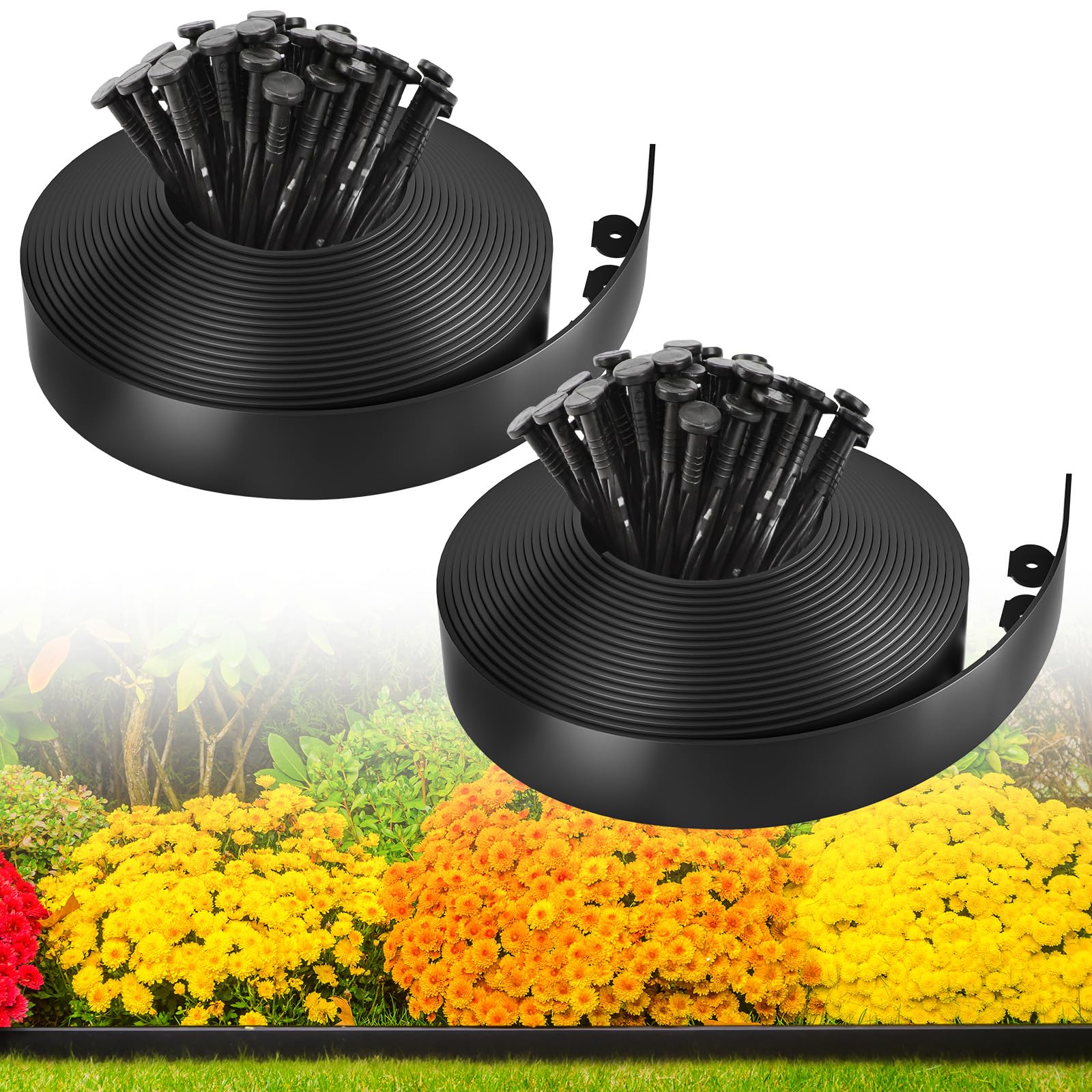
Three 33-foot coils instead of one 100-foot roll is the detail that makes this kit pleasant to live with. You carry a light bundle around a bed, cut it where you need to, and don't spend an afternoon wrestling a springy spiral that wants to coil back up.

The board is 1.5 inches of black plastic with 120 six-inch spiral stakes, so there's no scramble for extras at the end of the job. It trims with shears, bends around a shrub, and takes a mallet without cracking, and the low profile disappears once the grass grows up to it.

For a yard with several separate beds rather than one long boundary, we think this is the easiest kit here to work with: short coils, plenty of stakes, no seams to line up. Straight runs are where it asks for patience, and the ground matters more than the technique, so this is edging for a bed you're shaping by eye rather than a ruler line along a driveway.

Bottom line: We reach for this one on a yard of separate beds: short coils, plenty of stakes, and no wrestling with a hundred-foot roll.

7

Amazon Basics Woodgrain Edging

Amazon Basics Woodgrain Edging

Natural wood look

Our Score 8.8/10
Check Price

Worth Noting

  • Goes wavy where stakes are spread out
Finish
Brown woodgrain
Run Length
40 ft
Board Height
5 in
Stakes Included
10
Read the full review

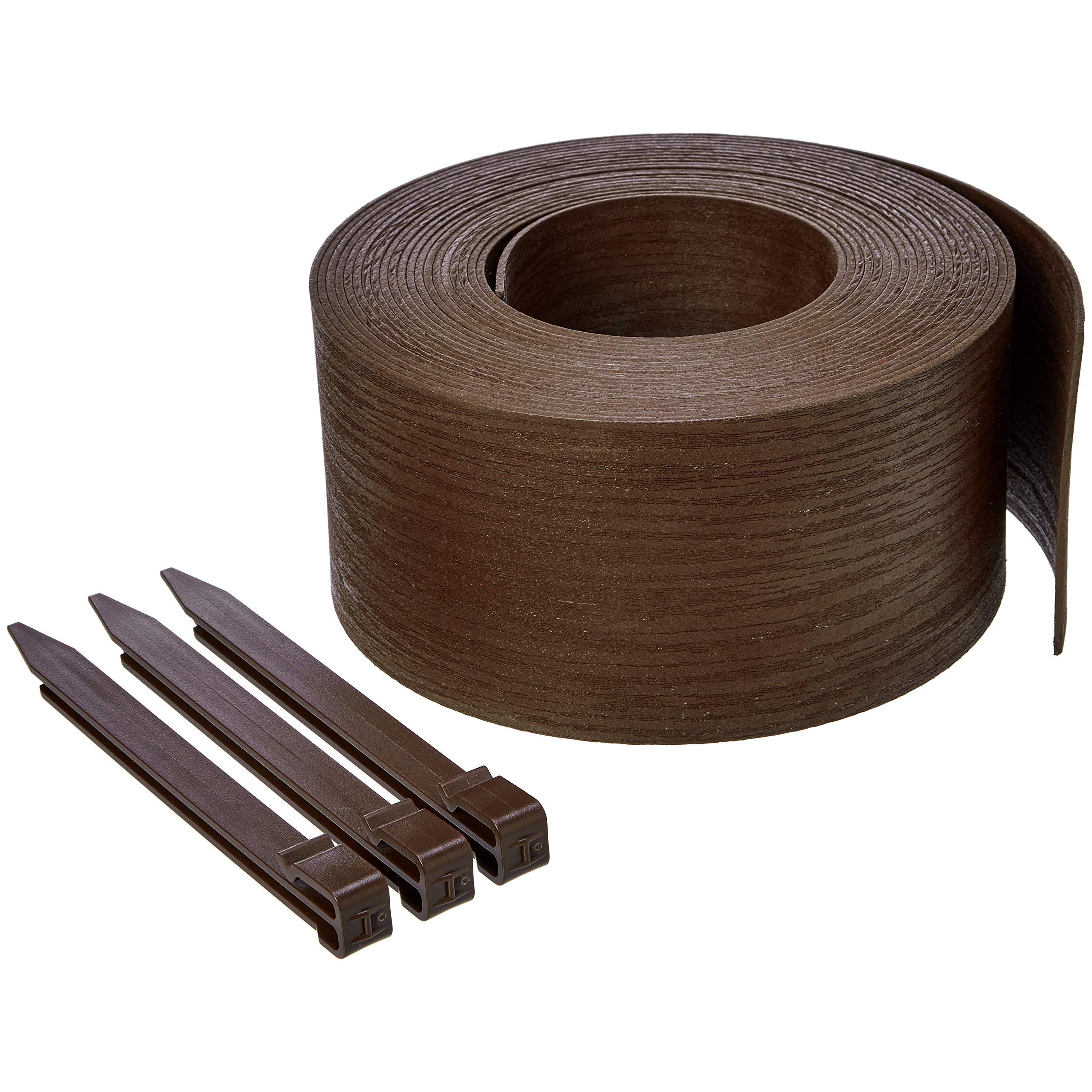
Brown, woodgrain-textured and five inches deep, this is the coil to pick when the edge has to look like something other than plastic. Against bark mulch or a gravel path the color reads as weathered timber from a few steps away, which is more than most black coils manage.

The height does practical work too. Five inches is wide enough that the board sits under the grass roots and still leaves a lip above the soil, and it holds a deep mulch bed so the chips stay in the bed after a storm instead of washing across the lawn.

It unrolls without much fight and cuts with a pair of shears, which matters when a run has to stop at a shrub rather than a nice round number of feet. Drive the stakes through the tabs and shape the rest with your hands; the flat of the board is not a hammering surface.

Where we think this one belongs is a front bed with a path or a driveway running along it, where a black line would spoil the look and the mulch needs holding. It's the best of the wood-look options here, and the one we point at when someone wants a border that reads as timber rather than hardware.

Bottom line: Our favorite wood-look coil — five inches deep, easy to cut, and the one that looks least like plastic against mulch.

8

FunFanso Landscape Edging 80 ft

FunFanso Landscape Edging 80 ft

Budget coverage

Our Score 8.8/10
Check Price

Worth Noting

  • Spikes snap in hard or stony ground
Material
Polyethylene
Run Length
80 ft
Board Height
2 in
Stakes Included
125
Read the full review

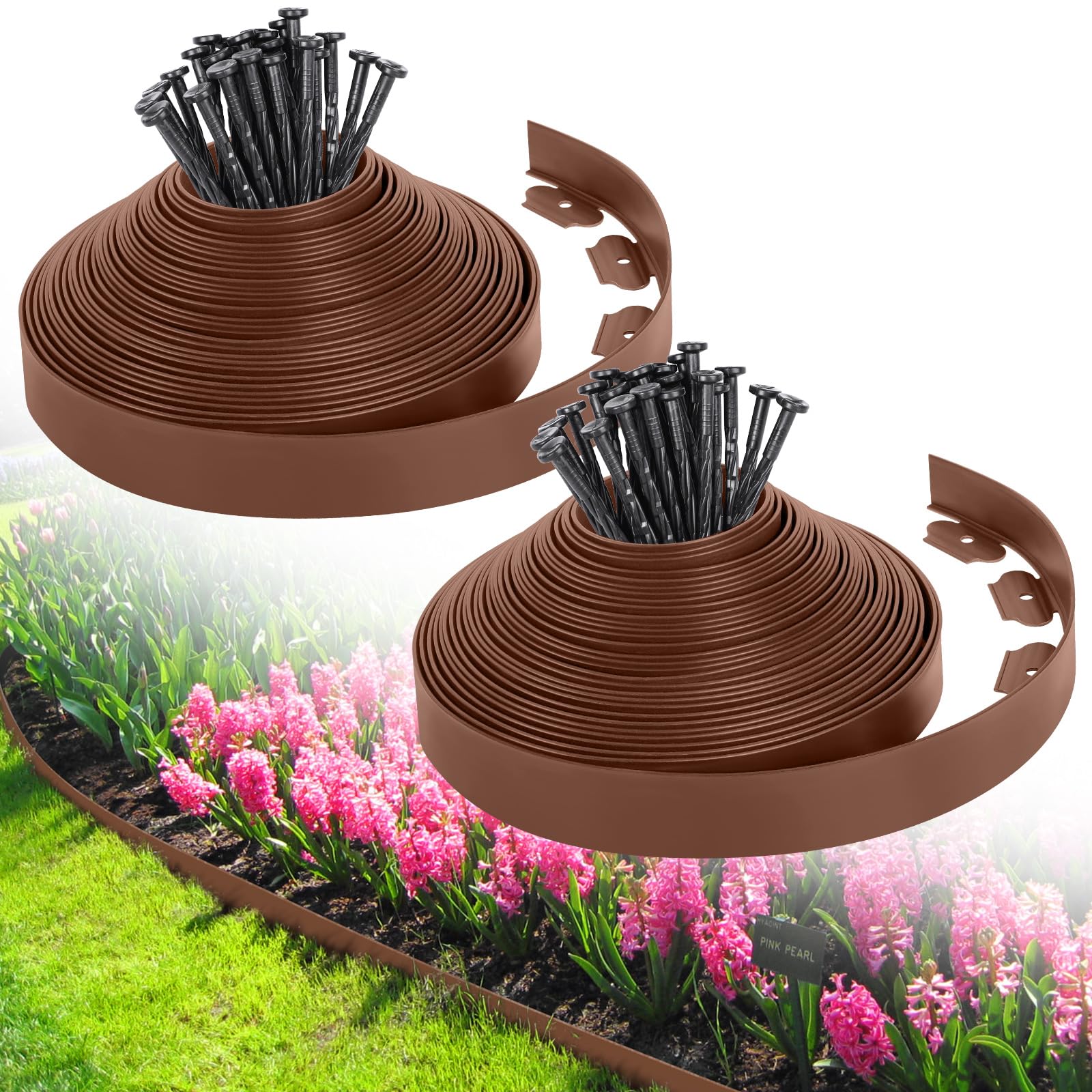
Eighty feet of edging and 125 stakes in one box is a lot of border for the least money here, and that combination is the whole case for this kit. If you're edging a large yard for the first time and the budget is the constraint, you can finish the job without placing a second order.

The board is two inches of brown polyethylene, soft enough to bend by hand and stiff enough to stand once it's staked. Brown is the friendlier color against soil and bark, and two inches is the useful middle: enough lip to hold mulch, low enough to run the mower over.

It cuts with a utility knife and shapes around a corner while the plastic is warm. As with any no-dig kit, the ground decides how the afternoon goes: work when the soil is soft after rain, and tap the stakes in with short strokes instead of leaning on them.

We think this is the right kit for a big, straightforward yard where quantity matters more than a crisp line: fence lines, the back of a shrub border, a vegetable patch. It's the one we point at when someone has eighty feet to edge, a small budget, and no need for the border to be the best-looking thing in the yard.

Bottom line: The most border for the least money here, and a sensible first kit if the yard is big, the budget is small, and the ground is soft.

How We Tested Plastic Garden Edging

We started by pulling together every plastic edging kit we could find, from unspooling rolls to interlocking panels to the bender-board style, then cut the list by price per linear foot, stake count, stated thickness, and whether the manufacturer published a warranty at all. Anything that shipped with a token handful of stakes for a 20-foot run, or that read like a single-season product, didn't make it. Twelve kits went into the ground.

Installation happened on Saturday mornings in my yard and a colleague's, in real beds rather than a test plot: one straight run along a driveway, two tight curves around shrub borders, and a sloped strip where water runs off. We timed each install solo, counted how many stakes came in the box versus how many the run actually needed, and noted whether the panels seated with a rubber mallet or pressed in by hand. Then we watched what the roll did when we let go of it, since the good ones lie down where you put them instead of springing back.

Over five months we kept after them the way a gardener actually does: string trimming along the edge, dragging a hose across the top, rolling the mower wheel over the crest, and leaning on the border while weeding. We checked for kinks at the bends, warping on the panels that took full afternoon sun, and whether the color chalked out or held. The top edge staying flush enough to mow over rather than around separated the kits we'd buy again from the ones we wouldn't. Extra stakes turned out to matter more than thickness in most yards, and a low price per foot only held up once we counted the stakes we had to buy separately.

How to Choose the Right Plastic Garden Edging

Match the height to the job

Height isn't about looks, it's about what the board has to stop. A 1.5- or 2-inch lip is a mowing line and a mulch stop: it disappears into the grass, the deck rides over it, and the bed edge itself reads clean. Four or five inches is a barrier, because you can sink it so the bulk of the board sits below the crown of the lawn, right where grass runners travel.

Measure from the soil line rather than the top of the board, and leave about an inch proud so you can see where to mow. If your beds adjoin a lawn that creeps in every summer, the taller board is the one that solves the problem; if you're tidying a mulch ring around a shrub, a low coil does everything you need.

Spend your attention on the stakes

The stake count on the box is the number most likely to disappoint. One every two to three feet holds a straight run; curves, corners and soft ground want them closer. A 40-foot coil shipped with ten will be pinned at the ends and loose in the middle, so order an extra pack before you start rather than halfway through.

Spiral plastic stakes are fine in loam and bend or snap in dry, stony ground. Metal staples with two legs cost more and hold far better where the soil stays wet, where the ground is uneven, or where a mower clips the edge. On hard ground, start each stake with a screwdriver and you'll bend fewer of them.

One long coil or three short ones

Coil memory is real. A hundred-foot roll arrives wanting to be a hundred-foot roll again, and it takes an afternoon of sun and a few stakes to convince it otherwise. Three 33-foot lengths are easier to carry around separate beds and leave less waste; a single long coil gives you fewer joints along one boundary, which matters when the line has to be continuous.

Stiffness is the other trade. A thicker HDPE board holds a ruler-straight run beside a driveway but resists a tight curve; a soft coil follows the shape of a bed by hand and reads slightly wavy over a long straight stretch. Deciding which of those two you actually need settles most of the choice.

Choose a finish you can live with

Black is the default because it disappears: against soil and shadow it reads as a gap rather than a product, which is what you want along a lawn. Brown woodgrain suits bark mulch and gravel and reads as timber from a few steps back, so it's the better match if the border sits in front of the house.

Stone-look interlocking sections are the front-yard option. They look like a low built wall rather than edging, curve well around shrubs, and cover far less ground per pack than a coil, so work out how many sections the bed really needs before you order one and assume it's enough.

Frequently Asked Questions

Final Verdict

Start with the MIXC 100-foot kit. It's the only edging here that arrives with enough stakes for the whole run, and two inches is the height that suits most beds: tall enough to hold mulch, low enough to mow over without thinking about it.

If grass is the enemy rather than tidiness, the five-inch Master Mark board puts real material below the lawn's roots. For ground that stays wet or slopes away, the LXVOOEE kit's metal staples are worth the extra outlay, and for the bed in front of the house, the Beuta stone sections are the only ones a visitor will notice.