Planters & Plant Supports

Best Metal Garden Edging of 2026

Metal edging does one job: it holds a line. A strip of steel or aluminum sunk into the soil keeps grass out of the mulch, keeps gravel off the lawn, and gives a bed an edge crisp enough that neighbors ask who did the landscaping. But the strip you pick decides whether that line stays crisp for a decade or ripples and rusts by the second spring. Gauge, coating, and how the material behaves around a curve matter far more than the finish shown on the box, and that is where most first-time buyers get surprised.

I have cut and reset edging along my own beds more than once, and the lesson I keep relearning is that the heaviest steel on the shelf is usually the wrong choice for a curved border. Over the past six months, my team and I installed 10 different metal edgings along lawns, gravel paths, and raised vegetable beds, then lived with them through mowing season. Appearance sold us on a few; sturdiness and ease of installation separated the rest. The picks below cover straight runs, tight curves, and everything a normal yard throws at an edge.

1

STIRLINGEAR 33 ft Steel Edging Kit

Top Pick
STIRLINGEAR 33 ft Steel Edging Kit

Most garden beds

Our Score 9.2/10
Check Price

Worth Noting

  • Only 2 inches stays above the soil
  • Needs a mallet and patience in dry ground
Height
5 in. total; 2 in. above ground
Coverage
33 ft (10 panels)
Material
Powder-coated galvanized steel
Anchoring
11 stakes included
Read the full review

Metal edging usually fails in one of two ways: it wanders off the line while you're driving it, or it eats a whole weekend. This ten-panel kit handles both. Each panel runs 40 inches long and 5 inches tall, with the bottom 3 inches designed to sit below grade, so the full 33 feet goes in with a consistent 2 inches of powder-coated black showing. The 11 stakes are what sold us. A bare serrated strip leans and heaves after a season; a staked panel stays where you set it.

The steel is stiff enough to hold a straight run beside a sidewalk and bends by hand around a bed corner — a 90-degree turn takes a firm push rather than a tool. At about 20 pounds for all ten panels, carrying the stack to the far bed is a one-trip job, and a hacksaw or tin snips shorten a panel to close a gap. A long, sweeping curve is the one shape it can't manage: 40-inch panels can only approximate a big arc, so a continuous roll is the better instrument there.

What you're buying beyond the steel is a finished look. The black powder coat reads as a mown edge rather than a wall, and it disappears against dark mulch in a way galvanized steel never does. It also costs more than the corrugated rolls here, which is the trade you make for hardware in the box and a line that doesn't need re-setting every spring.

Bottom line: Our pick for most yards: a staked panel kit that installs quickly, holds a crisp line, and looks finished the day you put it in.

2

Edge Right COR-Ten Edging, 5 Pack

Edge Right COR-Ten Edging, 5 Pack

Permanent borders

Our Score 9.2/10
Check Price

Worth Noting

  • Five strips cover only 20 feet
  • Rust finish won't stay dark grey
Depth
6 in.
Finish
Weathers to rust patina
Coverage
20 ft (5 strips)
Material
16-gauge COR-TEN steel
Read the full review

This is the most expensive edging we're recommending, and the money goes somewhere you can measure: 16-gauge COR-TEN steel, 6 inches deep, cut into 48-inch strips, five to a box. That's 20 feet of border at a much higher cost per foot than the galvanized picks here. Whether it's sensible depends entirely on what's going to hit it.

The stiffness is the whole argument. These strips resist denting, and the deeper 6-inch profile gives the steel more soil to grip than the 5-inch kits do, so a run along a driveway takes a string trimmer and a wheelbarrow without shifting. If your last edge went wavy after two seasons, this is the correction.

You drive them with a sledge and a block of wood, 48 inches at a time, and budget an afternoon rather than an hour. COR-TEN also changes colour on purpose, going from grey to a brown-orange patina as it weathers; it can be sealed if you want to hold it where it lands.

Where it earns its keep is a permanent edge in an abused spot — a driveway, a fire pit surround, a bed along a fence you'll never rebuild. Where it doesn't is tight curves and small beds, where 48 inches of heavy steel is more material than the job needs. Buy it once, in a straightish line, and it stops being a decision.

Bottom line: For a driveway, fire pit, or fence line that takes a beating, this is the heavy steel we choose and the one that ends the job for good.

3

SnugNiture 6 in. x 40 ft Edging

SnugNiture 6 in. x 40 ft Edging

First-time borders

Our Score 9.2/10
Check Price

Worth Noting

  • Softer than steel and dents under a trimmer
Edges
Hemmed top and bottom
Height
6 in.
Coverage
40 ft
Material
Aluminum
Read the full review

Forty feet, a 6-inch profile, and hems rolled over at both the top and bottom edge — this is the least expensive roll we're recommending, and it covers the basics. The material is listed as aluminum rather than steel, which explains a lot: it's the lightest 40-footer here, and it goes around a shrub without the wrestling match the steel rolls put up.

Installation is the part we appreciated. The corrugation gives the roll enough vertical stiffness to stand in a slit on its own, so an ordinary straight run along a bed doesn't need stakes, and the hems mean you can steer the whole thing with bare hands and no blood. A pair of tin snips gets through it for the final trim.

Where it makes sense is a first border, a rental, or a bed you might redesign in two years: the money is small, the improvement over plastic edging is immediate, and the roll is light enough to carry around the yard while you work out the shape. It's also the one we hand to someone edging a community plot they don't own.

Bottom line: Our budget pick: light, forgiving, and easy to steer by hand, this is the roll we suggest for a first border or a bed you may redo.

4

WORTH 14-Gauge Corten Edging

WORTH 14-Gauge Corten Edging

Tall rustic borders

Our Score 9.0/10
Check Price

Worth Noting

  • Covers only 20 feet per box
  • Stiff 8-inch profile fights tight curves
Finish
Pre-rusted patina
Height
8 in. total; 4.9 in. above ground
Coverage
20 ft (6 panels)
Material
14-gauge Corten steel
Read the full review

The rust isn't coming; it's already here. These six panels arrive pre-rusted, so the border looks settled on the afternoon you finish rather than the season after next. That patina is the pitch: dark, weathered steel against green, from the first week. It also means the box, your gloves, and the wheelbarrow handle are brown by lunchtime, so wear something you don't care about and keep the panels off pale paving until they're in the ground.

Six 40-inch panels cover 20 feet, joined by seven 10-inch clamps, and each stands 8 inches tall with 4.9 of those above the soil. That's more than twice the visible height of the Stirlingear kit and the tallest we can state for anything here, which is exactly what you want when the edge is holding back gravel or holding the line on a raised bed.

The 14-gauge Corten is heavy in the hand and takes a serious mallet, and the upside is that a panel doesn't wander once it's in; the clamps make a joint that reads as one continuous line. On money it sits between the Edge Right strips and the corrugated rolls — you're paying for the heavier profile and for a patina that's already done. If you want to freeze the finish as delivered, a coat of polyurethane locks it.

Bottom line: For a rustic border that needs real height from day one, this is the pre-rusted steel we reach for — with gloves on and the paving covered.

5

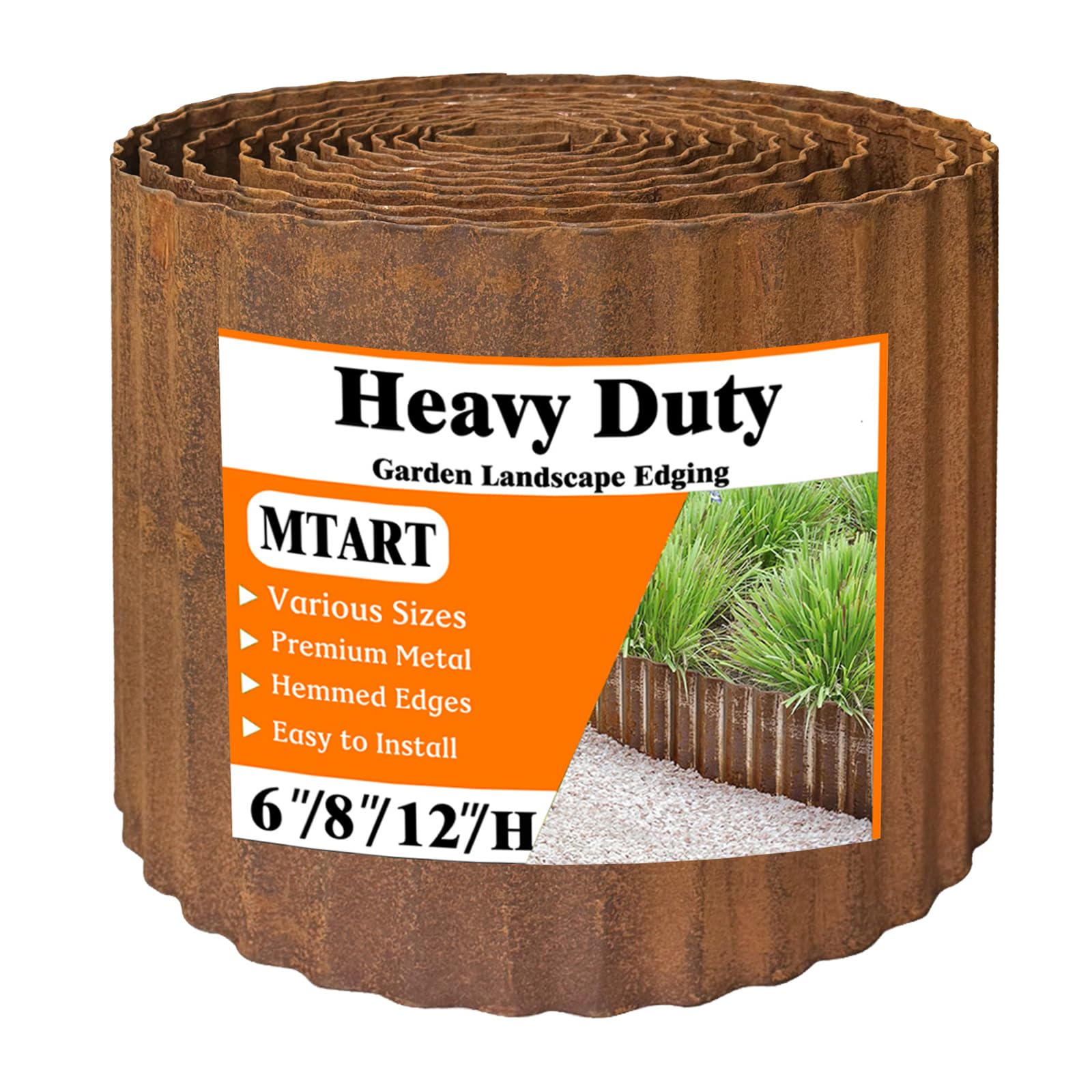
MTART 5.5 in. x 60 ft Edging

MTART 5.5 in. x 60 ft Edging

Long curved runs

Our Score 8.8/10
Check Price

Worth Noting

  • Pre-rusted finish keeps rusting in wet ground
  • Awkward for one person to place
Edges
Hemmed
Height
5.5 in.
Coverage
60 ft
Material
Pre-rusted metal
Read the full review

Sixty feet in a single piece. Nothing else we're covering goes that far without a joint, and on a long curve around a drive or a paddock fence that matters more than anything else on the label. Every join is a spot where the line steps sideways and the top edge catches a mower wheel.

It's the roll we pick when the shape is the hard part. The 5.5-inch profile bends smoothly through a curve and stays where you leave it, the hemmed edges let you steer it without gloves, and the pre-rusted finish means the border looks a decade old the day you finish it. It's also the easiest of the pre-rusted options to work with alone, at least until the last ten feet.

In loose or sandy soil, don't rely on burial depth alone: add a stake of your own every couple of feet and the roll will hold a line far better. The finish is worth thinking about too, because pre-rusted steel keeps rusting wherever water sits — keep this out of a boggy corner or under a downspout.

Bottom line: When the border is long and curved, this is the roll we choose: 60 feet without a joint, in a finish that already looks weathered.

6

GTSABWAY Pre-Rusted 6 in. x 40 ft

GTSABWAY Pre-Rusted 6 in. x 40 ft

Instant rusted look

Our Score 8.8/10
Check Price

Worth Noting

  • Rust coverage varies from roll to roll
Edges
Rolled, rounded corners
Height
6 in.
Coverage
40 ft
Material
Metal with pre-rusted finish
Read the full review

The rust is already there when you unwrap it, and so is the mess: this roll leaves a brown film on hands, gloves, and anything pale it brushes on the way to the bed. Wear gloves, unroll it on the lawn rather than the driveway, and you get a border that looks like it's been in the ground for years from the hour you set it. For a cottage garden or a bed against an old fence, that trade is worth making.

The edges are rolled and the corners rounded, so handling it during installation is easy, and the 6-inch profile buries deep enough to sit still once it's in. It's also the heaviest of the 40-foot rolls here, which is exactly the reassurance you want when you're setting a line and hoping it stays.

In the ground it does what it should: 40 feet, a 6-inch profile, and enough weight that a few inches of burial holds it. And it costs about the same as the plain black rolls here, which is the whole argument for choosing it over one of those.

Bottom line: If you want the aged-steel look without waiting for it, this is the roll we hand people — gloves on, and keep it off the pale paving.

7

LAVEVE 6 in. x 40 ft Edging

LAVEVE 6 in. x 40 ft Edging

Long budget borders

Our Score 8.6/10
Check Price

Worth Noting

  • Coating can fail where soil stays wet
Edges
Rolled U-hem, top and bottom
Height
6 in.
Coverage
40 ft
Material
Galvanized steel, coated
Read the full review

The wavy profile is what you notice from across the yard; the rolled hems at the top and bottom are what you notice with your hands. Both edges curl back on themselves, so you can push this roll into place without gloves, and the corrugation gives it a vertical stiffness that a flat strip of the same thickness doesn't have.

It curves beautifully and straightens grudgingly. Off the coil, the steel remembers its shape, and turning it into a dead-straight 40-foot run beside a path takes a string line, stakes, and some persuasion. Around a rounded bed or a tree ring, it's the most cooperative of the rolls here.

Cutting is a tin-snips job, though the steel is thick enough that a decent pair and a few minutes per cut make a difference, and the coating marks if you drag the roll across concrete — unroll it on grass. Set it into a spade-cut slit rather than hammering at intact turf, and drive it with a mallet on a block of wood instead of on the top edge.

For a large property where the border has to go in this season, 40 feet at a modest price is the appeal, and the curves are where it earns its place. Treat it as a good ten-year edge rather than a permanent one and it makes sense.

Bottom line: A flexible, budget-friendly roll for big curved beds; it shapes easily and straightens reluctantly, so give it a string line on the long runs.

8

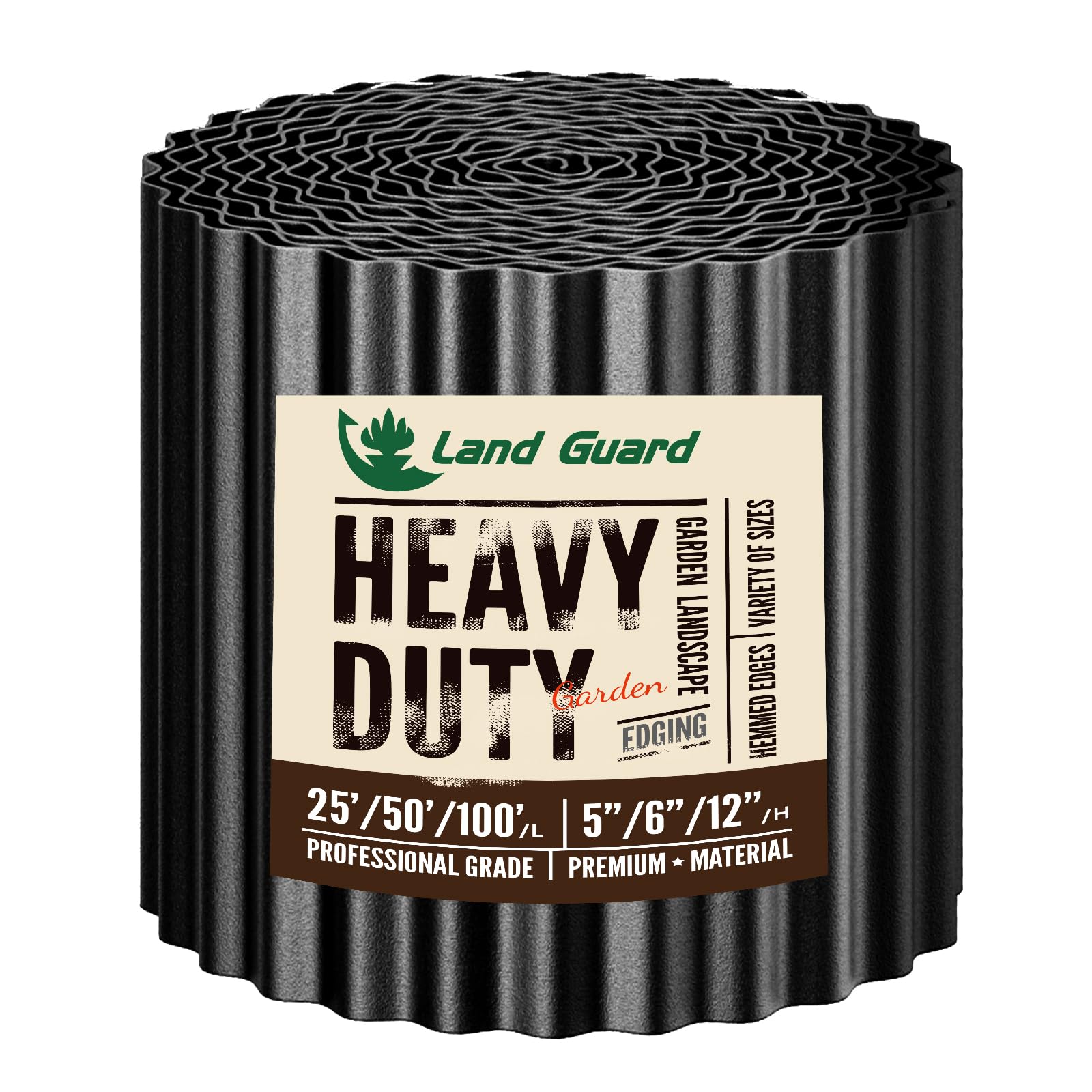
Land Guard 6 in. x 50 ft Edging

Land Guard 6 in. x 50 ft Edging

Straight fence lines

Our Score 8.6/10
Check Price

Worth Noting

  • Ages inconsistently over several seasons
Height
6 in.
Coverage
50 ft
Material
Galvanized metal, coated
Read the full review

Fifty feet on one roll, in black, with a 6-inch profile. That's the second-longest continuous run in this group, and it means a fence line or a long driveway edge can go in without a single joint to line up halfway along.

It's also the roll that taught us the most about technique. The steel bends readily — a virtue around a shrub, a nuisance on a straight run — and hammering the top edge directly kinks the profile and sends the line wavy. Put an offcut of 2x4 between the mallet and the steel, wet the line the night before, and the same roll behaves itself.

Two people make the first ten feet much easier, particularly if the roll has been sitting in a cold garage: one holds the line taut while the other drives. After that, burial depth does the work, and the black finish reads clean against mulch.

What we can't promise is how it looks in five years. The finish is a coating over galvanized steel, and it doesn't wear consistently — the sections that stay wet go first. Install it where redoing the border in a few years is acceptable, not where you want a forever edge; for that, pay for the Corten.

Bottom line: A good-value 50-foot roll for a straight run along a fence or drive, as long as you back it with a board and don't expect a forever edge.

How We Tested Metal Garden Edging

We started by reading spec sheets for more than 40 edgings and narrowed the field to 10, filtering on gauge, height, coating type, pack length, and cost per linear foot. Anything too short to hold back a mature lawn or too flimsy to survive a string trimmer was cut early. The remaining 10 went into real yards for six months, not a test plot.

Each length was installed by one person working alone, and we timed it: digging the trench with a half-moon edger, setting the strip, driving stakes, and backfilling. We noted where the soil fought back, since two of our sites had heavy clay and one was full of small rocks. We cut every product to length with a hacksaw and, where the material allowed, tin snips, recording how long each cut took and whether the edge deformed. To judge flexibility, we bent a section around a three-foot-radius curve and checked whether it kinked, scalloped, or held a smooth arc, then did the same along a straight driveway run to see if it stayed true.

After installation we leaned on each border, rolled a mower wheel along the top, and ran a trimmer against the face to see what shifted or scratched. Every few weeks we walked the runs to check appearance, look for rust at cut ends and scratched coatings, and see whether frost heave or foot traffic had pushed anything out of line. Durability and value showed up there, in what still looked deliberate after a wet spring and a dry August.

How to Choose the Right Metal Garden Edging

Panels or a continuous roll

Panels arrive in 40- to 48-inch lengths and join with stakes or clamps. They travel easily, hold a dead-straight line, and let you replace one damaged section instead of a whole border. Rolls run 40 to 60 feet in one piece, cost less per foot, and follow a curve without a joint — but they arrive coiled, and the coil has a memory that fights you on a straight run.

Match the format to the shape you're edging. A straight run beside a walk or a fence, or a few rectangular beds, suits panels like the Stirlingear kit or the WORTH Corten strips. A long border sweeping around a drive wants a roll, and the longer the better: the MTART roll covers 60 feet with nothing to line up in the middle.

Read the height figures properly

Almost every listing quotes total height, and a third to a half of that disappears underground. The Stirlingear panels stand 5 inches tall but show 2; the WORTH Corten panels stand 8 inches and show 4.9. Two inches is a mown edge — enough to keep mulch off the lawn and give a trimmer something to run against. Four inches or more is a retaining edge that holds gravel on a slope and marks a path.

So subtract the buried portion first, then ask whether what's left is the look you want. If a listing won't tell you how much stays above grade, ask before you order 40 feet of it.

Galvanized steel, Corten, or aluminum

Galvanized steel under a powder coat gives you a uniform black edge, and the coating — not the steel — is what wears. Scratches show, and a chip is where rust starts. Corten weathers instead: it rusts on purpose, darkens to brown, and has no coating to chip, which is why the Edge Right and WORTH strips are our picks for a border nobody wants to revisit. It can mark pale paving while it settles, and it can be sealed to hold the colour.

Aluminum, which is what the SnugNiture roll is listed as, is lighter, easier to bend and cut, and softer when a trimmer catches it. Pick it for curves and light duties; pick steel where a machine is going to be running along the edge every week.

Getting it in straight

Wet the line the night before. Cut a slit with a spade rather than trying to drive into intact turf, then work along it with a mallet and a block of wood. Never the mallet alone: the top edge kinks, and a kink telegraphs its way down the rest of the run.

Stakes or clamps hold the joints; burial depth holds everything else. Before you drive a long run of anything, call 811 so nobody puts a spade through an irrigation line or a service cable, and keep gloves on for cut ends.

Frequently Asked Questions

Final Verdict

The Stirlingear 33-foot kit is the one we recommend first: stakes in the box, panels that go in quickly, and a crisp 2-inch line that looks deliberate from the street. Spend the extra on the Edge Right or WORTH Corten strips only when the border has to survive a trimmer and a decade — that's the purchase where paying once beats paying twice.

For a large, curved, low-stakes bed, the SnugNiture roll is the cheapest way in and the MTART roll the longest. Decide how much steel you want showing, then pick the format that gets you there.