Planters & Plant Supports

Best Terracotta Pots of 2026

Terracotta is the rare plant pot that can look better after a season on the windowsill—chalky, sun-faded, maybe a little mossy at the base. The catch is that the same porous clay that lets roots breathe can also flake at the rim, crack in a cold snap, or dry out a fern before you've finished your coffee. A good pot holds its shape through repotting, lets excess water leave quickly, and has a drainage hole sized for real soil, not just a token pencil hole. I've killed enough plants in pretty-but-glazed pots to appreciate that difference, and over the past seven months we tested 12 terracotta pots in sizes from thumb-sized to floor-planter big; the spread in thickness, color, and sturdiness was wider than I expected.

Painted finishes were a wild card, too: some looked crisp after weekly watering, while others chipped at the rim within weeks. The winners balanced color and appearance with a fair price for their size, heft, and clean drainage. They're the ones I'd put on my own shelf or balcony.

1

D'vine Dev Beaded 4-Inch Pot

Top Pick
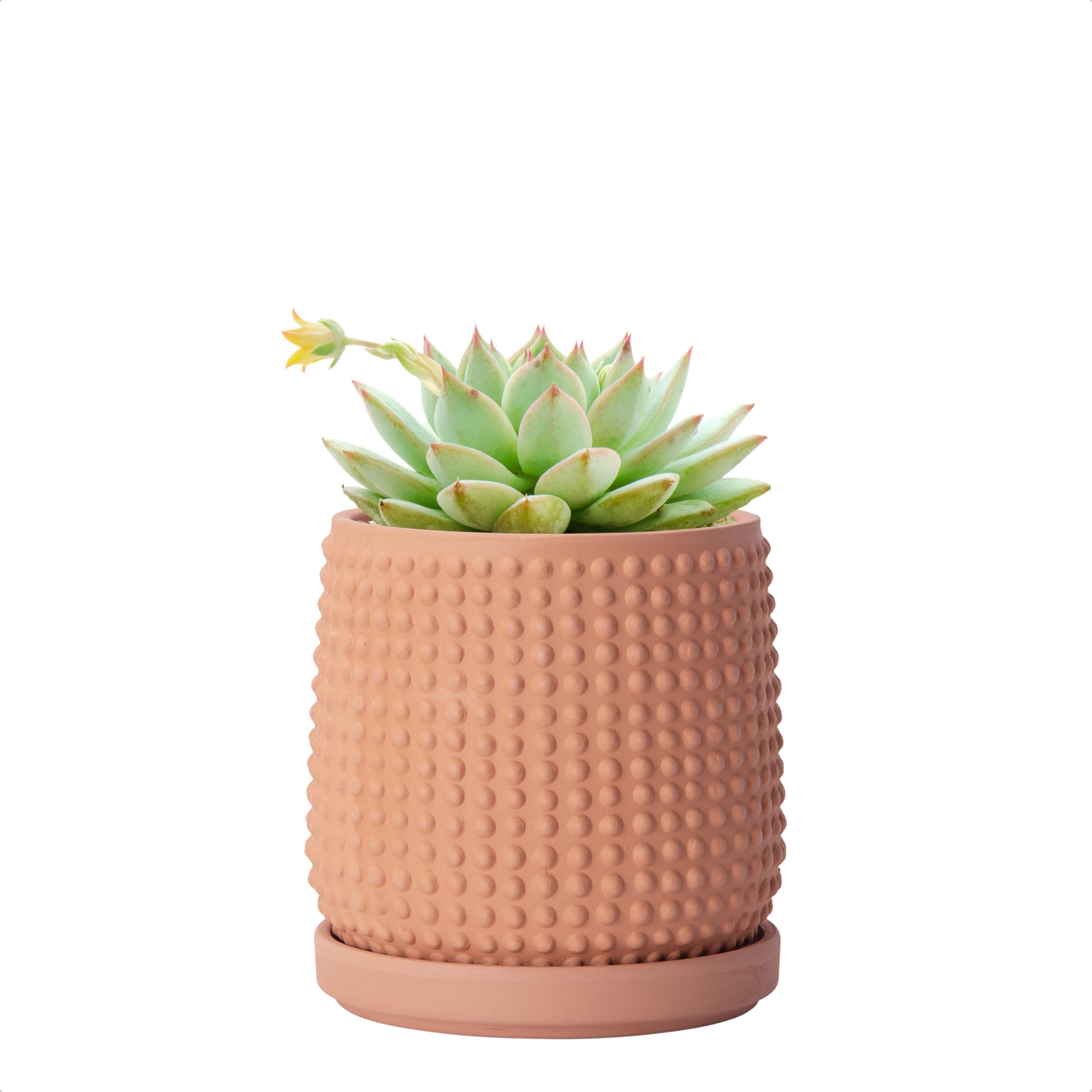
D'vine Dev Beaded 4-Inch Pot

Gifts and desks

Our Score 9.8/10
Check Price

Worth Noting

  • One pot per order at a premium
Size
4.4 in outside, 5 in tall
Extras
Drainage mesh, felt pad
Saucer
Included
Soil Capacity
0.2 gallons
Read the full review

A beaded band around the rim is the whole idea here, and it works: this is the pot we choose when the pot is part of the present. It measures 4.4 inches across the outside and 5 inches tall, so it's taller than it is wide, which gives a plant with a deeper root ball somewhere to go — orchids and African violets fit it better than a squat four-inch pot does. A saucer, a mesh net for the drain hole, and a felt pad come with it.

The trade-off is one pot per order at a price that buys several of the plain four-inch pots here. That's fine for a gift or a single plant on a desk and wrong for furnishing a shelf. The listed capacity is 0.2 gallons, so it's a repot for something coming out of a four-inch nursery pot, not for a plant already in a six. What you get for the money is a pot that looks finished on its own, without a cachepot covering it up.

Bottom line: A beaded four-inch pot that arrives with saucer, mesh net, and felt pad — the one we choose when the pot itself is part of the gift.

2

YBX 8+6 Inch Pair

YBX 8+6 Inch Pair

Large floor plants

Our Score 9.6/10
Check Price

Worth Noting

  • No saucers included
Sizes
7.87 and 5.91 in
Finish
Decorated outside, unglazed inside
In The Box
2 pots, mesh pads, plugs
Pots Per Set
2
Read the full review

Just under eight inches and just under six: these are the two biggest pots in this group, and the scale is the whole reason to consider them. Most of the sets here stop around six inches, which is fine for a pothos and useless for a plant that outgrows its nursery pot every spring.

The outside carries a wildflower pattern and a warm finish; the inside is plain unglazed clay. That combination matters more than it sounds. Where the clay meets the roots it still pulls moisture out of the soil, while the outside gives you something that looks deliberate in a living room rather than utilitarian.

The pair weighs about five pounds, and that weight is what makes it work for a top-heavy plant — a wide, heavy base isn't going to tip when a monstera leans. We treat the big one as the floor pot and the six-inch as its companion on a stand, and between them they cover the large end of the range the multipacks here don't reach.

No saucers come with them; you get mesh pads for the drain holes and silicone plugs. We leave the plugs out — a terracotta pot with its drainage sealed is a heavy vase — and stand the pots on trays instead. The wildflower finish is also the least neutral look in this group, so it's a choice rather than a safe default.

Bottom line: The two biggest pots here, with an unglazed interior that behaves like terracotta and a decorated outside that earns a place in the living room.

3

D'vine Dev Classic 3-Pack

D'vine Dev Classic 3-Pack

Repotting several plants

Our Score 9.4/10
Check Price

Worth Noting

  • Costs more per pot than the bulk packs here
Extras
Drainage mesh, felt pads
Saucers
Included
Pots Per Set
3
Sizes Included
4.2, 5.3, 6.5 in
Read the full review

Four, five, and six inches across — the three sizes most houseplant repotting actually calls for — arrive together in the same matte clay, each with its own saucer. That is the reason this set sits at the top of our list. The usual pattern is ordering one pot, finding it a size off, and ordering again.

The completeness of the kit is what settled it for us. Every pot has a drainage hole and a mesh disc that keeps soil from washing into the saucer, and the saucers come with felt pads to sit on. We count those extras as real value rather than filler — a felt pad is the difference between a saucer and a ring on a windowsill. The clay is smooth and matte rather than rustic, so a shelf of these looks deliberate instead of salvaged.

Check the saucers when the box lands. The pairing on the largest pot is the least tidy of the three and can sit slightly proud of the base, so give that one a mat you don't mind seeing. The pots themselves arrive ready to plant, with no sharp rims and no blocked holes.

Unglazed clay darkens at the rim and down the sides where water wicks through, and these will do exactly that over a season. It's terracotta working as intended rather than a defect, and it's why the clay suits plants that want to dry out between waterings. If you need one pot, the beaded single further down is the better buy; if you're potting a dozen cuttings, start with the twenty-pack.

Bottom line: Three graduated sizes with matching saucers, mesh screens, and felt pads make this the set we reach for when several plants need repotting at once.

4

Orceler 6-Inch 4-Pack

Orceler 6-Inch 4-Pack

Medium houseplants

Our Score 9.4/10
Check Price

Worth Noting

  • Thin walls chip if a pot tips over
Size
6 in wide, 5.5 in tall
Saucers
Included
Drainage
Hole in each pot
Pots Per Set
4
Read the full review

Six inches across and about five and a half inches tall is the size a lot of medium houseplants want at their next repot, and this set gives you four of them with saucers. That arithmetic is why it's our value pick: a matched group for a shelf instead of buying singles one at a time.

The walls run thin on these, and that changes how we use them. Thin clay keeps the pot light, which is fine on a windowsill, but it chips more readily if a pot tips onto a hard floor. We put the heavier, top-heavy plants in sturdier pots and keep these for ferns, pothos, and anything with light top growth. The clay itself is properly unglazed, so it still breathes and pulls moisture out of the soil the way terracotta should.

Each pot has a drain hole with a saucer underneath, and the plain cylinder shape disappears into a group of plants rather than competing with them. Nothing here is decorative, and that is the point — four pots that do the job and let the foliage be the interesting part.

Bottom line: Four six-inch pots with saucers for about what one decorative planter costs — our pick when several medium houseplants need clay at once.

5

vensovo 3-Inch 20-Pack

vensovo 3-Inch 20-Pack

Propagation and favors

Our Score 9.4/10
Check Price

Worth Noting

  • Outgrown within a season
Size
3 in
Finish
Unglazed clay
Drainage
Hole in each pot
Pots Per Set
20
Read the full review

Twenty small pots in one box is an odd purchase until the week you need it. Three inches across is the size for leaf cuttings, seed starts, the seedlings you didn't expect to all survive, and the favors for a shower — and having twenty means you're not rationing them.

They're honest little pots: natural clay, unglazed, with a drainage hole in each. The surface takes paint and marker, which is why they turn up in classroom projects as often as on plant shelves.

One practical note: the drain holes are small at this size, so check each one is clear before you fill it rather than discovering it halfway through watering. And set them on a tray, because there are no saucers in the box.

The point of a box this size is generosity. We pot up a tray of cuttings, hand them round, and keep the rest back for the next round, because they're inexpensive enough to part with. If you want pots a plant lives in for years, buy fewer and bigger.

Bottom line: Twenty small clay pots for cuttings, seed starts, and favors, at a price that makes giving them away with the plant in them easy.

6

Riseuvo 2-Inch 32-Pack

Riseuvo 2-Inch 32-Pack

Crafts and favors

Our Score 9.4/10
Check Price

Worth Noting

  • Too small to grow a plant on
Size
2.1 in wide, 2 in tall
Finish
Unglazed, paintable
Pots Per Set
32
Soil Capacity
0.1 liters
Read the full review

Two inches is smaller than it sounds. These measure about 2.1 inches across the rim and 2 inches tall, on a base barely an inch and a third wide, and the listed soil capacity is a tenth of a liter — enough for a cutting or one small succulent, not enough to grow anything on for long.

What they're for is volume: thirty-two pots covers a favor table, a classroom, a craft afternoon, or a season of propagation. The surface is plain unglazed clay, so paint and marker take to it, and each pot has a drain hole in the base.

Small pots dry fast. A tenth of a liter of soil in a sunny window can go from damp to bone dry in a day, so plan to look at these far more often than you look at a six-inch pot, and stand them on a tray — there are no saucers in the box.

We found the count is the product here. If you need five pots, buy five; if you're making thirty-two favors, nothing else in this group gets you there in one order. Just don't expect one of these to be the last pot a plant lives in.

Bottom line: Thirty-two two-inch pots for favors, crafts, and propagation, when the count is the point and long-term growing isn't.

7

vensovo 4-Inch 6-Pack

vensovo 4-Inch 6-Pack

Budget repotting

Our Score 9.2/10
Check Price

Worth Noting

  • Rims can arrive chipped
Size
4 in across
Saucers
Included
Drainage
Hole in each pot
Pots Per Set
6
Read the full review

Buy the brown. These are sold in painted colors as well, and the paint is the part that lets them down: it fades and wears where water runs over the rim, so a colored set looks tired well before the clay does. In natural terracotta, the same six pots and saucers are one of the better deals in this group.

Four inches across is the standard step up from a nursery plug, and six at a time means a whole tray gets repotted without a second order. Each pot has a drainage hole with a saucer under it, they're light enough to shift around while you work, and they stack out of the way between plantings.

As a plain clay workhorse, this is the pack we reach for when small plants need potting and the pot isn't the point. They're not the thickest pots here, and a rim can arrive chipped, so open the box well before you need them — a spare saucer under a cracked rim buys you a season.

Bottom line: Six plain four-inch pots with matching saucers, sized for stepping up nursery plugs — the pack we reach for when a tray of small plants needs potting.

8

Laerjin Shallow 6-Pack

Laerjin Shallow 6-Pack

Succulent dish gardens

Our Score 9.2/10
Check Price

Worth Noting

  • Set is pots only, with no saucers
Size
6.43 in
Shape
Shallow bowl
Saucers
Not included
Pots Per Set
6
Read the full review

About six and a half inches wide and not quite three inches deep, these are bowls rather than pots, and the shape is the reason to buy them. Rosette succulents such as echeveria spread their roots sideways and shallowly, and a deep pot keeps wet soil underneath them that the roots never reach.

What arrives is six unglazed bowls, each with a drain hole. The clay is matte and slightly rough in the hand, and the wide mouth gives the soil surface plenty of air — which is part of why a planting in one of these dries out as fast as it does.

For a succulent dish garden this is our pick in the group: the shallow depth lets you cluster several rosettes and still read the arrangement from above. It's the wrong choice for anything thirsty, since a fern would be dry by the second day, and the drain hole is generous enough that a mesh disc over it keeps your soil where it belongs.

Bottom line: Wide, shallow bowls that match how rosette succulents actually root — the right shape for a dish garden, and a poor home for anything thirsty.

How We Tested Terracotta Pots

We started with more than 40 terracotta pots from nurseries, garden centers, and online listings, then narrowed the list by size range, price tier, wall thickness, and whether the drainage hole was actually cut through the base. We ended up testing 12 pots for seven months, from 3-inch seedling pots to a 14-inch floor planter. Each one lived on a kitchen windowsill with herbs, a bright balcony shelf, and a crowded plant stand where pots get moved for watering and bumped during vacuuming.

I potted each in the same soil mix; quality showed in the hand, where denser walls generally survived knocks better than thin pots whose rims flexed. Every two weeks I watered until it ran out the base, timing how quickly the drainage hole cleared and whether a standard saucer caught the overflow. I measured the holes, too, since a small one clogs with grit and an oversized one washes soil out. To judge sturdiness, I lifted each pot by the rim, moved it between rooms, and noted chips, hairline cracks, and any flex at the foot.

Appearance and color were judged in daylight, not under store lights—I compared how each pot looked beside green leaves and whether the color stayed even after watering. Painted pots got a weekly wipe-down with a soft brush and mild soap; I recorded flaking, blistering, or color rub-off at the rim. Unpainted clay was watched for dusting, white mineral bloom, and hairline cracks after cold nights outside. At the end, I weighed cost against size, wall thickness, drainage, and durability, because value wasn't the cheapest pot—it was the one still looking right after seven months.

How to Choose Terracotta Pots

Match the Pot to the Root Ball, Not the Foliage

Measure the root mass, then add an inch or two. Going much wider than the roots leaves a ring of wet soil the plant can't reach, which is how a bigger pot makes a plant sicker. Four-inch pots suit plugs and small succulents, six-inch pots are the workhorse for medium houseplants, and anything near eight inches is a floor plant. Shallow bowls are a separate shape for a separate job: rosette succulents and shallow-rooted sedums, not anything with a taproot.

One trap: the listed size is nearly always the outside diameter at the rim. The D'vine Dev beaded pot is 4.4 inches outside and 4 inches inside, and on a tapered pot the base is narrower again. If the pot is for repotting, judge the opening rather than the label.

Check Whether a Saucer Is Actually Included

Plenty of sets are pots only — the Laerjin bowls, the twenty-pack of three-inch pots, and the large YBX pair all arrive without saucers. That's fine on a porch or over a gravel tray and a problem on a wooden sill. Where a saucer is included, fit is the next question: on a set with several sizes, the biggest saucer is usually the one that sits least neatly.

Mesh discs and felt pads are worth having and not every set includes them; they keep soil out of the drainage water and keep the saucer from marking furniture. We count them as value rather than filler.

Expect Thin Walls, and Open the Box Early

Terracotta is fired clay, and clay chips, cracks, and shatters — most of the risk lands in transit, before you have planted anything. Thicker walls survive more handling and hold a top-heavy plant more steadily. Thinner walls are lighter and cheaper, which is the trade the budget packs make.

Open the box the day it arrives, check rims, bases, and saucers, and start a return before you fill anything. A pot that arrives with a hairline crack will split once it is full of wet soil, and a pot with a blocked drain hole is worse than one with no hole at all.

Bare Clay or a Painted Finish

Unfinished terracotta does two jobs at once: it wicks moisture out of the soil, and it ages, darkening where water passes through the wall. Some people love that patina and others want the pot to look the way it did the day it arrived.

Painted and decaled pots hold their look on a shelf, but paint wears where water runs over the rim, and the colored version of a set is the one that fades first. If you want the clay working against the roots, buy unfinished. If you want color, treat it as a finish with a lifespan.

Buy the Pack Count That Matches the Job

Counts run from one pot to thirty-two, and the cost per pot falls steeply as the count climbs. A three-pot set in graduated sizes outfits a small collection, a six-pack handles a windowsill of small plants, and twenty or thirty is propagation, favors, or a classroom. Buying thirty-two pots to use four is how a bargain becomes clutter in the garage. If you're between counts, take the smaller one and add a single pot in the size you're missing.

Frequently Asked Questions

Final Verdict

Start with the D'vine Dev three-pack if more than one plant needs repotting. Three graduated sizes with saucers, mesh discs, and felt pads cover what most houseplants need, and the matte clay reads as tidy rather than rustic indoors.

If everything on your shelf is in the six-inch range, the Orceler four-pack does the same job for less per pot, and if you're potting something that has outgrown every pot you own, go straight to the YBX pair. Buy the size your root ball needs, not the pot that photographs best.