Planters & Plant Supports

Best Garden Obelisk Trellises of 2026

An empty obelisk is a liar. In May, every one of them — powder-coated steel, stained wood, folded wire — looks tidy and expensive standing in bare soil. The truth arrives in August, when the vines are heavy, the wind picks up, and a frame that seemed solid in spring starts listing sideways with a half-grown clematis dragging it down. What a good obelisk actually fixes is exactly that: it holds a climber up at eye level through a full season without turning into a leaning mess by Labor Day.

We spent one full growing season with 11 obelisks, from pot-sized frames to six-foot towers, and the differences showed up fast. The thing first-time buyers miss is height relative to vigor — a four-foot obelisk disappears under a single morning glory, and by July the vine's top is flopped over the finial. Watch the footprint, too, since a base wide enough for a raised bed can swallow a patio pot whole. The picks below are the ones still standing straight, and the ones I'd spend my own money on again.

1

H Potter 8 Ft Obelisk Trellis

Top Pick
H Potter 8 Ft Obelisk Trellis

Permanent climbing roses

Our Score 9.6/10
Check Price

Worth Noting

  • Narrow 12-inch base belongs in a bed, not on a deck
  • Joint hardware takes patience during assembly
Frame
Solid iron, powder coated
Height
101 in plus 12 in stakes
Weight
31 lb
Anchoring
Four 12 in ground stakes
Read the full review

A hundred and one inches is a lot of tower, and the thirty-one pounds of iron underneath it are what make that height worth having. A tall obelisk has two jobs — carry a heavy climber without bowing, and stay put when the weather turns — and this is the one here that looked least bothered by either. The tubing is round and reinforced at the joints, the charcoal brown powder coat has a hand-applied darker finish with a UV sealer over it, and up close it reads as garden architecture rather than plant furniture.

Anchoring is where tall, light obelisks usually lose their nerve. H Potter sends four twelve-inch stakes, and the twelve-inch square footprint means those stakes, not the base, do the holding. We drove them into open ground where the wind gets a clear run and never needed a wall or guy lines. In sandy or freshly turned soil, set the tower and firm the ground before you plant, then let a season of roots knit it in.

Putting it together is a solo job for most people, though the joints reward patience rather than force. Where this earns its keep is the third and fourth season, when the clematis has turned into a plant that acts like a lever in a storm. Reinforced joints and thirty-one pounds are exactly what that moment asks for, and it is the reason we keep coming back to this one for a permanent planting.

Two things worth knowing before you commit. The base is twelve inches square, slim for a tower this tall, so it belongs in a bed rather than on a deck where a mower or a football can nudge it. And the price is the highest here by a wide margin, which makes this a poor first experiment and a very good last purchase.

Bottom line: This is the trellis we recommend when the vine is the point: 101 inches of iron that carries a mature rose without bowing, held by stakes that keep it there through winter wind.

2

Gardener's Supply 7 Ft Obelisk

Gardener's Supply 7 Ft Obelisk

Easy one-person setup

Our Score 9.6/10
Check Price

Worth Noting

  • Legs need deep setting in loose or sandy soil
Frame
Powder-coated steel
Height
84 in
Assembly
No-tool stacking
Footprint
15.25 in diameter
Read the full review

What arrives is a stack of rings and a set of legs that nest into one another, and the whole tower goes up without a screwdriver. No-tool assembly sounds like a marketing line until you have balanced a bolted obelisk on a windy afternoon; here you stack, and the height is whatever number of sections you decide to use. Taking a section out later is a two-minute job rather than a rebuild.

Once it was standing, what struck us is how much of the design work is done by the proportions. At eighty-four inches tall with a fifteen-inch spread, it is high enough for a clematis to show off and wide enough not to look like a stake with ambitions. The powder coat is even, the rings are welded rather than clipped, and the frame sits in a border without demanding attention. That is the balance we want from a mid-priced tower: present, not precious.

Two notes. The frame is light enough that a bare tower in wet, loose soil can shift in a gale until roots take over, so set the legs deep and firm them in properly. And the finish is the part that decides how long it looks this good, so touch up a chip the same weekend you spot it. If you want a tower you can raise alone in half an hour and leave in place season after season, this is the strongest case here for spending in the middle.

Bottom line: For most gardens this is the sensible middle: seven feet of powder-coated steel that goes up without tools and still looks deliberate rather than decorative at the end of a border.

3

H Potter Lotus Bud Obelisk

H Potter Lotus Bud Obelisk

Garden focal point

Our Score 9.6/10
Check Price

Worth Noting

  • Needs a large bed to look right
  • Slower assembly than stackable towers
Frame
Solid iron, powder coated
Width
36.5 in
Height
69.25 in plus 12 in stakes
Weight
38 lb
Read the full review

Thirty-six and a half inches across is the number that decides this one. Most obelisks are towers; the Lotus Bud is closer to garden architecture, wide enough that a bleeding heart or a climbing rose can spread sideways instead of being funnelled into a column. We like it where the structure is meant to be seen — the end of a path, an empty corner, the middle of a bed — and less where space is tight or the plant is small.

Underneath the shape it is the same recipe as H Potter's taller tower: solid iron, a charcoal brown powder coat over zinc plating with a hand-applied finish, and four twelve-inch stakes for anchoring. At thirty-eight pounds it is the heaviest thing here, and the weight shows up as steadiness rather than as effort — the frame does not shiver when a vine loads one side. Assembly is slower than on the stackable towers and the parts are lettered for a reason; two people make it quicker, and one person can still finish it.

The scale is the trade. At sixty-nine inches tall with that spread, it wants a bed of real size and a plant that will eventually fill it, because in a narrow border the bare frame looks like ironwork waiting for a job. Give it three seasons with the right climber and it stops reading as a trellis at all.

Bottom line: If you want the obelisk to be the feature rather than the support, this is the one: thirty-six inches wide, thirty-eight pounds of iron, and a silhouette that earns its space.

4

Evergreen 5 Ft Obelisk Trellis

Evergreen 5 Ft Obelisk Trellis

Patio containers

Our Score 9.2/10
Check Price

Worth Noting

  • Instructions are drawings only, with no written steps
Frame
Powder-coated steel
Height
5 ft, adjustable
Hardware
Stainless steel
Footprint
11 in diameter
Read the full review

An eleven-inch diameter is the whole argument for this one. Most obelisks of this height assume open ground and a mature climber; the Evergreen assumes a pot. It slips inside the rim of a large planter, which means the tower and its plant can move together when you rearrange a patio, and there is no separate stake to argue with in a container full of roots.

Five feet is a deliberate compromise, and we think it is the right one for containers. At just over ten pounds the frame has enough mass to sit still while a jasmine climbs it, and the height gives a small clematis something to hold without turning the pot into a sail. Sections come out if you want it lower for a young plant, the steel is powder-coated with stainless hardware, and the scrolled bands give it a bit of presence. It works in a sunroom as readily as on a deck.

The weak point is where the sections meet. Bottom joints do not always tighten cleanly, and in soft soil or a loose pot the whole frame can twist on its axis. Set it in a heavy planter, firm the mix around the legs, and check the collars at the start of each season — do that and it behaves. The instructions are drawings only, so work from the top down, which is the reverse of what feels natural and the reason some builds end up crooked.

Bottom line: The one we reach for on a patio: an eleven-inch base that drops into a large planter, five feet of coated steel, and a height that suits a balcony rather than a hedge.

5

LeJoy 6.3 Ft Metal Obelisk

LeJoy 6.3 Ft Metal Obelisk

Budget first trellis

Our Score 8.8/10
Check Price

Worth Noting

  • Assembly takes patience and the sheet is thin
Frame
Epoxy-coated metal tubing
Height
75 in
Weight
4.9 lb
Footprint
13.8 in diameter
Read the full review

At 4.9 pounds, the LeJoy is the lightest full-height metal tower here, and the first thing we checked was whether that lightness was honest. It is: the tubes are steel under an epoxy coating, the rings come molded as complete circles so there is nothing to clip together at the top, and the four legs end in points for the soil. What you are buying is a simple frame done in metal, not a sculpture.

Seventy-five inches is a genuinely useful height, and you can leave a section out to bring it down for a young vine or a raised bed. That matters more than it sounds in the first season, when a bare tower next to a two-foot plant looks like a mistake. The four legs also sit well in a large pot, which is not something every tower this tall manages.

The caveat is longevity. The coating is thinner than on the expensive towers, and a leg standing in damp soil can rust through and eventually snap within a year or two. In exchange you get a twelve-month warranty, a seller that ships replacement parts, and a price that makes replacing the whole thing painless. For a first vine, a rented garden, or a row of annuals you replant each spring, that is an easy trade to take.

Bottom line: We point budget-minded gardeners here first: real metal tubing, six feet of height and a twelve-month warranty, at the lowest price in this guide.

6

Plow & Hearth 7 Ft Obelisk

Plow & Hearth 7 Ft Obelisk

Classic border accent

Our Score 8.8/10
Check Price

Worth Noting

  • Assembly takes patience and two people up top
Frame
Powder-coated steel
Finial
Cast iron
Height
84 in
Footprint
11 in diameter
Read the full review

The floral bands and the cast-iron finial are what you notice first, and they are the reason this one gets bought. At seven feet tall on an eleven-inch footprint it is a slim, formal column — closer to an English garden ornament than to a tomato cage — and in a border where the vine is late to arrive, it still looks like something worth looking at.

Assembly takes an afternoon's patience. The rings and the tubular legs want to line up squarely before you tighten anything, and the order matters; working alone, you will want a second pair of hands for the upper sections. The payoff is a tower whose detail sits at eye level, which is more than most obelisks manage.

It also behaves indoors and on a covered porch, where the bronze reads warmer than black and the finial is not wasted. The stainless hardware helps there — a damp sunroom is harder on fasteners than a garden bed is.

The trade is proportion. Eleven inches across at seven feet makes a narrow column: lovely with a single clematis trained up one side, far less convincing with a heavy, leafy climber catching the wind, so set the legs deep and consider a sheltered spot. That is our judgement on it — buy this one for the look, and put it somewhere the look can be seen.

Bottom line: A seven-foot bronze tower with floral bands and a cast-iron finial, for the gardener who wants the structure to look finished before the vine arrives.

7

Quibbay 65 In Mushroom Trellis

Quibbay 65 In Mushroom Trellis

Playful pot support

Our Score 8.6/10
Check Price

Worth Noting

  • Plastic casing is obvious once you handle it
Pack
1 tower
Frame
Plastic-coated metal
Height
65 in
Footprint
10 in
Read the full review

The mushroom cap is the reason to look at this one at all, and we think it is a better idea than it sounds: a rounded top gives a morning glory something to spill over instead of a spike to sit beneath, and it makes a potted plant look styled rather than staked. At sixty-five inches it is a patio tower, not a border monument.

The frame is metal poles in a plastic casing, five tiers that push together without tools, and a ten-inch footprint that drops into an ordinary pot. Assembly is quick by design, the tiers are marked, and the height can be built up as a plant grows — the right way round for a young jasmine that will not reach the top this year.

Lightness is the price of that convenience. At about three pounds, an empty tower in a windy spot will move before it is planted, so the pot does the anchoring: a heavy planter, firm compost, legs pushed to the bottom. Rods can also arrive in slightly uneven lengths, so dry-fit the tiers on the ground and check the top cap sits level before you commit it.

Where it fits is the small garden — a doorway pot, a balcony corner, a herb bed with a cucumber climbing it. It is not the tower you buy for a mature rose or a permanent planting, and it is not trying to be. This is the one we reach for when the pot needs to look good this season, and it does that better than the plain black frames beside it.

Bottom line: A playful mushroom-topped tower for a pot by the door, where sixty-five inches and a light frame are plenty and the price makes a second one easy.

8

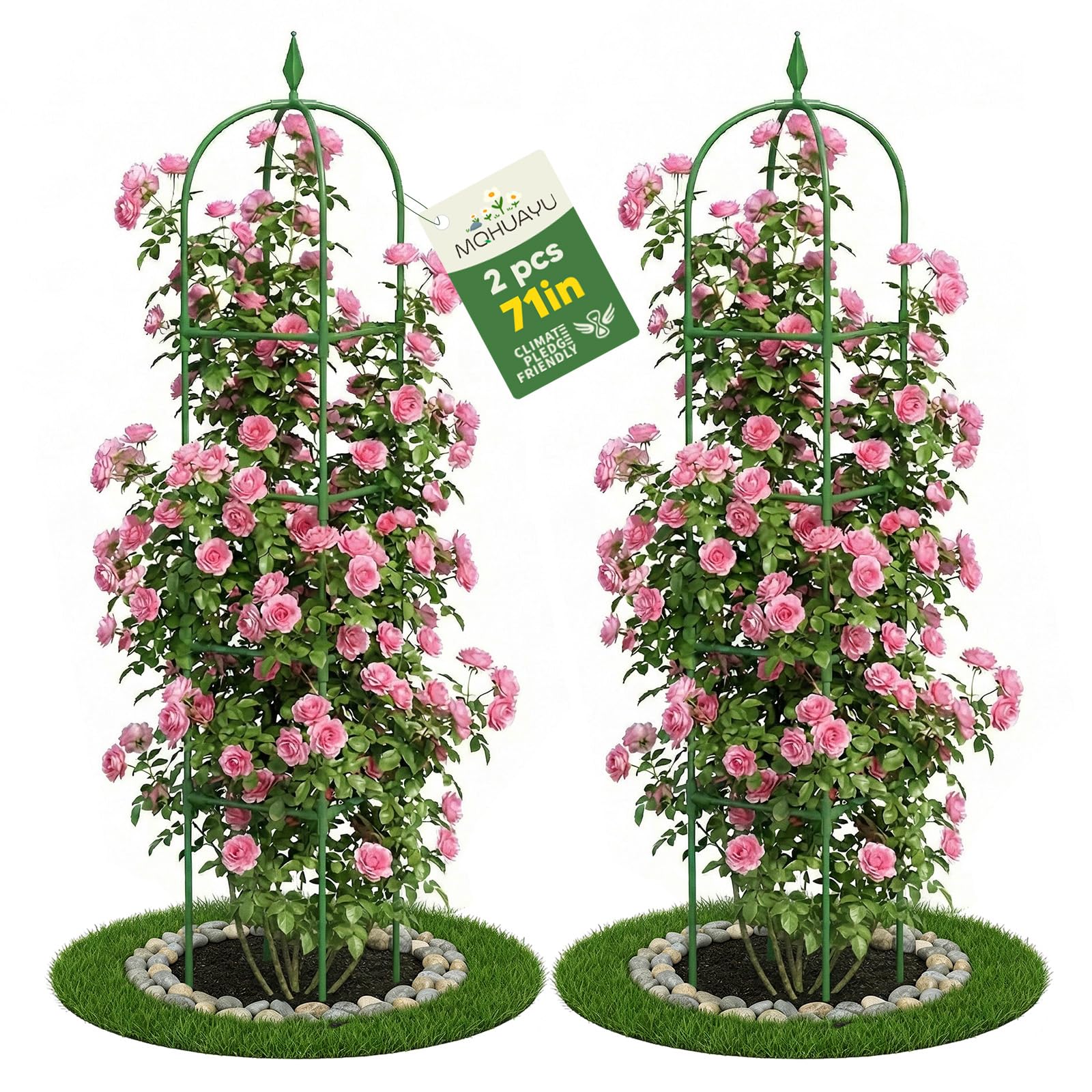
MQHUAYU 6 Ft Obelisk 2-Pack

MQHUAYU 6 Ft Obelisk 2-Pack

Multiple vines

Our Score 8.4/10
Check Price

Worth Noting

  • Plastic-coated tube reads as plastic up close
Pack
2 towers
Frame
PVC-coated iron
Height
71 in
Footprint
12.2 in
Read the full review

Two towers sound like a small thing until you are actually planting a row. One obelisk in a border leaves the rest of a line of morning glory with nothing to climb, and buying a second premium frame later stings in a way this pair does not. At seventy-one inches tall on a 12.2-inch footprint, the two of them cover a stretch of fence line or a pair of ten-gallon grow bags without crowding either.

The build is a stack of PVC-coated iron tubes joined by removable four-way connectors, and the tiers come off so the height can grow with the plant. No tools, no screws, and a first tower that goes together quickly once you have worked out the connector orientation. The coating is a sleeve over the metal rather than a paint finish, which is fine in weather and feels like plastic in the hand — from three feet away these look like metal, and up close they do not.

Where the pair earns its place is a garden that needs several supports at once. Sturdiness is decent for the money: a four-tier tower set deep in a bed held up through a windy fortnight for us, and it will carry tomatoes if you tie the leaders in. Read the load honestly, though. A vigorous vine in full leaf is more than a light frame with plastic connectors wants to hold, and a gust against an empty tower can lay it flat before the roots help. Set it deep, plant promptly, and it does the job.

Bottom line: Two six-foot towers for less than one premium obelisk costs: the frame is light, but it goes up without tools and covers a whole row of vines.

How We Tested 11 Obelisks Through a Full Growing Season

We started with more than 60 obelisks sold by big-box retailers and specialty garden shops, then narrowed the list by material, listed height, footprint, and price until 11 were left — steel, wood, and coated wire, from small container frames to six-foot towers.

Each one went into the garden in early spring and stayed up through the end of the season. Three went into raised beds under tomato and cucumber vines, four stood in containers on a windy patio, and the rest lined a south-facing fence with clematis and morning glories. I assembled every one alone, timing myself and noting where the instructions were missing, vague, or disagreed with the hardware in the box; two of them genuinely needed a second pair of hands.

Every couple of weeks I walked the line and pushed each frame at knee height to see how much it gave, checked whether the legs had heaved out of wet soil, and looked for rust, chipped coating, splitting wood, and joints that had worked loose. I measured each obelisk against its listed height and watched how far the vines spilled over the top by midsummer, and I judged appearance the way a visitor would — whether the color and finish still looked intentional in September, once the foliage had swallowed half the frame. Value came down to whether a trellis needed stakes, guy lines, or extra ties to stay upright; the ones that did got marked down.

How to Choose Garden Obelisk Trellises

Match the height to the vine, not the fence

Most climbing vines want more room than a decorative tower gives them. Clematis, morning glory, cup-and-saucer vine and wisteria will run past six feet in a good season, and a five-foot frame means a summer of tying in leaders that want to keep going. For open ground and a perennial climber, six to eight feet is the useful range, and taller is not automatically better — an eight-foot tower in a small bed reads as scaffolding.

In a pot, the maths flips. The container, not the frame, limits how big the plant gets, so five feet is often the smarter size; it keeps the whole assembly from becoming top-heavy. Pick the height for the plant you intend to grow next July, not the one in the nursery pot today.

What keeps a tall tower standing in wind

Two things hold an obelisk upright: mass low down and stakes in the ground. A five-pound metal frame relies almost entirely on its legs, so it wants firm soil and a spot out of the worst gusts. A thirty-pound iron tower stays planted with far less help, but it is a two-person job to move and re-sit, and it belongs where it will stay.

Look at the anchoring as closely as the height. Four long pins, twelve inches or so, hold far better than short feet resting on the surface. Whatever you buy, set the tower before you plant, drive the stakes fully, then firm and water the soil around the legs.

What metal actually means in the description

Nearly every tower here calls itself metal, and most are telling the truth in a narrow sense: a steel core inside a plastic or PVC sleeve counts. The difference shows up in the joints and in the weight. Solid iron with welded or bolted connectors is the version that takes a mature vine; a light tube with push-fit plastic connectors is the version that holds annuals and tomatoes for a season or two.

Use the weight as your shortcut. Anything under about five pounds is a light frame, and it should be treated as a seasonal support rather than a permanent one. Powder coat outlasts a plastic sleeve, and stainless hardware won't be the first thing to rust in a damp spot.

Pots, small gardens and the footprint question

Diameter decides where a tower can go as much as height does. An eleven-inch base slips inside the rim of a large planter and suits a patio; a thirty-six-inch spread needs a bed and a plant big enough to fill it. In a pot, choose a heavy planter and fill it to within an inch of the rim, because the stability comes from the pot rather than from the legs.

On a balcony, keep the tower behind the rail rather than at the edge. A five-foot frame with a full vine on it catches more wind than the empty tower suggests, and a pot that tips takes the plant with it.

Assembly is part of the purchase

Stackable, tool-free towers go up in minutes and come apart for storage. Bolted iron takes an afternoon and, above thirty pounds, a second pair of hands. Neither is better in the abstract: a stackable frame suits a renter or a small patio, and a bolted one suits a tower that will stay put for years.

Lay the parts out against the diagram before you start, and build from the bottom unless the instructions say otherwise. A frame tightened out of square is the reason so many obelisks end up leaning.

Frequently Asked Questions

Final Verdict

Buy the H Potter 8-foot tower if the vine is meant to be there for years. Nothing else here combines that height with that much iron, and the four long stakes make it a one-time job rather than a spring chore.

If that is more structure than your garden needs, the Gardener's Supply 7-foot obelisk is the pick we make for a normal border: it goes up alone, it looks right from the kitchen window, and it costs a good deal less. And if this is your first climber, start with the LeJoy and find out how much tower you actually want before spending more.