Poultry & Livestock

Best Livestock Ear Tags of 2026

A tag that peels out in the chute costs you more than the tag—you lose the number, the treatment history, and the afternoon you spent wrestling the animal into the headgate. The right ear tag stays put, stays readable, and fits without flopping around like a license plate. That sounds simple until you're comparing materials, sizes, and locking mechanisms in a farm-supply aisle. What you're really buying is fewer surprises months later: a clean record and a quick look from the alley.

I've used cheap feed-store tags and heavier sets, and the differences show up long after tagging day. The cheapest bag isn't a bargain if you're retagging half the herd in July, and the biggest tag isn't the easiest to read when it's caked in mud. Over the past eight months, we put 14 tag styles through spring tagging, summer heat, and fall sorting on cattle and goats. A good one locks cleanly, prints numbers you can read from ten feet, and survives a season without snagging. Below are the ones that earned a spot in the ear.

1

PAULOZYN 300-Piece Numbered Kit

Top Pick
PAULOZYN 300-Piece Numbered Kit

Sheep and goats

Our Score 9.0/10
Check Price

Worth Noting

  • Only 100 distinct numbers across 300 tags
Tag Size
2.09 x 0.75 in
Numbering
001–100, laser printed
Tags Per Pack
300 in three colors
Tools Included
Applicator and remover
Read the full review

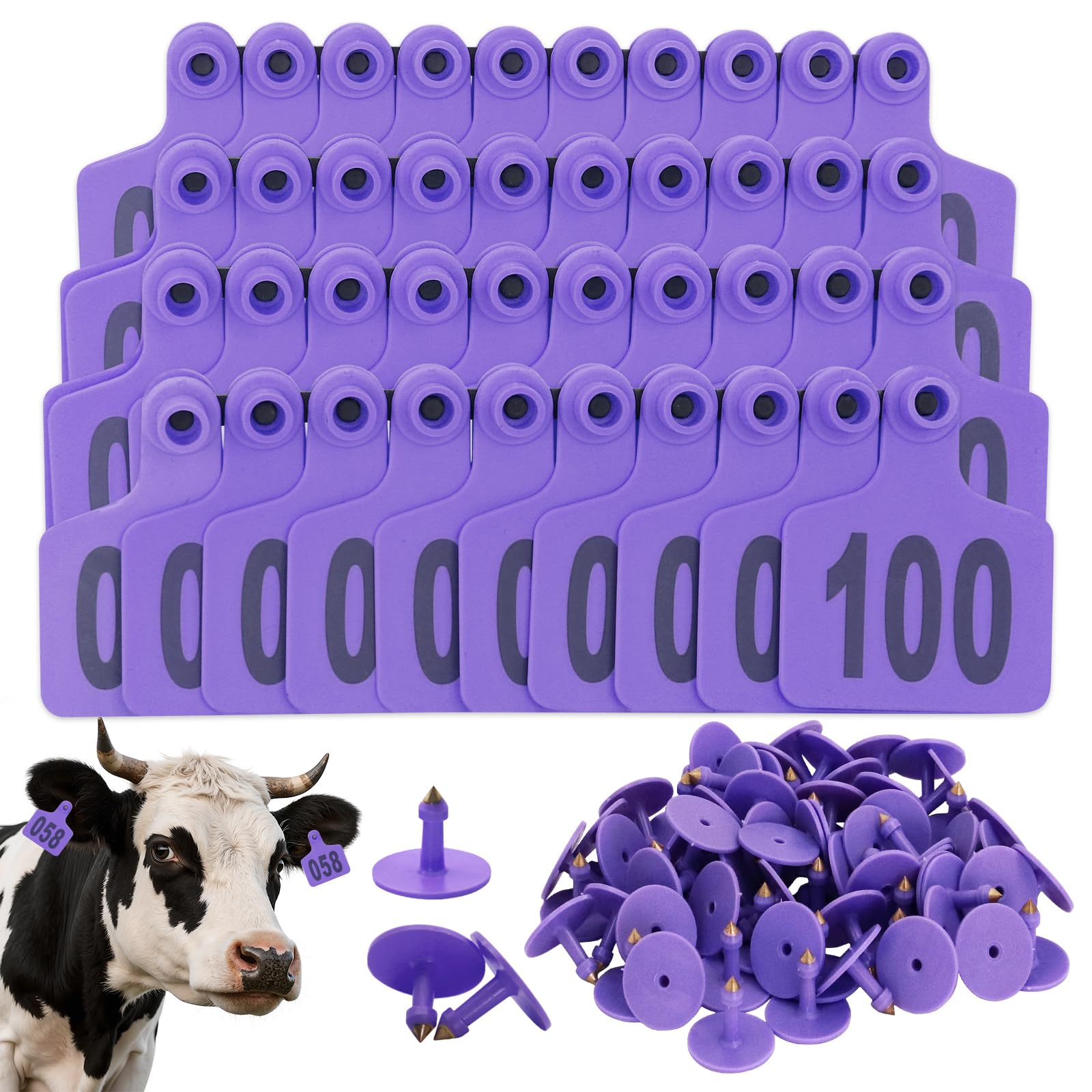
Three color-coded sets of a hundred is the reason this became our default kit. Orange, blue and green each run 001 to 100, so this year's ewe lambs can wear one color and the older ewes another without buying two separate products. The tags measure 2.09 by 0.75 inches — small-stock territory, right for sheep, goats and pigs, and fine on a young calf. For adult cattle you want a three-inch tag instead.

The applicator runs 9.45 inches and weighs about two-thirds of a pound, light enough to work through a pen of goats without your forearm burning, and the automatic lock seats the pin with a single squeeze. There's a 5.12-inch remover in the box as well, the tool almost every other kit here leaves out; getting a tag off an animal that has lost hers is a much shorter job with it than with a pair of side cutters.

Numbers are laser printed rather than inked, and the TPU has enough flex that a tag catching on a fence or a feeder bends and comes back instead of snapping. That flexibility is the part you can't judge from a product page, and it's what lets a snagged tag give instead of tearing out of the ear.

For a mixed smallholding — a few dozen sheep, a pen of goats, a couple of bucket calves — one box covers a round of tagging and leaves two colors spare for next season's group. That breadth, rather than the tag count, is what earns it the top spot.

Bottom line: Our default for small stock: three color-coded sets of a hundred, a light applicator that locks, and a remover most kits here leave out.

2

ZHEQOGZH Numbered Sheep Tags

ZHEQOGZH Numbered Sheep Tags

Spare small tags

Our Score 8.8/10
Check Price

Worth Noting

  • Tags only, applicator not included
Tag Size
2 x 0.7 in
Numbering
001–100
Tag Color
Purple
Tags Per Pack
100
Read the full review

Two inches by seven-tenths is the smallest tag here — a round sheep-and-goat tag that barely moves with the ear. That's the point. Small stock carry small tags, and a cattle-size tag on a young doeling is weight swinging from her head all day.

It's tags only, which we don't mind: this is the buy for someone who already has a tagger on the shelf and just needs numbers. The run is 001 to 100, laser printed on purple plastic, and the material is described as soft, flexible and resistant to cold and heat.

For a flock you tag every year, it's the cheapest way here to restock numbers without paying again for a tool you already own. Check the fit first, though — at 2 by 0.7 inches this is a lamb, kid and small-goat tag, and a mature ewe will make it look like jewelry.

Bottom line: The restock buy: small, flexible numbered tags for sheep and goats, for anyone whose applicator is already in the shed.

3

ZHEQOGZH Blank Tags, 100 Pieces

ZHEQOGZH Blank Tags, 100 Pieces

Write-your-own IDs

Our Score 8.6/10
Check Price

Worth Noting

  • Applicator sold separately
Tag Size
3 x 2.48 in
Numbering
Blank for hand marking
Tags Per Pack
100
Tools Included
Pins only
Read the full review

Blank is a feature, not a gap. These let you write what actually matters — dam number, birth date, a treatment code — instead of squeezing everything into somebody else's 001 to 100. That freedom is why we keep a box of blanks in the shed beside the numbered tags, and at 3 by 2.48 inches there's room for more than one line.

The green plastic is soft and flexible, the pins come in the box, and a standard applicator will drive them. What you notice after a few weeks is that the tag outlasts the writing: pen ink can lift within days of going on, and a permanent marker fades well before the plastic gives up. If a number has to survive a whole season, buy it printed.

In practice these read as a calf tag — right for calves, goats and sheep, small on a mature cow, whatever the tape measure says. We treat them as the tag for animals you handle often and re-mark as you go, not the one you expect to read from the far end of the field in eight months.

Bottom line: For codes of your own rather than 001 to 100: a large, flexible blank that needs your own applicator and a fresh mark now and then.

4

Lucky Farm Numbered Kit with Pliers

Lucky Farm Numbered Kit with Pliers

Cattle and calves

Our Score 8.4/10
Check Price

Worth Noting

  • No removal tool in the box
Numbering
001–100, laser printed
Tag Color
Orange
Tags Per Pack
100
Tools Included
Applicator and 2 pins
Read the full review

The plier is where this kit puts its effort. It has an automatic lock, a punch needle that stays aligned instead of wandering, and a scrub-textured handle that keeps its grip when your hands are wet — details that matter on the hundredth squeeze of the morning rather than the fifth. Cattle work is repetitive work, and a clumsy tagger is what makes it miserable.

We keep this one for cattle and calves: a hundred laser-printed tags, two spare pins, and a tool that lets you hold an ear with one hand and close the plier with the other. The handle texture and the one-handed lock are what separate it from the plainer pliers in this group.

The kit is one orange run of 001 to 100, so it suits a single herd rather than a color-coded system. The plier is the part you're really buying, and across a hundred head you'll be glad it's a good one.

Bottom line: The kit for anyone heading out to tag calves or cattle: a strong one-handed plier, laser-printed numbers and two spare pins in a single orange run.

5

APlayfulBee 100-Tag Applicator Kit

APlayfulBee 100-Tag Applicator Kit

Single-color herds

Our Score 8.4/10
Check Price

Worth Noting

  • Tag dimensions not stated in the listing
Numbering
001–100
Tag Color
Blue
Tags Per Pack
100
Tools Included
Applicator and 2 pins
Read the full review

One color, a hundred numbers, an applicator and two spare pins. This kit is deliberately plain, and plain is what a lot of people want when they're tagging a couple of dozen animals a year: nothing to sort out, nothing to match up, one box on the shelf.

What the listing never tells you is the tag size — no dimensions appear anywhere on the page. Measure against a tag you already use before you order a hundred, because a box that turns out to be the wrong scale for your stock is a box that stays in the shed. That's the one hesitation we have.

Everything else is straightforward. The applicator ships with the tags it's meant to drive, the numbers run 001 to 100, and blue is easy to pick out on a moving animal. Where it earns its place is as the matched set for a small group or a second color code; for anything bigger, the three-color kit at the top of this list does more with the same shelf space.

Bottom line: A clean single-color starter kit — a hundred numbered tags with the applicator and spare pins — provided you confirm the tag size suits your animals.

6

KHEARPSL Blank TPU Tags

KHEARPSL Blank TPU Tags

Small-stock blanks

Our Score 8.4/10
Check Price

Worth Noting

  • Applicator not included
Tag Size
2 x 1.7 in
Numbering
Blank for hand marking
Tag Color
Purple
Tags Per Pack
100
Read the full review

TPU is the softer end of tag plastics, and it's the first thing worth knowing here: the tag gives when an animal pushes through a gap it should have walked around. Flexible plastic is easier on the ear than the stiff blanks sold by the handful, and it's why the color stays bright rather than crazing.

At 2 by 1.7 inches these sit between the tiny sheep tags and the big cattle tags — enough surface for a date and a dam number, little enough that a goat isn't carrying a flag. Purple, a hundred in the box, and that's the lot.

The claim to test is compatibility. The listing says these match most applicators on the market, and one tag is worth sacrificing to find out before you run a hundred through yours; an applicator that doesn't line up with the hole will mangle the tag and upset the animal.

Where they make sense is a small goat or sheep herd that wants its own codes and more writing room than the little tags allow, with a pen re-mark now and then accepted as part of the routine. That's a narrower job than a printed kit, and we think these do it well.

Bottom line: For a small herd with its own coding system, these blanks give you more writing room than the tiny sheep tags — if you own a matching applicator.

7

Abustle Pig Large Numbered Tags

Abustle Pig Large Numbered Tags

Mature cattle

Our Score 8.2/10
Check Price

Worth Noting

  • No applicator in the box
Tag Size
3 x 2.5 in
Numbering
001–100, laser printed
Tags Per Pack
100
Tools Included
Pins only
Read the full review

A hundred and one cows is the awkward number. The animal past the hundredth needs a tag that doesn't duplicate one already in the herd, and a single 001 to 100 run has nothing left to give. This set answers that: the same three-by-two-and-a-half-inch tag is sold in 101 to 200 and 201 to 300 runs as well.

We like that continuity more than anything else about it. The purple 001 to 100 run is laser printed, pins come in the box, and there's no applicator — you're buying tags for a tool you already trust. Three inches by two and a half is a proper cattle size, the sort you can read from the gate rather than the crush.

It's a plain, honest set with a long numbering plan behind it and a tool you supply yourself. If you run more than a hundred head, this is one of the few here that won't have you improvising numbers in year two.

Bottom line: For cattle and a herd that will pass a hundred head, this large printed set keeps the numbers coming — bring your own applicator.

How We Tested Livestock Ear Tags

We built the shortlist from tags that keep coming up in farm-supply catalogs, extension bulletins, and conversations with producers, then narrowed by material, available sizes, and applicator compatibility. That left 14 styles, from lightweight visual tags to heavier two-piece sets, and we ran them on a working cattle herd and a small goat herd for eight months. We started at spring calf processing, continued through summer heat and fly pressure, and finished at fall sorting, when tags have had a season to get dirty, faded, and snagged.

At tagging, I noted whether each tag locked without cracking, whether the applicator pin lined up cleanly, and how much ear I had to work with on smaller animals. At 30-day checks, we looked for droop, sun fade, mud staining, and wallowed-out holes, and we read each number from ten feet away at dusk—bad printing shows up then. We also tugged gently on every tag to see whether the hole had enlarged enough to let it spin or pull free.

Durability came down to retention: we counted how many stayed in through the chute, pasture moves, and fence-line work. Size was judged in the ear, not on the card—we watched whether a tag snagged on brush or feeders and whether the number stayed legible on smaller goats. For value, we tracked cost per tag against how many we had to replace mid-season; a cheaper tag that needed retagging was no bargain. Quality showed up in the small stuff: sharp molding, clean locking, and numbers that didn't rub off.

How to Choose Livestock Ear Tags

Start With the Size of the Ear, Not the Size of the Herd

Tags in this group split into two families: roughly 2 by 0.7 to 2.09 by 0.75 inches for sheep, goats, pigs and calves, and about 3 by 2.4 to 2.5 inches for cattle. A small tag on a cow disappears into the ear and can't be read at ten paces; a big tag on a lamb snags on fences and drags its head. If you run both kinds of stock, buy both sizes rather than one compromise, because the two-inch tag on a mature cow is the purchase people regret. Where a listing never states dimensions, measure against a tag you already use before ordering a hundred.

Numbered or Blank: Decide How the Number Gets On There

Laser-printed numbers are marked into the surface and last as long as the tag does. Blank tags take whatever code you invent, which is the right call for birth dates, dam numbers and treatment notes. The catch is the writing: pen ink can lift within days of going on, and permanent marker fades well before the plastic gives up. If a number has to survive a whole season and be read from a distance, buy it printed. Keep blanks for animals you handle often and re-mark as you go.

Count the Applicator, the Pins and the Remover

A tag is only as good as its application, and that means the tool. Kits with a matched applicator remove the guessing: the punch needle lines up with the pin hole and an automatic lock seats the pin in one squeeze. Tags-only packs assume you already own a tagger, and applicators are not universal, so run one tag through yours before you start on the herd. Spare pins are worth having in the drawer, and a removal tool turns getting a lost or damaged tag off an animal into a quick job instead of a knife and a struggle.

Color, Number Runs and Keeping Records Straight

Color is bookkeeping: a different color per age group or ownership saves you reading numbers at all. Underneath the color, watch the number run. A 300-tag set built from three 100-tag colors gives you only 100 distinct numbers, so a 150-head herd ends up with duplicates — fine if the colors keep those animals apart, a headache if they don't. Past a hundred head, look for sets that continue into 101 to 200 and 201 to 300 rather than starting over.

Frequently Asked Questions

Final Verdict

The PAULOZYN kit is what we point most people to: three color-coded sets of 001 to 100, an applicator that locks, and a remover in the same box, all sized for sheep, goats, pigs and calves.

If your animals are cattle, change the plan. The Lucky Farm kit brings the better one-handed plier, and the Abustle Pig set keeps the numbers going past a hundred in a proper three-inch tag. Decide the size for your biggest animal first; everything else follows from that.