Poultry & Livestock

Best Livestock Fly Control of 2026

Summer is supposed to be the easy season at the barn — long evenings, animals turned out, gates propped open. Instead it's the season of stomping: tails going like metronomes, welts along the belly, a heifer parked in the corner of the pasture with her head down because the flies won't let up. That's not just an annoyance. Animals that spend all day fighting flies graze less, gain less, and pick up pinkeye and summer sores that cost real money to treat, so decent fly control buys back the season for them and for you.

I've worked my way through most of it — sprays, pour-ons, feed-through, traps, and more than one desperate swing with a fly swatter. This past season my team and I put 12 products through a full fly season on horses, beef cattle, and a small goat herd, and the pattern held: sprays knock adults down fast and fade, feed-through takes weeks to register, and traps pull more than their price tag suggests if you hang them where flies actually congregate and empty them before they're full. The picks below all earned their place, but which one suits you depends on how many animals you're covering and how much of your morning you want to spend applying something.

1

Gordon's Permethrin 10

Top Pick
Gordon's Permethrin 10

Mixed livestock premises

Our Score 9.4/10
Check Price

Worth Noting

  • Needs a pump sprayer and careful measuring
  • Strong solvent odor while applying
Form
Liquid concentrate
Size
1 quart (32 fl oz)
Target Livestock
Cattle, Horse, Goat, Sheep, Swine, Poultry
Active Ingredient
Permethrin
Read the full review

Mixed herds create more than one fly problem: animals in the barn, animals on pasture, and the surfaces where flies rest between feedings. A single bottle of ready-to-use horse spray rarely covers that whole map. Gordon's Permethrin 10 is the pick that comes closest, because the label reaches both livestock and the premises around them.

What earns it the top spot is breadth. The label lists cattle, horses, goats, sheep, swine, and poultry, and the quart is a 10 percent permethrin concentrate rather than a pre-mixed spray. That lets you make up a batch for a pen, a barn wall, or an animal, instead of buying several products for one fly season. We also like that a quart stretches into more than one mix, so the cost per mixed gallon lands well below the ready-to-use bottles here.

The format is the catch. You need a pump sprayer, a measuring cup, and enough patience to follow the dilution directions every time. That makes it slower to grab than UltraShield or Endure, and it is not the bottle to hand someone who wants to spray a horse and walk away. For a small operation with a few species, however, that extra step buys a lot of coverage.

Odor is the other thing to plan for. The concentrate has a solvent smell while you mix and spray, and it lingers on a still day. Set up downwind, keep animals out until surfaces dry, and store the bottle where children and pets cannot reach it. If you want a no-mix product, this is not it. If you have a mixed barn and a sprayer, the quart earns its shelf space.

Bottom line: We make Gordon's the top pick because one quart covers mixed livestock and barn surfaces, provided you are willing to measure, dilute, and spray with care.

2

RESCUE! Big Bag Fly Trap

RESCUE! Big Bag Fly Trap

Barnyard perimeter

Our Score 9.4/10
Check Price

Worth Noting

  • Strong odor limits placement
  • Full bags are messy to remove
Use
Outdoor only
Placement
At least 20 ft from living areas
Pack Count
4 traps
Trap Capacity
Up to 40,000 flies
Read the full review

The smell is not a side effect; it is the engine. RESCUE! Big Bag traps use a bait packet that draws flies into the bag, where they drown. That is why the four-pack works so well at the edge of a barnyard, and why you do not want one hanging beside the porch.

Each trap holds up to 40,000 flies, and the bags arrive folded with the entrance sealed until you open it and add water. The package includes four traps, enough for a couple of hot spots or a rotation around pens. The instructions call for at least 20 feet of separation from living areas, and that distance matters more than the exact placement.

We recommend it for perimeter control rather than as the only fly product on a farm. The bait pulls flies from a wide area, so it complements sprays and premise treatments instead of replacing them. Once a bag fills, it is genuinely disgusting to handle; tie it off and get it to the trash without a detour through the barn.

Bottom line: We recommend the Big Bag when you can put four bait traps at the barnyard edge and let the odor do the work.

3

Pyranha Wipe N' Spray

Pyranha Wipe N' Spray

Multi-horse barns

Our Score 9.4/10
Check Price

Worth Noting

  • Greasy finish attracts dust
  • Can irritate sensitive skin
Form
Oil-based spray or wipe-on
Size
1 gallon (128 fl oz)
Added Care
Lanolin coat conditioner
Active Ingredient
Permethrin
Read the full review

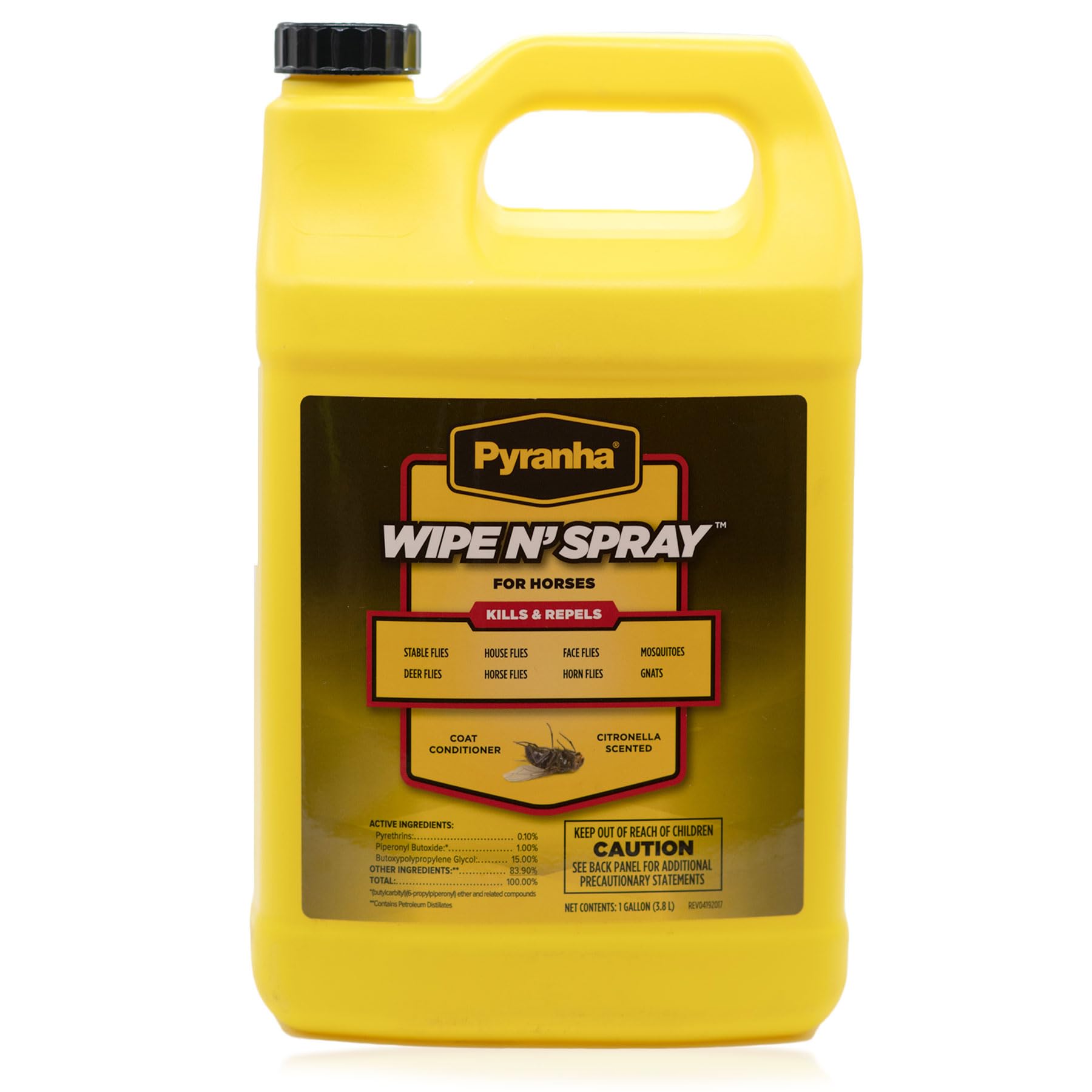
A gallon jug tells you who this spray is for: a barn with several horses and a fly season that does not let up. Pyranha Wipe N' Spray is oil-based, permethrin-powered, and sold in a 128-ounce refill. The formula includes lanolin, so it conditions the coat while it repels flies.

The oil base is the reason it stays. It remains stable without shaking and is designed to hold up through sweat, rain, and mud. On a horse that lives outside, that translates into less frequent application than a thin, water-based spray. The lanolin also leaves a gloss that show barns tend to like.

That same base can feel heavy. It attracts dust and dirt, and it can be greasy on hands and tack. Some horses with sensitive skin can react to permethrin formulas, so patch-test a small area before covering the whole coat. The citronella scent is noticeable, though it fades.

For a multi-horse operation, the gallon is the practical size. It costs more up front than a 32-ounce bottle, but it is the one we choose when the goal is less spraying every week. A single horse owner may never finish it in a season; a busy barn will. The lanolin shine is a bonus for show prep, but the main win is fewer spray sessions.

Bottom line: For a multi-horse barn that wants one gallon of long-wearing, coat-conditioning spray, Pyranha is worth the extra handling.

4

Absorbine UltraShield EX

Absorbine UltraShield EX

Ready-to-use horse spray

Our Score 9.2/10
Check Price

Worth Noting

  • Costs more than basic permethrin sprays
Form
Ready-to-use spray
Size
32 fl oz
Insects Targeted
70+ species
Protection Claim
Up to 17 days
Read the full review

The label claim is the first thing we noticed: up to 17 days of protection against more than 70 insects, including flies, mosquitoes, ticks, and gnats. That is a longer window than the 14-day sprays here, and it comes in a ready-to-use 32-ounce bottle, so there is no measuring or tank mixing.

UltraShield EX is built for horses, ponies, dogs, barns, and premises. The water-based formula includes sunscreens and coat conditioners, which makes it easier to use on a horse that lives outside and still needs fly relief. The sprayer is straightforward, and the bottle is sized for a full season of routine turnout rather than a single show.

We reach for it when simplicity matters most. The 17-day figure assumes thorough coverage, so a horse that sweats hard or stands in rain may need touching up. Even so, it is the easiest bottle here to hand someone who wants one product for horses, dogs, and barn surfaces. It is the bottle we want by the barn door for quick touch-ups.

Bottom line: For the simplest ready-to-use bottle that protects horses, dogs, and barn surfaces for up to 17 days, UltraShield EX is our first reach.

5

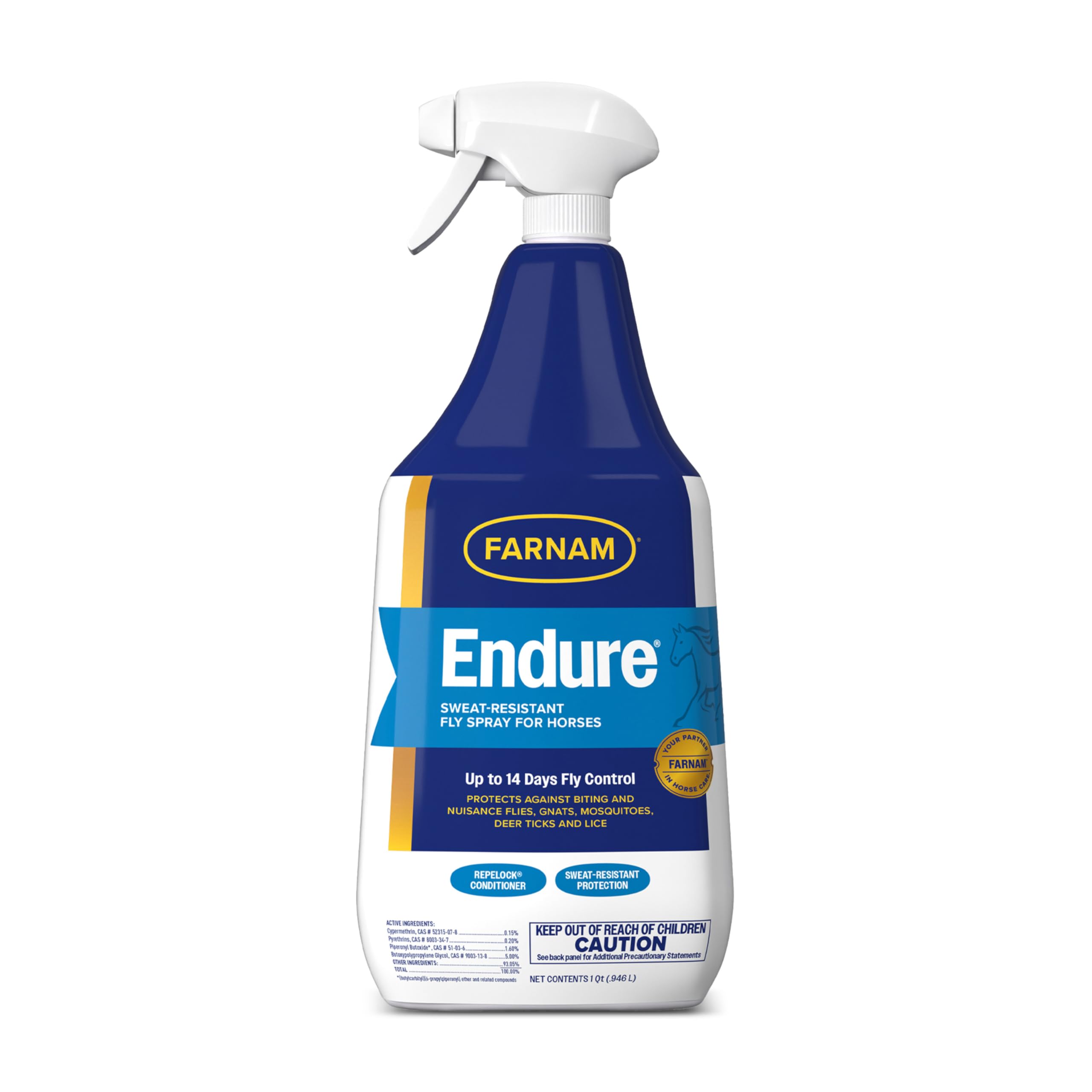
Farnam Endure Fly Spray

Farnam Endure Fly Spray

Hot, sweaty horses

Our Score 9.2/10
Check Price

Worth Noting

  • Premium price for a 32 oz bottle
Form
Spray or wipe-on
Size
32 fl oz
Technology
Repelock sweat-resistant
Protection Claim
Up to 14 days
Read the full review

Hot, humid turnout is where ordinary fly sprays come apart. Farnam Endure is built for that exact condition: Repelock technology binds to the hair shaft, and the label claims up to 14 days of sweat-resistant, rain-ready protection through flies, gnats, mosquitoes, ticks, and lice. We choose it for working horses that sweat through lighter formulas.

The 32-ounce bottle can be sprayed or wiped on, which helps around the face, legs, and other spots where a direct mist spooks a horse. The finish is non-greasy, so it does not leave the coat heavy or slick. It also covers house, stable, face, and horn flies, not just one species.

Fourteen days is a ceiling, not a promise. In heavy fly pressure or after repeated hosing, expect to reapply sooner. The bottle is also priced as a premium spray, so it makes the most sense for a horse in regular work rather than a pasture pet that gets one application a month. A 32-ounce bottle fits a grooming tote for shows and trail rides.

Bottom line: Endure is the spray we choose when heat and sweat are the problem, with 14-day sweat-resistant coverage that holds up through hard work.

6

Formula 707 MultiFly Pellets

Formula 707 MultiFly Pellets

Horse feed-through control

Our Score 9.2/10
Check Price

Worth Noting

  • Requires daily feeding
  • Only targets flies breeding in horse manure
Size
10 lb bag
Type
Insect growth regulator
Servings
182 servings
Active Ingredient
Novaluron
Read the full review

Adult flies are the ones you see, but the next wave starts in manure. Formula 707 MultiFly uses novaluron, an insect growth regulator, to break that cycle. The alfalfa-and-wheat-midd pellets are fed daily, and the active ingredient is not an organophosphate, which matters for horses on a regular program.

This is the most systematic product in the group. A 10-pound bag provides 182 servings, so one horse gets a full fly season from a single bag, and the daily portion goes into feed rather than onto the coat. We like that it addresses the breeding site instead of waiting for flies to land on a horse. It also avoids the odor and residue of a spray.

The catch is that it only works if the horse eats it every day and the manure stays in the program. It is not a knockdown product for adult flies coming from a neighbor's cattle or a wet hay pile. Start before fly season, keep the bag sealed, and accept that this is a management tool rather than a rescue bottle. A sealed 10-pound bag takes little shelf space in a feed room.

Bottom line: MultiFly earns its place for horse owners who will feed it daily, because it attacks the next generation rather than just the adults.

7

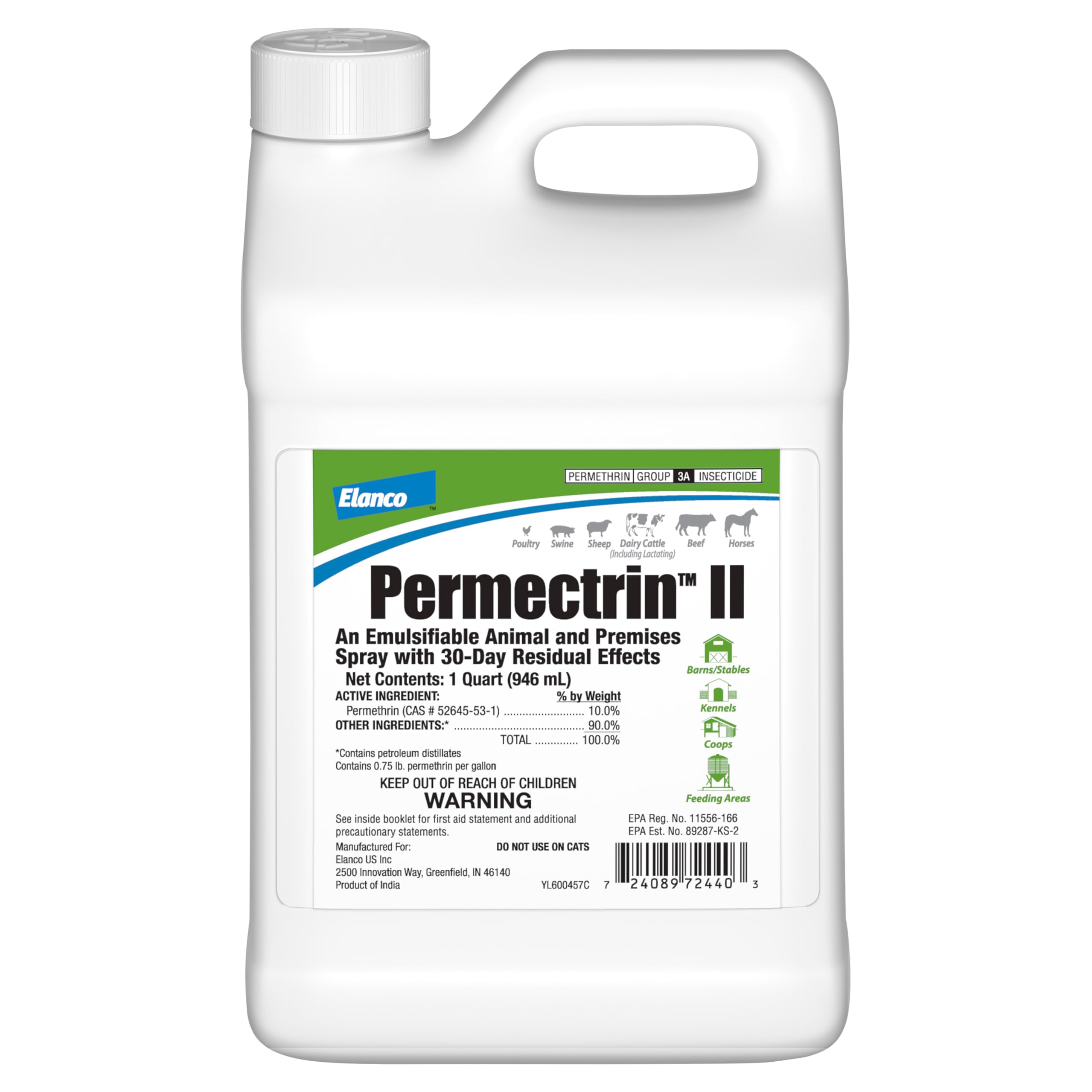
Elanco Permectrin II

Elanco Permectrin II

Livestock premise control

Our Score 9.0/10
Check Price

Worth Noting

  • Requires mixing and equipment
  • Noticeable odor during application
Size
1 qt (32 oz)
Protection Claim
Up to 30 days
Active Ingredient
Permethrin
Application Methods
Spray, mist blower, fogger, back-rubber, or paint-on
Read the full review

Thirty days is the number that separates Permectrin II from most of the sprays here. Elanco's quart is a permethrin concentrate for livestock and animal resting areas, with a label that claims up to 30 days of control. That is a premise product's kind of residual, not a horse spray you touch up before a ride.

The quart can be applied as a spray, mist, fogger, back-rubber, or paint-on, which makes it adaptable to a barn with different surfaces and equipment. It is labeled for beef and dairy cattle, poultry, swine, sheep, horses, and goat structures. A little goes a long way once diluted, so the bottle covers more area than its size suggests.

It is not a grab-and-go product. You need to mix it, and you need the right sprayer or applicator for the job. The odor is noticeable while you work, especially in a closed barn, so ventilate and keep animals out until the surfaces dry.

We like it for a premise program where residual matters: treating stalls, alleyways, and resting areas between cleanouts. For a single horse, UltraShield or Endure is simpler. For a barn that needs a month of surface protection from one concentrate, Permectrin II is the strongest option here. Label the sprayer and keep it separate from the one used for herbicides.

Bottom line: Permectrin II is our pick for a premise and herd concentrate when a 30-day label claim and flexible application methods matter more than ready-to-use ease.

8

Bonide Fly & Tick Dust

Bonide Fly & Tick Dust

Direct dust application

Our Score 9.0/10
Check Price

Worth Noting

  • Dust leaves a visible residue
  • ⚠️ Not safe around cats
Form
Dust-on powder
Size
4 lb
Also Controls
Fleas, lice, bedbugs
Target Livestock
Horses, cattle, sheep, goats, hogs
Read the full review

Some animals are easier to dust than to spray, and some spots are easier to reach with a squeeze jug than a mist. Bonide Fly, Lice & Tick Control Dust-On is exactly that tool: a 4-pound powder labeled for horses, cattle, sheep, goats, and hogs, plus fleas, lice, and bedbugs. We reach for it when a sprayer would spook the animal or waste product.

The dust goes on dry, so it clings to the coat and can be worked into hard-to-reach areas. It is also useful around coops and bedding, where a light application can be easier to control than a wet spray. The container is simple to squeeze, and a little puff covers more surface than you expect.

It is a messy product. Powder drifts, leaves a visible residue, and can be irritating if you breathe it, so wear a mask and apply it downwind. It is also not safe around cats, which matters on a farm with barn cats. For direct application on cattle, goats, or sheep, though, it solves a job the liquids here do not. Apply it before the heat of the day, when animals are calm and the dust will settle.

Bottom line: The Bonide dust is the practical answer for direct application on cattle, goats, sheep, or hogs when spraying a moving animal is a struggle.

9

Farnam Flys Off Ointment

Farnam Flys Off Ointment

Ears and wounds

Our Score 9.0/10
Check Price

Worth Noting

  • Leaves a visible white residue
  • ⚠️ Not labeled for cats
Form
Ointment
Size
7 oz
Best Use
Wounds and sensitive areas
Target Pests
House flies, stable flies, face flies, horn flies
Read the full review

Ears, wounds, and other sensitive spots are where fly sprays are hardest to use. Farnam Flys Off is an ointment, not a spray, and that is the whole reason it earns a place. A 7-ounce tub can be dabbed around the ears or on a sore without misting the horse's face.

The active ingredients are pyrethrins, piperonyl butoxide, and di-n-propyl isocinchomeronate, and the label covers house flies, stable flies, face flies, and horn flies. It is intended for dogs, horses, and ponies, especially around wounds and sensitive areas. The twist container is easy to open and close with one hand.

Once applied, it stays put longer than a spray. That is useful on a horse that is turned out in mud or a dog that keeps rubbing its ears. It also means the product is sitting on the skin, so use only as directed and keep it out of reach of children.

The texture is thick and slightly greasy, and it can leave a white residue on hair and clothes. Application is messy, especially on a moving animal, and a little goes a long way. Wear gloves if you do not want the ointment on your hands.

We keep Flys Off for the spots that need a targeted barrier, not for whole-body fly control. If your horse has crusty ears or a wound that flies will not leave alone, this is the most practical form here. If you need to cover a coat, a spray is still the better tool. A little on a fingertip goes further than a thick smear, and it is easier to keep off the hair.

Bottom line: Flys Off is what we keep for ears, wounds, and other spots a spray cannot cover, provided you can live with a little mess.

10

Durvet Permethrin 10%

Durvet Permethrin 10%

Small herd starter

Our Score 8.8/10
Check Price

Worth Noting

  • Strong odor during mixing
  • 8 oz may be short for large herds
Size
8 fl oz
Use Sites
Livestock premises and homes
Target Livestock
Dairy cattle, beef cattle, horses, sheep, goats, dogs, swine, poultry
Active Ingredient
Permethrin 10%
Read the full review

Eight ounces does not sound like much until you remember it is a concentrate. Durvet Permethrin 10% is a small bottle of active ingredient that gets diluted into a sprayer, and that makes it a low-commitment way to try a premise and livestock product without buying a gallon.

The label is broad for the size: dairy and beef cattle, horses, sheep, goats, dogs, swine, poultry, livestock premises, and homes. It controls horn flies, house flies, face flies, fleas, ticks, lice, and mange mites, among other pests. In a barn, that flexibility is useful because the same bottle can treat a wall, a pen, or an animal.

Mixing is straightforward if you have a sprayer and a measuring container. The concentrate is not meant to go on straight, and the label directions are the authority on dilution. We like the small size for a few animals or a first purchase, but a large operation will go through it quickly.

The odor is the biggest drawback. It is strong while mixing and spraying, so plan to work with ventilation and keep animals out of the treated area until it dries. Store it locked away from children and pets, and never mix more than you can use.

Our verdict is that Durvet is the starter concentrate we reach for when the job is small and the label fits. It is not the most convenient product here, and it is not the one for someone who wants a ready-to-use spray. As a compact, flexible permethrin concentrate, it does the job without a big upfront commitment. Write the mix date on the bottle so you know what is in the sprayer.

Bottom line: Durvet is the low-commitment way to try a permethrin concentrate, as long as you can manage the odor and have a sprayer ready.

How We Tested Livestock Fly Control

We built the shortlist from large-animal vet and extension recommendations, then cross-checked every label for active ingredients, approved species, withdrawal times, and how often the product claims to need reapplying. Anything that couldn't be used on at least two of the species we keep got cut, as did anything whose directions assumed a spotless wash rack and unlimited patience. That left 12 products, which we ran across one full fly season, roughly May through September, on the same pastures and in the same barns so the comparison stayed honest.

Flies are worst at morning turnout and again in the late-afternoon heat, so that's when we counted: a timed 60-second tally of flies on each animal's face, legs, and belly, logged twice a day, five days a week. Trap catch containers got emptied every morning and the contents tallied, which told us plainly enough whether a trap was killing flies or just sitting there looking agricultural.

Ease of use was judged at 6 a.m. with a restless horse — one person, one hand, stopwatch running, noting how long a spray or pour-on took and how hard the animal argued. We smelled each product straight out of the jug, again an hour after application in a closed barn, and once more the next morning, because something that lingers is something nobody reaches for twice a day. Duration was measured by the calendar rather than the label: we marked the day counts started climbing and logged that as the real reapplication interval. We also read the fine print on safety — species and age restrictions, withdrawal periods, whether it was sensible around working dogs and kids in the aisle — and worked out cost per animal per month.

Nothing we tested handled flies by itself, and the products that scored highest were the ones honest about their own limits. We'll keep using them next season and update if anything changes.

How to Choose the Right Livestock Fly Control

Match the Product to the Fly's Life Stage

Adult flies biting animals call for a spray, wipe-on, dust, or ointment that puts insecticide where the flies land. Premise concentrates handle barn walls, stalls, and resting areas. Feed-through products and bait traps work upstream: the pellet breaks the life cycle in manure, while the trap pulls adults away from animals. If you only treat the horse and ignore the manure and shaded walls, you are chasing the next generation. Choose the stage you can actually reach first, then add the others.

Decide How Much Mixing You Will Do

Ready-to-use sprays cost more per ounce but get used because there is no measuring, no tank, and no leftover mix. Concentrates are cheaper per gallon and let you treat both animals and surfaces, but they require a sprayer, water, and label discipline. Dusts and ointments are best for direct, targeted application; traps need only water and a hanging point. Be honest about the routine. A concentrate that sits in the shed because mixing is a chore is worse value than a bottle you actually carry to the barn.

Read the Label for Species and Site

The same active ingredient can be labeled for different animals, ages, production classes, and surfaces. Check that your species is on the label, then check the site: lactating dairy cattle, poultry houses, horse stalls, and kennels can have different directions. Follow dilution rates and withdrawal times exactly. Keep permethrin products away from cats and aquatic areas unless the label says otherwise, and remove animals from treated areas until surfaces dry. A product that is convenient but off-label is not a bargain.

Plan Residual, Odor, and Season Cost

Label days are measured under typical conditions, not a guarantee through sweat, rain, dust, or heavy fly pressure. A 14- or 17-day spray may need touching up sooner on a horse in work; a premise concentrate may hold longer on a shaded wall than in a wet wash area. Factor in reapplication when comparing sizes. Also plan for odor and residue: bait traps and permethrin concentrates are noticeable, and oil-based sprays can leave a coat greasy. The best product is the one you can place and reapply without disrupting the animals.

Frequently Asked Questions