Soil & Fertilizer

Best Liquid Plant Fertilizer of 2026

The fastest way to hurt a houseplant usually isn't neglect — it's enthusiasm. A little extra plant food and you get scorched leaf edges, a crust of white salts on the soil, and a plant that looks worse than it did before you started. A good liquid fertilizer does something smaller and more useful: it puts back the nutrients a potted plant exhausted months ago, at a strength the roots can actually take.

I've burned my share of pothos with a heavy hand, so I was paying attention when we ran 14 bottles through a full growing season — about six months — on houseplants, kitchen herbs, and patio tomatoes. The ones that earned a spot weren't the strongest; they were the ones we could dose without guessing. Everything below has the dilution math, the smell, and the drip-prone caps already sorted out, so you can pick a bottle and get back to watering.

1

Purived All-Purpose

Top Pick
Purived All-Purpose

Odor-free containers

Our Score 9.4/10
Check Price

Worth Noting

  • No NPK ratio published
Use
Soil, foliar, hydroponics
Coverage
Makes 50 gallons
Application
1 capful per gallon
Bottle Size
16 fl oz
Read the full review

What stands out about Purived is what isn't there: no odor, no mixing ritual, no complicated measuring. A capful goes into a gallon of water, and the 16-ounce bottle is rated to make 50 gallons. For anyone who feeds a shelf of houseplants or a few patio pots, that is a very low-friction routine.

The formula is all-purpose and designed for potted plants, with directions that cover soil drenching, foliar feeding, and even full or semi-hydroponics. We think that versatility is the reason to pay more here: one bottle can follow you from a ficus in the living room to a tomato in a patio pot, as long as the plant is in a container. It has a two-year shelf life, too, which is more than we can say for a half-used jug of ready-to-use feed.

The appeal is predictability: no smell in the room, no residue on the leaves, and no need to rinse a measuring spoon. The caution is strength. This is a concentrate, and the capful dose is not a suggestion to eyeball. Plants can yellow or burn when the mix is too strong, so measure it over the watering can rather than pouring straight from the bottle.

For a container collection, the convenience is worth the premium. If you are feeding a large in-ground garden, a cheaper concentrate will stretch further. That is the dividing line: Purived is for the pots you tend closely, not the whole back forty.

Bottom line: We recommend Purived for odor-free container feeding: a capful makes a gallon, and one bottle makes 50 gallons.

2

FoxFarm Big Bloom

FoxFarm Big Bloom

Flowers and fruit

Our Score 9.4/10
Check Price

Worth Noting

  • Not a standalone all-purpose feed
  • Heavy feeders use it quickly
Application
4 tbsp per gallon
Bottle Size
1 quart
NPK Analysis
0-0.5-0.7
Key Ingredients
Earthworm castings and bat guano
Read the full review

The 0-0.5-0.7 analysis looks almost like a misprint next to the 10-10-10 formulas here. It is not. Big Bloom is a bloom-stage supplement built around earthworm castings and bat guano, and it is meant to support flowering and fruiting rather than push leafy growth.

We reach for it when tomatoes, peppers, roses, or annuals have already put on their leaves and now need to set fruit or flowers. The organic inputs are part of the appeal, and the liquid is easy to dilute at 4 tablespoons per gallon. It does not smell like a bouquet, but it is not the worst offender in this group.

The low NPK number is the key to using it well. Use it after the plant has a good framework, or pair it with a grow formula. The 1-quart bottle is a reasonable size for a small garden.

What we appreciate most is the focus. It does one job — supporting blooms and fruit — and it does not ask you to rebuild your whole feeding routine around it. If you already have a balanced fertilizer and want more flowers, this is the bottle to add.

Bottom line: We recommend this bloom-stage specialist for gardeners who already have a base feed: organic, easy to mix, and good for flowers and fruit.

3

FoxFarm Liquid Trio

FoxFarm Liquid Trio

Complete feeding

Our Score 9.4/10
Check Price

Worth Noting

  • Most expensive option here
  • Requires keeping a multi-bottle schedule
Use
Vegetative and bloom stages
Form
Liquid concentrate
Includes
Big Bloom, Grow Big, Tiger Bloom
Bottle Sizes
3 pints
Read the full review

Three bottles, three stages, and a feeding chart: the FoxFarm trio is a program, not a single product. Big Bloom, Grow Big, and Tiger Bloom are meant to be used together through vegetative growth and bloom, and the set gives a committed grower a complete liquid feeding schedule. That is the appeal: one system for the whole season.

The trio is popular for a reason: it covers the whole season instead of asking you to switch brands when flowers start. We were struck by the logic of it, and the three pint bottles are easy to store together. The formulas are concentrated, so the set lasts longer than the bottle count suggests, but you do need to measure each one separately.

The structure is the point. It assumes you want to think about growth stages and feed accordingly. For tomatoes, roses, or a serious container garden, that control can be worth it. For a windowsill of pothos and snake plants, a single balanced bottle is the simpler buy.

Bottom line: We recommend this complete three-part program for serious edible and flower growers: it covers vegetative growth and bloom in one set.

4

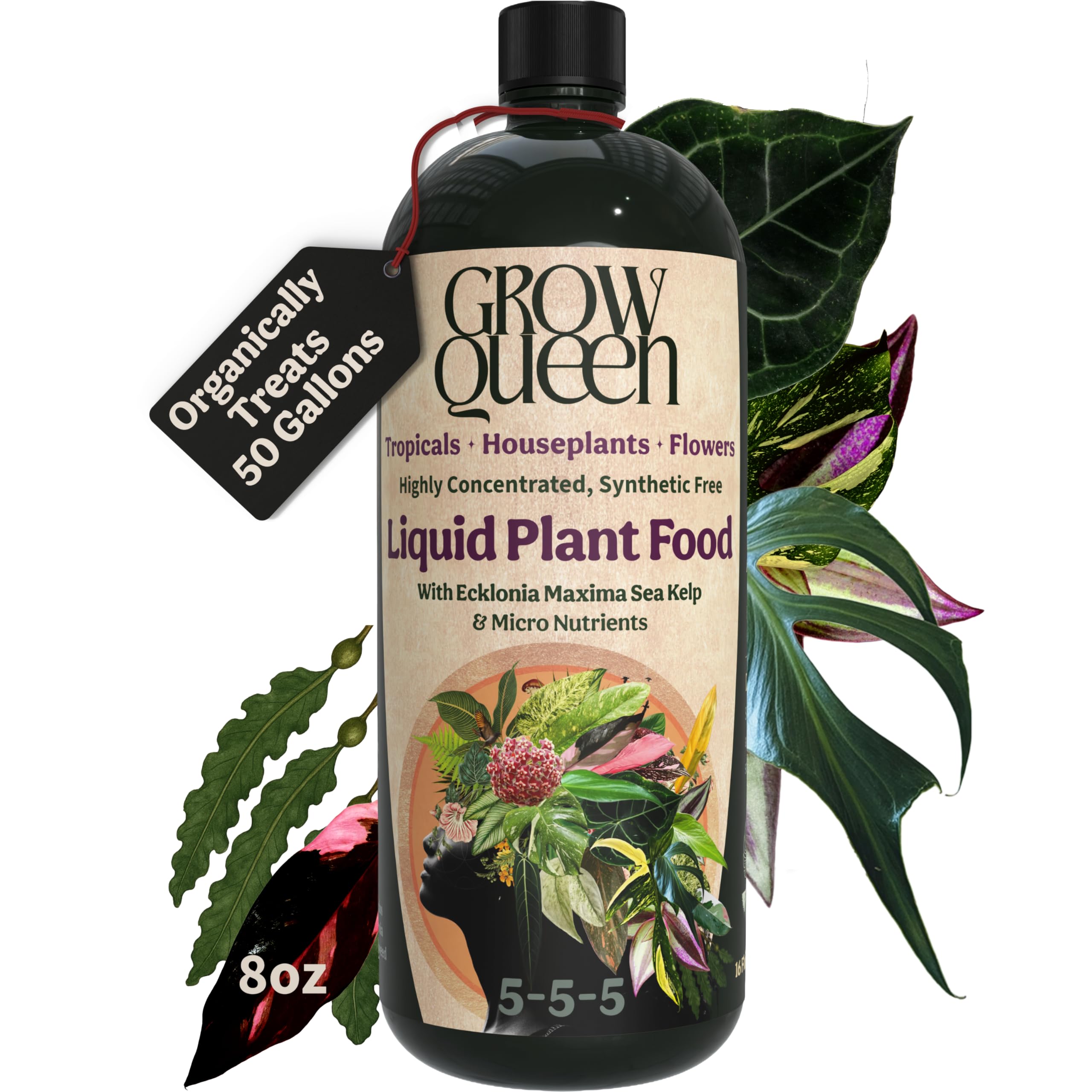
Grow Queen Organic 5-5-5

Grow Queen Organic 5-5-5

All-purpose feeding

Our Score 9.2/10
Check Price

Worth Noting

Coverage
Treats up to 50 gallons
Bottle Size
8 fl oz
NPK Analysis
5-5-5
Key Ingredient
Ecklonia maxima sea kelp
Read the full review

Eight ounces treating up to 50 gallons is the kind of claim that makes us check the label twice. The math works because the dose is one capful — about 4 ml — per gallon, and the analysis is a balanced 5-5-5. For a mixed collection of houseplants and outdoor containers, that is the combination we want: enough nitrogen for leaves and stems, enough phosphorus and potassium for roots and flowers, and no need to buy a second bottle when the season changes. That is why Grow Queen is our top pick.

The formula also includes Ecklonia maxima sea kelp and micronutrients, which is the detail that separates it from a plain 5-5-5. That matters for container plants, where the roots are confined to a small volume of soil and trace minerals run out faster. It is organic, and the dose is gentle enough to use through the growing season rather than only as a rescue treatment. We kept it in the regular watering rotation, not the emergency shelf.

What we look for in a fertilizer is steady, healthy growth rather than a sudden flush that leaves the plant weak. This one is built for that pace: a balanced feed that supports new leaves, stronger roots, and better flowering without pushing one stage at the expense of another. It is also simple to repeat, which matters more than a fancy label. The capful dose is easy to remember, and 50 gallons goes a long way for a small garden.

The trade-off is the smell. Organic formulas can carry an earthy note when you open the bottle, and this one is no exception. Mix it near a sink or use it outdoors if you are sensitive, and the scent does not linger on the plants. That is a small price for a fertilizer that is this easy to measure and this broad in what it feeds.

Bottom line: Our top pick for most people: a balanced organic 5-5-5 concentrate that treats up to 50 gallons and handles houseplants and outdoor containers with one easy capful.

5

TPS Nutrients Indoor

TPS Nutrients Indoor

Indoor houseplants

Our Score 9.2/10
Check Price

Worth Noting

  • Indoor-only; not for outdoor gardens
Use
Indoor houseplants
Formula
Kelp-enriched indoor blend
Application
Mix with water
Bottle Size
8 fl oz
Read the full review

TPS draws a clear line around who this bottle is for: indoor houseplants. The 8-ounce concentrate is built for monstera, pothos, philodendron, snake plants, peace lilies, and other indoor tropicals, and it is meant to mix into a regular watering routine. That focus is useful if your plant care is mostly a windowsill and a shelf.

The formula is kelp-enriched and easy to mix, and the bottle is small enough to tuck away between waterings. We appreciated that it does not ask for a dozen measuring tools or a complicated schedule. A little goes into the watering can, and the job is done. The 8-ounce size is also a sensible entry point if you are trying a new fertilizer without committing to a quart.

The brief is narrow by design. It is an indoor specialist, and the label does not pretend otherwise. If your collection is indoors and you want a gentle, kelp-based feed that mixes easily, this is a strong, straightforward pick.

Bottom line: A houseplant specialist we recommend for indoor collections: kelp-enriched, easy to mix, and sized for a shelf.

6

Miracle-Gro Pour & Feed

Miracle-Gro Pour & Feed

Ready-to-use pots

Our Score 9.2/10
Check Price

Worth Noting

  • For containers only; not in-ground beds
  • Used up faster than a concentrate
Form
Ready-to-use
Application
Directly to soil
Bottle Size
32 fl oz
Feeding Interval
Every 10-14 days
Read the full review

Pour & Feed removes the two steps that make liquid fertilizer a chore: measuring and mixing. It is a ready-to-use 32-ounce bottle, and you apply it directly to the soil of indoor or outdoor container plants every 10 to 14 days. For a few pots on a patio or a handful of houseplants, that convenience is the whole point.

The formula is aimed at container plants. For pots, it is simple and fast. We value that there is no concentrate to spill and no measuring spoon to wash, and the 32-ounce size is manageable to carry around.

Ready-to-use liquid is mostly water, and a larger container can take several capfuls at once. The cap can also leak in shipping, which is frustrating with a product you are supposed to pour. Store it upright and check the cap before you shake it.

For a small container garden, the time saved is real, and the no-mix routine makes it easier to feed consistently. For a large collection, choose a concentrate. That is the line we draw: buy this for convenience, not for the lowest cost per gallon.

Bottom line: We recommend this ready-to-use bottle for a small container garden: no measuring, no mixing, and a simple 10-to-14-day schedule.

7

Miracle-Gro All Purpose

Miracle-Gro All Purpose

Budget gardens

Our Score 9.0/10
Check Price

Worth Noting

  • Bottle can leak in shipping or storage
For
Flowers, vegetables, shrubs, trees, houseplants
Bottle Size
32 fl oz
Container Dose
1 tsp per gallon
In-ground Dose
Cap to first line per 2 gallons
Read the full review

Miracle-Gro's all-purpose concentrate is the budget bottle in this group, and it is hard to argue with how far it stretches. The 32-ounce bottle mixes at 1 teaspoon per gallon for containers or a cap filled to the first line in 2 gallons for in-ground beds, and it is labeled for flowers, vegetables, herbs, shrubs, trees, and houseplants. If you want one cheap liquid to cover a lot of ground, this is the obvious place to start.

The formula is not subtle. It is a conventional all-purpose feed, and it works best when you respect the dilution. We measured it carefully because a strong mix can burn roots and leaves, especially in dry containers. Used at the label rate, it is a practical way to feed a mixed garden without buying three different bottles.

What we do not love is how unforgiving the mix can be. This is not a gentle organic feed, and it is easy to overdo if you free-pour. Measure it, water the soil first, and do not feed a stressed plant at full rate. That is the workaround, and it is simple enough.

If you want a cheap, broad-purpose fertilizer and you are willing to measure, it earns its place. If you want something you can splash into a watering can without thinking, pay for a more forgiving formula.

Bottom line: We recommend this budget all-purpose pick for gardeners who want one cheap liquid for flowers, vegetables, shrubs, trees, and houseplants.

8

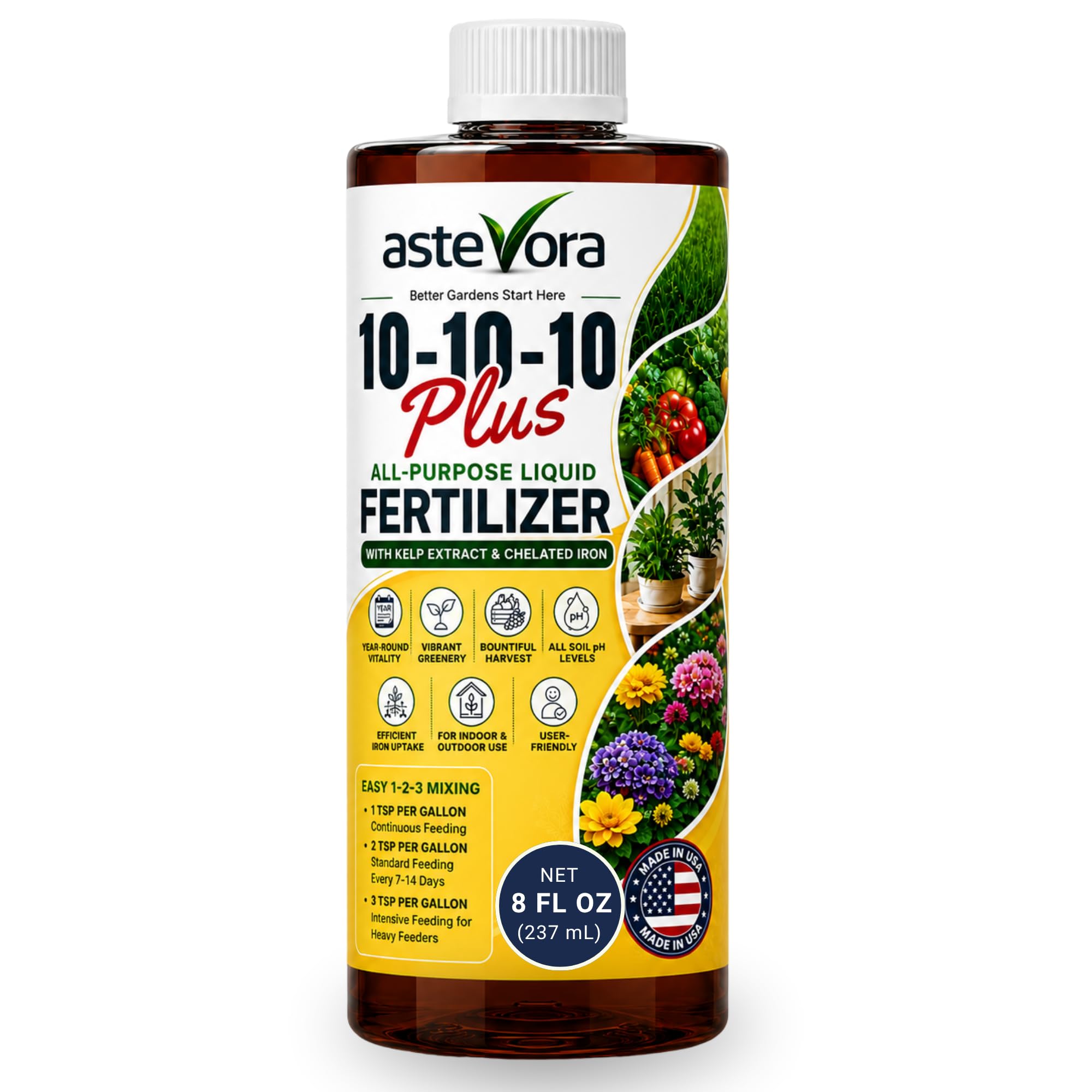
ASTEVORA 10-10-10

ASTEVORA 10-10-10

Lawns and veggies

Our Score 9.0/10
Check Price

Worth Noting

  • Small bottle for large gardens
Iron
6% chelated iron
Bottle Size
8 fl oz
NPK Analysis
10-10-10
Added Nutrient
Seaweed extract
Read the full review

The 10-10-10 analysis is ordinary; the 6% chelated iron is what makes ASTEVORA worth a second look. Iron is the nutrient that helps keep leaves deep green, and a chelated form is easier for plants to take up. For lawns, vegetables, flowers, shrubs, and houseplants that yellow between feedings, that is a useful addition to a balanced formula.

The bottle is 8 ounces and mixes with water for a watering can or hose-end sprayer. The formula also includes seaweed extract, which adds micronutrients and growth hormones, though the 10-10-10 base is doing the main feeding. The versatility is what won us over: one bottle can move from the vegetable bed to the flower border to a few containers without changing the dose.

The dilution instructions are worth reading twice, because a 10-10-10 concentrate can burn plants if you guess. Measure it, and do not treat the hose-end sprayer as a license to eyeball. A full watering can every week is a commitment, so mix only what you need.

For a small garden with a few hungry plants, the iron and seaweed make this a more interesting all-purpose feed than a plain 10-10-10. For a big lawn or a large bed, buy a larger size or a cheaper concentrate. That is the trade: useful extras for the plants you tend closely.

Bottom line: We recommend this 10-10-10 with chelated iron and seaweed for small gardens that need a versatile all-purpose feed.

9

Bonide Houseplant Food

Bonide Houseplant Food

Small houseplants

Our Score 8.8/10
Check Price

Worth Noting

  • Bottle can leak in transit or storage
For
Houseplants, orchids, succulents, ferns
Application
1/8 tsp per quart
Bottle Size
8 fl oz
NPK Analysis
10-10-10
Read the full review

Bonide asks for 1/8 teaspoon per quart of water, which is a dose small enough to make you reread the label. That tiny measure is the point: an 8-ounce bottle lasts a long time, and you can feed houseplants every time you water without mixing a whole gallon. For a small indoor collection, that is a genuinely useful format.

The 10-10-10 analysis is balanced and straightforward, and the formula is aimed at orchids, succulents, ferns, poinsettias, and other common houseplants. It is not a bloom booster or a specialist mix, and it does not pretend to be. It is a general houseplant feed for people who want to keep a bottle on the shelf and use it regularly.

We prefer the small dose for containers because it is easy to under-feed rather than over-feed, which is the safer mistake with liquid fertilizer. The bottle is also compact enough to store in a cabinet. The pour top is not the most precise, so measure over a sink and rinse the threads before closing.

The formula itself is straightforward: mix 1/8 teaspoon into a quart, water as usual, and repeat each time you water. It is not a bloom booster or a specialist mix, but it does not need to be. For orchids, succulents, ferns, and other common houseplants, that simple balance is the point.

For a handful of houseplants and a patient feeding routine, Bonide is a sensible, inexpensive concentrate that will last. For a large collection or anyone who wants a no-fuss pour, a ready-to-use bottle is the easier choice. That is the boundary: good value in a small bottle, as long as you measure carefully.

Bottom line: We recommend this long-lasting houseplant concentrate for small indoor collections that get fed often; the tiny dose stretches an 8-ounce bottle a long way.

How We Tested 14 Liquid Fertilizers

The shortlist started on nursery shelves and in extension-office nutrient guides, then got cut down hard. Any bottle that wouldn't give us a measurable dilution rate — a teaspoon per gallon, not "a capful" — came off the list, as did concentrates that only made sense in a hydroponic reservoir. That left 14: synthetic all-purpose feeds, organic blends, fish emulsions, and a couple of seaweed concentrates.

Testing ran through one full growing season, roughly six months from early spring into late summer, and it happened where plants actually live: a windowsill row of pothos and philodendrons, a kitchen counter tray of basil, and five-gallon patio pots of tomatoes and annuals. Plants within each group got identical light and identical water, with the fertilizer as the only variable, and a handful of pots went unfed as controls.

Every feeding was mixed in a marked gallon jug, and we logged which plants pushed out new leaves, which held their color, and which browned at the tips after a full-strength dose. Bottles got knocked over on purpose to see whether the caps and threads leaked, and we counted how many gallons of mixed feed each container actually yielded so cost per watering was comparable across sizes. Odor got its own test: we mixed indoors and timed how long the room smelled like a fish counter. On the patio, we also watched whether the fed annuals pulled in more bees and butterflies than the controls did.

How to Choose the Right Liquid Plant Fertilizer

Start with the analysis, not the label

Balanced formulas such as 5-5-5 and 10-10-10 are the easiest place to start because they feed leaves, roots, and flowers without pushing one stage too hard. If your goal is flowers or fruit, a low-NPK bloom formula can be added later; if you are growing leafy greens or young transplants, a higher-nitrogen feed makes more sense. We prefer one balanced bottle for a mixed collection and a separate bloom booster only when a plant is ready to flower. That is why Grow Queen's 5-5-5 and ASTEVORA's 10-10-10 are useful starting points, while FoxFarm Big Bloom is a specialist addition.

Concentrate or ready-to-use?

Concentrates cost less per gallon and take up less shelf space, but they add a measuring step. Ready-to-use bottles remove that step and are easier to use on a few pots, though you pay for the water and the bottle goes faster. For a large container garden, a concentrate such as Purived or Miracle-Gro All Purpose stretches much further. For a handful of patio pots or a single windowsill, Miracle-Gro Pour & Feed is the convenience play. Count your plants before you choose: the fewer the plants, the more sense a ready-to-use bottle makes.

Measure the dose, then measure it again

Liquid fertilizer is easy to overdo because a small extra splash is a large jump in concentration. Mix at the label rate, use a proper measuring spoon or cap, and water the soil before feeding a dry or stressed plant. If you are unsure, start at half strength and watch for yellowing, crispy leaf edges, or a white crust on the soil. A formula with a clear, repeatable dose — a capful per gallon or 1/8 teaspoon per quart — is easier to live with than one that asks you to guess.

Match the bottle to your plant count and your nose

Coverage claims matter more than bottle size. An 8-ounce concentrate that makes 50 gallons can outlast a 32-ounce ready-to-use bottle, especially if you have large pots. Odor is the other practical divider: organic formulas can carry an earthy smell, while odorless products are easier to use indoors. Check the cap and seal before you store a bottle on a shelf; a leaky concentrate is a mess you do not want behind a cabinet. Buy for the number of plants you actually feed, not the biggest bottle on the page.

Frequently Asked Questions

Final Verdict

Start with Grow Queen Organic 5-5-5 if you want one balanced liquid for houseplants and outdoor containers. It makes up to 50 gallons, measures by the capful, and supports steady growth without pushing a single stage.

If you feed only indoor plants, TPS Nutrients is the more focused choice; if you want no smell and a cap-per-gallon routine, Purived is the odorless alternative. The right bottle is the one you will measure correctly and use often.