Planters & Plant Supports

Best Insect Netting for Plants of 2026

Every June, the cabbage white butterflies find my kale before I do. I've tried row covers, soap sprays, and an optimistic amount of marigold planting, and every August I still end up with leaves that look like lace. Insect netting is the unglamorous fix that actually works: a fine barrier that keeps egg-laying moths, aphids, and berry-stealing birds on the outside while light, air, and rain still get through. The catch is that not every roll is fine enough to stop the small stuff, wide enough to drape over a mature plant, or tough enough to survive a season of sun and wind.

Over the past five months, my team and I have draped, clipped, and staked 14 different nettings over raised beds, patio pots, and a blueberry bush that has never once made it to July intact. A few sagged after the first heavy rain, and some had mesh wide enough to welcome in the very pests they were supposed to block. The ones that made the list are the ones that held up and kept things out, whether you're guarding a single pot of basil or an entire row of brassicas.

1

Garden Tailor 10 x 30 Netting

Top Pick
Garden Tailor 10 x 30 Netting

Whole-garden coverage

Our Score 9.2/10
Check Price

Worth Noting

  • Fine mesh also shuts out pollinating bees
Material
HDPE, UV-stabilised
Warranty
3 years
Mesh Count
40 mesh
Sheet Size
10 x 30 ft
Read the full review

Forty mesh is the number that earns this sheet its place. That weave is finer than the 0.8 to 1 mm netting most of this group uses, which puts it in the range that shuts out aphids, whitefly, leafminer and carrot fly rather than only the cabbage whites and beetles a coarser net stops. We like that it manages this without sealing the bed off: rain goes straight through, and light reaches the leaves the way it did before the cover went on.

Then there is the size. Ten by thirty feet is 300 square feet, enough to run hoops down several beds with material left over for a fruit cage or a cold frame, and it cuts cleanly where you want it to stop. The selvedge is the detail we appreciated most: a cut length holds together instead of shedding strands over the soil, which is what happens to netting with a raw edge. It is light, so the corners need real weight on a breezy day — soil, stones or pegs along every edge rather than two bricks at the ends.

What separates it from the cheaper sheets is the finishing. The HDPE is UV-stabilised, which is what keeps a plastic weave from going brittle after a summer in the sun, and Garden Tailor backs the sheet with a three-year warranty that nobody else in this group offers. A sharp stake top or a rose thorn will still find it, so cap your stakes — that one habit is the difference between a sheet that folds away in October and one that goes in the bin.

Bottom line: For most gardens, this is the sheet we reach for: 40-mesh HDPE fine enough for aphids and whitefly, 300 square feet of it, and edges that survive being cut.

2

Agfabric 6.5 x 10 Netting

Agfabric 6.5 x 10 Netting

One raised bed

Our Score 9.0/10
Check Price

Worth Noting

  • 65 square feet covers one or two beds
Coverage
65 sq ft
Material
HDPE
Sheet Size
6.5 x 10 ft
Mesh Opening
0.03 x 0.03 in
Read the full review

Sixty-five square feet is the honest headline, and for plenty of gardeners that is exactly the right amount: one 4 x 8 bed with enough overhang to bury the edges, or two smaller frames. This is the sheet we keep for that job, because a piece this size goes on in a couple of minutes instead of turning into an afternoon of dragging ten-foot-wide netting across a plot.

The mesh is listed at 0.03 x 0.03 inch, roughly 0.76 mm, and that number does the work — cabbage white butterflies, flea beetles and Japanese beetles all meet a barrier before they reach a leaf. What impressed us beyond the figure is the construction: the weave holds its shape, the edge stays neat, and the sheet goes on straight instead of snagging on every stake in reach. Sun and rain pass through, so watering does not mean lifting it off.

HDPE in a fine weave is also the combination that survives being folded and put away. Dry it, fold it flat, and it takes up the corner of a shed until spring. The limitation is simply scale: on a garden bigger than a couple of beds you will be buying two or three and joining them, and a join is where a moth gets through. Buy one sheet that covers the bed rather than patching coverage together.

Bottom line: The best small sheet here for a single raised bed: 0.03-inch HDPE mesh, a neat edge we never had to fight, and enough size to bury the borders properly.

3

KLEWEE 10 x 50 Netting

KLEWEE 10 x 50 Netting

Long bed runs

Our Score 9.0/10
Check Price

Worth Noting

  • Snags on stake tops, rough timber and thorns
Coverage
500 sq ft
Material
PE
Sheet Size
10 x 50 ft
Mesh Opening
0.8 x 0.8 mm
Read the full review

When the beds run end to end along a fence, joining sheets is where the job turns ugly: overlaps flap, seams open, and the whole thing looks like laundry. Ten by fifty feet is the answer — 500 square feet in one piece, one length down the run, cut where you need it and no seam for a moth to find.

The mesh is 0.8 x 0.8 mm, square rather than oblong, and in practice that is the same class of protection as the 0.8 x 1 mm sheets here: it stops the moths, beetles and flies that do the visible damage and lets rain through. What struck us is how easy it is to see through, which matters more than it sounds when you are walking the plot every evening and do not want to lift the cover to check a crop.

It is light for its size, and that cuts both ways: easy to throw over a frame, easy for wind to shift. The thing to guard against is snagging. This weave catches on stake tops, rough sawn timber and rose thorns, and a snag becomes a hole. Cap your stakes, run a hand along the top edge of a homemade frame, and leave slack rather than pulling the sheet tight — do that and it is a cover you will get several seasons from.

Bottom line: The sheet we point at when one length has to cover a whole run: 500 square feet in one piece, easy to see through, with mesh that handles the usual garden pests.

4

Jevrench 4 x 25 Row Cover

Jevrench 4 x 25 Row Cover

Single crop rows

Our Score 8.8/10
Check Price

Worth Noting

  • Four-foot width needs two lengths on wider beds
Coverage
100 sq ft
Material
PE
Sheet Size
4 x 25 ft
Mesh Opening
0.8 x 1 mm
Read the full review

Four feet wide by twenty-five long is a strip, and the shape is the whole point. It matches a standard raised bed or a single row under low hoops, with just enough overhang to weigh the edges down. Expect it to cover a whole plot and you will be disappointed; buy it for a row of kale and it is almost exactly right.

The weave is 0.8 x 1 mm, the oblong hole most of this group uses, and it is a sensible compromise for greens: fine enough to stop cabbage white and carrot fly, open enough that air moves through and water goes straight in. Jevrench says the PE is twice as thick as ordinary netting, and it does feel more substantial than the very thinnest sheets here — it stretches over hoops without splitting at the corners.

Width is where it gives ground. Four feet is fixed, so a wider bed needs two lengths side by side, and the seam between them is the one spot a butterfly will find. Because it is long and light, a gust lifts it along its whole length unless you peg or weight every few feet; we use a brick at each stride and that holds it. As a dedicated row cover it does the job well; as the only sheet you own, it is too narrow.

Bottom line: A four-foot strip is what a row wants, and Jevrench cuts it twenty-five feet long — we like it for greens under low hoops, where the narrow width stops mattering.

5

RIFNY 10 x 33 Netting, 2-Pack

RIFNY 10 x 33 Netting, 2-Pack

Several beds

Our Score 8.8/10
Check Price

Worth Noting

  • Raw-cut edges fray and shed strands
Material
PE
Sheet Size
10 x 33 ft each
Mesh Opening
0.04 in
Sheets Per Pack
2
Read the full review

Two ten-by-thirty-three-foot sheets in one pack behave differently from one big piece. You can cut into one and keep the other whole, run one over this season's bed and hold the second for a late sowing, or cover two beds at opposite ends of the garden without a join between them.

The mesh is listed at 0.04 inch, about a millimetre, so this is standard netting rather than ultra-fine. It stops the big fliers — cabbage whites, beetles — and it does the bird job as well, which is why a sheet like this usually ends up over blueberries and cherries rather than over cabbage.

Two things to check before it goes on. The edges are cut rather than sealed, so they shed strands, and a loose strand on the ground is a hazard to birds; trim the edges before you lay it out. And unroll the whole sheet and hold it up to the light first, because the weave can arrive with gaps in it, and a gap you spot in September is one a moth found in June.

None of that is fatal, and the spare sheet is why this one keeps its place: a bad cut or a tear on a stake does not end the season, you just go to the second piece. For a plot with several beds and a bird problem alongside the insect one, the two-pack earns its keep. Keep the spare dry and folded, because sun is what kills a stored sheet left hanging on a shed wall.

Bottom line: Two large sheets for one price, with standard mesh that handles moths, beetles and birds — we keep the spare for a bad cut.

6

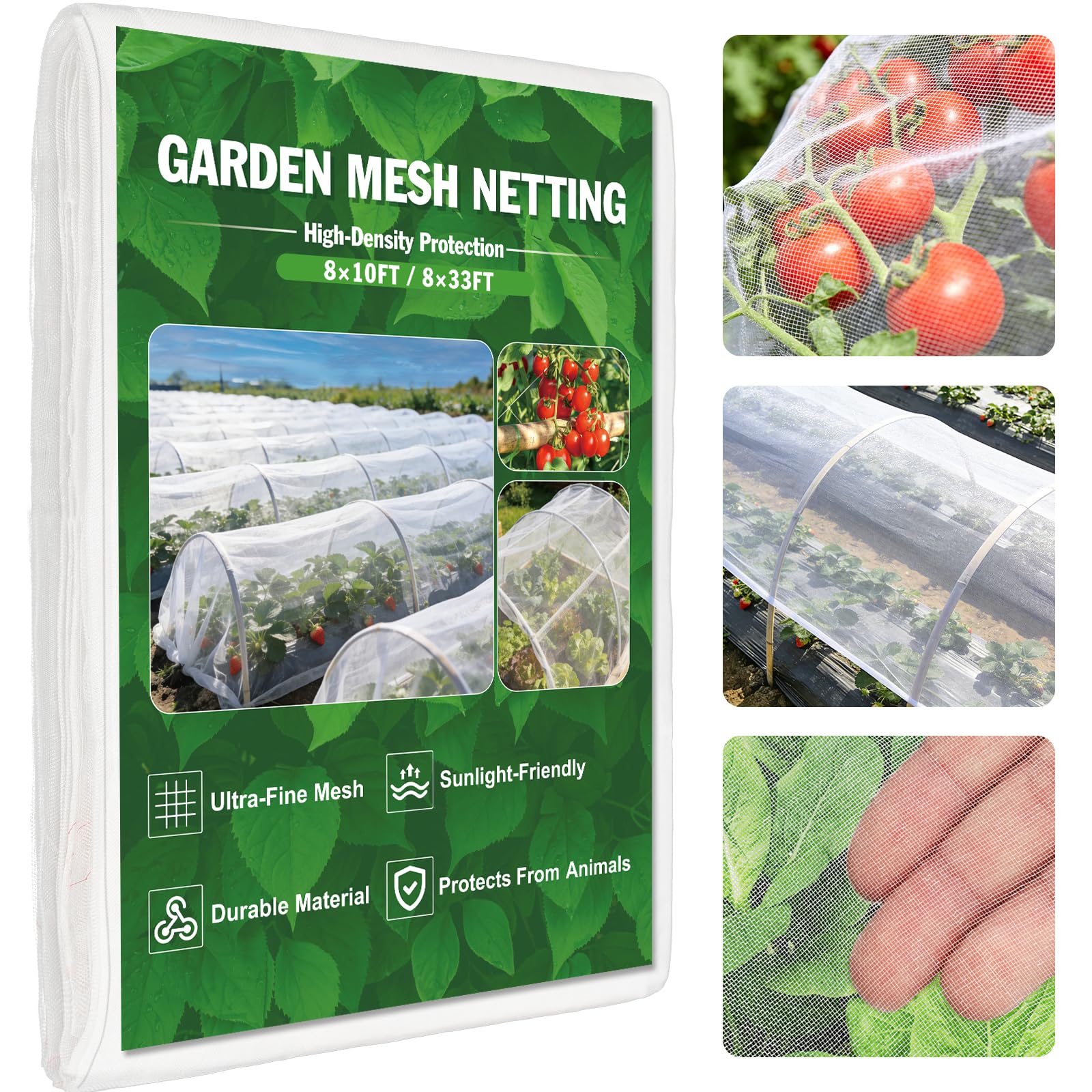
FEED GARDEN 8 x 10 Netting

FEED GARDEN 8 x 10 Netting

Small plots

Our Score 8.8/10
Check Price

Worth Noting

  • Very thin; snags and tears on rough ground
Material
UV-stabilised PE
Sheet Size
8 x 10 ft
Mesh Opening
0.7 x 0.8 mm
Read the full review

Sold as insect netting, this one earns its place on the four-legged and feathered side of the ledger. Eight by ten feet suits a shrub, a small bed or a young tree, and the 0.7 x 0.8 mm mesh is fine enough for cabbage whites as well — but the sheet is very thin, and that is the trade.

Where it works is against things that push rather than crawl: rabbits, deer and birds. It drapes over a frame or a bush without weighing branches down, and the PE is UV-stabilised for a cover that stays out all season. Anchor it properly, though. This is the lightest-feeling sheet here, and a deer will push a loose edge aside without noticing it was there.

Toughness is the drawback. It snags on rough ground and on its own stakes, and once there is a hole a rabbit will find it; on an exposed site the wind works at the edges until they tear. Use it where the pressure is moderate — a suburban back garden, a shrub you are bringing through its first year — and put real weight or pegs along the edges rather than a few stones at the corners.

Bottom line: We buy it for rabbits, deer and birds over a small bed or a young shrub; the fine mesh works on insects too, but the sheet is thin wherever it meets a stake.

7

SnugNiture 10 x 33 Netting

SnugNiture 10 x 33 Netting

Thrips and whitefly

Our Score 8.6/10
Check Price

Worth Noting

  • Cuts airflow and light more than coarser mesh
Weight
1.2 lb
Material
PE
Sheet Size
10 x 33 ft
Mesh Opening
0.1 x 0.1 mm
Read the full review

SnugNiture lists a 0.1 x 0.1 mm opening — far and away the finest mesh in this group — and that number changes the list of pests it stops. Thrips, whitefly and leafminer, the ones that walk through ordinary netting, have a much harder time reaching a crop under this sheet.

Handling is where the fineness shows. The sheet weighs about 1.2 pounds over ten by thirty-three feet, light enough to hang on hoops without bowing them, but the weave is thin and a stake top will punch through it. This is a cover to put up once at the start of the season, tie off and leave, rather than something to lift every morning to weed.

For a crop under real pressure from small sap-sucking insects, the trade is worth making: you give up some airflow and some light in exchange for a barrier the smallest pests cannot walk through. Where the problem is cabbage white or beetles, you are paying that cost for protection you do not need, and one of the standard-mesh sheets here does the job with more air around the leaves. Match the mesh to what is actually eating the crop.

Bottom line: If thrips or whitefly are the problem, this is the finest mesh here, and we like it hung over hoops and left there for the season.

8

Meuallikit 4 x 10 Netting

Meuallikit 4 x 10 Netting

A first bed

Our Score 8.6/10
Check Price

Worth Noting

  • One 4 x 10 ft sheet only
  • Best treated as a single-season cover
Weight
5.64 oz
Material
PE
Sheet Size
4 x 10 ft
Mesh Opening
0.8 x 1 mm
Read the full review

This is the cheapest way into the category, and at 4 x 10 feet it is also the smallest sheet here: one bed, a strawberry patch, or a couple of containers under a frame. Four by ten covers a 4 x 4 bed with about a foot of overhang on each side, and not much beyond that.

The mesh is 0.8 x 1 mm, the same oblong weave the mid-priced sheets use, so on the pests that do the damage — cabbage white, carrot fly, flea beetle — it is doing the same work for less money. It is light, it drapes, rain and sun go through it, and it cuts to size with a decent pair of scissors.

What you give up is margin. There is no spare width to pull over a crop that grows taller than you planned, and the sheet is finished plainly, so a careless cut will run. Multi-season durability is the open question: the material is thin, the sheet is best treated as a season's cover, and a second summer out of it is a bonus rather than the plan.

For a first season, a single bed, or a trial against a pest you are not sure about, buy two and treat them as one season's worth of cover. It is the low-risk way to find out whether netting solves your problem before you commit to a sheet big enough for the whole plot.

Bottom line: The cheapest sheet here and a sensible first buy for one bed — we treat it as a season's cover rather than something to hand down.

How We Tested the Best Insect Netting for Plants

We started by gathering every netting we could find that listed an actual mesh size, then sorted them by the two jobs people buy them for: fine mesh for insects, wider mesh for birds. Anything that wouldn't say how small its holes were got cut from the list. That left 14 nettings, which we used from early spring through the end of summer, about five months, on a raised bed of kale and broccoli, around a tomato cage, over three patio pots of herbs, on a blueberry bush, and on a young fig the birds had stripped the summer before.

Each roll got measured against its advertised length before it went outside. We held samples up to a bright window and counted the openings against a ruler, because 'fine mesh' means wildly different things from one listing to the next. For thickness and durability, we stretched a square over a frame, pushed a thumb through it, scuffed it with a stiff brush, and checked the corners for tears after clipping. Every netting was also set up solo and timed, then left out through wind and rain so we could see which ones sagged, pulled their stakes, or stopped reaching the ground.

The bugs did the real judging. We draped nettings over pots with active aphid pressure, checked leaf undersides weekly, and watched whether cabbage whites could land through the fabric or slip under a loose edge. On the blueberry bush we pegged the netting down, looked for the gaps birds exploited, and checked for birds snagged in the mesh, which rules a netting out immediately. Because moths will lay right through fabric that touches a leaf, we measured how much ground each roll genuinely covered once draped. Value came last: price divided by the square footage of real coverage we got.

How to Choose the Right Insect Netting for Plants

Match the mesh to the pest you actually have

A 0.8 x 1 mm weave, the most common in this group, stops the visible troublemakers: cabbage white butterflies, carrot fly, beetles and vine weevil. Going finer, as the SnugNiture sheet does at a listed 0.1 mm, adds thrips, whitefly and leafminer to the list, but a weave that tight also cuts airflow and casts more shade, so it is a cover for a crop under real pressure rather than a default. The trap is buying the finest mesh available and then wondering why the bed looks dull and stays damp.

Mesh also decides who gets in, not just who stays out. Anything fine enough to stop a moth will stop a bee, so a cover left on flowering squash, beans or courgettes costs you pollination. Either open the ends when the flowers appear, hand-pollinate with a soft brush, or accept a coarser net and some damage. Decide this before you buy, because it dictates whether you need a sheet with a liftable side.

Size the sheet to the bed, not to the price

When a sheet comes up short it is nearly always the width. Four-foot strips like the Jevrench suit a standard raised bed or a single row; six-and-a-half to ten-foot widths drape over hoops and wider beds with slack to spare. Buy one piece big enough rather than two smaller ones joined together, because an overlap looks secure and isn't, and a gap along a seam is exactly where a cabbage white gets in. Measure the bed and add two feet to each dimension for overhang, then add more wherever a crop will grow tall.

Anchoring, and the contact trap

Netting is light by design, so the edges are what hold it down: soil, stones, pegs, or clips onto a frame. Weight every few feet rather than at the corners, because wind gets under a long edge and lifts the whole run. The bigger mistake is contact. A sheet lying on a leaf lets a cabbage white lay eggs straight through the weave, and the crop underneath is unprotected even though it looks covered. Run the net over hoops or a frame with a hand's width of clearance, and keep it taut enough not to billow onto the plants.

What makes a sheet last past one season

Three things kill garden netting: sun, snags, and being dragged across a bed. UV-stabilised PE is what resists the first, which is why a stabilised claim or a warranty tells you more than an extra few square feet. The second is on you: cap stake tops, sand the sawn edge of a raised bed, and lift the sheet rather than pulling it over rough ground. Store it dry and loosely folded. A sheet packed away damp goes mouldy, and one left out on a shed wall arrives at spring brittle.

Frequently Asked Questions

Final Verdict

Most gardeners should start with the Garden Tailor 10 x 30. Forty mesh is fine enough for aphids and whitefly, 300 square feet covers several beds, the cut edge holds together, and it is the only sheet here with a three-year warranty. If your whole garden is one raised bed, the Agfabric 6.5 x 10 does the same work with less waste; if you are covering a long run, the KLEWEE 10 x 50 takes the seam out of the job.

Save the ultra-fine SnugNiture for thrips and whitefly, where the extra fineness earns the airflow you give up. Buying it for cabbage white means paying in ventilation for protection a standard weave already provides.