Planters & Plant Supports

Best Bird Netting for Garden of 2026

The first ripe strawberry is a small triumph, and the birds usually find it before I do. A single afternoon can strip a blueberry bush that took three years to establish. Bird netting is the simplest barrier between your harvest and the local wildlife, but the wrong net is a flimsy tangle that snags, sags, and lets birds slip underneath anyway. The right one keeps birds—and, in heavier grades, deer—off the plants without turning every harvest into a wrestling match.

I’ve draped netting over raised beds, berry rows, and young fruit trees, and over one full growing season my team tested 12 different nets. The gap between good and bad showed up fast: some went on solo in minutes and stayed taut through wind and rain, while others snagged, sagged, or tore along a seam. A few were too thin to trust and too narrow once we measured them against the bed. The picks below are the ones that balanced real protection with durability and fit, and that I’d happily put up again next spring.

1

RIFNY 28 x 30 Bird Netting

Top Pick
RIFNY 28 x 30 Bird Netting

Large orchard coverage

Our Score 9.2/10
Check Price

Worth Noting

  • Overkill for small gardens and single bushes
Mesh
5/8 inch
Coverage
28 x 30FT
Included
6 landscape staples, twist ties
Material
HDPE
Read the full review

A 28-by-30-foot panel is not a casual purchase; it is for the gardener who is covering a row of blueberry bushes, a small orchard, or a big hoop structure. The RIFNY panel uses 5/8-inch mesh and HDPE, and it comes with six 7-inch landscape staples plus twist ties. The first thing we noticed is how much ground one piece covers: 840 square feet, which can wrap several beds or form a large temporary enclosure.

The mesh is fine enough for birds and flexible enough to drape over a frame without fighting back. The high-density polyethylene is the material we prefer for a net that will stay outside across seasons; it is more UV- and rot-resistant than the cheapest PP rolls, and the panel is meant to be reused.

This is the premium pick in this group, and the money is mostly buying coverage and material rather than a fancy kit. Six staples will not pin a 28-foot edge every few feet, so add extra stakes or use the twist ties on a frame. For a large planting, though, one big panel is simpler than stitching together three narrow rolls, and this is the one we choose when the area is too big for a standard roll. Any surplus can be cut away and saved for patches.

Bottom line: We recommend the RIFNY panel for big plantings where one wide piece of tough HDPE netting covers more ground than several narrow rolls.

2

KLEWEE Garden Netting

KLEWEE Garden Netting

All-purpose garden netting

Our Score 9.0/10
Check Price

Worth Noting

  • Tears at sharp stakes or tight staples
Mesh
3/4 inch square
Coverage
7.5ft x 100ft
Included
10 metal U staples, 50 zip ties
Material
Polypropylene
Read the full review

A 100-foot roll sounds like plenty until you start draping it over a bed and down the sides. The KLEWEE gives you 7.5 feet of width and 100 feet of length, and the 3/4-inch square mesh is fine enough for small birds while staying easy to see through. What made it our top pick is the combination: the roll comes with 10 metal U staples and 50 zip ties, so you can open the box and secure a bed without hunting for hardware. We also prefer square mesh to diamond netting because it opens flatter and is less likely to ball up as you pull it across a row.

The material is polypropylene, UV-stabilized, and light enough to move without a second person on a small bed. That lightness is the point: you can cut it with scissors, drape it over tomatoes or blueberries, and lift an edge to harvest. The trade-off is that the same thin strands demand a little care at the edges. We kept the tension firm but not drum-tight and used the included ties at corners rather than punching new holes.

Coverage is the strongest argument for this one. A 7.5-foot width covers a typical raised bed and folds down the sides, and 100 feet lets you run several rows or wrap a small fruit tree. It is not a fence that will stop a determined deer on its own; treat it as a bird barrier that can discourage larger animals when it is staked tall and kept taut.

If you want one roll for a mixed garden, this is the one we recommend first. It has the size, the mesh, and the hardware to get the job done. We prefer to start with a roll that covers the whole bed rather than buy a narrower net and discover halfway through that we are short.

Bottom line: The KLEWEE roll is our top pick for a mixed garden: broad coverage, a fine square mesh, and the stakes and ties to install it without a second shopping trip.

3

AlpineReach Garden Netting

AlpineReach Garden Netting

Small windy gardens

Our Score 8.8/10
Check Price

Worth Noting

  • Shorter 65-foot roll than the 100-foot picks
Mesh
5/8 inch
Coverage
7.5 x 65 ft
Included
Zip ties
Material
Composite
Read the full review

Compared with our top pick, the AlpineReach is the heavier, tighter roll: 2.7 pounds for 7.5 by 65 feet, with a 5/8-inch woven mesh that resists tangling better than the thinnest bird nets. That extra body is why we reach for it when a net has to stay up through wind or when the garden is small enough that a 65-foot roll is the right amount.

Our top pick wins on coverage and included hardware, but this is the one we choose when durability matters more than square footage. The zip ties are useful for securing it to a trellis or fence, and the tighter weave is the more durable construction here.

For a blueberry patch, a row of espaliered fruit, or a windy balcony, that trade is sensible. You give up some length and some certainty about the finished width, and you get a net that feels less disposable. The one real caveat is width: it does not always pull out to the full 7.5 feet, and it can vary along the roll. We do not stretch it to make the label work; we overlap two panels when the bed is wider than the net pulls. It is also the better choice if you are covering a structure rather than draping a bed, because the tighter mesh catches less on itself as you wrap it around posts.

Bottom line: For a smaller or wind-exposed plot, AlpineReach's tougher woven mesh is the one we trust; its tighter construction makes it the durability pick here.

4

Evoio Drawstring Netting Bags

Evoio Drawstring Netting Bags

Berry bush covers

Our Score 8.8/10
Check Price

Worth Noting

  • Drawstring cords can fail
Mesh
60 mesh
Closure
Drawstring
Coverage
2.3 x 3.5ft
Material
Polyethylene
Read the full review

Not every bird problem is a whole-garden problem. The Evoio set gives you four drawstring bags, each 2.3 by 3.5 feet, for blueberry bushes, potted fruit, or a small tomato cage. Slip one over the plant, pull the cord, and the fruit is covered without draping a sheet over everything. We like that for a patio or a few containers where a 100-foot roll would be ridiculous.

The 60-mesh fabric is much finer than the 3/4-inch mesh on the rolls, so it keeps out small insects as well as birds. That is useful for blueberries, but it also means these are ripening covers, not bloom-time covers: put them on after pollinators have done their work, or you will shut the bees out. The drawstring has a spring-loaded toggle, which is easier than tying a knot and makes it practical to open the bag for harvest and close it again.

The main limit is size. A 2.3-by-3.5-foot bag is right for a young bush or a pot, not a mature fruit tree. We treat the bags as a multi-year consumable rather than a permanent cage, because the fabric and cords are light. For the right plant, though, they are the neatest solution here: no stakes, no cutting, no wrestling with a roll for one bush.

Bottom line: We recommend Evoio for blueberries and potted fruit: four drawstring covers that go on quickly and keep birds off without a full garden roll.

5

FEED GARDEN Bird Netting

FEED GARDEN Bird Netting

Deer and birds

Our Score 8.8/10
Check Price

Worth Noting

  • Thin mesh can be pushed down by deer
  • Only 10 staples for 100 feet
Mesh
3/4 inch
Coverage
7ft x 100ft
Included
10 landscape staples, 50 zip ties
Material
Polypropylene
Read the full review

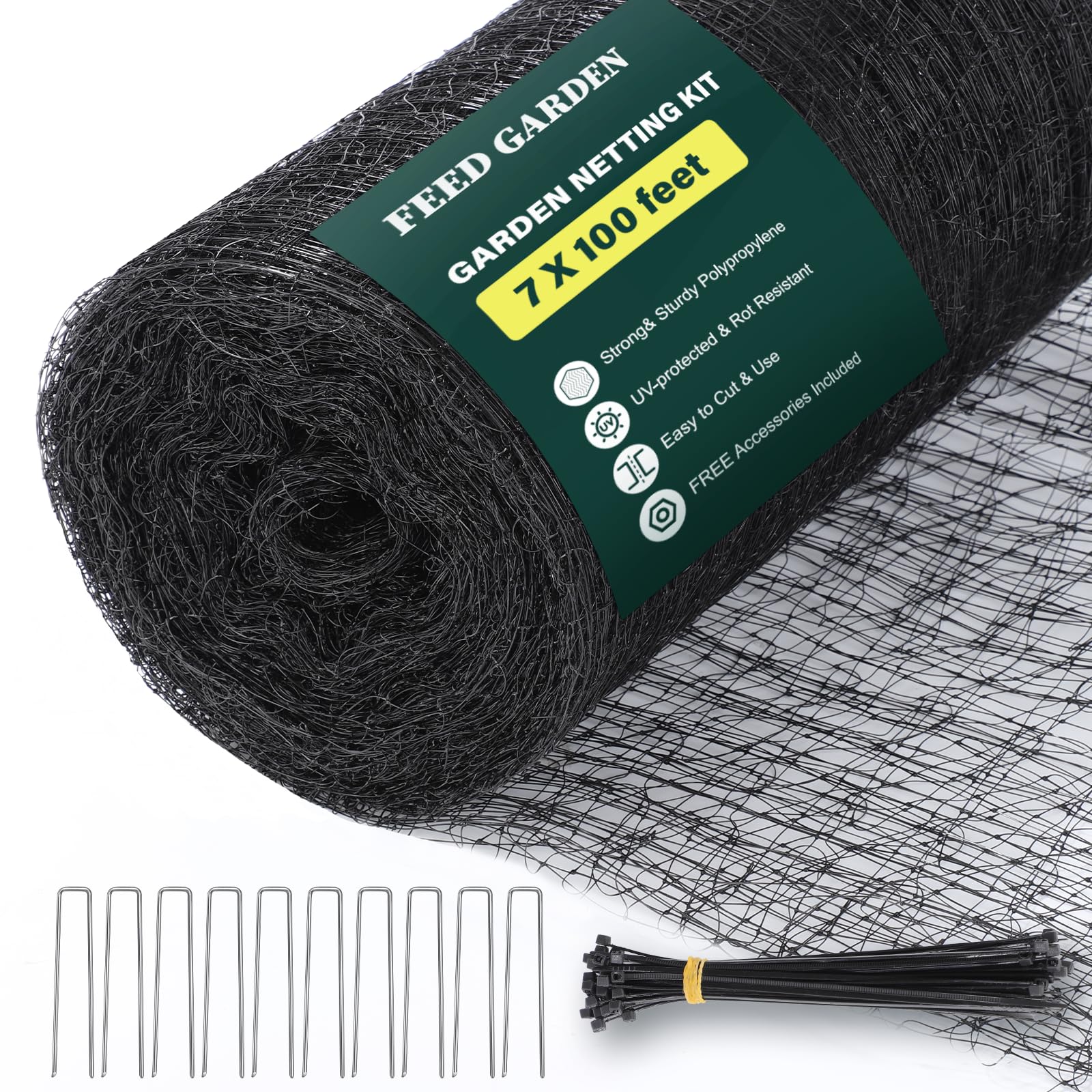
FEED GARDEN is aimed at the garden where birds are only part of the problem. The 7-by-100-foot roll has a 3/4-inch mesh, and the kit includes 10 metal landscape staples and 50 zip ties. The netting is UV-protected polypropylene, and the pitch is a complete barrier for deer, rabbits, birds, and small pests. We treat the deer claim as a useful extra rather than a guarantee: a light net can discourage deer, but it will not stop one that leans in.

The mesh is the same all-round size we like for birds, and the black color disappears against most garden shadows. The included staples are the practical difference: you can pin the bottom edge instead of piling rocks on it, which matters if you are covering a raised bed or a row of greens. The roll is light enough to carry and cut, and the zip ties are handy for tying the top edge to a fence or trellis.

What keeps this out of the top spot is the material feel. This is a light barrier, not the armored option. Set it up with that in mind and it earns its place for birds and rabbits. The mesh is fine enough to protect a blueberry row without blocking your view of the fruit.

Bottom line: We like FEED GARDEN for a bird-first garden that also sees rabbits and deer; it is the most complete kit here for that mix.

6

POYEE Garden Netting

POYEE Garden Netting

Lightweight bed coverage

Our Score 8.8/10
Check Price

Worth Noting

  • Not for windy, exposed sites
Mesh
3/4 inch
Coverage
7.5x100FT
Material
HDPE
Read the full review

The POYEE roll is the one we reach for when the stakes and ties are already in the shed. It gives you 7.5 by 100 feet of 3/4-inch square mesh in high-density polyethylene, with no kit to sort through. The square openings are easier to spread than diamond netting, and the roll has a springy feel that makes it simple to pull across a bed and cut to length.

Our top pick is still the better first purchase because it includes the hardware, but POYEE makes sense if you are adding a second row or replacing a worn panel and already have a stash of ties. The HDPE material is a step up from the thinnest polypropylene rolls, and the mesh is fine enough for birds without turning the garden into a solid tent. We treat the 7.5-foot figure as a starting point, not a promise: it can pull narrower once it is under tension, so measure with the net stretched.

The mesh is light and easy to work around a row, and the 100-foot length gives you room to overlap panels or replace a section. For a protected vegetable bed or a blueberry row, the combination of square mesh, generous length, and low weight is easy to work with. Just keep the tension even and inspect the edges after a storm.

Bottom line: POYEE is the roll we suggest for gardeners who already own stakes and ties and want a large, easy-to-spread HDPE roll.

7

Feitore Deer Fence Netting

Feitore Deer Fence Netting

Budget large rolls

Our Score 8.6/10
Check Price

Worth Noting

  • Tears at sharp stakes or rough edges
Mesh
3/4 inch
Coverage
7 feet x 100 feet
Included
10 installation nails, 50 cable ties
Material
Polypropylene
Read the full review

The Feitore is the bulk roll you buy when the job is bigger than the budget. You get 7 feet by 100 feet, a 3/4-inch mesh, 10 installation nails, and 50 cable ties. On paper it is almost the same package as our top pick, and for a first garden fence or a row of blueberry bushes, that similarity is the point: it puts a lot of netting in your hands without asking you to commit to a premium material.

We rank it as the budget roll rather than the overall winner because the net is very thin. That thinness shows up as tangling when you unroll it, and it makes the net feel more like a drape than a barrier. But it also keeps the roll light and easy to drape, and the reinforced edge gives you a stronger line to staple or tie.

The 3/4-inch square mesh is a sensible all-round size for birds. It lets air and rain through, it is easy to see through at a distance, and it does not look like a solid fence. The reinforced edge is more useful than it sounds: that is the part you handle most when pulling the roll across a bed, and it gives the staples something to bite into without starting a run.

We do not expect this roll to double as a deer fence. A deer can lean into a light net and push it down, and the strands will not stop a determined animal. For birds, however, it does the job at a size that lets you cover several beds; plan on two people for the first unroll, and keep a pair of scissors handy for clean cuts.

Bottom line: Feitore is our budget choice for covering a lot of ground with one light roll.

8

UWIOFF Garden Netting

UWIOFF Garden Netting

Low-visibility garden netting

Our Score 8.6/10
Check Price

Worth Noting

  • Not a deer barrier
Mesh
3/4 inch
Coverage
7 ft x 100 ft
Material
Polypropylene
Read the full review

Green netting is a small thing that makes a big difference in a front-yard bed. The UWIOFF roll is 7 by 100 feet with 3/4-inch mesh, and the green strands sit against foliage more quietly than black. We like it for strawberries, blueberries, and a mixed flower border where the net needs to do its job without becoming the most visible thing in the garden.

The material is polypropylene, UV- and rot-resistant, and the roll is light enough to drape over low crops without pulling them down. The square mesh is easy to spread, and the 3/4-inch openings are the right all-round size for birds. It is a seasonal cover rather than a permanent structure, but it is easy to move and reuse.

What we noticed most is how quickly it disappears once it is up. At a distance the green mesh reads as part of the plants, which is exactly what we want for a bed near the house. It is also easy to cut, so you can make a panel for a small bed without unrolling the whole 100 feet.

The downside is durability. This is a very thin net, and it can tear under tension or where it rubs against a stake; we do not leave it loose on a windy site. For a seasonal bird cover in a sheltered garden, though, it is a good low-visibility choice, and the long roll gives you room to redo a panel if one fails.

Bottom line: The green UWIOFF mesh is our low-visibility choice for a sheltered garden where a light seasonal cover is enough.

How We Tested Garden Bird Netting

We built the shortlist by comparing mesh size, listed width and length, material weight, UV stabilization, and whether stakes or clips came in the box. Price mattered, but we ranked it as price per square foot and weighed that against build quality—a cheap net that tears in a season is no bargain.

Twelve nettings made the cut, and we used them through one full growing season in a working vegetable garden: over raised beds of greens, a blueberry row, two young fruit trees, and a deer-prone edge bed. Each net was unrolled and installed solo with a timer running, then secured with the included hardware or our own clips. We opened and resealed sections for weeding and picking, noting snags, tangles, and whether the mesh held its shape.

For bird protection, we checked gaps at the soil line, watched for sagging after rain, and noted whether birds could push through or get caught. On the deer-prone bed, we looked at whether the net stayed taut after a browse attempt and whether it tore at the top edge.

Every few weeks we measured actual coverage against the listed dimensions, checked for UV brittleness, seam separation, and stretching, and weighed each net dry and after a rain to see how it draped. A net stayed in contention only if it survived the season without patches and still fit a standard bed with enough overhang to peg down. Value came down to whether it could go up again next spring, not just what it cost on day one.

How to Choose the Right Bird Netting for Garden

Choose the Shape Around the Plant

Rolls and drawstring bags solve different problems. A roll is right for a row, a raised bed, or a fruit tree you can wrap; a bag is right for a blueberry bush or a pot you want to cover and uncover quickly. Mesh size matters next: 3/4-inch netting is the all-round bird barrier here, while 5/8-inch closes the gaps a little more. Insect-fine mesh catches smaller pests but also keeps pollinators out, so use it after flowering rather than during bloom.

Measure the Net Under Tension

Labels give you the unrolled length and width, not the coverage you get once the net is draped over plants. A 7-foot width has to span the top and fall down both sides, so a 4-foot-wide bed can eat most of it. Some rolls also pull narrower than the listed width. Measure the bed, add the drop on both sides, and round up; if the number is close, buy the wider roll or plan to overlap two panels.

Tension Matters for Birds, Too

A loose net is not just untidy; it is the condition where birds and small animals get caught. Pull the net taut enough that it does not billow, pin the bottom edge, and check it after wind. A wildlife-friendly claim on a package is not a guarantee, so inspect the net every few days during fruiting season. If a bird does get caught, free it promptly and tighten the slack before leaving the garden.

Pick a Material and Kit You Will Maintain

Polypropylene and HDPE are the usual choices. HDPE tends to be the more weather-resistant material in this group, while light polypropylene is easier to drape and cheaper to replace. UV protection matters if the net stays up through summer, and a reinforced edge helps where you staple or tie. Check what comes in the box: 10 staples will start a 100-foot roll but not pin the whole perimeter, so budget for extra ties or stakes.

Frequently Asked Questions

Final Verdict

For a mixed garden, the KLEWEE 7.5 x 100 roll is the straightforward buy: it covers a real bed, the 3/4-inch square mesh is easy to work with, and the staples and ties are in the box. We prefer it as the default because it removes the two practical stalls: not enough net and no way to secure it.

If your planting is measured in rows rather than beds, the RIFNY 28 x 30 panel is the better tool, and the drawstring Evoio covers make more sense for a handful of blueberry bushes. Start with the shape of the job, and the choice gets simple.