Planters & Plant Supports

Best Ceramic Plant Pots of 2026

A ceramic pot is the rare home purchase that has to look good and keep something alive. The prettiest ones are often the heaviest, some glazed beauties turn out to have no drainage hole at all, and a chip on the rim is forever. What you actually want is a pot heavy enough to hold a leaning fiddle leaf upright, thick enough not to crack when you drag it across the floor, and honest about where the water goes.

I've repotted everything from a rootbound pothos to a five-foot monstera over the better part of five months, while my team and I worked through 14 ceramic pots in every glaze and finish we could get our hands on. Here's what first-time buyers rarely check: pot sizes are listed by diameter across the top, not by volume, so the plant you're moving usually wants a pot about two inches wider than its current one, and no more. The picks below are the ones still holding plants, and holding up.

1

Tuscan Ceramic Planter, Vintage

Top Pick
Tuscan Ceramic Planter, Vintage

Decorative single pots

Our Score 9.8/10
Check Price

Worth Noting

  • No saucer included
  • Unglazed patches along the rim
Set
1 pot, no saucer
Finish
Distressed crackle glaze
Drainage
Bottom hole
Pot Size
6.1 in diameter x 5.7 in high
Read the full review

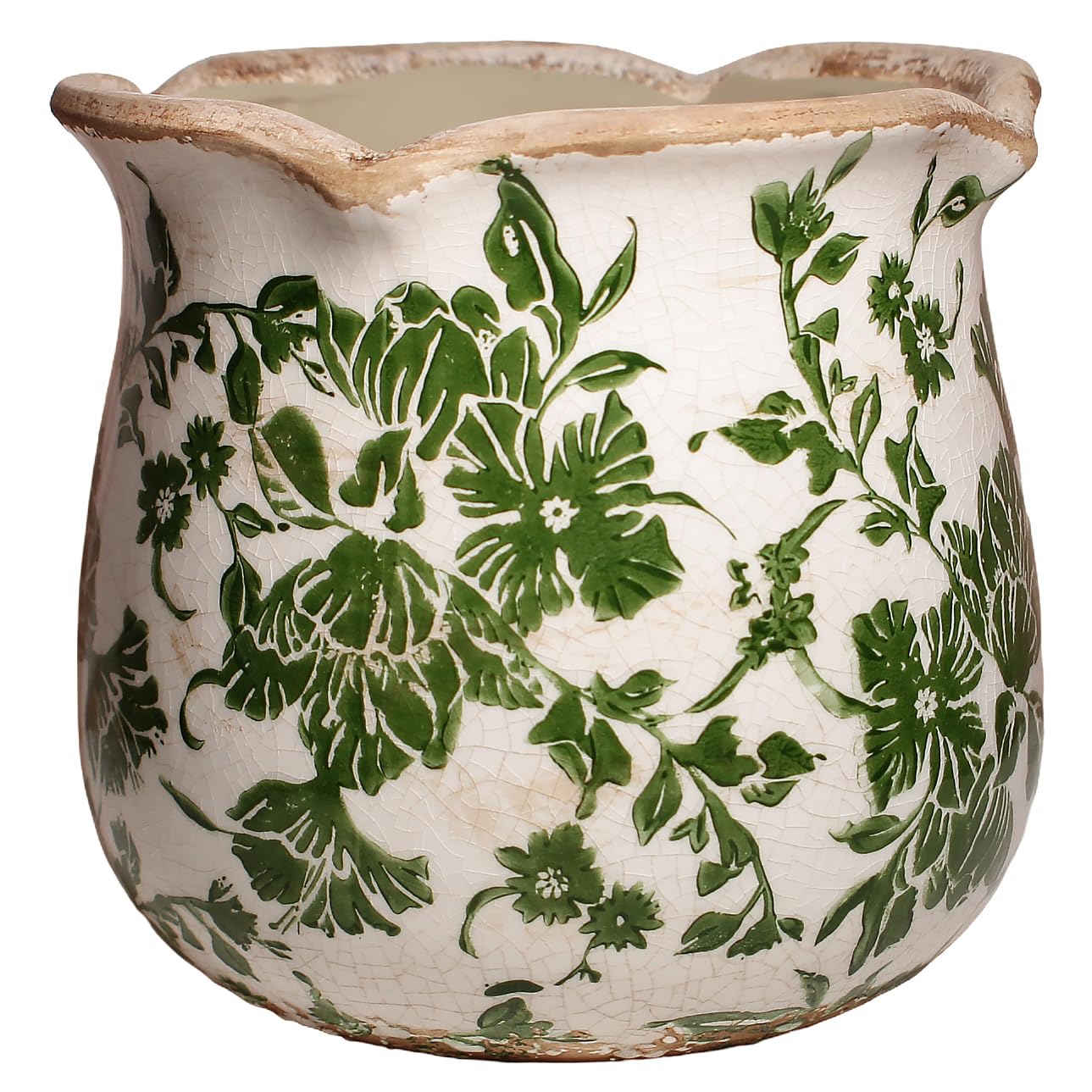
There's no saucer in the box, and that's the first thing to know: this is a decorative pot with a drainage hole, made to be seen rather than to sit on a polished table unaided. Just over 6 inches across and 5.7 inches tall, it's a dense, heavy little pot that won't shift on a porch step, with a distressed crackle glaze and a scalloped rim that read older than the pot is.

Put a herb or a small flowering plant in it on a covered porch, or set it on a saucer you already own indoors. The hand-finishing is uneven by design and uneven in practice — the top rim can carry unglazed patches, which looks like character on a vintage pot and like a flaw if you expected a clean edge. Keep the planting low enough that the scalloped rim still shows; that rim is why we kept this one in the guide.

Bottom line: A heavy, vintage-looking pot for a porch or a bare shelf, best bought knowing the saucer is on you.

2

sietpoek 5.5-Inch Ceramic Pots, Set of 4

sietpoek 5.5-Inch Ceramic Pots, Set of 4

Everyday houseplant sets

Our Score 9.6/10
Check Price

Worth Noting

  • 5.5-inch pots leave no room for a large houseplant
  • Hand wash recommended
Set
4 pots with attached saucers
Drainage
Bottom hole with mesh filter
Material
Glazed kaolin ceramic
Pot Size
5.5 in diameter x 4.7 in high
Read the full review

Four pots arrive in one box, and they aren't identical: the set mixes a few subtle surface patterns rather than repeating one glaze four times. That surprised us in a good way. A matched quartet of white cylinders can read as office supplies, and the variation keeps a row of them on a shelf from looking like storage bins.

What makes this our default pick is the package rather than any single specification. Four 5.5-inch glazed pots, each with a drainage hole, a mesh filter over it and a saucer molded into the base — nothing separates in the cupboard, nothing goes missing, and you can pot up four small houseplants the day the box lands. The molded saucer has one quirk: you empty it by tipping the pot rather than lifting a dish, which takes a second over a sink.

At 5.5 inches across and 4.7 inches deep, these are for compact plants — a small snake plant, a pothos cutting ready for soil, herbs on a kitchen sill. A 4-inch nursery pot drops in with room to spare; a 5-inch one fills the pot. If you're repotting a monstera or a fiddle-leaf fig, this isn't the set, and the D'vine Dev below is the one sized for that job.

The glaze takes a damp cloth and gives up the soil in one pass, which matters more than it sounds: a set you'll reuse between plants gets cleaned far more often than it gets admired.

Bottom line: Four glazed pots with drainage, mesh filters and attached saucers, at a set price that undercuts the singles here — this is the set we point most houseplant owners to first.

3

D'vine Dev 6.5-Inch Ceramic Planter

D'vine Dev 6.5-Inch Ceramic Planter

Statement single pots

Our Score 9.6/10
Check Price

Worth Noting

  • Shallow saucer holds little overflow
  • One pot per box at the top of the price range
Included
Saucer, mesh screen, felt pad
Material
Glazed ceramic
Pot Size
6.5 in diameter x 6.6 in high
Soil Capacity
0.5 gallons (2 qt)
Read the full review

This is the most expensive single pot here, and we think it earns that in one specific role: the plant that sits by itself, in the room where people actually look at it. The 6.5-inch cylinder arrives with a matching ceramic saucer, a stainless mesh disc for the drainage hole and a felt pad for the underside — three things you'd otherwise buy separately and then forget to use.

The wall is thick and the pot is genuinely heavy in the hand, so it stays where you put it even with a lopsided plant leaning out of it. It holds about half a gallon of potting soil, more room than the 6.5-inch diameter suggests, and the sides run nearly straight, which makes sliding a root-bound plant out again less of a wrestling match than a rounded pot does.

The saucer is shallow, so it holds less overflow than a deep dish; water a thirsty plant in two passes rather than one long pour. The felt pad is the detail that turned out to matter most to us — a pot this heavy dragged across a sideboard leaves a mark, and the pad is why it doesn't.

Bottom line: Buy it for the one plant you want on display: thick walls, a precise saucer and a felt pad make a single pot feel like furniture rather than equipment.

4

Selamica 5.6-Inch Ceramic Pots, Set of 4

Selamica 5.6-Inch Ceramic Pots, Set of 4

Colorful windowsill sets

Our Score 9.6/10
Check Price

Worth Noting

  • Most expensive multi-pack in this group
  • Saucer color can differ from the pot
Set
4 pots in assorted colors
Included
Separate saucers and mesh pads
Material
Porcelain
Pot Size
5.6 in diameter x 4.5 in high
Read the full review

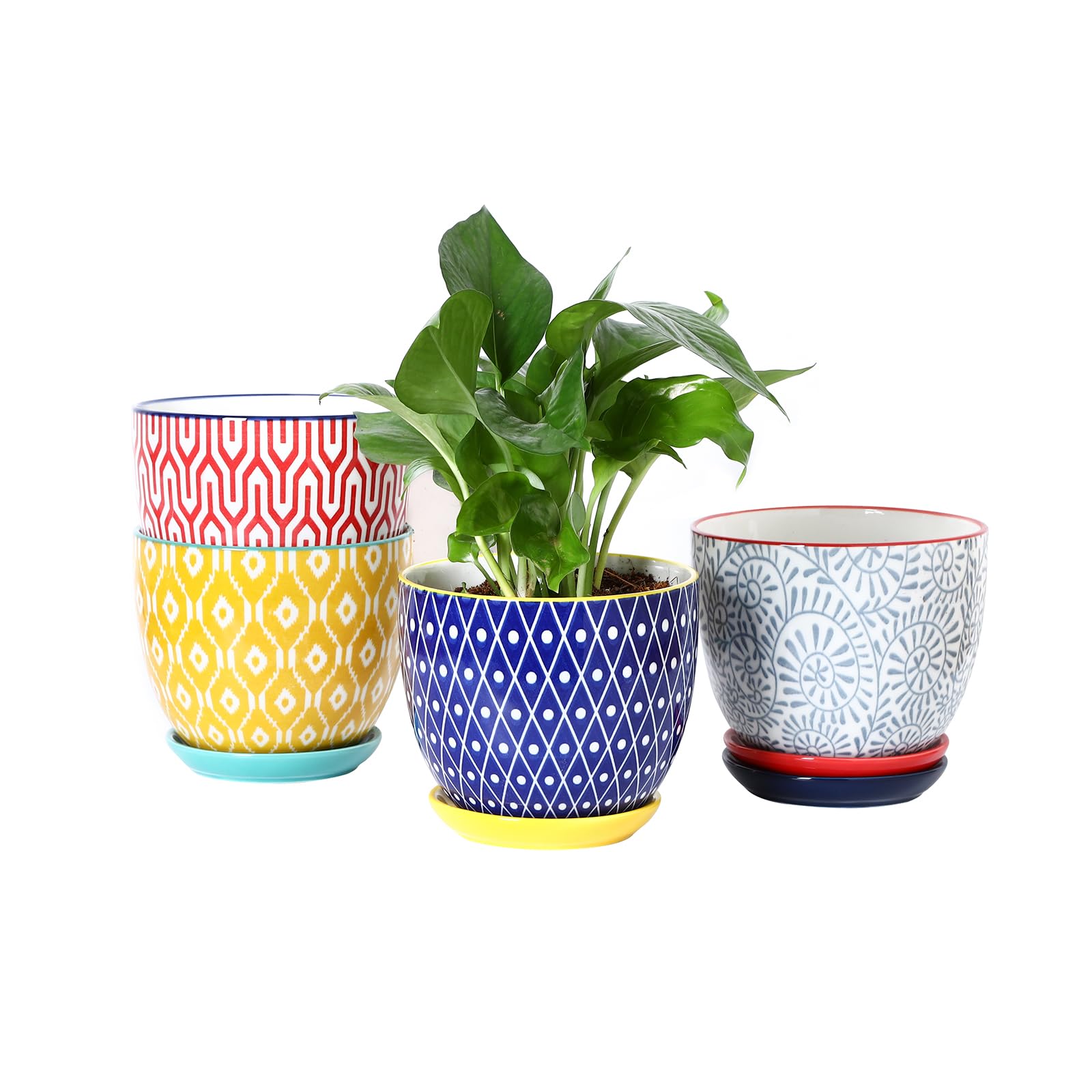
Four pots in four colors is a decorating decision as much as a gardening one. This is the set for someone who wants an open shelf to look arranged rather than uniform: each 5.6-inch planter is porcelain, glazed and high-fired, with a separate saucer and a mesh pad for the drainage hole.

At 5.6 inches across and 4.5 inches tall including the saucer, they suit African violets, small orchids and the kind of plant that arrived in a 4-inch nursery pot. The rim flares slightly, which makes planting less fiddly than a straight cylinder, and the separate saucers let you see and empty the overflow instead of guessing at it.

One thing to know before you order: the trays aren't always dyed to match the pot exactly. A bright royal blue pot can come with a navy saucer, and sitting side by side on a shelf, that shows. Treat the set as four related colors rather than four matching pairs.

This is the priciest multi-pack here, and what you're paying for is color and porcelain rather than capacity. If you want four pots that look deliberate on an open shelf, or a set that arrives gift-ready, we think it earns the difference. If you're potting up an ordinary windowsill, the white sets cost less and hold just as much soil.

Bottom line: The set to buy when the shelf is part of the decor: four porcelain planters in colors strong enough to plan a room around.

5

Orceler 6-Inch Terracotta Pots, Set of 4

Orceler 6-Inch Terracotta Pots, Set of 4

Succulents and cacti

Our Score 9.4/10
Check Price

Worth Noting

  • Thin walls chip when knocked
  • Unglazed clay shows water marks and salt bloom
Set
4 pots with saucers
Drainage
Bottom hole in each pot
Material
Unglazed terracotta
Pot Size
6 in diameter x 5.3 in high
Read the full review

Unglazed clay is a different tool, not a cheaper version of the same one. Water moves through the porous walls and evaporates, so the root ball dries faster and stays airier between waterings. That's the wrong home for a fern in a bright window and exactly right for a hoya, a snake plant, or anything that sulks when it sits wet.

You get four 6-inch pots, about 5.3 inches tall, each with a drainage hole and a saucer. Six inches across is a useful size: a 5-inch nursery pot settles in without a moat of fresh soil around it, and the wide mouth leaves room for both hands when you repot.

The wall thickness is what we noticed first — these are lighter than the glazed pots here, and thin clay chips when it meets a patio step. Packing is the weak point with any clay pot, so open the box over something soft and check the rims before you plant rather than after.

For succulents, cuttings and kitchen herbs, this is the set we reach for ahead of anything glazed: four plantable pots, breathable walls, and a look that belongs on a potting bench. If what you want is a spotless white pot on a living room shelf, glazed does that job better.

Bottom line: If your plants prefer to dry out between waterings, these breathable clay pots are the better home — thin walls and all.

6

Gepege 6-Inch Ceramic Pots, Set of 2

Gepege 6-Inch Ceramic Pots, Set of 2

Budget medium pots

Our Score 9.4/10
Check Price

Worth Noting

  • Cream White reads tan-grey in daylight
  • Pattern varies slightly between the two pots
Set
2 pots with removable trays
Drainage
Large hole with mesh pads
Material
Glazed ceramic
Pot Size
5.9 in top diameter x 5.15 in high
Read the full review

Cream White is the name on the listing, and in daylight these read as warm grey-beige — closer to a stoneware mug than to white. That difference is visible next to white trim or a bright white windowsill, so know it before you order. What we like is the tray: it seats two ways, tucked under the pot or slightly proud of it, so the planter can look a little more decorative when you want it to.

Each pot is 5.9 inches across the top and about 5.15 inches tall, which is the range of a 5-inch nursery pot. The drainage hole is large enough that the mesh pad genuinely matters, and one comes with each pot.

Two six-inch glazed pots with trays and strainers, at the bottom of this group's price range, is a sensible place to start a first shelf of houseplants. The finish is the real decision here, not the specification. And two is the right number if you're repotting a pair and don't want three more sitting empty in a cupboard.

Bottom line: Two six-inch glazed pots with trays and mesh pads at the bottom of this group's price range — as long as tan-grey counts as white in your room.

7

Ton Sin Grey Ceramic Pots, Set of 3

Ton Sin Grey Ceramic Pots, Set of 3

Graduated windowsill trio

Our Score 9.2/10
Check Price

Worth Noting

  • Attached saucer keeps the base close to standing water
Set
3 pots with saucers
Finish
Embossed two-tone glaze
Drainage
Bottom hole in each pot
Pot Sizes
6.7, 5.5 and 4.2 in diameter
Read the full review

Three planters in three sizes is a different proposition from four of the same. The 6.7-inch, 5.5-inch and 4.2-inch pots can sit together on one windowsill as a composed group, or you can start a cutting in the smallest and move it up twice as it grows. That graduation is why we kept this set in the guide instead of another quartet.

The finish does the personality: an embossed texture under a two-tone grey-blue glaze that reads bluer in good light. The saucers come attached, which keeps pot and tray together for good, but it also leaves the base closer to standing water than a lift-off dish does — fine for a plant you water sparingly, less so for one that drinks heavily.

Open the box over something soft and check the middle pot first; it's the one most likely to take a hit in transit, and a set is only as good as its three intact pieces. What you're buying here is the composition — three sizes that look chosen together — at the bottom of this group's price range.

Bottom line: Three graduated planters that look chosen together make this the natural pick for a windowsill grouping, provided you water lightly enough for attached saucers.

8

LamDawn Succulent Pots, Set of 5

LamDawn Succulent Pots, Set of 5

Tiny succulents

Our Score 9.2/10
Check Price

Worth Noting

  • Too shallow for anything but small succulents
Set
5 pots with wooden bases
Drainage
Large bottom hole
Material
Glazed ceramic
Pot Size
4 in diameter x 2 in high
Read the full review

Four inches across and two inches deep is the whole story. These are shallow, wide little bowls for plants that don't need root depth — succulents, lithops, cuttings you're rooting on a windowsill. Five come in the box, each in a different crackle glaze, each sitting on a small wooden disc that lifts it clear of the surface.

The wooden disc is decoration, not a saucer: it won't hold water, so on a wooden shelf you still need something underneath. What we like is the drainage — the holes are big and each pot gets a screen — and getting five in one box instead of buying singles. Count the pieces when it arrives; the bases are the part that goes missing.

Bottom line: Five shallow, bright pots for succulent collections and cuttings — just don't expect the wooden bases to do a saucer's job.

How We Tested 14 Ceramic Plant Pots

We started with every ceramic pot we could find from brands we already trust and the ones that kept surfacing in customer reviews, then narrowed with three practical filters: was it genuinely fired clay rather than resin dressed up to look like stone, did it have a drainage hole (or clay soft enough to drill without shattering), and did a saucer come in the box or cost extra. That left 14 pots, ranging from a four-inch terracotta to a 12-inch glazed floor planter.

Testing ran five months, and the pots lived where pots live: on windowsills, on a steamy bathroom shelf beside the shower, and in a dry corner near a radiator. We measured wall thickness with calipers at the rim and the base, filled each one with wet soil and a plant, and carried it around by the rim to see whether the walls flexed or felt solid enough for a top-heavy monstera. We also knocked each pot against a doorframe at shin height, the same accidental hit a vacuum delivers, and noted which ones chipped, which crazed, and which shrugged it off. Anything that arrived cracked or chipped in the box got flagged immediately.

Drainage got timed rather than eyeballed: we poured two cups of water into each pot, counted how long it took to stop running out the bottom, and checked whether the saucer overflowed on a full watering. We weighed every pot empty and full, measured the actual interior diameter against the size on the label, and compared what came included at each size, since a saucer or drainage screen in the box changes the value considerably. Glaze and color were judged in daylight and under a grow light, and we watched for water rings and mineral bloom over the weeks. The unglazed pots that developed a chalky patina earned some affection; the glazed ones that stained did not.

How to Choose Ceramic Plant Pots

Drainage and the saucer decide most of it

Every pot worth buying here has a hole in the bottom; what separates them is what sits under it. A separate saucer lets you lift the pot, see how much water actually came through and tip it out, which is the easiest arrangement to live with if you water generously. A molded or attached saucer keeps pot and dish together and looks tidier on a shelf, but you empty it by tilting the whole pot.

The hole matters too. A wide drainage hole without a mesh pad washes soil straight into the tray, which is why most of these sets include one. Whichever design you choose, water until it runs through and empty the tray within the hour; that habit prevents more root rot than any pot design does.

Glazed ceramic or unglazed terracotta

Glazed pots hold moisture and unglazed clay breathes, and that single difference should drive the choice more than color does. Ferns, calatheas and anything that resents drying out are happier in a glazed planter that keeps the root ball evenly damp. Succulents, hoya, snake plants and kitchen herbs do better in terracotta, where water escapes through the walls and the roots get air.

We care about this more than we care about looks, because the wrong pairing turns an easy plant into a daily negotiation. Match the pot to your watering habits and you'll water less and lose fewer plants.

Size the pot to the nursery pot, not to the plant's future

Measure the plastic pot the plant came in. A 4-inch nursery pot wants a planter around 5 to 5.5 inches across; a 5-inch nursery pot wants roughly 6 inches. Going much larger leaves a collar of wet soil around the root ball that dries slowly and can rot roots, and it makes the plant look lost besides.

Depth counts as much as width. A two-inch bowl suits a succulent or a cutting, while a five-inch-deep pot suits a plant with roots to stretch into. If you're caught between two sizes, this is one place to choose the smaller.

Walls, weight and what survives the mail

Thick walls cost more and do two jobs: they stop a top-heavy plant tipping the pot over, and they take a knock against a step without chipping. Thin terracotta is lighter and cheaper and marks more easily. If a pot is going on a high shelf or a windy balcony, weight is a feature worth paying for.

Ceramic travels badly. Unpack it the day it lands, check the rims and saucers, and keep the foam until you're sure — a chipped set is far easier to send back in its own packaging than in a box you've already recycled.

Color and finish rarely match the screen

Cream white reads tan or grey in ordinary daylight, a dark glaze shot under studio light comes out nearly black in a north-facing room, and a set's saucers aren't always dyed to match its pots. If color is why you're buying, look through buyer photos before ordering and expect a shade of difference either way.

Neutral white and grey are the safe choice for a shelf you'll add to over time. Strong colors are easier to love in a set of four than to match with a fifth pot bought a year later.

Frequently Asked Questions

Final Verdict

For most people the sietpoek set is the answer: four glazed 5.5-inch pots with drainage, mesh filters and attached saucers, at the price of a couple of singles. If the plant is a centerpiece rather than one of a row, buy the D'vine Dev 6.5-inch instead, where the heavier wall and fitted saucer are what you're paying for.

And if you're growing succulents, herbs or hoya, choose the terracotta Orceler four-pack. Breathable clay will do more for those roots than any glaze, even with walls thin enough to chip.