Greenhouses & Hydroponics

Best Hydroponic Water Pumps of 2026

A hydroponic pump is the gear you never think about until the water stops moving. When flow slows, roots sit in stale water and the system starts to smell like a pond you'd rather not explain. I've grown lettuce in a kitchen bucket and tomatoes on a balcony tower, and over the past four months my team and I ran 14 submersible pumps through small reservoirs, seed trays, and taller towers. Two pumps can look identical online and still differ in noise, power, and fitting compatibility.

Gallon-per-hour ratings are only half the story; what matters is how much flow survives a lift to the top of your system and whether it holds up after weeks of continuous use. The models that earned a spot below stayed quiet at the reservoir, fit through a standard lid opening, and felt solid rather than toy-like. They came with useful hardware, adjustable output, and a price that made sense for their build—value here isn't cheap, it's not replacing a pump mid-grow. The picks ahead cover small trays, deep-water totes, and taller towers.

1

EcoPlus Eco 396

Top Pick
EcoPlus Eco 396

Continuous duty

Our Score 8.8/10
Check Price

Worth Noting

  • Larger body than the mini pumps
Max Lift
6.5 ft
Warranty
1 year
Flow Rate
396 GPH
Fittings Included
6
Read the full review

A safety certification and a one-year manufacturer's warranty are the two lines on the EcoPlus spec sheet we keep coming back to, because no other pump in this roundup states either. Everything here is a cheap submersible centrifugal pump, and the honest way to buy one is to assume it will eventually stop and then ask who stands behind it. On that question the Eco 396 wins by default.

The surprise is what it does not have: a flow dial. This is a fixed-flow pump, so the only way to slow it is a valve on the discharge side or a smaller outlet fitting, and it ships with six fittings to choose from. We did not miss the knob, because a ball valve a few inches downstream does the same job and holds its setting. But if you want to reach into the reservoir and turn the pump down, this is not that pump.

What the extra money buys beyond the paperwork is placement. The Eco 396 is rated for inline use as well as submersion, so it can sit on the floor beside the reservoir with its intake plumbed to the bottom, keeping its motor heat out of the nutrient solution and letting you open the filter without draining a thing. At 396 gallons per hour and 6.5 feet of lift it handles a two-tray recirculating system comfortably, and it is not a pond pump.

It is also the most expensive pump in this set, and we think that is the right place to spend. The component that runs twenty-four hours a day, unattended, in water, next to mains power, is exactly the one where a warranty and a certification are worth more than another hundred gallons an hour.

Bottom line: We recommend the Eco 396 for any system that runs unattended: it is the only pump here with a stated warranty and a safety listing, and it can be plumbed outside the reservoir.
2

VIVOSUN 550 GPH

VIVOSUN 550 GPH

Tall systems

Our Score 8.8/10
Check Price

Worth Noting

  • Service life is the weak point
Power
35W
Max Lift
8.2 ft
Flow Rate
550 GPH
Cord Length
6.5 ft
Read the full review

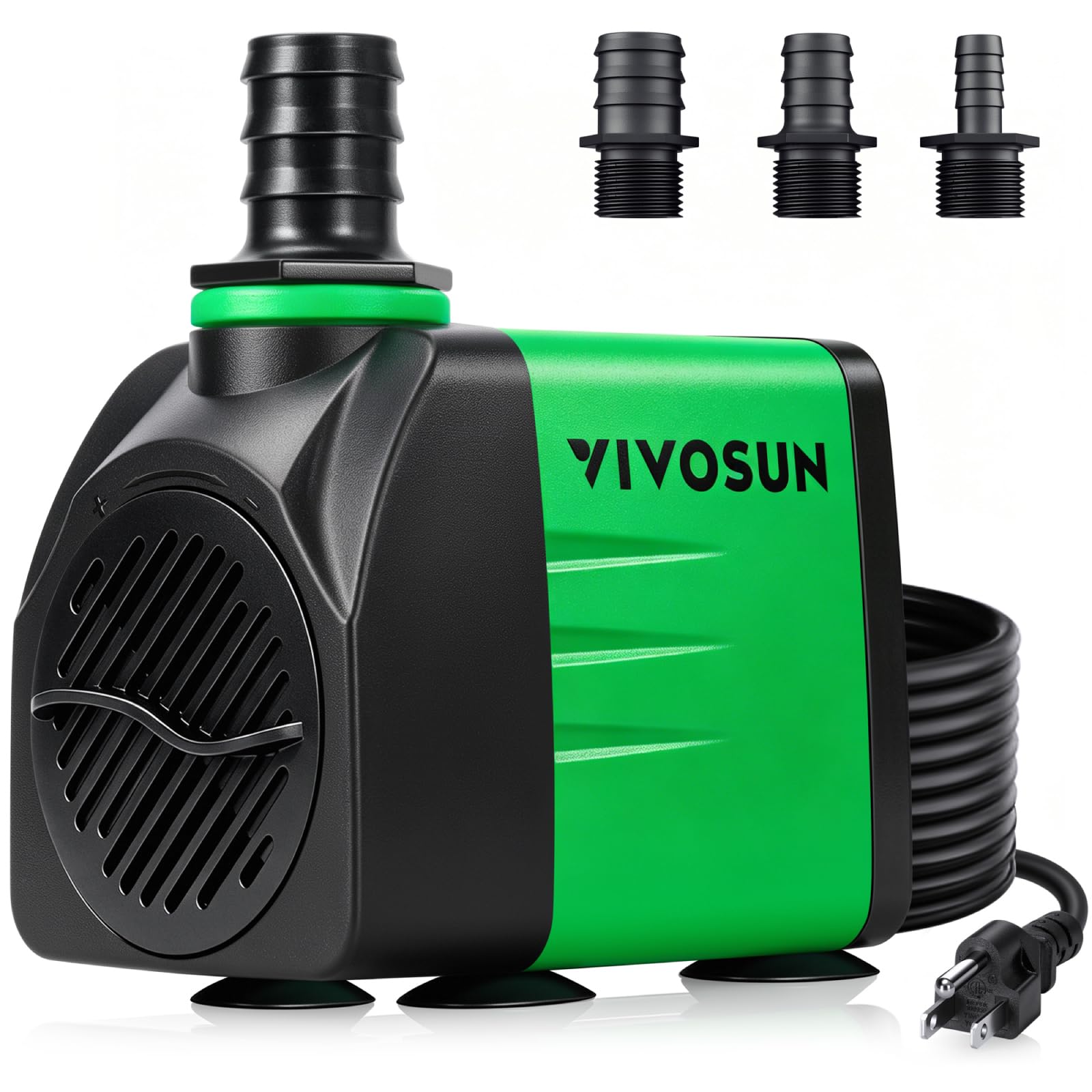
8.2 feet is the number that puts the VIVOSUN near the top of this group on lift, and it is the figure to buy it for. The 550 gallons per hour on the box is measured at zero head, and the listing says plainly that flow falls as the lift rises. Hang a riser on the outlet and you are working with a fraction of that rating, so read the two numbers together or not at all.

For a reservoir on the floor feeding a tray at chest height, this is the pump we reach for. It has the reach, the 35-watt motor keeps a steady stream at the top of a long climb, and the flow knob lets you back the torrent down once the riser is full. The body can be stuck to a vertical or angled surface with its base and rotated into position, so it fits in a tote where a flat-sitting pump needs a stand.

Maintenance is where cheap pumps are won and lost, and the VIVOSUN comes apart without tools into enough pieces to get at the impeller and the intake, which with nutrient solution is a job you will be doing every few weeks. The 6.5-foot cord is workable but not generous, so plan on an outlet near the reservoir rather than across the room.

Bottom line: Buy this one when your grow tray sits well above the reservoir; 8.2 feet of lift is the reason it earns a place here.

3

FREESEA 800 GPH

FREESEA 800 GPH

Large reservoirs

Our Score 8.8/10
Check Price

Worth Noting

  • Oversized for small reservoirs
  • Noise can rise as the pump ages
Power
45W
Max Lift
10 ft
Flow Rate
800 GPH
Dry-Run Protection
Yes
Read the full review

The FREESEA is the only pump in this roundup whose listing mentions dry-burn protection, and if you have ever let a reservoir drop below the intake you know why that matters. Most pumps in this class simply keep running in air until the heat does damage. This one is designed to shut down instead, which for a system you leave alone for days at a time is worth more than another hundred gallons an hour.

At 800 gallons per hour and 45 watts, it is a pond-scale pump. Ten feet of maximum lift means it can push water up to a gutter-mounted trough without complaint. The catch is those watts. A submersible pump puts nearly all of its draw into the water as heat, so a 45-watt unit is, in a real sense, a 45-watt heater in your reservoir. In a hundred-gallon tank that vanishes. In a five-gallon bucket it will warm the solution faster than you expect.

The side-suction body measures 4.1 by 2.6 by 3.5 inches and weighs about two pounds, heavy enough to sit still on the bottom and small enough to hide behind a tote wall or a rock. Three outlet nozzles at 1/2, 2/3 and 3/4 inch cover most garden hose and irrigation fittings, and the adjustable flow means a big pump can be backed down for a small feature.

We recommend it for the big end of the job: a large reservoir feeding several trays, a rain barrel, or an actual garden pond. The three-year service life in the listing is a marketing claim rather than a warranty, so buy it for the lift and the dry-run protection, not the promise. If your system tops out under four feet, it is far more pump than you need.

Bottom line: Our pick for a big reservoir or a pond: 800 GPH, ten feet of head and dry-run protection that nothing else here offers.

4

PULACO 400 GPH

PULACO 400 GPH

First systems

Our Score 8.4/10
Check Price

Worth Noting

  • Bigger body needs a roomier reservoir
Power
25W
Max Lift
6.5 ft
Flow Rate
400 GPH
Tubing Included
5 ft
Read the full review

The PULACO 400 arrives with five feet of silicone tubing, which sounds like a small thing until you have made a second trip for hose. It is soft tubing and it comes kinked from packing; the listing's own advice, stretching it out and leaving it on the floor for a few hours, works. Plan the plumbing around that first evening rather than the first ten minutes.

Four hundred gallons per hour and 6.5 feet of lift is the sweet spot for a hobby system, and this is the pump we suggest to someone setting up their first recirculating tray. A flow valve on the body lets you cut the output to a trickle for a small tray, and the whole thing comes apart by hand, which is the maintenance job that does most to keep a cheap pump alive.

The intake is the part that needs watching. At 400 GPH it will pull loose perlite and root fragments into the impeller, so set it where it is not sitting in the sludge at the bottom of the reservoir and clear the intake whenever the flow at the top of the riser weakens.

Bottom line: We hand this to first-time growers: 400 GPH, 6.5 feet of lift, a flow valve and tubing in the box at midrange money.

5

CWKJ 400 GPH

CWKJ 400 GPH

Tight spaces

Our Score 8.4/10
Check Price

Worth Noting

  • No tubing in the box
Power
25W
Nozzles
3
Max Lift
6.56 ft
Flow Rate
400 GPH
Read the full review

Put the CWKJ next to the PULACO 400 and the spec sheets look like twins: 400 gallons per hour, 25 watts, about 6.5 feet of lift, a flow knob, three nozzles and hand disassembly. The difference is the body. At 5.6 ounces and 2.3 by 2.8 by 3.2 inches, this one disappears into a reservoir that is really just a bucket with a net pot in the lid, and that is why we reach for it first in tight setups.

Adjustability is where it earns its keep. The knob backs the flow down to a trickle without changing fittings, and swapping nozzles changes the shape of the stream as well as the volume, which matters when you are feeding a drip line rather than a waterfall. The 6.5-foot cord gives you slack to put the outlet where you want it.

Noise is the thing to test in the first week. Across this whole set, the same model can be silent in one reservoir and irritating in the next, and a pump humming against a thin plastic tote wall will always sound worse than the same pump on a rubber mat. If it is going in a room you sit in, run it for a few days while you can still change your mind.

Bottom line: Choose the CWKJ when the reservoir is small and the space above it is tight; it matches the 400 GPH class in a much smaller body.

6

PULACO 160 GPH

PULACO 160 GPH

Single buckets

Our Score 8.4/10
Check Price

Worth Noting

  • Short 3.3 ft tubing limits placement
Power
10W
Max Lift
4 ft
Flow Rate
160 GPH
Tubing Included
3.3 ft
Read the full review

If your whole system is a five-gallon bucket under a light, the PULACO 160 is the sensible shape of pump: 160 gallons per hour from 10 watts, in a body 2.4 by 1.8 by 2.1 inches. It is small enough to sit under a net pot without eating root space, and ten watts barely registers as heat in a volume that a 35-watt pump would noticeably warm.

The number that matters is the lift: four feet from a pump this size. Most of the mini pumps that undercut it top out between one and three feet, which is fine for a tabletop fountain and useless the moment you put a riser on the outlet. Four feet covers a bucket on the floor feeding a tray on a bench, and that is a bigger jump in usefulness than the flow figures suggest.

We recommend it for single-bucket systems and small tray-and-reservoir pairs where the water does not have to climb more than a few feet. Above that, the PULACO 400 is the better spend; below it, you are paying for lift you will never use. The flow valve lets you slow it to a drip for a small net pot.

Bottom line: For a single bucket under a light, this is the pump we pick: ten watts, four feet of lift, and no wasted capacity.

7

DOMICA 90 GPH

DOMICA 90 GPH

Tabletop herbs

Our Score 8.4/10
Check Price

Worth Noting

  • Must stay fully submerged at all times
Power
5W
Nozzles
2
Max Lift
3 ft
Flow Rate
90 GPH
Read the full review

Three feet of maximum lift is the first thing to understand about the DOMICA 90 GPH, and for plenty of hydroponic setups it ends the conversation. Put a riser on the outlet and the flow falls away quickly; this pump is at its best moving water within a foot or two of where it sits. If your tray is on a shelf above the reservoir, look at the PULACO 160 instead.

The detail that decides whether it suits your container is the intake. It sits on the side of the body rather than the bottom, so as the level in a shallow tray drops, the pump starts pulling air while a bottom-intake pump would still be submerged. In a deep bucket that never runs low it makes no difference; in a three-inch basin it is the whole story. At 1.8 by 1.6 by 1.4 inches it hides almost anywhere.

For a tabletop herb setup, a single small bucket, or a water feature you want to hear rather than see, 90 gallons per hour and 5 watts is a cheap and pleasant way to keep things moving, and the two nozzles give you either a narrow jet or a wider spill. It is the one we suggest for a windowsill, where the water only has to travel a few inches and quiet matters more than volume.

Bottom line: We keep the DOMICA for tabletop herb trays and other jobs where the water moves inches, not feet.

How We Tested These Hydroponic Pumps

To build the shortlist, I read through spec sheets and owner reviews, compared each pump's claimed flow at realistic lift heights, and checked whether replacement impellers, suction cups, and fitting sizes were easy to find. I ruled out pumps that were too tall for a standard 5-gallon bucket lid, models with proprietary tubing connections, and anything that seemed priced above its parts. That left 14 submersible pumps, which we ran for four months in a kitchen bucket, a shelving-unit seed tray, and a balcony tower.

Every pump went into the same reservoir first, with a short length of tubing and a riser adjusted to push water about three feet up. We measured how long it took to fill a quart jar at that height, then checked whether the flow dropped or surged when we turned the adjustable valve. For noise, I stood about three feet away in a quiet room and listened for rattling against the bucket; later I set each pump on a folded towel to see if vibration was the culprit. For size, we noted whether it cleared the lid opening without forcing the cord and whether the suction cups held when the reservoir was bumped.

Build quality got a hands-on check: I squeezed the housing, tugged gently on the cord strain relief, and looked at how the impeller and seal went back together after cleaning. To test reliability, every pump ran continuously for a week, restarted after a power interruption, and kept going through a low-water top-off; we also cleaned them with diluted vinegar to see whether scale changed performance. Value came down to what came in the box and whether the pump still moved water like it did on day one. The ones that stayed quiet, kept their flow, and didn't crack or clog are the ones we recommend.

How to Choose Hydroponic Water Pumps

Lift Comes First, Flow Second

A pump rated at 550 gallons per hour is rated that way with the outlet level with the water surface. Raise the outlet and the pump is now lifting as well as moving water, and the flow drops with every foot. Measure the climb from the reservoir surface to the highest point the water has to reach, then add a foot for elbows, tees and long runs. A reservoir on the floor feeding a waist-high tray is about three feet; feeding a chest-high Dutch bucket is four to five.

The trap is trusting the headline figure. The PULACO 160's four feet of lift covers a bucket-to-bench run with barely anything left over, while the VIVOSUN's 8.2 feet covers a chest-high tray with flow to spare. A 550 GPH pump at six feet of head is not moving 550 gallons an hour, and no pump in this set is.

Watts End Up As Heat

Almost everything a submersible pump draws leaves it as heat in the water around it. In a fifty-gallon reservoir that disappears; in a five-gallon bucket, a 35 or 45 watt pump running all day will take the chill off and then keep going. Warmer water also holds less dissolved oxygen, which is the opposite of what the pump is there to do.

Match the watts to the volume: 5 to 10 watts for a bucket or a tabletop tray, around 25 for a tote-sized system, and 45 only when you have both the lift and the gallons to justify it.

Fittings, Tubing And What Ships In The Box

Check the discharge fitting before anything else. Pumps ship with nozzles from roughly 5/16 inch up to 3/4 inch, and the pump only helps if its outlet matches the tubing you already own, so measure the inside diameter of your hose and compare it to the smallest nozzle in the box. A pump with several fittings, like the EcoPlus with six, saves a hardware run.

The PULACO pumps include soft silicone tubing, which arrives kinked from packing and needs a few hours stretched out on the floor before it hangs straight. If you are buying for a system you have not built yet, choose the pump with the fittings and let the plumbing follow.

Cleaning Is A Maintenance Item, Not A Feature

Nutrient solution leaves a mineral film on everything it touches, and light plus nutrients grows algae, so the intake and impeller need clearing every few weeks in a working system. A pump that comes apart by hand gets cleaned; one that needs a screwdriver gets ignored until the flow drops at the top of the riser.

The VIVOSUN, the CWKJ and both PULACO pumps disassemble without tools. The other route is keeping the pump out of the water altogether: the EcoPlus is rated for inline use, so it can sit beside the reservoir with its intake plumbed to the bottom.

Buy For The Support, Not The Sticker

Continuous duty is hard on a cheap pump, and early failure runs through this whole category rather than being a quirk of one model. Since nothing here is immune, the sensible hedge is a stated warranty and a named safety certification, and only the EcoPlus has both.

What we do not recommend is buying the biggest number you can afford. An oversized pump throttled down to a trickle works harder than a small pump at full flow and does nothing extra for your plants.

Frequently Asked Questions

Final Verdict

The EcoPlus Eco 396 is the pump we point to first, and the reason is not the flow figure. It is the stated one-year warranty, the safety certification, and the fact that it can be plumbed outside the reservoir and serviced without draining anything. In a component that runs every hour of the year, that combination is worth more than another 150 gallons per hour.

If your riser climbs six feet or more, buy the VIVOSUN for the lift. If you are circulating a hundred gallons or more, the FREESEA's dry-run protection and ten feet of head decide it. And if your reservoir is a bucket, spend less: the PULACO 160 or the DOMICA will do the job that the big pumps only pretend to do quietly.