Greenhouses & Hydroponics

Best Hydroponic pH Control Kits of 2026

Your nutrients are mixed, your light is dialed in, and the leaves still look pale — because pH drifted a few tenths overnight and locked up the iron the plants needed. A pH control kit is the least glamorous purchase in hydroponics and the one that keeps everything else you bought from going to waste. The right one gives you three things: a reading you can trust, adjusters concentrated enough to move five gallons without half a bottle, and caps that survive a damp shelf in the tent.

I've mixed nutrients in a garage tent and a kitchen bucket for years, and the bottles matter as much as the meter — watery adjusters mean pouring a quart into a reservoir to shift one point, and cheap meters drift right when you stop watching. Over seven months, my team put 12 kits through weekly reservoir changes, noting how fast each one brought pH into range and how long it stayed there. The good ones are honest about concentration. The picks below are the ones that earned the shelf space.

1

General Hydroponics pH Control Kit

Top Pick
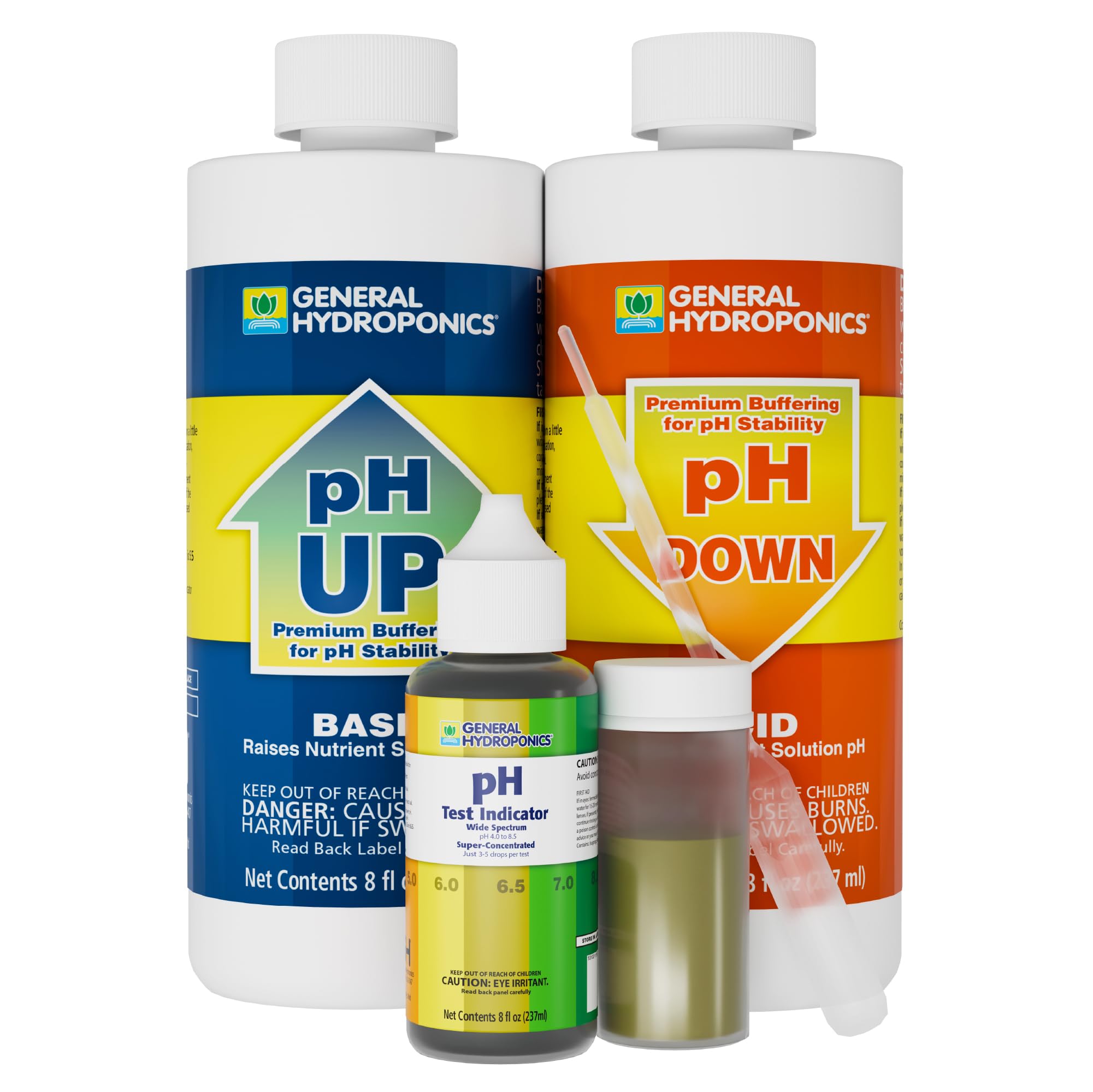
General Hydroponics pH Control Kit

First hydroponic kit

Our Score 9.4/10
Check Price

Worth Noting

  • Eyedropper is fiddly for small doses
Bottles
8 oz pH Up and 8 oz pH Down
Test Kit
1 oz indicator, test tube, eyedropper, color chart
Test Method
Drop indicator, color match
Read the full review

Everything needed to measure pH and then move it comes in one box: 8 ounces of pH Up, 8 ounces of pH Down, an ounce of test indicator, a test tube, an eyedropper and a color chart. That closed loop is why this is the kit we point a first-time reservoir owner toward. Several sets here sell you the adjusters and leave you to work out how you'll know where your water stands; this one answers that question before you open the second bottle.

We keep coming back to the drop test. Half a tube of nutrient solution, a few drops of indicator, and the color tells you what you're working with — no calibration solution, no batteries to discover are flat on a Sunday. It reads in shades rather than decimal points, which is the honest limit of any drop kit; if you're steering a crop toward a narrow target, a meter earns its place beside it. For two buckets or a small tray checked twice a week, matching a color is enough.

Concentration is the quieter advantage. A small pour moves a full reservoir, so the bottles stretch across a lot of nutrient changes rather than a few weeks of them, and the chart takes the guesswork out of which direction to go. Check the test tube the day the box lands: vials can arrive cracked, and a kit missing its tube leaves you improvising a container on the evening you actually need a reading.

Bottom line: We make this our default because the indicator, tube and chart let you measure as well as correct — one box covers a new reservoir from the first fill.
2

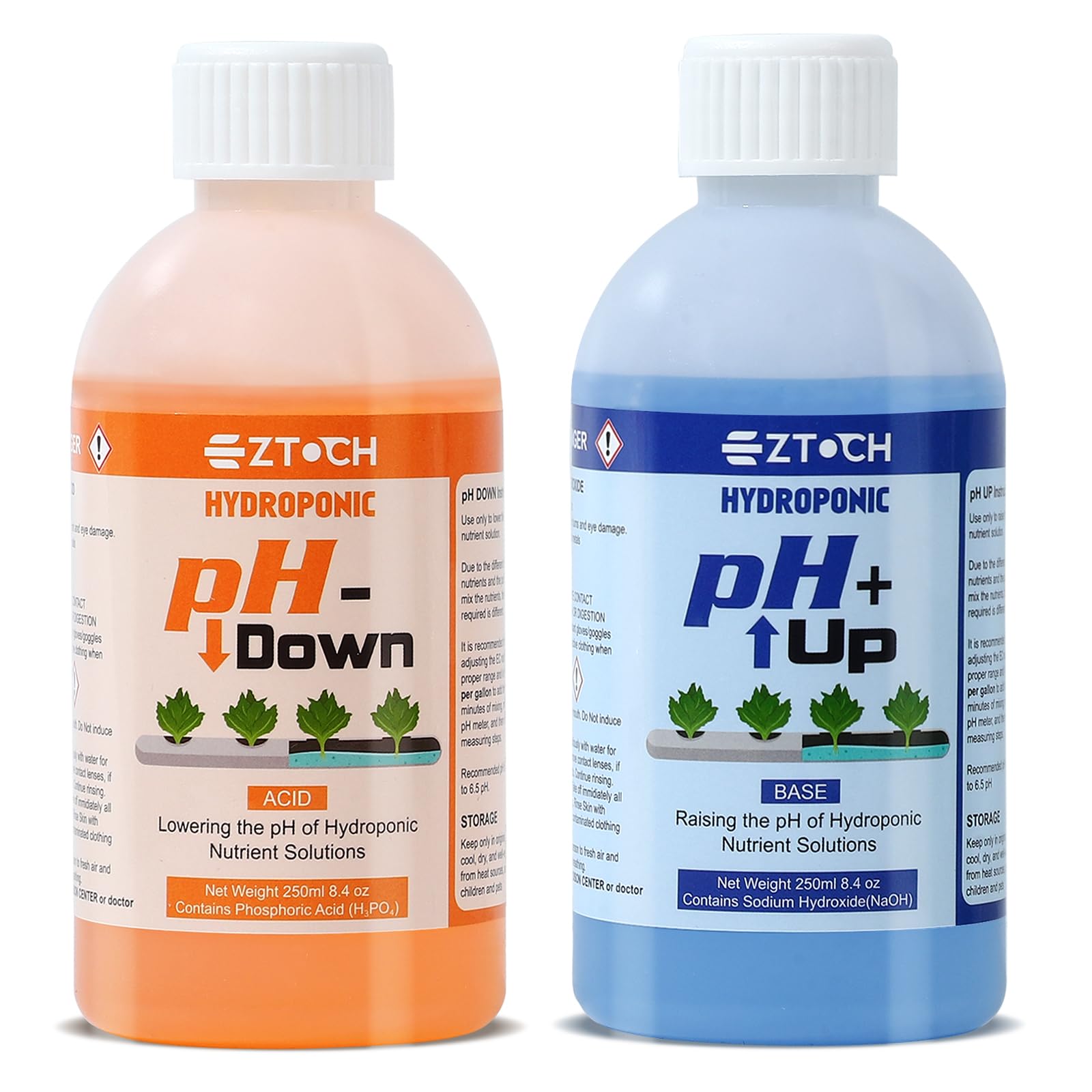
EZTOCH pH Up and Down

EZTOCH pH Up and Down

Small systems

Our Score 9.4/10
Check Price

Worth Noting

  • No test method in the stated kit
Bottles
250 ml pH Up and 250 ml pH Down
Bottle Type
HDPE with leak-resistant cap
Starting Dose
1 ml per gallon
Read the full review

HDPE bottles with leak-resistant caps, packed into a bundle measuring 5.8 by 2 by 4.5 inches and weighing about 1.4 pounds. That's compact and sturdy enough to live on a shelf beside the nutrients and to survive a trip out to a greenhouse, which is more than we can say for a glass vial in a cardboard box.

The figure that decides the value is the starting dose: 1 ml per gallon. At that rate a 250 ml bottle covers something like 250 gallons of solution, so a pair of these keeps a small system supplied for a very long time and the bottles stay on the shelf instead of running dry mid-change.

We noted that nothing in the listing promises a test method — no drops, strips or chart — so read this as the pair for someone whose pen is already calibrated. That's the shape of it: economical chemistry, sensible packaging, and the measuring left with you. Starting from zero, buy a box with indicator in it; already testing, this is the least fussy way to keep the shelf stocked.

Bottom line: A neat, economical pair for a grower who already reads pH — packaging that stores well and chemistry that lasts, with the measuring left to you.

3

Bloom City pH Up & Down Kit

Bloom City pH Up & Down Kit

Growers with a meter

Our Score 9.2/10
Check Price

Worth Noting

  • Caps can work loose and leak in transit
Use
Hydroponics, containers, soil feeding
Bottles
8 oz pH Up and 8 oz pH Down
Mixing Ratio
1-2 ml per gallon
Read the full review

Two 8-ounce bottles and nothing else — no indicator, no tube, no chart. Whether that's a shortfall depends entirely on what's already on your shelf: with a pH pen or a strip kit in the drawer, paying for a second testing method is money spent twice. We rate this as the set for growers who already measure.

What's inside the bottles is the part we think is genuinely good. A couple of milliliters per gallon moves a reservoir, the change happens quickly, and 16 ounces covers a lot of adjustments at that rate. The label's 1 to 2 ml per gallon is a starting point rather than a rule, since water that begins far from target takes more, so add, stir, wait a few minutes and read again before adding a second dose.

Whether these bottles feel concentrated or diluted comes down to your source water. Alkaline tap water with plenty of buffering capacity eats through a set; soft water barely touches it. That explains why the same bottle can feel weak in one garden and generous in the next — and why the first adjustment of a new reservoir is the one to watch closely.

Bottom line: Buy this one if you already own a pH pen: two strong, fast-acting bottles with no testing gear to pay for twice.

4

GIDIGI pH Control Kit

GIDIGI pH Control Kit

One-box beginners

Our Score 9.2/10
Check Price

Worth Noting

  • High listed dose empties bottles quickly
Dose Rate
15 ml per gallon
Kit Contents
250 ml Up, 250 ml Down, cup, dropper, test strips, chart
Target Range
5.5-6.5 pH
Read the full review

The dose printed on this kit is 15 ml per gallon, and that figure matters more than the price on the listing. Set it beside the 1 to 2 ml per gallon Bloom City asks for and the arithmetic turns: 250 ml at a tablespoon a gallon covers roughly sixteen gallons of nutrient solution, while an 8-ounce bottle at the smaller dose covers well over a hundred. A cheaper bottle isn't a cheaper kit if you empty it ten times faster.

What the money buys is the most complete beginner's box in this group: 250 ml of Up, 250 ml of Down, a measuring cup, a dropper, pH test strips and a color chart. Strips suit a first season — nothing to calibrate, nothing to break, and they read straight from the sample — though they resolve pH in wider steps than drops do. We appreciate that the same mix is pitched at soil containers as well as reservoirs, which helps if you're feeding pots from the same watering can.

Our reservation is about consumption, not quality. Run one bucket, change it weekly, and the 15 ml habit will have you through a bottle in roughly a month; the measuring cup and dropper make that easy to do, but they don't make it cheaper. Treat this as a starter kit you'll reorder, and it does its job.

Bottom line: The most complete starter box here and a good one for a first reservoir — just know that the label's dose empties the bottles faster than the price suggests.

5

Microbe Life pH Control Kit

Microbe Life pH Control Kit

Large reservoirs

Our Score 8.8/10
Check Price

Worth Noting

  • Highest price of the kits here
  • Up can need heavier doses than expected
Extras
4 oz nutrient sample
Bottles
16 oz pH Up and 16 oz pH Down
Formulation
Deionized water, two adjusters, three electrolytes
Read the full review

Sixteen-ounce bottles — the largest in this group — with a 4-ounce sample of the company's photosynthesis nutrient packed alongside. The formula is the real difference: deionized, UV-sterilized water carrying two pH adjusters and three electrolytes, built to hold a reservoir steady rather than just move the number once.

Buffering is the claim we care about. Moving pH is the easy part; keeping it moved through a week of top-offs and feeds is the tedious part of the hobby, and a mix built for osmotic balance is a sensible answer to it. How well any buffer holds depends on your water, your nutrient line and how warm the reservoir runs, so read the pH a day after adjusting rather than five minutes after.

The price is the other half of the decision. You're paying the most here for the largest bottles and the buffered formula, and on a big recirculating system with a feeding schedule that's a reasonable place to put the money. On two buckets, the sample bottle will be long gone before either adjuster is.

Bottom line: Worth the premium on a large recirculating system, where bigger bottles and a buffered formula can earn back the difference.

6

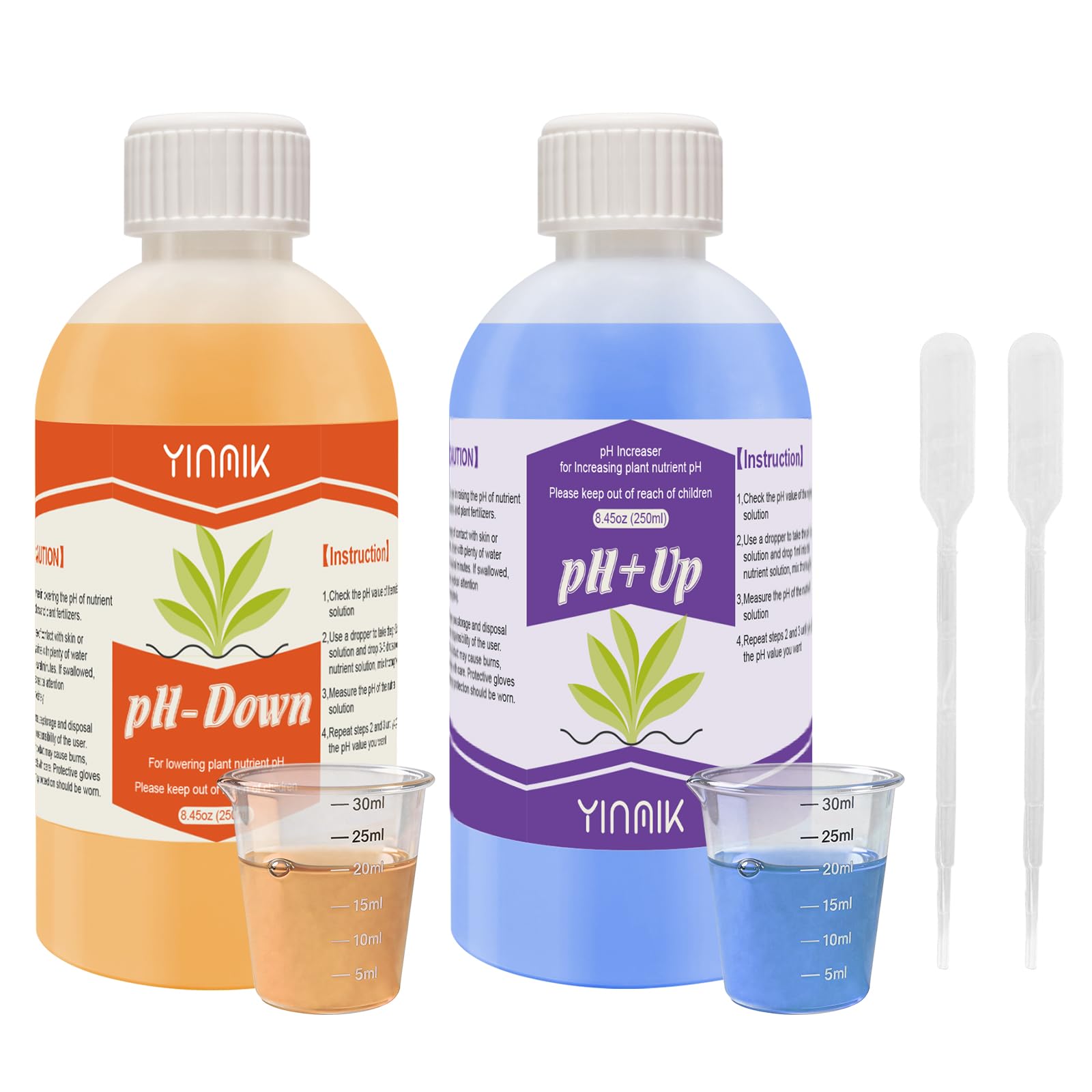
YINMIK pH Up Down Set

YINMIK pH Up Down Set

Tight budgets

Our Score 8.6/10
Check Price

Worth Noting

  • Adjustment can take more liquid than expected
Bottles
250 ml pH Up and 250 ml pH Down
Bottle Type
HDPE with double-layered cap
Target Range
5.5-6.8 pH
Read the full review

The lowest-priced pair of bottles in this group still buys 250 ml of pH Up and 250 ml of pH Down, and for a small system that's a fair trade: no chart, no tube, no box of extras, just the two liquids you dose with. We think that's the right shape of purchase for someone who already owns a meter and mainly needs to stop running out mid-flower.

The bottles are better specified than the price suggests — HDPE with a double-layered mouth and a cap designed not to leak in transit, which counts for something when the contents are caustic. The label targets a 5.5 to 6.8 band, and the formula is free of dyes and additives, so it won't stain a white reservoir or leave residue behind in a drip line.

What tempers the low price is how much liquid a stubborn reservoir can take. Water that starts well off target can swallow far more than a drops-per-gallon suggestion implies, and the bottle empties accordingly. A 1 ml syringe costs next to nothing and turns guesswork into a dose you can repeat, which is the upgrade this kit really wants.

Bottom line: Our value pick for growers who already test: two well-built bottles at the lowest price here, with no extras you don't need.

How We Tested 12 pH Control Kits in Real Reservoirs

We started with a list of roughly 30 complete kits — adjusters plus a way to read pH — and cut anything that shipped without calibration solution or a readable measurement scale on the bottle. Twelve made the cut, some meter-based, some drop-based, a couple with both.

Testing ran seven months across three systems: a 4x4 tent in a garage, a five-gallon DWC bucket by a kitchen window, and a recirculating setup topped off twice a week. Every Saturday we drained and refilled, dosed each kit down from 6.8 to 5.8, and noted how many milliliters it took — the clearest read on concentration and on what you're paying per gallon. We checked again at 24 and 48 hours to see whether pH held or crept back. Because our tap runs hard, we repeated the whole dose test with filtered water to see how much source water changed the answer.

We set each kit's drops or meter against a freshly calibrated reference meter, then rechecked the meters every few weeks to see how far they drifted. Ease of use came down to small things: a bottle that drips down the side, a cap that measures cleanly at 6 a.m., a dose that needs two hands. Bottles sat cap-down in a humid tent for a week to check for seepage, every meter took one drop from counter height onto concrete, and we noted which bottles actually emptied — in most kits the pH Down was gone long before the Up.

How to Choose Hydroponic pH Control Kits

Pick the testing method first

Any kit here will move your pH; only some of them tell you where it started. Indicator drops with a test tube and color chart give the finest read of the inexpensive options and cost almost nothing per test, which is why the General Hydroponics box is built around them. Test strips are quicker and resolve in wider steps, a fair trade for someone checking a single bucket.

If a kit ships with no testing gear at all, you're buying half a kit unless a calibrated meter is already on your shelf. Decide that before you look at bottle sizes.

Do the dose math, not the price math

Two sets at similar prices can differ tenfold in how far a bottle goes. GIDIGI lists 15 ml per gallon; Bloom City lists 1 to 2. Divide a bottle's volume by its listed dose and a 250 ml bottle covers roughly sixteen gallons, while an 8-ounce bottle at the smaller dose covers well over a hundred.

Judge a set by the gallons it treats rather than the ounces it ships, then check that figure against how much solution you actually mix in a month.

Expect drift, and correct in small steps

pH does not sit still. Nutrients, top-off water and the plants themselves pull it around, and a reading taken five minutes after dosing can look different the next morning. Add adjuster in small increments, stir, wait, and read again before adding more.

Overshooting into a big swing stresses roots more than a number slightly off target does. Two or three small corrections a week beat one dramatic rescue, and a written log tells you which direction your system keeps drifting.

Store and handle the bottles properly

These are concentrated acid and base solutions and deserve the same care as any other garden chemical: caps tight, bottles upright in a tray, out of reach of children and pets. Caps can work loose in transit, so check them on arrival and wipe down anything that leaked before you put the bottle away.

Keep the two bottles apart on the shelf and label them if the manufacturer's print is small. Dosing the wrong one costs you a reservoir and a mixing session.

Frequently Asked Questions

Final Verdict

The General Hydroponics kit earns the recommendation because it closes the loop: indicator, tube, chart and both adjusters in one box, so a new reservoir is covered from the first fill.

If a calibrated meter is already on your shelf, buy Bloom City instead — about the same money for fast, concentrated chemistry and no second testing kit to store. Running a large recirculating system, Microbe Life's bigger bottles and buffered mix are the upgrade worth paying for.