Greenhouses & Hydroponics

Best Seed Starter Kits with Grow Lights of 2026

Every February I do the same thing: sow a flat of tomatoes on the windowsill, then spend March watching them stretch into pale, spindly stalks. The problem isn't the seed — it's the light. A winter window delivers a fraction of what seedlings need, which is why kits that pair trays with their own grow light have become the smarter way to start a garden indoors. You're buying two things at once, a seed-starting system and a light fixture, and the good ones make both feel like a single piece of equipment.

First-time buyers fixate on tray count and miss what actually decides the outcome: whether the light can be raised as plants grow, and whether it's strong enough to keep seedlings stocky instead of tall and thin. Cheap kits skimp on both, and their trays flex and crack by the second season. I've started seeds on windowsills, under shop lights hung from chain, and in most plastic flats sold; this spring my team ran 14 kits side by side for four months, from first sowing through hardening off. The picks below earned their shelf space.

1

SOLIGT 60-Cell Seed Starter Kit

Top Pick
SOLIGT 60-Cell Seed Starter Kit

All-around starter

Our Score 9.0/10
Check Price

Worth Noting

  • Single 60-cell tray limits large sowings
Cells
60
Heat Mat
Included
Grow Light
11.5W full spectrum, 5 levels
Timer Settings
4, 8, 12, 18 hours
Read the full review

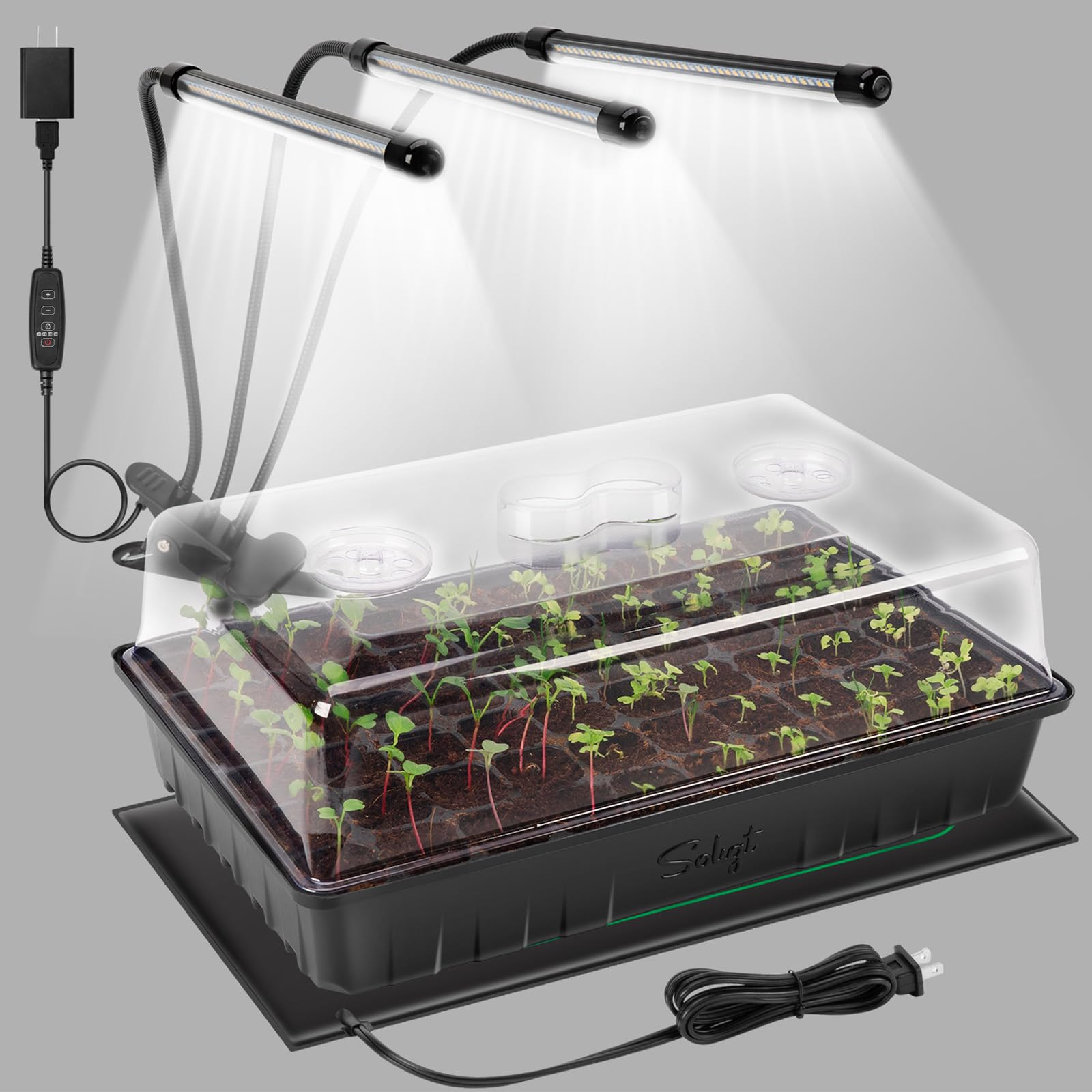
The SOLIGT kit is the one we recommend first because it covers the two jobs that make indoor seed starting fiddly: light and bottom heat. You get a single 60-cell tray, a 4.3-inch vented dome, an 11.5W full-spectrum light, and a waterproof heat mat in one setup. We like that the light and mat are separate pieces, so you can use the lamp after germination without keeping the mat running.

The light is more adjustable than most in this group. It has five brightness levels and four timer settings, which means you can start seeds under lower light and step up as they grow, then leave the schedule alone. The tall dome gives seedlings room beyond the rim, and the vents let you dial back humidity without lifting the lid. That matters when condensation starts running down the sides.

The 1.5-inch square cells are deep enough for tomatoes, peppers, and herbs for the first few weeks, and the drainage holes feed into the bottom tray. At roughly 16.7 by 10.7 inches, the kit fits a sturdy shelf or a spare table without spreading out. We think the complete package is worth the step up from the budget five-packs, especially if you want one reliable setup rather than a collection of small trays.

The heat mat is the part we handle with care. It can run warm, so check soil temperature before leaving it for the day, especially in an already warm room. That small habit is the difference between steady germination and cooking a tray of expensive seed.

Bottom line: For most indoor seed starters, this is the kit we point to first: 60 cells, a vented dome, a timer, and bottom heat in one setup.

2

AC Infinity Humidity Dome Kit

AC Infinity Humidity Dome Kit

Premium lighting

Our Score 9.0/10
Check Price

Worth Noting

  • Holds only 40 seedlings
Dome
3mm clear, extensions
Heat Mat
Adjustable dial
Grow Light
Samsung LM301H EVO bars
Seedling Capacity
Up to 40
Read the full review

The AC Infinity kit is the premium option in this group, and it looks the part before you plug it in. The dome is 3mm thick with a glossy finish, the trays are rigid, and the LED bars are a clear step above the small pucks on budget kits. It is built for a gardener who wants the hardware to last and does not need a 120-cell production line.

We think it's the pick for light quality. The bars use Samsung LM301H EVO diodes, and the dome has extension panels so you can raise the light as seedlings stretch. The 5-by-8 layout holds up to 40 seedlings, which is enough for a serious home garden but not for a whole farmers-market table. The adjustable heat mat dial is a useful upgrade over a fixed mat, and the vents give you control over humidity.

The kit is more modular than the all-in-one trays. The drip tray, plant tray, dome, and light bars come apart for cleaning, and the extension panels let you keep the same footprint as plants grow. We like that flexibility, though it also means more pieces to store between seasons. The heat mat can run hot even on its low setting, so start low and check the soil before you trust it with expensive seed.

Bottom line: If light quality matters more than seedling count, this is the kit we choose; its Samsung LED bars and rigid dome are the best hardware here.

3

Kokopro Seed Starter Kit

Kokopro Seed Starter Kit

Budget heat

Our Score 9.0/10
Check Price

Worth Noting

  • Small cells need early transplanting
  • Heat mat can run warmer than expected
Cells
72 (six 12-cell trays)
Timer
4 settings
Heat Mat
Included
Dimensions
10.2 x 8.07 x 6.69 in
Read the full review

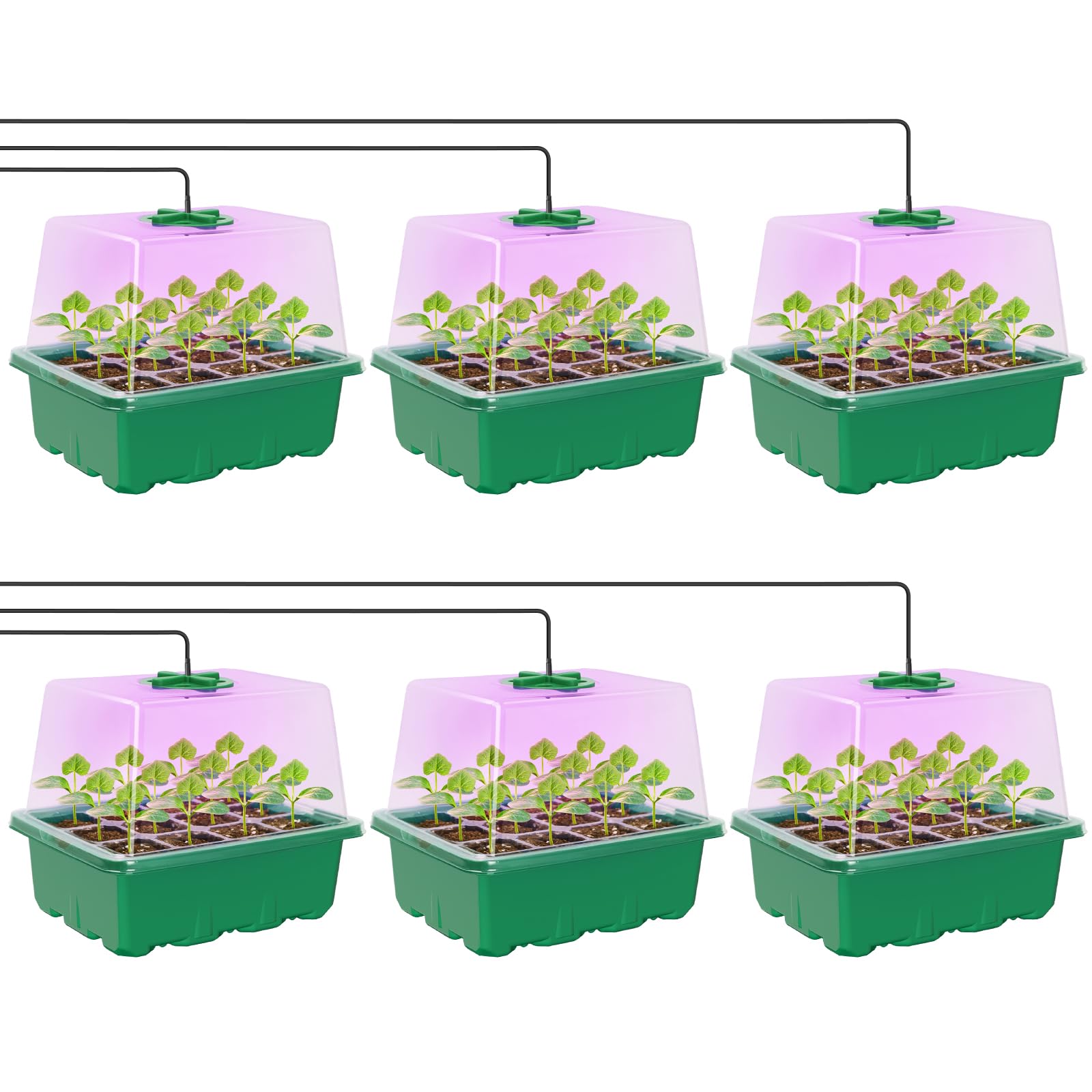
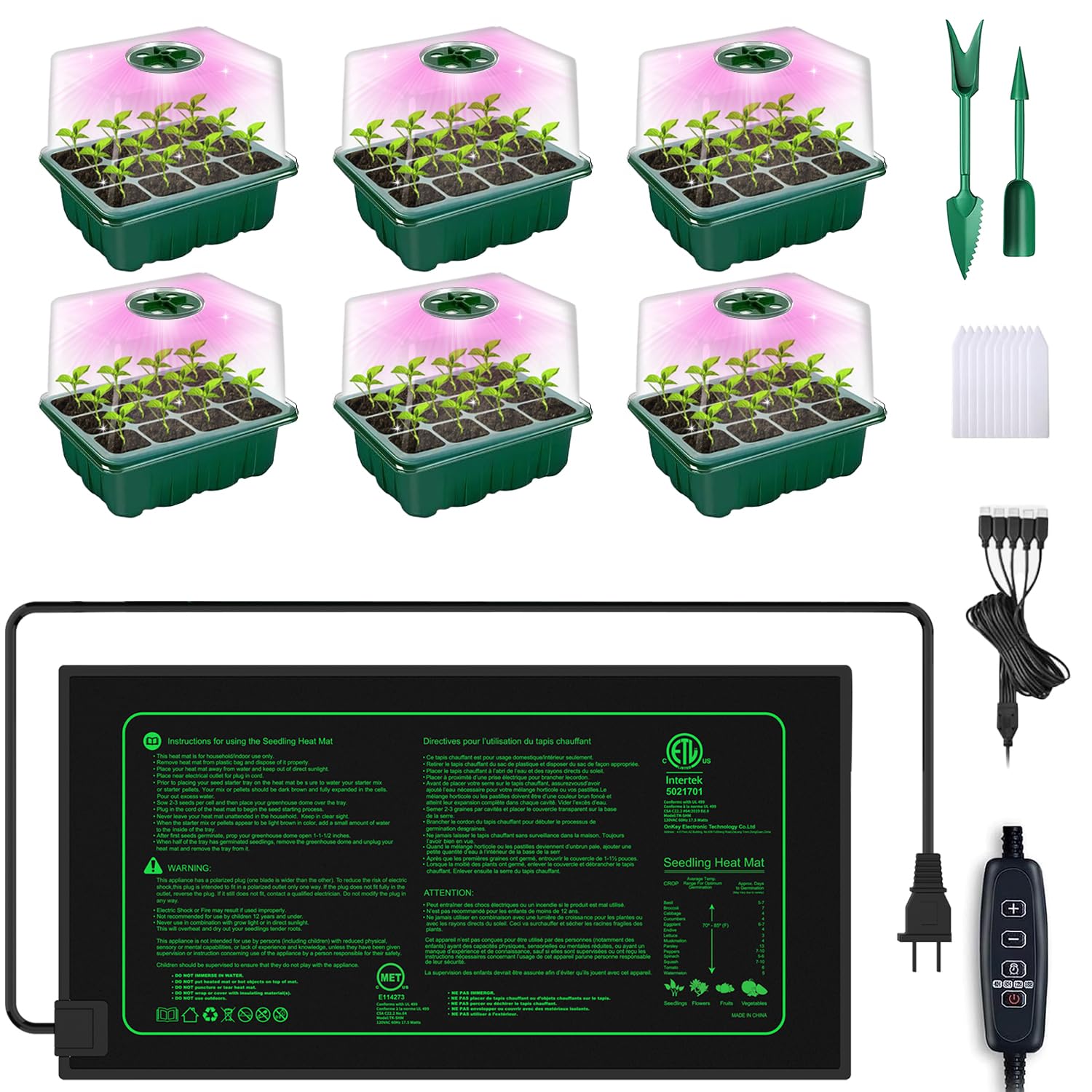
The Kokopro kit is the lowest-cost way in this group to get bottom heat along with lights and domes. It includes six trays with 72 small cells, a heat mat, and a four-setting timer. The pitch is simple: more warmth for germination without paying for a separate mat and controller.

The trays are compact, which makes the kit easy to fit on a shelf. The domes are heightened and the trays have drainage, and the timer gives you a few scheduling choices rather than a simple on-off switch. The six-tray format also lets you separate varieties or move one tray closer to the light.

The lights are best treated as a germination aid; they are not the strongest here, and taller seedlings will want more light. The kit is a value play, not a lifetime bench setup. For a first season or a small indoor garden, that trade-off is easy to accept.

What tips it for us is the combination of heat, light, and a timer at a budget price. If you are starting a few dozen seeds in a cool room and want to keep the spend low, it covers the basics. If you need 60 or more cells or stronger light, the SOLIGT or Sondiko kits are the better fit.

Bottom line: We pick the Kokopro kit for a cool room on a tight budget: it adds a heat mat and timer to 72 small cells without much else.

4

Guioiby 120-Cell Seed Starter Kit

Guioiby 120-Cell Seed Starter Kit

High-volume sowing

Our Score 9.0/10
Check Price

Worth Noting

  • No heat mat included
  • Small cells need early transplanting
Dome
Vented
Cells
120 (two 60-cell trays)
Footprint
16.5 x 11 x 7 in
Grow Light
Full-spectrum, adjustable modes
Read the full review

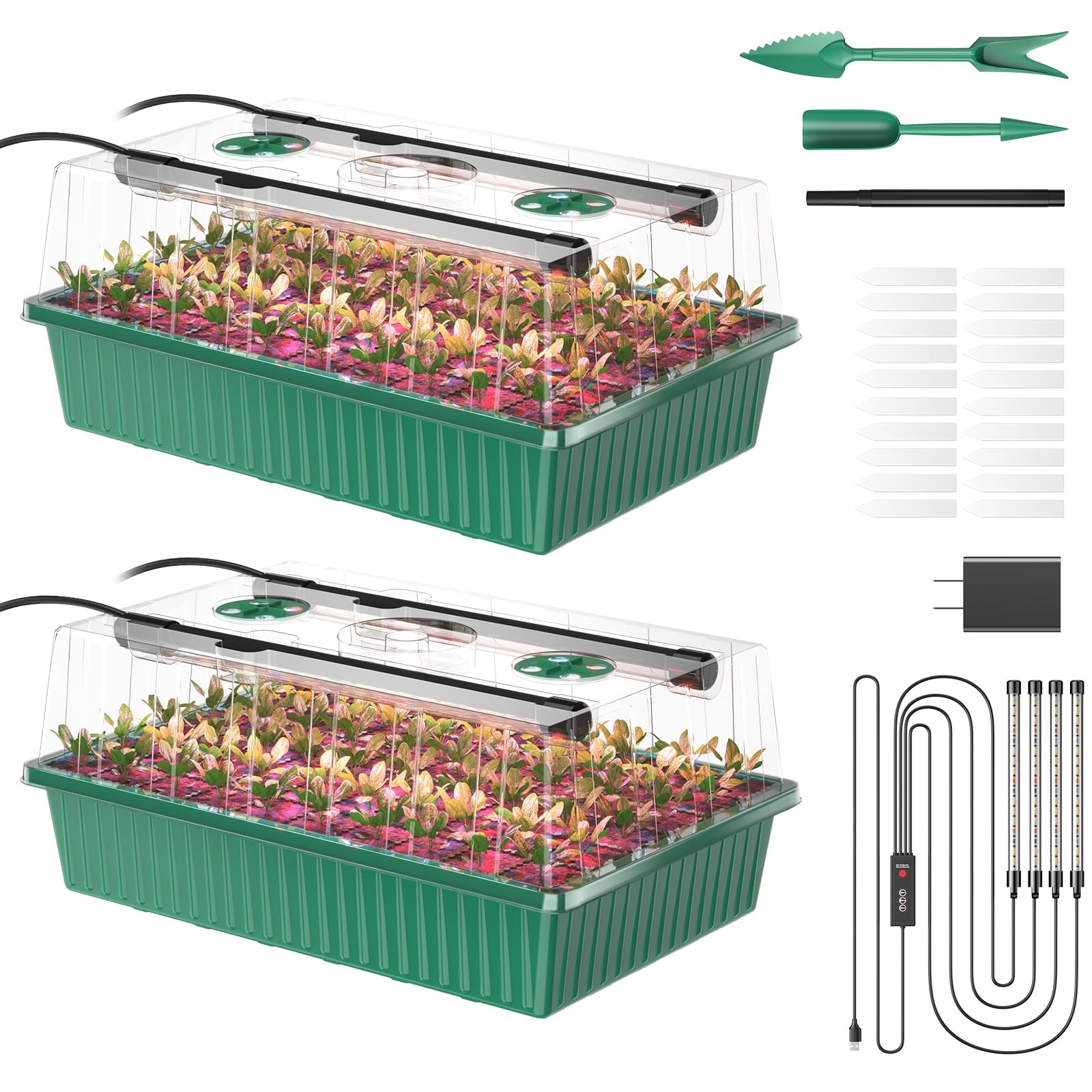
The Guioiby kit is the high-volume option here: two 60-cell trays for 120 seedlings, each with its own clear dome and full-spectrum light. At roughly 16.5 by 11 inches, it takes up a real shelf, so it suits a dedicated grow area more than a kitchen windowsill. If you are sowing a whole cutting garden or a large vegetable patch, the capacity is the point.

The lights are adjustable and full-spectrum, with modes rather than a simple on-off switch. The domes are vented, and the trays have drainage holes. The two-tray format lets you run one tray under brighter light and keep the other more humid, which is useful when germination times differ. The kit also includes a smart control system, labels, and a gardening tool.

The two-tray format is more flexible than one big flat, but it also means two domes and two light fixtures to manage. The clear covers make it easy to check moisture, and the drainage holes are a help when you water heavily. This is a kit for someone who wants to fill a shelf and can keep up with the watering.

We recommend it for the gardener who needs volume and does not mind handling a large flat. The adjustable light and two independent domes make a big sowing easier to manage, and the 120-cell capacity is the best here. If you want a smaller footprint, the MIXC kit is the easier fit.

Bottom line: When volume is the goal, we turn to the Guioiby kit: 120 cells across two lit trays make a large sowing easier to organize, as long as you have the shelf space.

5

Sondiko Seed Starter Tray

Sondiko Seed Starter Tray

Bigger sowings

Our Score 8.8/10
Check Price

Worth Noting

  • Light bars are weak at tray edges
  • Some light bars are fiddly to snap in
Cells
80
Timer
Built-in
Cell Size
1.57 x 1.37 in
Grow Light
Dual lights, 5 levels
Read the full review

The Sondiko kit makes sense when one 60-cell tray is not enough. It splits 80 cells across two 40-cell trays, each with its own pair of adjustable lights. The cells measure about 1.57 by 1.37 inches, so they are a touch wider than the smallest cells here, and the bottom trays give you some margin when you water heavily.

The lighting is the feature to understand before you buy. Each tray gets dual lights, five brightness levels, and a timer, which is more control than the budget five-packs offer. The domes are vented and the trays have drainage holes. The ABS plastic feels more substantial than the thin PET trays, and the two clear covers make it easy to check moisture without lifting the whole setup.

What settles it for us is the combination of capacity and per-tray control. You can run one tray under brighter light and keep the second tray at a lower level, which is useful when you sow peppers and lettuce on the same day. The two-tray format also lets you move a tray to a brighter spot without disturbing the other. For a first-year gardener sowing a full vegetable bed, the extra cells save a second round of sowing.

The two trays are wider than a single 60-cell flat, so measure your shelf before ordering. If you have a narrow windowsill, the MIXC six-pack is the easier fit; if you have a dedicated shelf, the Sondiko gives you more seedlings without adding a second controller.

Bottom line: We reach for the Sondiko kit when one 60-cell tray is not enough; its two independently lit 40-cell trays make a bigger sowing easier to manage.

6

MIXC 6-Pack Seed Starter Kit

MIXC 6-Pack Seed Starter Kit

Windowsill growing

Our Score 8.8/10
Check Price

Worth Noting

  • Lids sit loosely and can shift
  • Small cells need early transplanting
Dome
Elevated, vented
Cells
72 (six 12-cell trays)
Cell Size
1.5 x 1.5 x 2 in
Grow Light
Full-spectrum LED
Read the full review

The MIXC kit is for the gardener whose seed-starting space is a windowsill, not a basement bench. It arrives as six separate 12-cell trays, each roughly 6 by 4 by 5 inches, with its own elevated dome and full-spectrum light. That small footprint is the whole point: you can tuck a tray wherever the light is decent and move it as the season changes.

We like the separate trays because they let you stagger sowings without committing a whole flat. The side grips make it easier to lift the inner tray, and the elevated dome gives seedlings a little more headroom than a flat lid. Drainage holes and a bottom tray help, but this is not a self-watering system. The vents are a useful touch for the first humid week.

The light is a full-spectrum LED built into each dome, and the vent adjusts humidity. We treat this as a starter light rather than a long-term grow lamp; it is strongest while seedlings are small. For a kitchen windowsill or a small shelf, the six small trays are easier to rotate than one big flat, and you can start a second variety without disturbing the first.

Bottom line: For a windowsill or a small shelf, we like the MIXC six-pack: its separate 12-cell trays fit into odd spaces and let you stagger sowings.

7

Bonviee Seed Starter Trays

Bonviee Seed Starter Trays

Tight budgets

Our Score 8.8/10
Check Price

Worth Noting

  • Lids sit loose and can fall off
  • USB adapter not included
Dome
Elevated, vented
Cells
60 (five 12-cell trays)
Power
USB, 5V/2A adapter required
Grow Light
12 LEDs per tray
Read the full review

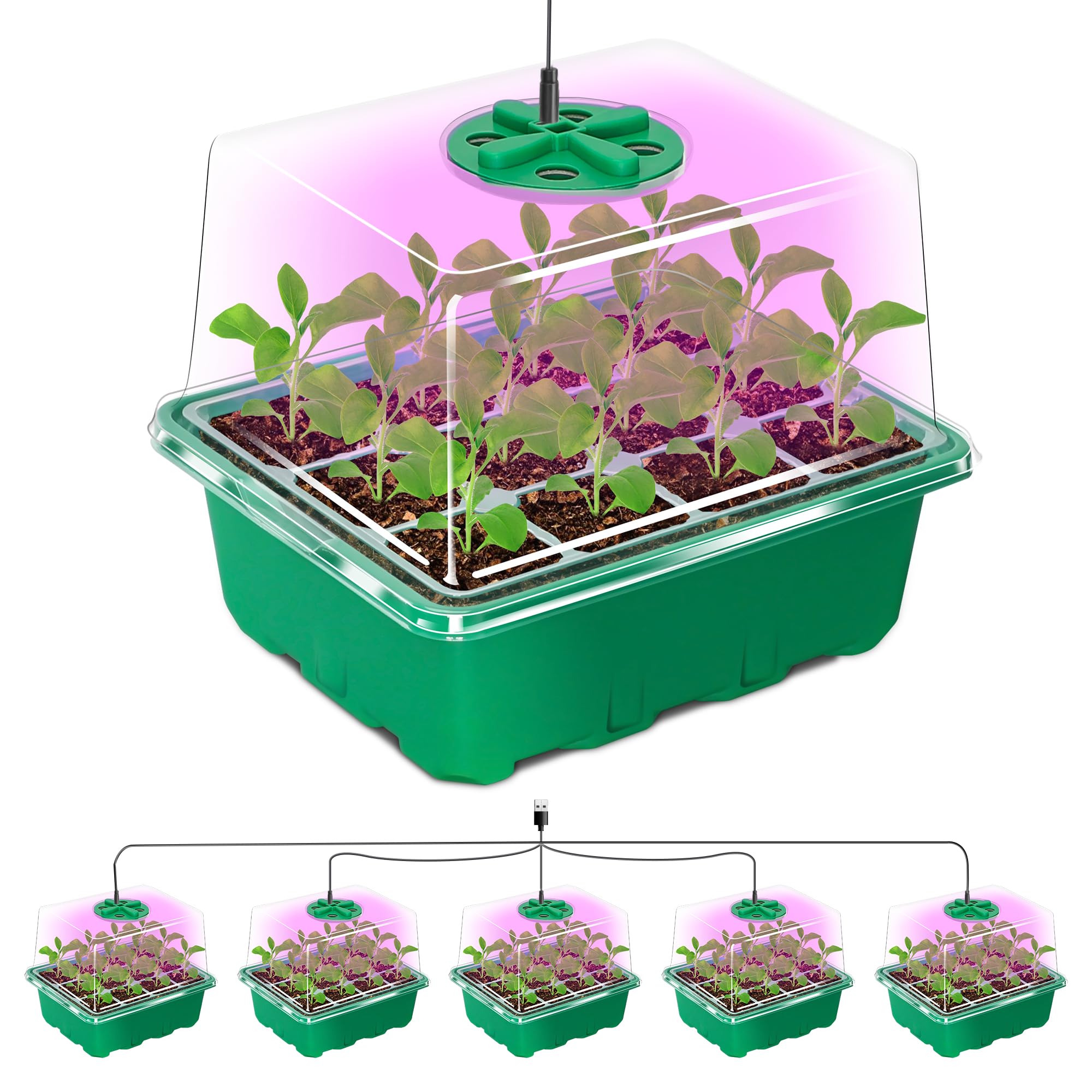
The Bonviee kit is the budget option we recommend when you want several small trays rather than one big flat. You get five 12-cell trays, five vented domes, and five 12-LED lights, all linked by a single USB cable. We like that each tray has its own light and vent, so you can start a few varieties now and add another tray later without buying a second controller.

The clear cell inserts are more useful than they sound: you can see moisture and root development without pulling a seedling out. The cells have drainage holes, and the green base trays catch the runoff. The 5.5 by 7.25 inch footprint is small enough for a windowsill, and the one-to-five cable keeps outlet use low.

The small cells suit herbs, lettuce, and flowers that you plan to transplant within a few weeks. For tomatoes and peppers, you will likely pot up sooner than with a 60-cell kit. At this price, the Bonviee is an easy way to try indoor seed starting without buying a full bench setup, and the five separate trays make it simple to keep varieties apart.

Bottom line: The Bonviee kit is our budget pick for trying indoor seed starting with five small lit trays, provided you can live with loose lids and a separate adapter.

8

YAUNGEL Seed Starter Tray

YAUNGEL Seed Starter Tray

Flexible scheduling

Our Score 8.6/10
Check Price

Worth Noting

  • Power plug not included
  • Light output is modest
Dome
Heightened, vented
Timer
Central controller
Brightness
Adjustable
Grow Light
16 LEDs per tray
Read the full review

The YAUNGEL kit is built around a central controller, which is the feature that separates it from the tray-by-tray kits here. One controller runs six 16-LED grow lights and lets you set brightness and a timer from one place. If you plan to keep several trays on the same shelf, that is a tidier setup than reaching for six separate switches.

The raised domes give seedlings more room, and the vents adjust humidity. Each tray has drainage holes, and the kit includes labels. The six-pack format is enough for a serious windowsill or a small grow shelf, though the trays are compact. The controller is the reason to choose it: you can match light intensity to germination and early growth without moving the trays.

We like the scheduling flexibility, especially for a setup that runs while you are at work. The controller makes it easy to match light intensity to germination and early growth without moving the trays. For a grower who wants one controller and six small trays, it is a sensible middle choice.

Bottom line: We recommend the YAUNGEL kit when you want one controller to run several trays; its adjustable timer and brightness are the draw, though the light is modest.

What Four Months of Seed Starting Taught Us

We built a shortlist of about 40 kits and cut it down by reading spec sheets closely: cell size and count, the wattage and spectrum of the light, whether the light height adjusted, and whether replacement trays and domes could be bought on their own. Price factored in, but we weighed it against cost per cell and whether the light unit was sturdy enough to outlive the plastic. That left 14 kits, which we ran for four months — from the first sowing in late winter through potting up and hardening off.

Each kit lived where it would in a real house: a cool basement shelf, a kitchen counter, a spare-room dresser near a window. We sowed the same varieties on the same day, bottom-watered on the same schedule, and counted germination every morning. We timed assembly out of the box and set the timers without opening the manual. Domes went on at sowing and came off at first true leaves; we noted which lids stayed put, which vents actually moved air, and which fogged so heavily the surface never dried. Once a week we raised the lights that adjusted and measured the gap to the tallest seedling.

Sturdiness got tested bluntly: we lifted every tray by one corner while fully watered and watched for bowing. Durability came from washing the trays and domes twice and flexing them the way you do when popping out a root-bound start. At four weeks we compared stem thickness, the stocky-versus-spindly test, and at the end we checked how evenly the outer cells had grown compared with the middle — that's where weak lights give themselves away. Kits that left half a flat leggy didn't move on, whatever they cost.

How to Choose Seed Starter Kits with Grow Lights

Start With Cell Count and Cell Size

A 12-cell tray is fine for a windowsill experiment; 60 to 80 cells suit a household vegetable garden; 120 cells are for a serious sowing or a plant sale. Cell depth matters as much as count: a 1.5-inch cell gives roots room for a few weeks, not a whole season. If you plan to grow tomatoes and peppers on before planting out, choose a kit with fewer, deeper cells or be ready to pot up early.

We prefer to buy slightly fewer cells than we think we need, because overcrowding makes it harder to keep light and airflow even. The Guioiby kit is the high-volume exception here; the 60- and 80-cell kits are easier to manage for most homes.

Judge the Light, Not the LED Count

A higher LED count does not guarantee better seedlings. Coverage matters: a bar that spans the tray beats a cluster of diodes in one corner. Adjustable brightness lets you start seeds gently and increase light as they grow, and a timer keeps the schedule steady when you are not home. Twelve to sixteen hours a day is a useful starting point.

We look for a light that sits close to the dome and can be raised later. The AC Infinity bars are the most serious light here; the YAUNGEL controller is the most convenient for running several trays. If a kit's light is weak at the edges, rotate the tray.

Decide Whether You Need Bottom Heat

Heat mats help peppers, tomatoes, and eggplant germinate in a cool room, but lettuce and many herbs do not need extra warmth. A mat without a thermostat can push soil too warm, so check the temperature with a probe and use a folded towel as a buffer if needed. If your seed-starting room stays above 70°F, you can skip the mat and spend the difference on better light.

The SOLIGT kit bundles a mat with a timer and light, which is the simplest heated setup here. The Kokopro kit is the budget route to bottom heat. Either way, treat the mat as a germination tool, not a permanent home for seedlings.

Check Domes, Drainage, and Tray Strength

A humidity dome should hold moisture without sealing so tightly that air cannot move. Adjustable vents are worth having; a dome that sits loosely is workable if you carry the tray by the base. Drainage holes and a bottom tray matter more than a self-watering reservoir for most seed starting, because they make overwatering easier to correct.

Thin PET trays can crack when you flex them, especially after a season in strong light. Thicker ABS or reinforced corners are worth paying for if you plan to reuse the kit. The MIXC trays are compact and easy to handle; the Bonviee trays are lighter and need gentler treatment.

Measure the Footprint and Plan the Power

A 120-cell kit can take a whole shelf, while six small trays can be rotated around a windowsill. Measure the space before you order, and leave room for the dome to come off. Check the cord length too: a short cable can decide where the kit lives, especially if you are running several lights from one strip.

Most of these kits use USB or small adapters, so count your open outlets and keep the power strip away from water. A kit that fits your routine is more likely to get watered and checked on time.

Frequently Asked Questions

Final Verdict

For most gardeners, the SOLIGT 60-cell kit is the one we recommend: it covers light, humidity, and bottom heat in a single tray, and its timer makes a spare-room setup easier to run. If you want the best light hardware here and can work with 40 seedlings, the AC Infinity kit is the upgrade; for the tightest budget, Bonviee gets you started with five small trays, provided you can live with loose lids.

Start with the cell count you will actually fill, then choose the light and heat you need. That decision will point you to the right kit faster than any single specification.