Poultry & Livestock

Best Hanging Chicken Feeders of 2026

A hen roots through a feed trough the way a toddler roots through a toy bin — a good share of it ends up on the ground, and by evening it's a wet, trampled mess pulling in mice and starlings. A hanging feeder is the fix: food off the floor, under a lid, dispensed a little at a time. But the gap between a good one and a cheap one shows up fast — a hook that bends under a full load, a lid that flaps loose in the wind, a port that clogs the first time humidity climbs. What you're really buying is calmer mornings: feed that stays dry, a fill that actually lasts, and a flock that eats without a stampede.

I keep six hens in a backyard that gets its share of weather, so I've watched feeders fail in the rain and once caught a raccoon working a lid open well after dark. Over the past four months, my team and I hung, filled, and refilled 14 models, from small plastic pails to metal tube feeders, and the ones worth your money got three things right: they held their stated capacity without sagging, they kept the lid on, and they spilled barely more than the birds ate. One thing I'd tell any first-timer — hang it so the lip sits near the height of your shortest hen's back. Too low and they rake feed onto the ground; too high and the smaller birds get pushed off entirely.

1

Tiflev 3.5 Qt 6-Pack

Top Pick
Tiflev 3.5 Qt 6-Pack

Multiple pens

Our Score 9.6/10
Check Price

Worth Noting

  • Small capacity for a large flock
Pack
6 feeders
Capacity
3.5 quarts
Mounting
Clips
Dimensions
11 x 6.5 x 4.3 in.
Read the full review

Six feeders in one box sounds like overkill until you have tried to keep layer pellets, oyster shell, and a little scratch separate. Each trough holds 3.5 quarts and hangs from clips, so you can put one on each pen or line several along a fence. The molded plastic is thick enough to feel substantial, and the shallow shape is easy to reach into.

The clips are the part that makes the set useful: they open wide enough to go over wire mesh and can be moved without tools. We like that the troughs are small enough to rinse in a bucket and stack when empty. The open top means they are not the set for an exposed run; rain will collect and spoil dry feed. The carabiners can be stiff at first, but they loosen after a few moves.

We recommend the six-pack for the keeper who wants to separate feeds or move feeders between pens. The value comes from the number of stations, not the size of any one trough. If you keep several small groups, the flexibility is worth more than the extra plastic.

Bottom line: For a keeper with several pens or feed types, this six-pack is the flexible way to keep each station stocked.
2

DallerSoode 3.5 Qt 2-Pack

DallerSoode 3.5 Qt 2-Pack

Small flocks

Our Score 9.4/10
Check Price

Worth Noting

  • Open top collects rain outdoors
Rim
Wavy edge
Pack
2 feeders
Capacity
3.5 quarts
Mounting
Clips
Read the full review

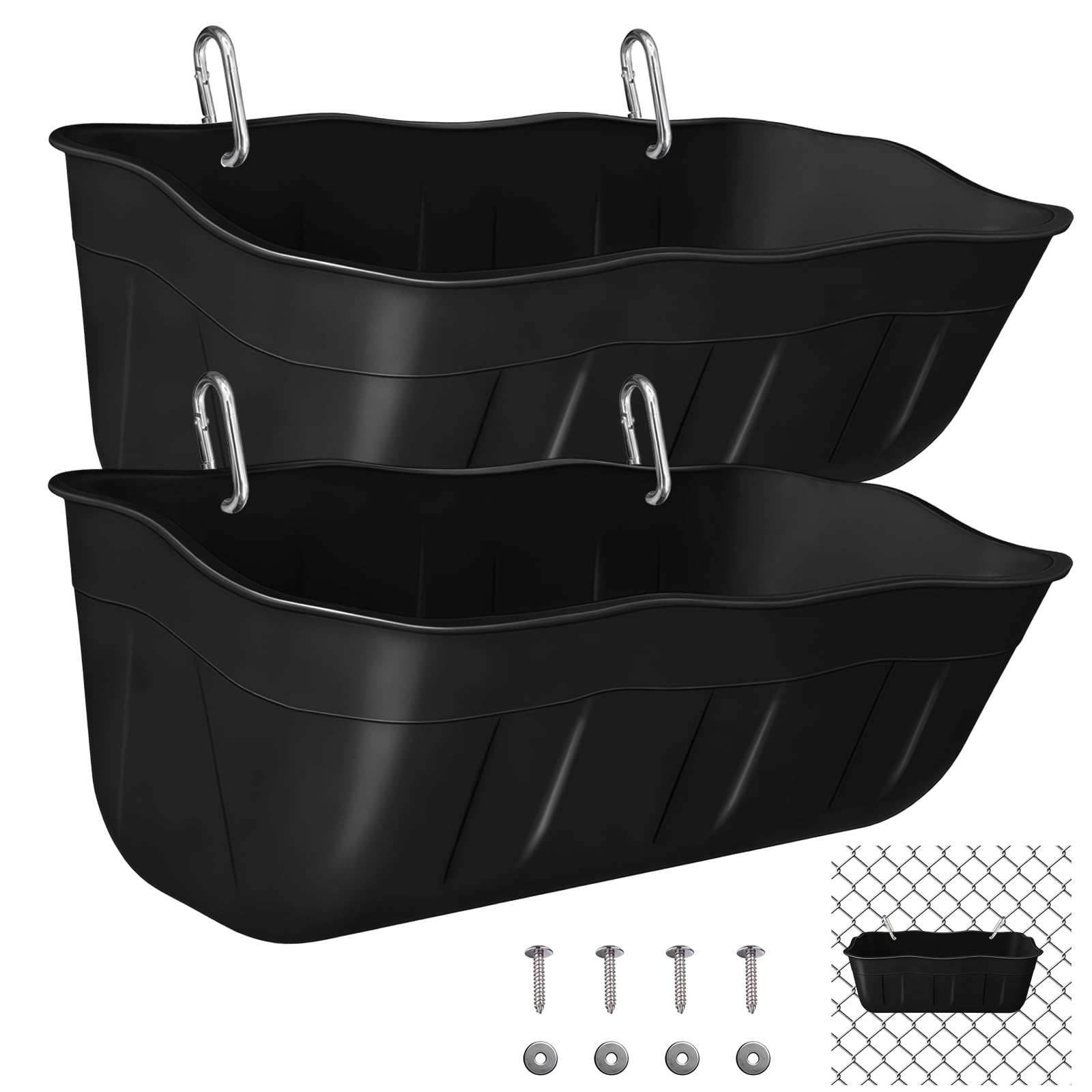
Two small troughs solve a problem a single big feeder doesn't: feeding two pens without carrying one feeder back and forth. At 3.5 quarts each, they are sized for a small flock, and the molded plastic feels denser than the price suggests. The wavy rim gives feed a lip to sit behind instead of a flat edge the hens can rake clean.

Clips fit through molded holes and let you hang the trough on wire mesh or a rail; the pair is light enough to move as the run gets muddy. Rinse and dry is quick because there is no lid or narrow corner to scrub, and the one-piece body does not trap feed in seams. The hardware is simple, and moving a trough takes seconds.

The 3.5-quart capacity is the dividing line. For four to six hens, one trough can hold a morning scoop with room for the birds to gather; for a flock of a dozen, you will refill both before the day is out. We see the pair as a good fit for a small coop, a grow-out pen, or a pair of separated runs, not as a replacement for a gravity feeder.

Bottom line: Buy the two-pack if you keep a small flock or want a separate trough for each pen; the molded plastic rinses clean and the wavy rim helps keep feed in.

3

mozoba 4 Qt 3-Pack

mozoba 4 Qt 3-Pack

Multi-pen value

Our Score 9.2/10
Check Price

Worth Noting

  • Open top collects rain outdoors
Pack
3 feeders
Capacity
4 quarts
Material
High-density polymer
Mounting
Clips and screws
Read the full review

Three 4-quart troughs land in the useful middle: more capacity than the smallest clip-on cups, less bulk than a five-quart pair. The set comes with clips and screws, and the troughs are light enough to move around the run. The plastic is rigid enough that the sides do not bow when you carry one full, and the molded rim is smooth enough to wipe down without snagging a cloth.

We like this set for a flock that gets fed in more than one spot, or for a keeper who wants separate troughs for grain and minerals. The value is in the number of feeders and the simple cleaning, not in capacity for a big flock. The 4-quart size is a daily top-up, not a week's reserve, so a large flock will empty all three quickly. If you need one feeder to hold a week's feed, go with a metal gravity model instead.

Each trough is a single molded piece, so there are no seams to dig feed out of. The wide opening makes it easy to dump leftovers and wipe the inside. For a smallholder with a few pens, that convenience is the reason to choose three smaller stations over one large hopper.

Bottom line: A useful three-pack for splitting feed between spots, with rigid, easy-to-rinse troughs and simple clip-on mounting.

4

Harris Farms 15 lb Hanging Feeder

Harris Farms 15 lb Hanging Feeder

Backyard flocks

Our Score 9.0/10
Check Price

Worth Noting

  • Spring clips can work loose and drop the pan
Capacity
15 lb
Mounting
Hanging handle
Dimensions
11.63 x 11.63 x 11 in.
Feed Adjustment
Adjustable pan height
Read the full review

The adjustable pan is what earns this feeder its place as our default. Harris Farms lists a 15-pound capacity, which is the sensible middle for a backyard flock: enough that you are not filling every morning, not so much that a bag of feed sits open for weeks. The pan hangs from the hopper on spring clips, and you can raise or lower it to change the gap. That matters more than it sounds. Pellets and crumble flow differently, and a gap that suits one can let the other pour out. We set it narrow, watched how the birds ate, and opened it a notch when the flow slowed.

The open top is the compromise. Hang it under the coop roof or in a covered run, and do not fill it to the brim before a wet week. The galvanized body has rolled edges, which matter when you are carrying a full hopper through a narrow door. The spring clips that set the pan height are the part we check before lifting; if one works loose, the pan drops and feed goes on the floor. A missing hanger is worth catching before assembly, too.

Cleaning is straightforward because the hopper and pan separate. The smooth metal wipes down, and the open shape lets you see feed that has caked at the bottom. What it does well is give a small-to-mid flock a dependable place to eat without turning every refill into a project.

Bottom line: Our default for a typical backyard flock is the Harris Farms 15-pound galvanized feeder: the adjustable pan handles pellets or crumble, and the hanger keeps feed off the ground.

5

Goovilla 5 Qt 2-Pack

Goovilla 5 Qt 2-Pack

Larger troughs

Our Score 9.0/10
Check Price

Worth Noting

  • Carabiner clips can bend under load
  • Open top collects rain outdoors
Pack
2 feeders
Capacity
5 quarts
Material
BPA-free PE plastic
Mounting
Clips, zip ties, screws
Read the full review

The mounting packet is unusually complete: clips, zip ties, and metal screws for each trough. That matters because the best hanging spot is often not the one the manufacturer pictured. A screw into a wooden rail, a zip tie around wire mesh, or a clip over a gate all work, and you can move the trough without leaving a hole.

At 5 quarts each, these are the larger end of the plastic troughs here. That is enough for a serious feed scoop, and the trough still lifts easily when full. The BPA-free PE plastic has a smooth finish.

The plastic is sturdy enough for chickens and ducks, though not for pigs or other animals that lean hard on a trough. For a backyard flock, the 5-quart size is generous enough that you are not topping it up every morning. The one-piece body and wide opening make it easy to dump and rinse at the end of the week.

We see these as a practical upgrade for someone who wants two bigger troughs without moving to metal. The mounting options make them easy to place, and the capacity cuts trips. The clips are handy for moving between pens, and the screws or zip ties let you leave a trough in one spot.

Bottom line: A roomy, adaptable trough for chickens and ducks, with three mounting options and enough capacity to cut daily refills.

6

Little Giant 40 lb Hanging Feeder

Little Giant 40 lb Hanging Feeder

Large flocks

Our Score 8.8/10
Check Price

Worth Noting

  • Open top leaves feed exposed to rain
Capacity
40 lb
Mounting
Hanging handle
Dimensions
12 x 12 x 10.13 in.
Weather Protection
Open top
Read the full review

A 40-pound hopper is a commitment as much as a convenience. This is the feeder for someone with 15 or more hens, or a flock that empties a smaller hopper in a couple of days. The capacity is the point: fewer refills, less hauling. The broad body and rolled edges make it feel like a piece of farm equipment rather than a plastic tub. It hangs from a central handle, and the pan sits below the tube.

That size is exactly why it is not our default for a small backyard flock. A 40-pound hopper can hold feed long enough to go stale in humid weather. We recommend it when refill frequency is the problem you want to solve, not when you have six hens and a small coop. For a large flock in a covered run, the trade-off is easy to accept.

The pan is held by metal pegs, and it can come loose if you lift the feeder by the pan instead of the handle. That is a small habit, but it is the difference between carrying a full feeder and cleaning up after one. The pan also sits loosely by design, so the feeder is not the one to choose if you want a sealed, locked-together unit. Lift by the handle, set it down level, and the hardware does its job.

Bottom line: If you keep a large flock and want to fill less often, the Little Giant's 40-pound capacity makes it the large-scale pick.

7

Omlet No Waste 12 lb Feeder

Omlet No Waste 12 lb Feeder

No-waste feeding

Our Score 8.4/10
Check Price

Worth Noting

  • Premium cost relative to metal feeders
Capacity
12 lb
Mounting
Hanging or free standing
Dimensions
14.5 x 14.5 x 18.5 in.
Feeding Ports
5 enclosed
Read the full review

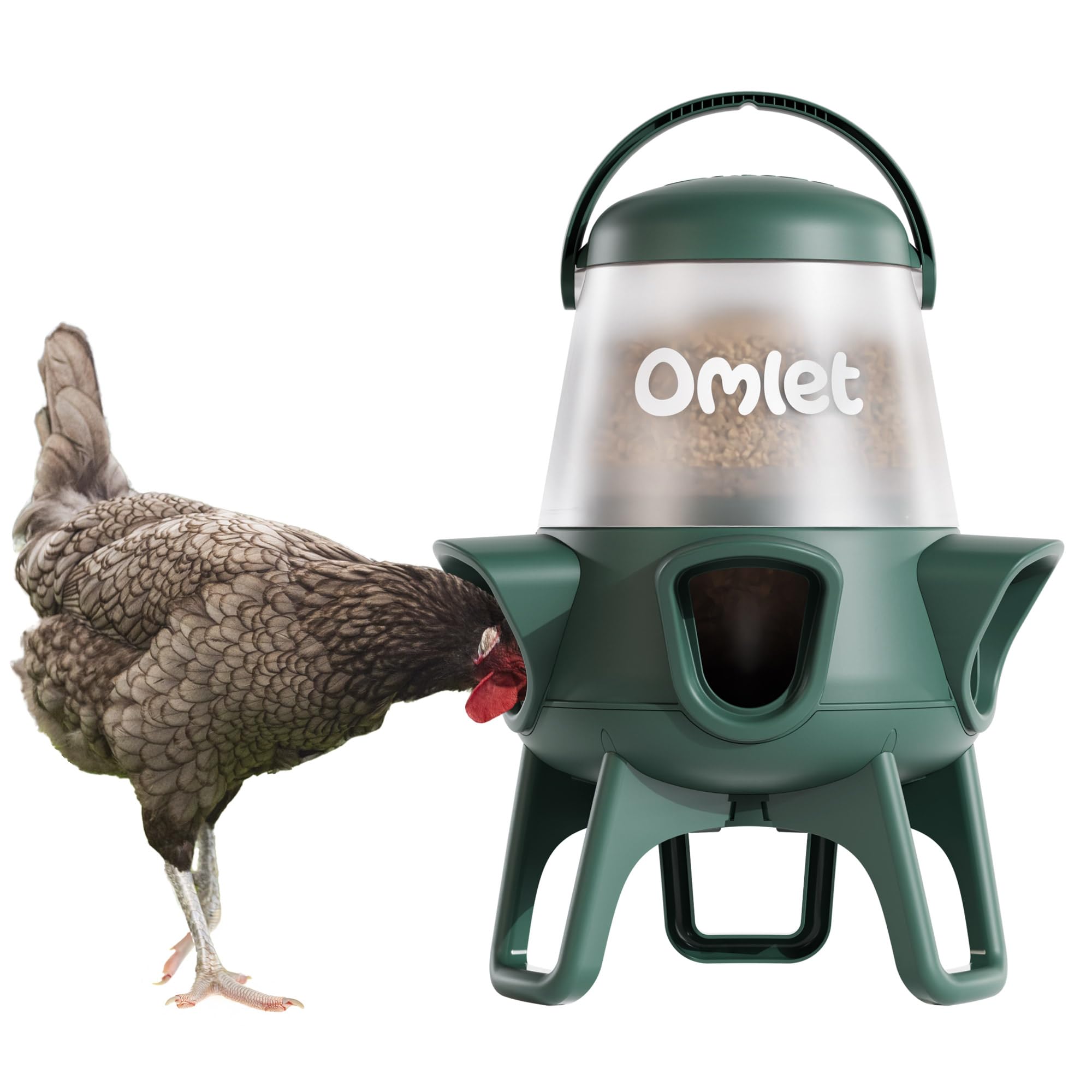
The enclosed ports are the whole idea here. Instead of an open trough, the Omlet has five enclosed openings that let a hen reach feed without billing it across the coop floor. The 12-pound hopper is sized for about six hens for a week, and it splits into three pieces without tools for cleaning. It can hang from its handle with the legs removed, or stand on the coop floor.

That design is not automatic for every flock. Some hens take to the ports immediately; others take days to figure them out, and a few would rather eat from an open pan. It is not the feeder to introduce the week you leave for vacation. The ports also mean a dominant hen cannot camp over the whole pan, though she can still guard one opening. The plastic body is light enough to move, and the handle makes it carryable when full.

We recommend it when waste is the problem you are trying to solve and you want the enclosed-port approach. The feeder asks for a little patience during the switch. For a small flock in a covered run, the reduction in scattered feed can be worth it. If you want the simplest possible fill-and-hang feeder, the metal gravity models are easier.

Bottom line: The Omlet earns its place when scattered feed is the main annoyance: five enclosed ports and a 12-pound hopper are built to keep feed in the coop, not on the floor.

How We Tested the Best Hanging Chicken Feeders

Every feeder here started as a candidate pulled from customer reviews and spec sheets, then filtered on the things that actually matter: what it holds, how the lid attaches, whether hanging hardware comes in the box, and what it costs per pound of capacity. Before hanging anything, I checked each hardware bag against the parts list in the manual, because missing chains, clips, and brackets came up repeatedly in buyer complaints.

Fourteen feeders went into two setups — a six-hen coop and an open run — for four months, hung at roughly the height of the shortest hen's back. I filled each with a weighed batch of layer pellets and crumble, then weighed what was left at the end of every week to see how much had landed on the ground instead of in a bird.

For durability and weather, I hosed each one down, left them out through a stretch of rain and a windy weekend, and checked whether lids stayed seated or lifted, whether seams cracked, and whether feed clumped or bridged at the ports. Two of the fourteen had no lid at all, so I tracked how quickly rain and coop dust got into the trough. I also timed refills and cleanouts, and noted how long the flock took to commit to a new design — some drew birds within the hour, others sat untouched for two days.

A few things I watched for that never make it onto a spec sheet: whether a full feeder swung or twisted on its hanger, whether the lid could be opened one-handed with a bucket in the other, and whether the stated capacity held up in practice or the hens emptied it by midweek.

How to Choose Hanging Chicken Feeders

Match Capacity to the Flock

Capacity is where labels get slippery. Metal gravity feeders list pounds; plastic troughs list quarts, and a quart of pellets does not weigh the same as a quart of water. We treat a 15-pound hanging feeder as the practical middle for a typical backyard flock, while a 40-pound model is for 15 or more hens or a keeper who wants fewer refills. A 3.5- to 5-quart trough is a top-up feeder, not a week's supply. On multi-packs, check whether the quart figure is per feeder or for the whole set before you compare.

Choose a Mount You Can Trust

Your coop decides the mount. A metal feeder with a center handle needs a rafter, hook, or bracket overhead; a trough with clips needs wire mesh, a rail, or a screw-friendly wall. We put more trust in two attachment points than one, because a single clip lets a full feeder swing and bang against the fence. If you are screwing into wood, use a screw that bites into a stud or rail, not just the paneling. If the only available spot is thin wire, add a wooden brace or choose a different location.

Match the Feeder to the Feed

Feed texture changes the right opening. Pellets and crumble flow best from a gravity feeder with an adjustable pan; the gap should let feed trickle into the lip without pouring it into the bedding. Troughs suit grain, minerals, oyster shell, and small top-ups, especially with a wavy rim that gives feed a place to sit. Enclosed-port feeders, like the Omlet, are built to stop hens billing feed onto the floor, but some flocks need days to learn them. Mash and dusty feed can bridge or clog in any gravity hopper, so watch the flow after a refill.

Plan for Weather and Pests

Almost every open feeder is a compromise in wet weather. The metal models here have no lid, and plastic troughs collect rain in the bottom; both belong under a coop roof, a covered run, or a lean-to. Fill only what the flock will eat in a few days when the forecast is wet, and empty any soggy feed instead of letting it sit. Hanging feed off the ground helps with rodents and scratching, but it does not make a feeder pest-proof. If your only spot is fully exposed, choose a feeder with a sealed lid or build a small cover.

Make Cleaning Part of the Choice

Cleaning is easier when the feeder comes apart without tools. Metal gravity feeders usually separate into a hopper and pan; plastic troughs rinse in one piece. We look for smooth corners, a wide opening, and hardware that can be removed without forcing it. Check the clips and pan pegs each time you refill, because that is where most feeders loosen or fail first. A feeder that takes two minutes to empty and rinse is one you will actually clean; a fussy one turns into a mold problem.

Frequently Asked Questions

Final Verdict

The Harris Farms 15-pound feeder is the one we recommend first for a typical backyard flock. Its adjustable pan handles pellets and crumble, the hanger keeps feed off the ground, and the size is manageable without constant refills.

If you keep 15 or more hens and want fewer refills, the Little Giant 40-pounder is the better scale. For a small flock or a pair of pens, the DallerSoode two-pack is the budget route.