Poultry & Livestock

Best Chicken Nesting Boxes of 2026

The first time I found an egg in the mud behind the feed bin, I stopped treating the nesting box as an afterthought. A good one does two jobs at once: it gives hens the dim, private corner they're looking for, and it gives you eggs that are clean and uncracked instead of grit-covered and trampled. Get it wrong and you're hunting through the coop every morning; get it right and collecting eggs takes about a minute.

Over the past seven months we've run a dozen nesting boxes through real coops and covered runs, and the ones that earned a spot all had the same things going for them: they went together without a fight, they wiped clean, and they fit the birds without a squeeze. One thing I've learned the hard way is that roll-away floors live or die on their angle — too steep and you get cracked eggs, too shallow and the eggs just sit there. Below are the ones worth your money, sorted by whether you want roll-away convenience or a simple, roomy box you can put up in an afternoon.

1

Miller 4-Pack Wall-Mount Nesting Boxes

Top Pick
Miller 4-Pack Wall-Mount Nesting Boxes

Multi-hen flocks

Our Score 9.4/10
Check Price

Worth Noting

  • Entrance runs tight for the heaviest hens
Material
High-density polyethylene
Mounting
Wall, 16-inch on-center studs
Compartments
4
Nest Dimensions
16.5"L x 15.88"W x 19.75"H
Read the full review

Four boxes in one carton. At the usual one-nest-per-four-hens rule, that covers a flock in the mid-teens, and it means you hang the whole laying wall in a single session instead of coming back with the drill every few weekends. Each nest is 16.5 inches long, 15.88 wide and 19.75 tall, and all four together weigh 15 pounds.

Nothing about the install is fiddly. The backs are set up for 16-inch on-center studs and can also be screwed to a sheet of plywood if your wall doesn't cooperate. We had all four up and level in an afternoon, and the hens were queuing at them the next morning — there was no adjustment period at all.

The one thing to measure first is the opening. These are sized for all breeds, but the biggest hens can look squeezed going in. If your flock runs heavy — Orpingtons, Brahmas, a big Australorp — compare the entrance against your widest bird before you commit to four of them.

Cleaning is the same routine as any covered plastic box: pull the bedding, hose the shell, let it dry before the straw goes back. Buying four at once saves the repeat trips to the hardware store, which is why we point bigger flocks here rather than hanging singles one at a time.

Bottom line: The simplest way to hang several nests at once: four covered boxes, one order, one afternoon with a drill, and enough nests for a mid-size flock.

2

Little Giant Single Plastic Nesting Box

Little Giant Single Plastic Nesting Box

Small flocks

Our Score 9.2/10
Check Price

Worth Noting

  • One nest per unit, so bigger flocks need several
Material
High-density polyethylene
Mounting
Wall, 16-inch on-center studs
Dimensions
26.5"L x 15.88"W x 19.75"H
Compartments
1
Read the full review

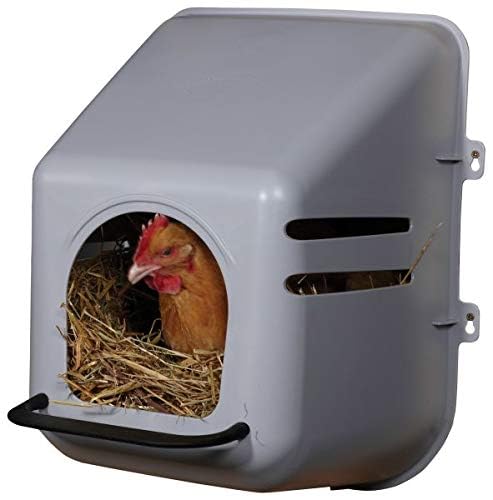
The entrance perch is the detail that won it the top spot. Hens like a landing strip before they commit to going inside, and this box puts a lip exactly where they arrive. We hung ours on 16-inch on-center studs and it hasn't shifted since — at 3 pounds the whole thing is light enough to hold with one hand while you drive screws with the other. It measures 26.5 inches long, 15.88 wide and 19.75 tall, so a good-sized hen fits without the box turning into a cave.

Cleaning is where the polyethylene earns its keep. There are no seams or corners for manure to pack into, no wood to rot, and nothing for mites to burrow into the way they do in plywood. It doesn't hold the cold the way the galvanized boxes here do either, which matters more on a January morning than it sounds.

The manufacturer suggests hanging the lowest box of a stacked set about 24 inches off the ground, and that's worth following for a single box too: it keeps the nest out of a predator's reach and out of the damp. Because the back is flat and drilled for framing, three of them stacked give you a small laying wall without building a shelf first.

What it can't do is talk a hen into it. If your flock has been laying in the same corner for two years, hang this where the old nest was, leave a fake egg inside, and give it a week before you call it a failure. Ours became the main laying spot within days, and the perch seems to be what did it.

Bottom line: Our default for a small flock: it hangs on standard studs, hoses clean, and the entrance perch gives hens somewhere to land before they go in.

3

Rite Farm 2-Pack Nesting Boxes

Rite Farm 2-Pack Nesting Boxes

Tight budgets

Our Score 9.2/10
Check Price

Worth Noting

  • Open front, so bedding scratches out
  • Sold in pairs only
Design
Open front, egg-shaped rear opening
Weight
5 lb
Mounting
Wall mount
Compartments
2
Read the full review

There is nothing to put together. Two molded poly boxes come out of the carton ready to hang — no trays to slide in, no lid to line up, no bag of bolts to count. The back has an egg-shaped opening, the front is open, and that's the entire design.

Hanging them is a ten-minute job when your studs cooperate. The backs are made for 16-inch on-center framing; if the studs don't land where you want the boxes, screw a sheet of plywood to the wall first and hang from that instead. Both boxes together weigh about 5 pounds, so one person can hold and drive screws.

Poly wipes clean and doesn't soak up the smell the way wood does — ours get a scrape and a rinse and go straight back up. The caveat is size: these are sold as fitting all breeds, but they run tight on the plumpest hens. For bantams through standard layers they're comfortable.

Two boxes suits a flock of six to eight at the usual ratio, which is where most backyard coops sit. It's the least glamorous pick here, and the one we hand to someone who just wants the eggs out of the mud.

Bottom line: Two plain wall-mount boxes with nothing to assemble and nothing to break — our pick when the coop budget is stretched and the hens just need somewhere dark.

4

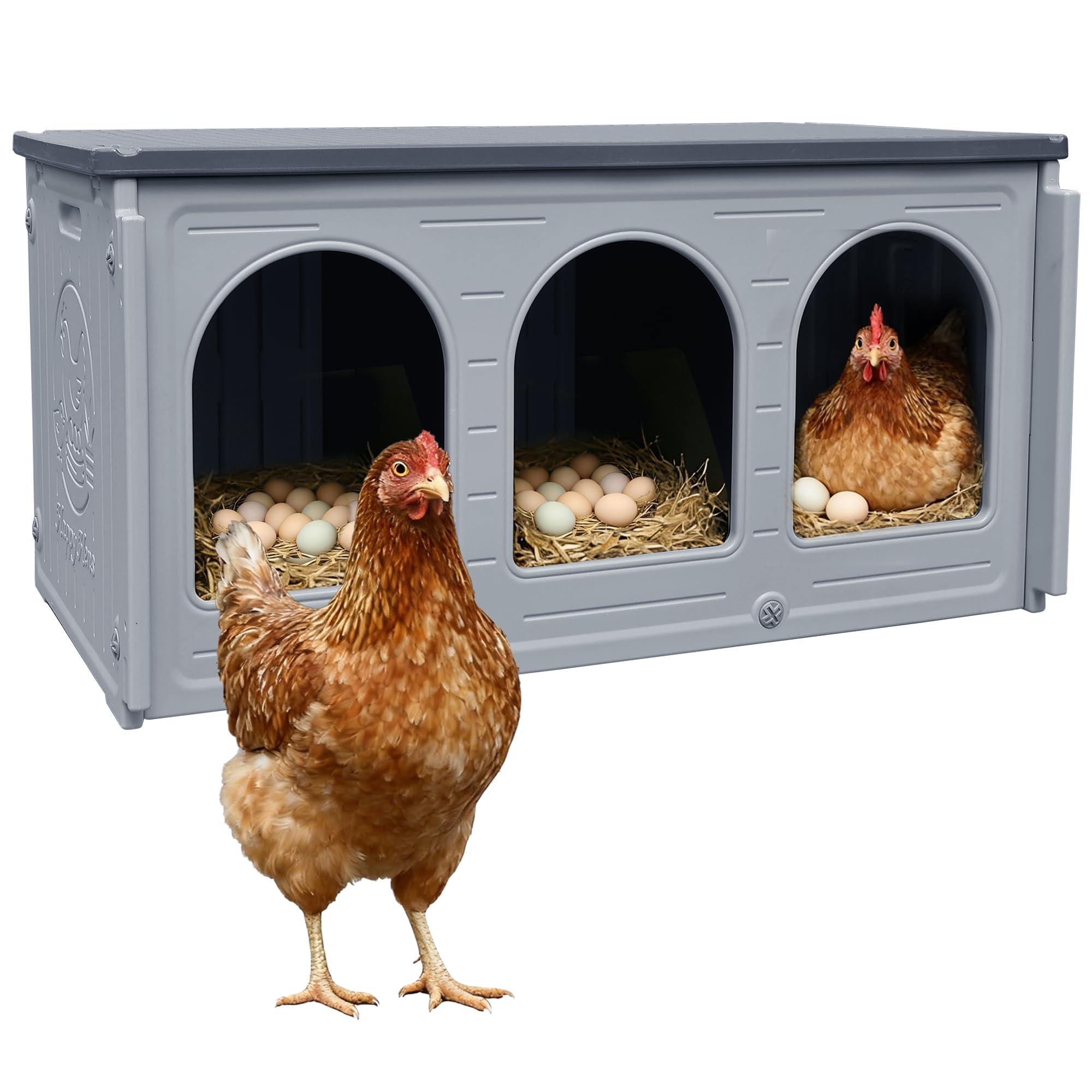
Rockever 3-Compartment Nesting Box

Rockever 3-Compartment Nesting Box

Compact coops

Our Score 9.0/10
Check Price

Worth Noting

  • No roll-away floor, so eggs are collected by hand
  • Wide 41-inch footprint needs a clear wall
Cleaning
Removable roof
Material
Thickened HDPE
Dimensions
41"L x 20.8"W x 20.3"H
Compartments
3
Read the full review

The roof comes off. Not hinged — off, in one piece — and that single decision is why this one leads our multi-compartment plastic boxes. Lift it and there's nothing between you and the floor of each compartment: no tray to slide, no corner to work around with a scraper.

Every part arrives pre-drilled, so assembly is a hand screwdriver and about twenty minutes rather than a power-tool session. The finished unit runs 41 inches long, 20.8 deep and 20.3 high, with three compartments side by side in thickened HDPE that won't rot, warp or take on water the way a plywood nest does.

What we appreciate most is how little there is to go wrong. There's no roll-away floor, so eggs stay in the nest under the hen and you collect them by hand — fewer moving parts, nothing to jam, nothing to come unlatched. The dark enclosed compartments are the shape hens look for, and the smooth interior wipes down without snagging on anything.

The trade is that a removable roof has to go somewhere. Ours lives hooked over a rafter while we work, because a lid set down on the coop floor is the thing most likely to get stepped on. Give the unit a clear 41-inch wall, too — you'll want a second pair of hands holding it level while the first screws go in.

Bottom line: Three dark compartments in one molded shell — the pick for a small coop that wants several nests on one wall instead of hanging three separate boxes.

5

Brower 2-Tier 10-Hole Nesting Box

Brower 2-Tier 10-Hole Nesting Box

Large flocks

Our Score 9.0/10
Check Price

Worth Noting

  • Flat steel can arrive bent or short hardware
  • Fifty pounds assembled
Weight
50 lb
Dimensions
60"L x 12"W x 34"H
Compartments
10
Hen Capacity
50 to 60 hens
Read the full review

Ten nests in 60 inches is a different order of thing from the boxes above. The Brower is rated for 50 to 60 hens, and with two tiers of five you can collect a full round of eggs without moving your feet. For anyone selling at the farm gate, that's the whole argument.

The build is galvanized steel with a sloped roof that sheds rain and discourages birds from roosting on top, side vents for airflow, and double-bolted perch rods that fold back — which doubles as a gate when you want to shut the nests off. Assembled it's 60 by 12 by 34 inches and 50 pounds; the maker reckons 30 to 45 minutes with a screwdriver and a wrench, which is optimistic for one person.

Assembly is where this one lives or dies, and it's why it sits in our also-consider list rather than higher. Count the hardware before you start, dry-fit the perch boards, and check that the drilled holes line up — flat-packed steel can arrive bent, and a bag short of bolts stops the job dead. Two people make the hang far easier.

It's also the most expensive thing here by a wide margin, and that only makes sense at scale. For ten hens, a wall of plastic boxes does the same job with far less assembly and far less swearing.

Bottom line: Ten nests across a 60-inch span — the only box here built for a flock in the dozens, provided you're ready to assemble it carefully and hang 50 pounds of steel.

6

AugFir 2-Compartment Roll-Away Nesting Box

AugFir 2-Compartment Roll-Away Nesting Box

Clean egg collection

Our Score 8.6/10
Check Price

Worth Noting

  • Eggs stall when bedding is heavy
  • Snug for the biggest hens
Material
All-weather plastic
Dimensions
11"L x 12"W x 26"H
Compartments
2
Egg Handling
Sloped floor to front tray
Read the full review

A roll-away floor only works if the bedding stays thin. That's the first thing we noticed with the AugFir: the sloped floor needs a light dusting of shavings under the hen to let an egg travel, and the moment someone packs in a straw nest, the egg stops where it lands and the point of the design goes with it.

The unit stacks two nests in a footprint about a foot square — 11 inches deep, 12 wide, 26 tall — so it fits a coop wall where a wider box won't. Side vents keep air moving, drainage holes in the base stop water pooling, and the all-weather plastic means it can go in an open run as well as a shed.

The collection area at the front is shallow. A big egg sits proud of it rather than dropping out of sight, which is fine in a secure coop and less fine if you have a determined egg eater about. Seat the tray firmly when you set the unit up; ours needed a proper push before it lined up flush with the floor.

Two boxes, one wall, clean eggs at the front every morning — that's the case for it. What it asks in return is discipline about bedding and a quick check that the tray is still sitting where you left it, and both of those are a ten-second habit rather than a chore.

Bottom line: A roll-away floor for two hens at the low end of the roll-away bracket — worth it if you keep bedding thin and want eggs waiting at the front.

7

Eggluuz 6-Compartment Nesting Box

Eggluuz 6-Compartment Nesting Box

Mid-size flocks

Our Score 8.6/10
Check Price

Worth Noting

  • Thin steel can arrive bent
  • Trays and lids can work loose
Material
Galvanized steel and ABS
Dimensions
31.5"L x 20.5"W x 30.2"H
Compartments
6
Egg Handling
Sloped floor to pull-out tray
Read the full review

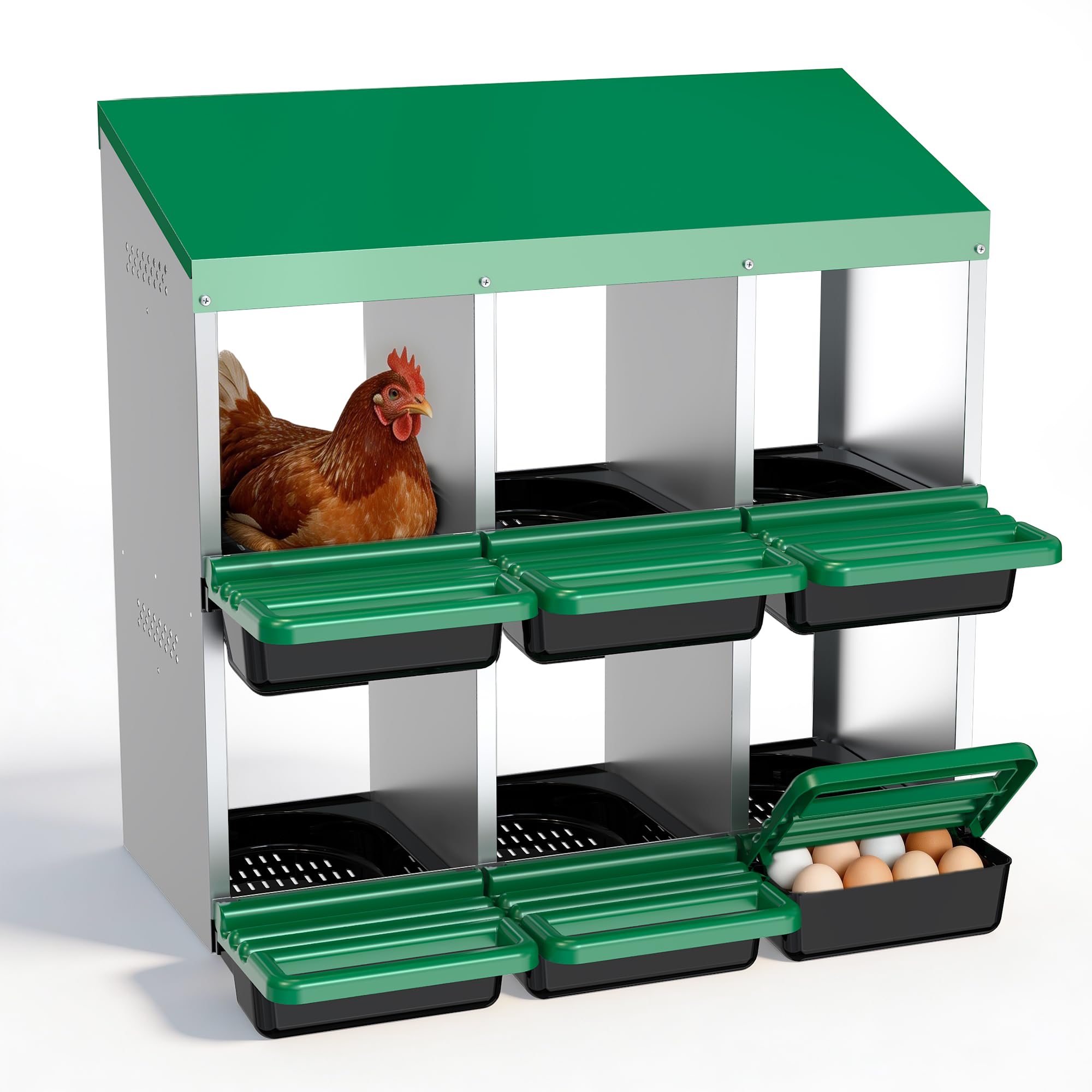
Six compartments in a frame 31.5 inches wide and 30 tall is a lot of nest for the money, and the sloped floors do the job they're meant to: eggs travel forward into a tray and come out clean instead of muddy. For a flock in the teens or twenties, that's a working laying wall rather than a weekend project.

The frame is galvanized steel with ABS trays and lift-off lids, and it hangs from key-shaped holes rather than needing a shelf built first. Small drainage holes across the bottom stop a tipped drinker from turning the base into a puddle, and the trays slide out for washing.

The parts are the weak point. The steel is thin enough that units can arrive bent, and the trays snap in hard — some come back out easily and some fight you every time. The lids lift off rather than hinging, so a knock can leave one sitting crooked over a compartment.

We kept coming back to how clean the eggs come out, which is the reason to buy a roll-away box in the first place. Buy it for the egg handling, check every tray and lid on arrival, and expect to spend the first week fiddling with whichever ones sit loose.

Bottom line: Six roll-away nests in one steel frame for a mid-size flock — good value on paper, as long as you're willing to baby the trays and lids.

8

Touri 3-Pack Nesting Boxes

Touri 3-Pack Nesting Boxes

Starter setups

Our Score 8.2/10
Check Price

Worth Noting

  • Panels are soft enough to be pecked
  • Floppy top ledge invites roosting
Assembly
Velcro, no tools
Material
0.2-inch polypropylene sheet
Dimensions
14.25"L x 12.5"W x 12.25"H
Compartments
3
Read the full review

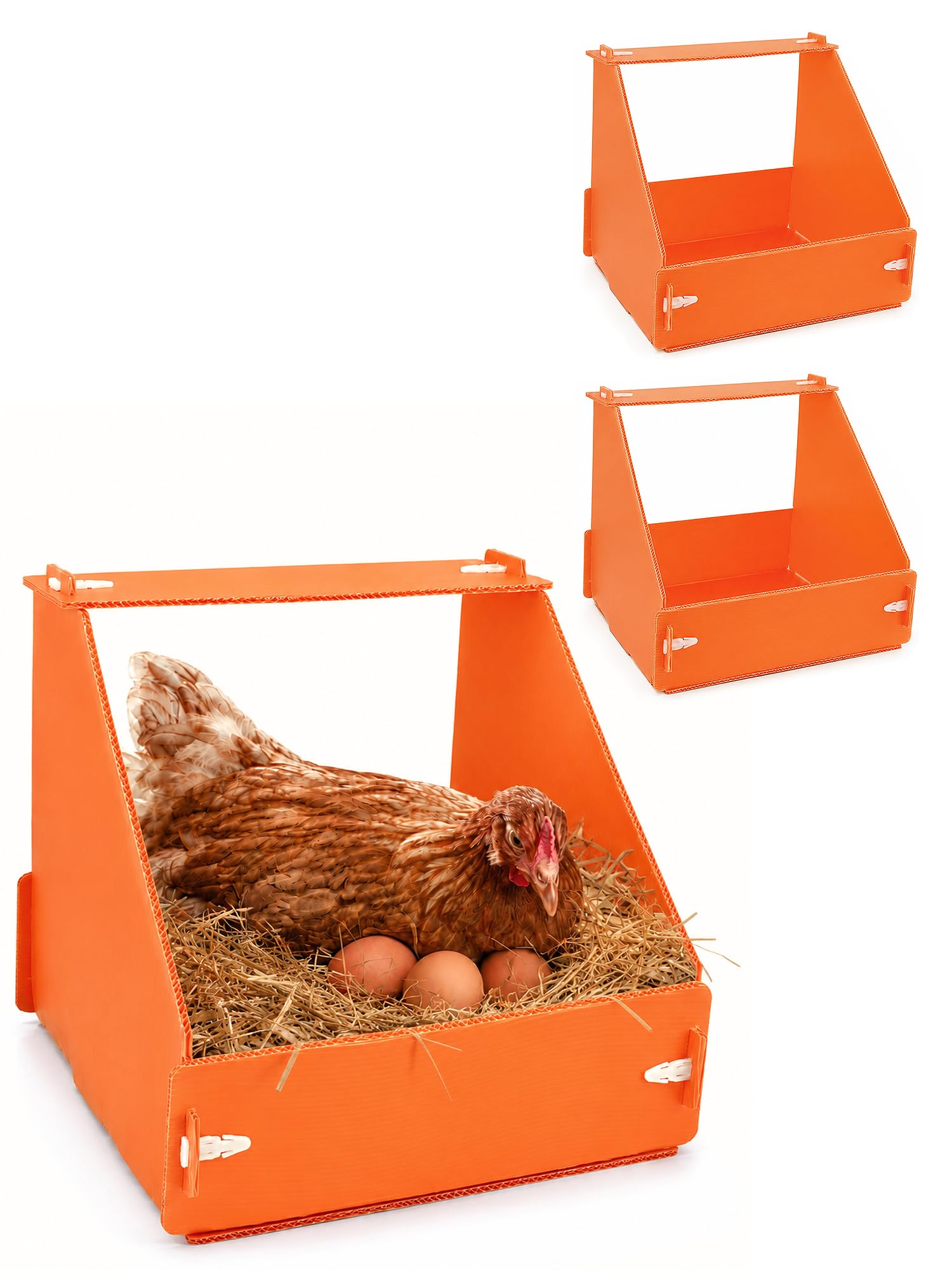
The lowest price here buys three nests folded from 0.2-inch polypropylene sheet, and that thickness explains everything about them. We treat these as a starter set or a stopgap: light, quick, and good enough for a handful of hens, but not something we count on for years in a damp coop.

Assembly really is tool-free. The panels are cut to slot together and the whole thing is held with Velcro, about a minute per box, and the cut-outs line up properly — more than you can say for a lot of flat-pack furniture.

Cleaning is a rinse and a wipe, and the 14.25 by 12.5 inch floor takes a standard 12-inch nesting pad almost exactly. The weaknesses show up over time: the panels are soft enough for a determined hen to peck, and the top ledge is floppy, which makes it a favourite roosting spot — and therefore a favourite place to soil the nest below.

What they're genuinely good at is the quick fix: a broody hen that needs her own corner, a hospital pen, a pullet's first eggs, three nests up before the weekend is out.

Bottom line: The cheapest way to put three nests up this weekend — folded polypropylene panels that suit a small flock and a tight budget, not a decade of service.

How We Tested the Best Chicken Nesting Boxes

We started by pulling every nesting box we could find that was genuinely sized for backyard flocks, then narrowed by capacity, mounting style, material, and price until we had 12 to test — a mix of roll-away designs, wall-mounted wooden boxes, and simple plastic lay boxes. Each one went into a working coop or covered run for seven months, with flocks ranging from four hens to about a dozen birds.

Assembly was timed and done solo, with a stopwatch running and the instructions propped somewhere I could actually read them. I noted whether hardware arrived sorted or in one bag, whether the pilot holes lined up, and whether the diagrams quietly assumed a second pair of hands. Once a box was built, I leaned my weight on the frame, shook the roost bar, and watched how it held when a heavy hen landed — leg stands that skated across concrete and wall brackets that flexed under load got marked down.

In use, I measured interior floor space against both a standard-size hen and a big dual-purpose bird, then watched whether the flock queued up at the entrance or settled in side by side. Cleaning meant scraping dried manure out of corners and seams, hosing down the tray, and seeing whether anything pooled or stuck. For roll-away models I penciled numbers onto eggs, timed how long each one took to reach the collection tray, and checked the shells for cracks, dirt streaks, and scratches at every collection.

After seven months outdoors, every hinge, latch, and screw got checked for rust, warping, and wobble, and I weighed what each box cost against how it looked by the end. The ones that came through a full cycle of weather and daily use without a loose part or a cracked egg are the ones that made the list.

How to Choose Chicken Nesting Boxes

Count nests before you shop

Plan on one nest for every four to five hens. That single rule decides whether you're buying one box, a pair, or a ten-hole wall — a flock of eight needs two nests, not eight, and a flock of thirty needs six or seven rather than one frame crammed with straw. The mistake we see most often is overbuying compartments, because six nests for four hens is six boxes to clean.

Underbuying is worse, since hens queue, squabble and eventually lay on the floor. If your flock is growing, buy a unit you can add to, like a two-pack or a three-compartment box, rather than a fixed ten-hole frame you can never shrink.

Walls, studs, and hanging height

Nearly every box here is a wall mount, which makes your framing part of the purchase. Backs are drilled for 16-inch on-center studs; if your coop is metal, wire mesh, or the studs fall in the wrong place, screw a sheet of plywood to the wall first and hang from that. Height is a compromise: low enough to reach comfortably, high enough to be out of a predator's reach — the maker of our top pick suggests about 24 inches to the bottom of a stacked set. Keep the boxes out of the direct line of a pop hole, where rain and draughts come through.

Roll-away floors and what they ask of you

A sloped floor lets a freshly laid egg roll forward into a tray, out of the hen's way and out of the muck. It's the best feature there is for clean eggs, and it comes with one condition: the bedding has to stay thin. A deep straw nest stops the egg exactly where it lands and the slope does nothing.

Roll-away boxes also put eggs where you can see them and where a determined egg eater can see them too, so check how far forward the tray sits. And check that the tray latches — a tray that slides out on its own is worse than no tray at all.

Plastic, steel, or folded sheet

Molded high-density polyethylene is what we look for. It doesn't rot, doesn't harbour mites the way plywood does, hoses out in minutes, and stays warmer to the touch than metal in winter. Galvanized steel earns its place when you need ten nests in a small footprint, but it's heavier, it can arrive bent, and the edges need checking before hens go near it. Folded polypropylene sheet sits at the bottom of the range: cheap, light, and soft enough for a bored hen to peck.

Perches, dark corners, and getting hens to use it

A perch at the entrance gives a hen somewhere to land before she commits, and a dark, enclosed box is the shape she's looking for. The rest is placement. Hang the new box where the old nest was, leave a fake egg or a golf ball inside, and give it a week — hens are conservative, and a box rejected on day one is often in use by day ten. Then watch the roost: if birds are sleeping in the nests, fit a higher roost bar and shut the boxes off late in the day.

Frequently Asked Questions

Final Verdict

For most backyard coops, buy the Little Giant single box first. It hangs on standard studs, hoses out, and the perch gets hens laying in it without a training campaign — and at three pounds you can add a second one whenever the flock grows.

If you already keep a dozen hens, go straight to the Miller four-pack and hang the whole laying wall in an afternoon. And if clean eggs matter more than anything else, the AugFir's roll-away floor earns its keep, provided you keep the bedding thin.