Greenhouses & Hydroponics

Best Grow Tent Ventilation Kits of 2026

A fan strong enough to hold a 4x4 tent at the right temperature is usually loud enough to hear through a closed door. That's the trade every grow tent ventilation kit asks of you, and it's why so many people end up buying twice — once for the airflow rating, once for the noise. Heat, humidity, and that unmistakable late-flower smell build up inside a sealed tent within hours, and the kit you hang is what clears them out.

We've hung 12 kits in tents running from a 2x4 in a spare bedroom to a 5x5 in a garage, and eight months in, the differences come down to less obvious things than peak power. Plenty of first-time buyers never account for this: the fan is only half the system. A filter rated below your fan's CFM, a duct run with two hard bends, or a sloppy speed controller will strangle a good fan and make it louder in the process. The kits below held their airflow, ran quieter than their specs suggested, and went up without a fight.

1

AC Infinity 4-Inch Air Filtration Kit

Top Pick
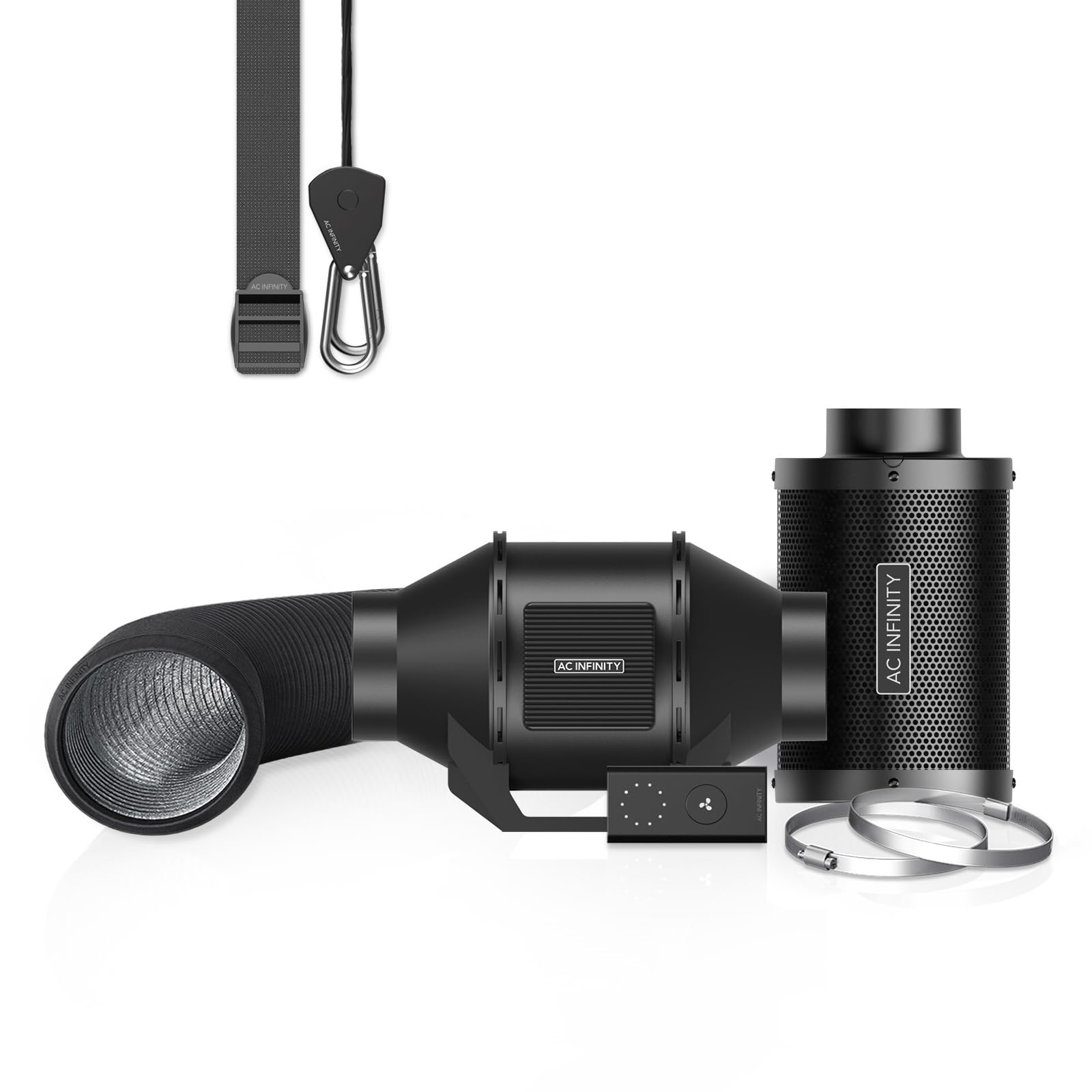
AC Infinity 4-Inch Air Filtration Kit

Small to mid tents

Our Score 9.6/10
Check Price

Worth Noting

  • The most expensive kit in this group
  • No temperature or humidity automation
Noise
29 dBA
Airflow
165 CFM
Ducting
25 ft
Carbon Bed
38 mm
Read the full review

Twenty-five feet of ducting is the first thing we noticed, because almost every other kit here ships eight. That length isn't a luxury: it's the difference between an exhaust that dangles out of the tent vent and one that reaches a window, a soffit, or the next room. Add a 38 mm carbon bed, four-layer duct, and a ten-speed controller, and this is the kit we recommend for most home grow tents.

The fan at the centre of it is a CLOUDLINE, rated at 165 CFM and 29 dBA. Neither number is the biggest here, and together they're the most useful: 165 CFM clears a 3x3 or a 2x4 with room to spare, and the low noise figure is what lets a tent live in a room you also sit in. The ten-speed dial matters for the same reason — it gives you somewhere to sit between inaudible and flat out.

Where it stops being the obvious answer is volume. A 4x4 tent, or a garage that bakes in summer, wants 200 CFM or more before a filter and a bend in the duct are counted, and this kit doesn't have it. The Spider Farmer and the VIVOSUN T4 are the picks for that job.

It's also heavier than most of the kits here at 7.88 kg, so plan the hang: upper poles, two ratchet straps, filter high and off the floor. Skip that and the tent's cross bar takes the weight and sags. The rest of the install is ordinary — hang, connect, plug in.

Bottom line: We recommend the AC Infinity kit as the default for a home grow tent: the 25 feet of duct, the quiet fan, and the finish are a step above the rest of this group.
2

VIVOSUN G4 Smart Filtration Kit

VIVOSUN G4 Smart Filtration Kit

Unattended humidity control

Our Score 9.4/10
Check Price

Worth Noting

  • 39 dB, the loudest rating in this group
  • Costs well above the T4
Noise
39 dB
Airflow
195 CFM
Ducting
8 ft
Controller
GrowHub E42A+ app
Read the full review

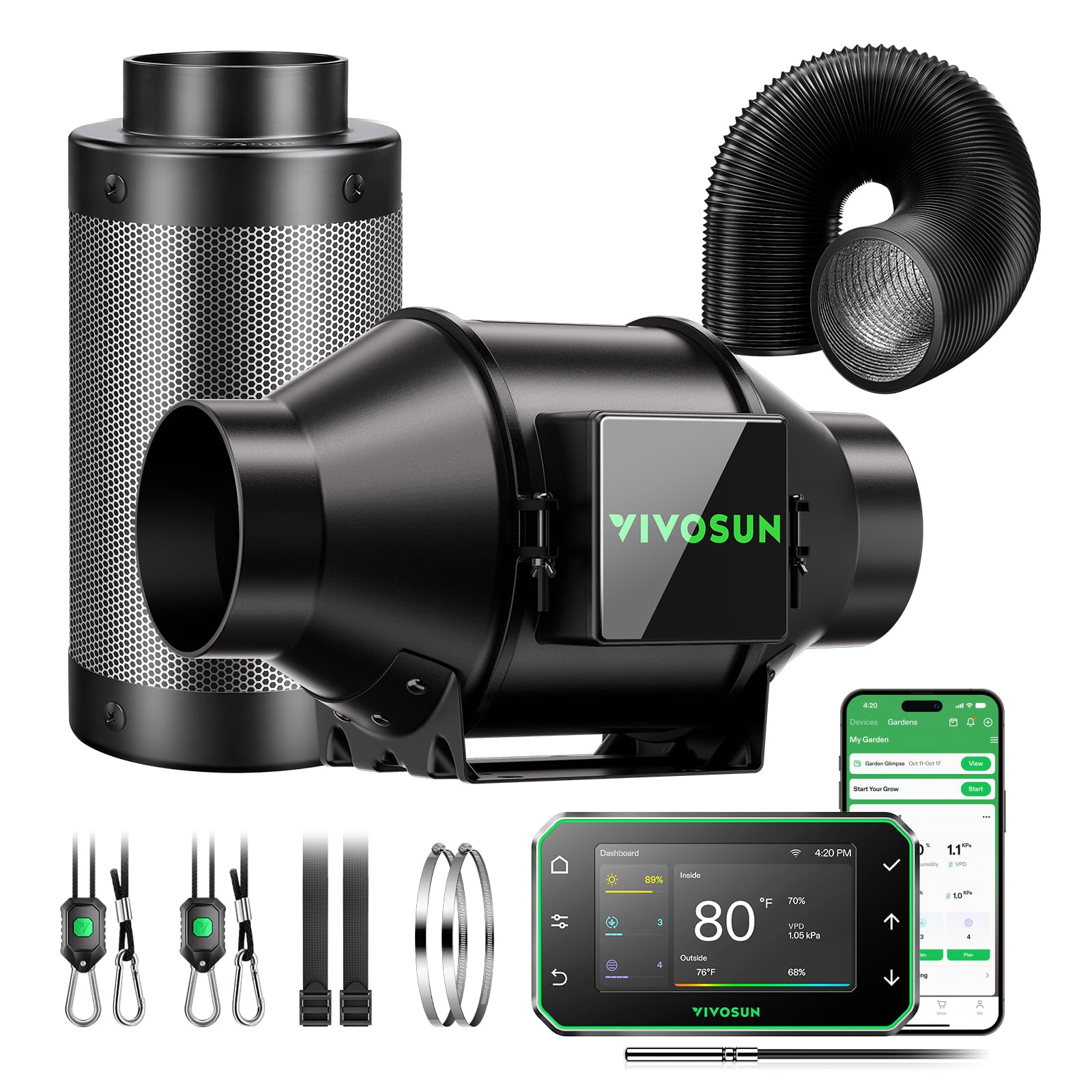
Humidity is what catches new growers out, and it moves at lights-off: the tent cools, the air can't hold what it held, and a fan set to one speed keeps running at exactly that speed. The GrowHub E42A+ controller in this kit reads temperature and humidity through a probe and switches the fan on when either crosses a threshold you set. That's the whole case for spending more than the T4.

The rest of the bundle is familiar VIVOSUN: an AeroZesh G4 fan at 195 CFM, a 4-inch carbon filter with the same 1200+ IAV charcoal, eight feet of duct. The app puts a graph of the last few days on your phone, which is the part we kept opening. Installation takes more thought than a plain kit because there's a probe to route and a controller to mount somewhere sensible.

If you travel, work late, or grow somewhere the weather turns before you get home, the automation is worth the step up, and no other kit here does it out of the box. If someone is home at lights-off most nights, the T4 does the same job with a dial and leaves you the difference.

Bottom line: We rate the G4 the automation pick: its GrowHub probe and app run the fan from temperature and humidity triggers rather than leaving you to turn a dial.

3

VIVOSUN T4 Air Filtration Kit

VIVOSUN T4 Air Filtration Kit

Airflow per dollar

Our Score 9.2/10
Check Price

Worth Noting

  • No temperature or humidity triggers
Airflow
210 CFM
Ducting
8 ft
Carbon Bed
38 mm
Controller
10-speed E12
Read the full review

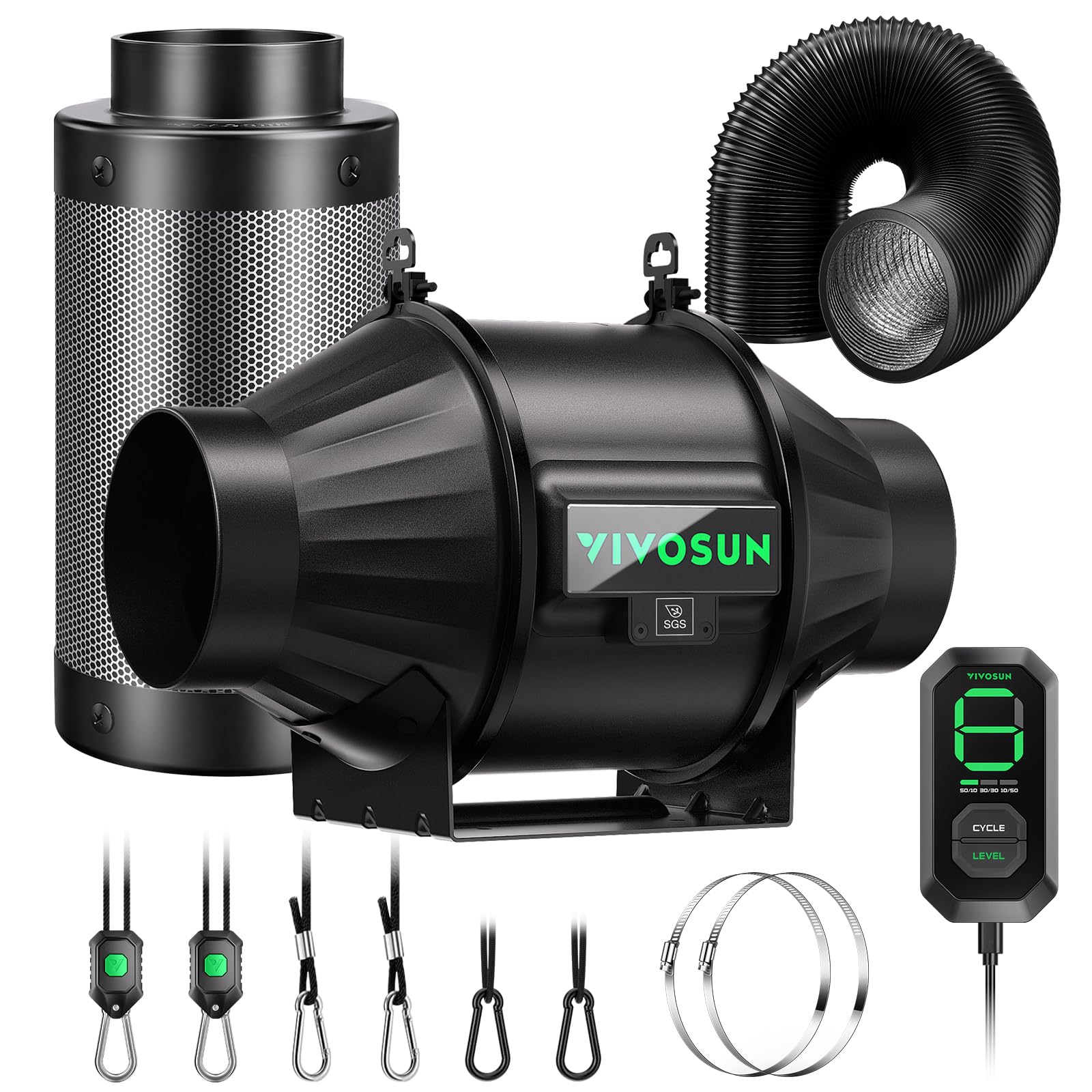
The T4's case rests on one comparison: 210 CFM against our top pick's 165, for noticeably less money. That airflow is what buys you a 4x4 tent, a filter, and a duct run with a bend or two in it without the fan spending its life at full speed.

The E12 controller keeps it from feeling like a budget kit. Ten speeds, PWM control, and a memory that brings the fan back to the setting it was on after the power cuts — a small thing that turns into a real convenience in a tent running on a timer. The filter is the same specification VIVOSUN puts in its pricier kits: 1200+ IAV charcoal in a 38 mm bed.

Eight feet of ducting is where the savings show. That's enough to join the filter to the fan and get out through a tent vent; it isn't enough to cross a room. If your exhaust has somewhere close to go, this is the smarter buy of the two VIVOSUN kits and of most of the field. If it has to travel, the AC Infinity's 25 feet is the reason to pay more.

Bottom line: We think the T4 is the best value here: 210 CFM for less than our top pick, plus a ten-speed controller that remembers its setting after a power cut.

4

iPower 4-Inch Kit with Monitor

iPower 4-Inch Kit with Monitor

Monitoring a small tent

Our Score 9.2/10
Check Price

Worth Noting

  • Speed control will not drop below half power
Airflow
118 CFM
Ducting
25 ft
Includes
Temp/humidity monitor
Speed Control
Does not adjust below 50%
Read the full review

A temperature and humidity readout on the tent wall turns ventilation from guesswork into something you can see: if humidity is climbing at lights-off, you know before the leaves do. That monitor is why the iPower kit is here. The 25 feet of ducting is the other practical advantage, and it's the same reach as our top pick for considerably less money.

The fan is where the savings went. At 118 CFM it moves the least air in this group, so a 2x3 or a drying closet is its ceiling and a 4x4 is out of the question. The prefilter, the reversible flange, and the one-year warranty round out a kit that makes sense for a first grow rather than a fourth.

Bottom line: We liked the iPower kit for the monitor in the box, which shows you what the tent is doing — just don't expect that fan to clear a big space.

5

Spider Farmer 4-Inch Filtration Kit

Spider Farmer 4-Inch Filtration Kit

3x3 and 4x4 tents

Our Score 9.0/10
Check Price

Worth Noting

  • Ducting is a tight stretch over the flanges
  • No built-in probe, app, or scheduling
Carbon
RC412 activated carbon
Airflow
205 CFM
Ducting
13 ft
Controller
RJ12 speed controller
Read the full review

Two hundred and five cubic feet per minute is the number to start with, because it puts this kit in a different class from the quiet small-tent fans. A 3x3 or a 4x4 with a carbon filter and any kind of duct run needs that headroom; 130 or 165 CFM leaves the fan pinned at full speed trying to keep up.

The fan uses an EC motor, the efficient sort, and it carries an RJ12 port so it can plug into Spider Farmer's own controller and power strip instead of running off its dial. If you already own their lights or their controller, that's the tidiest integration in this group — one schedule covering the whole tent.

Noise is the reason to think about where the tent lives. This is a garage or basement fan rather than a bedside one: 205 CFM through a 4-inch body makes itself heard, and a tent in a spare bedroom will want one of the quieter kits.

So this is our pick when the tent has outgrown a small fan and the budget stops short of the AC Infinity. The 13 feet of ducting gives you more reach than the eight-foot kits, the filter is a proper RC412 carbon unit, and it all goes together with hose clamps. In a 2x3, buy the Hon&Guan and keep the difference.

Bottom line: We chose the Spider Farmer kit for bigger tents: 205 CFM is enough for a 4x4, and the RJ12 port ties it into Spider Farmer's own controller ecosystem.

6

Hon&Guan 4-Inch Filtration Kit

Hon&Guan 4-Inch Filtration Kit

Small tents on a budget

Our Score 9.0/10
Check Price

Worth Noting

  • 130 CFM suits small tents only
Noise
26 dB
Airflow
130 CFM
Ducting
8 ft
Carbon Bed
38 mm
Read the full review

The Hon&Guan kit is the one we recommend for a 2x2, a 2x3, or a closet. It moves 130 CFM — a small-space figure, honestly labeled as one — and it does it at a quoted 26 dB, quiet enough that a tent in a spare room stops being the loudest thing in it. That combination, at a lower price than every kit here except the MELONFARM, is the whole argument.

The cable on the speed controller is short, so plan the hang around it: the dial needs to sit within reach of wherever the fan goes, which usually means inside the tent or right at the port. Everything else about the build is more than the money suggests. A rubber coupler seals the filter joint better than the hose clamps the other budget kits rely on, and the duct is three-layer rather than the usual thin foil.

Bottom line: The Hon&Guan kit is our budget pick for a 2x3 or a closet: it runs quiet, costs little, and still includes a proper 38 mm carbon filter.

7

MELONFARM 4-Inch Filtration Kit

MELONFARM 4-Inch Filtration Kit

Tight spaces

Our Score 8.6/10
Check Price

Worth Noting

  • One-piece design: a fan failure retires the filter
Noise
30 dB
Speeds
12
Airflow
260 CFM
Ducting
8 ft
Read the full review

The fan in this kit sits inside the carbon filter rather than beside it. That sounds like a gimmick until you've tried to fit a fan, a filter, and a length of duct into a 2x2. One cylinder hangs from the ceiling bar, the duct leaves one end, and there's no second thing to find room for. In a small tent that's a real gain, and it's the reason we kept it on the list.

The 260 CFM claim comes out of a short body, so treat the top of the twelve-speed dial as the setting for a hot afternoon rather than everyday running — the 30 dB figure is not a full-speed number. The charcoal is the same 1200+ IAV material the better kits here use, and the hexagonal mesh over it opens more of the filter surface than round perforations do.

It's also the cheapest kit here, which buys some patience. A 4x4 is out of reach for a fan this size, and that's the honest limit of the design; in a closet or a drying box, the limit never comes up.

Bottom line: For a tent with no floor space to spare, we point at the MELONFARM kit: fan and filter in one cylinder, at the lowest price in this group.

How We Tested Grow Tent Ventilation Kits

We built the shortlist by pulling every kit that ships as a complete system — fan, carbon filter, ducting, clamps, and usually a speed controller — and dropping anything that didn't publish a CFM rating or that left the filter out. From there we matched each kit to a tent whose volume it was actually rated for, from a 2x4 in a spare room to a 5x5 in a garage, and refused to run anything outside its stated range. That left 12 kits, from plain inline-fan bundles to EC-motor setups with digital controllers.

Each one went up the same way: filter hung from the crossbar, fan isolated with a strap or bungee, ducting run to the nearest vent with as few bends as we could manage. I timed the install solo with a stopwatch and noted where fit got fussy — ducting that wouldn't quite reach, clamps that needed two hands, a filter body too fat to hang without eating canopy space in a small tent. Then the tent ran 18/6 through veg and 12/12 through flower, week after week.

Airflow got checked by feel and by smoke: I watched whether the tent walls pulled in, then held a stick of incense at the intake and at the exhaust port to see how quickly it drew. Noise was a decibel reading at three feet, but the number I trusted more came from the next room with the door shut. On the speed controller, I dialled down to the lowest setting and listened for stall or motor hum, then back up to check the fan didn't surge. Eight months of near-continuous running exposed the rest: ducting that pinched, controllers that drifted, coatings that yellowed, and housings that buzzed against the tent frame once they'd settled.

How to Choose Grow Tent Ventilation Kits

Size the fan to the tent, not to the price

A 4-inch kit is the right size for most home tents, but the number that decides it is volume, not floor area. Multiply length by width by height in feet: a 2x4 standing 5 feet tall holds 40 cubic feet, a 4x4 at 6.5 feet holds about 104. In practice, 130 to 165 CFM suits the first once a filter is in the path, and the second wants 200 or more.

Two things eat capacity — the carbon filter and every bend in the duct — so buy headroom rather than running the fan flat out. A fan loafing two settings down from maximum is quieter and lasts longer than one pinned at the top of its dial.

Where the noise actually comes from

Fan noise rises with speed, so a larger fan turned down beats a small one turned up. That's why we favour kits with a multi-speed controller and a low dBA figure over a bare on-off switch: the fan can spend its life in the bottom half of the dial, where you stop noticing it. Vibration is the other half of the problem. A fan hard-mounted to a tent pole sends its hum into the frame and then into the floor, so hang it on straps and keep metal off metal.

Filters: bed depth beats badge words

Almost every kit here claims Australian virgin charcoal at 1200+ IAV, so that figure won't separate them. Bed depth will: 38 mm is the benchmark in this group, and a 10-inch filter body holds less carbon than a 12-inch one of the same depth. Watch the prefilter too — it keeps dust out of the charcoal, and a clogged one shortens the filter's working life. Buy a spare with the kit.

Ducting, flanges, and the fit nobody mentions

Eight feet is standard and covers filter-to-fan plus a short run out of a vent. It does not cover a window across the room, which is why the 25-foot kits exist. Check the diameter against the flanges before you commit: 4-inch duct over a 4-inch flange is a friction fit, and some of these need the duct worked over the inside lip rather than stretched around the outside. Four-layer duct survives that better than thin foil hose.

When automation is worth the money

A speed dial is enough for one tent with someone home most evenings. A ten-speed controller with memory earns its keep where the power blips, because the fan returns to its setting instead of defaulting to full. A temperature and humidity controller earns a bigger premium: it reacts at lights-off, when humidity spikes and nobody is watching. Buy automation only if the tent runs unattended; otherwise the money goes further on quiet hardware and longer duct.

Frequently Asked Questions

Final Verdict

Our own tent gets the AC Infinity kit. Twenty-five feet of duct, a fan that stays quiet in the range you'll actually use, and a finish that survives being taken down and hung again each season are worth the extra spend, and no other kit here puts all three together.

For a 4x4, or a firm budget, the VIVOSUN T4 moves more air for less money. For a tent that runs unattended, the G4's controller reacts at lights-off when nothing else here does.