Greenhouses & Hydroponics

Best Grow Tent Fans of 2026

Still air is the quietest way to lose a grow. Without a fan moving leaves and pushing humid air out of the canopy, a tent turns into a petri dish: condensation on the walls, damp pockets between buds, heat pooling under the light while plants stall. A fan fixes all three at once, and it builds sturdier stems while it's at it. The catch is that airflow and quiet pull against each other, and the models that move the most air are usually the ones you can hear through a closed door.

Over the past five months, my team and I have run 12 of them — pole clips, oscillating clip-ons, and ducted inline models — through full veg and flower cycles in tents ranging from a 2x2 on a dresser to a 4x4 in a garage. The pattern held: nothing is silent at full tilt, so the fans worth buying are the ones whose lowest speed is genuinely usable and whose clamp is still where you left it at week six. The ones that passed are below.

1

AC Infinity CLOUDLINE S4

Top Pick
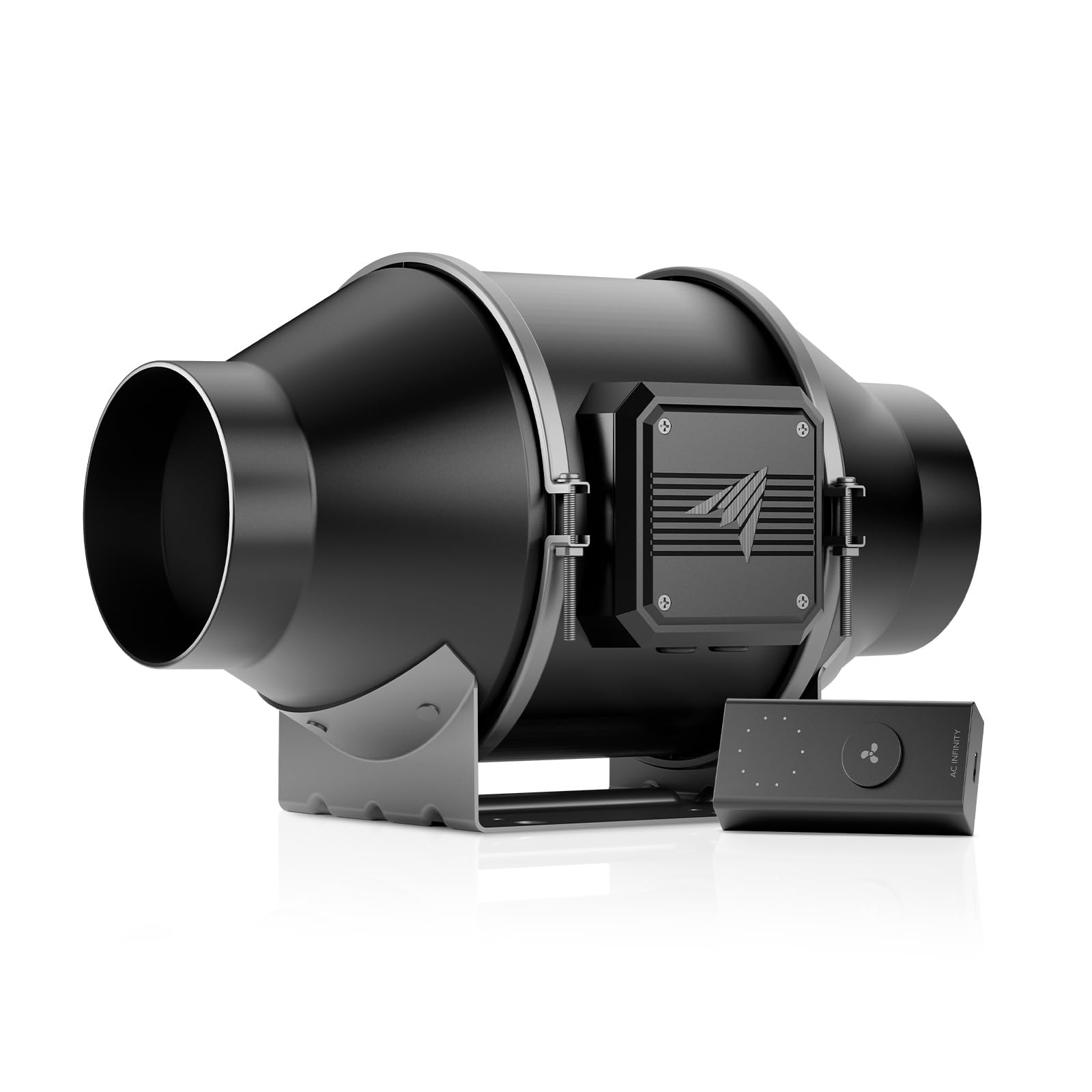
AC Infinity CLOUDLINE S4

Whole-tent exhaust

Our Score 9.4/10
Check Price

Worth Noting

  • Some units fail early; keep the receipt
Airflow
205 CFM
Control
Wired variable speed
Duct Size
4 inches
Noise Level
28 dBA
Read the full review

A 4-inch fan rated for 205 CFM at 28 dBA sounds like a spec-sheet trick until you hear how much air the CLOUDLINE S4 moves without filling the room with noise. We used it as the exhaust fan for a small tent, and the mixed-flow design is the part that matters: it has enough pressure to pull through a filter and a duct run, where a cheap axial booster tends to stall. The wired controller is another detail we appreciated, because you can mount it away from the fan and change speeds without crawling behind the tent.

At the low end, the fan fades into the background; at full speed, you will hear moving air, which is normal for any fan doing real work. The 10-speed control gives you room to find a setting that keeps the tent exchanging air without sounding like a jet. We also like that the 4-inch body fits a standard duct collar and that the controller cable is long enough to reach the tent door. It is the sort of practical layout that makes a fan easier to live with than a bare-metal blower.

For a small tent, this is the fan to start with; for a larger tent or a long duct run, step up to a bigger mixed-flow model rather than asking a 4-inch fan to do too much. The 4-inch collar matches the ducting most small tents already use, and the controller can live at the tent door instead of behind the canopy. That is the kind of small convenience you notice every time you adjust the airflow.

Bottom line: We recommend the CLOUDLINE S4 as the default exhaust fan for a small grow tent: it is quiet, controllable, and has the pressure to pull through a filter.
2

Spider Farmer 6" Clip Fan 2-Pack

Spider Farmer 6" Clip Fan 2-Pack

Canopy circulation

Our Score 8.8/10
Check Price

Worth Noting

  • Some units fail within a year
Airflow
315 CFM
Noise Level
33 dB
Oscillation
90° horizontal
Speed Settings
10
Read the full review

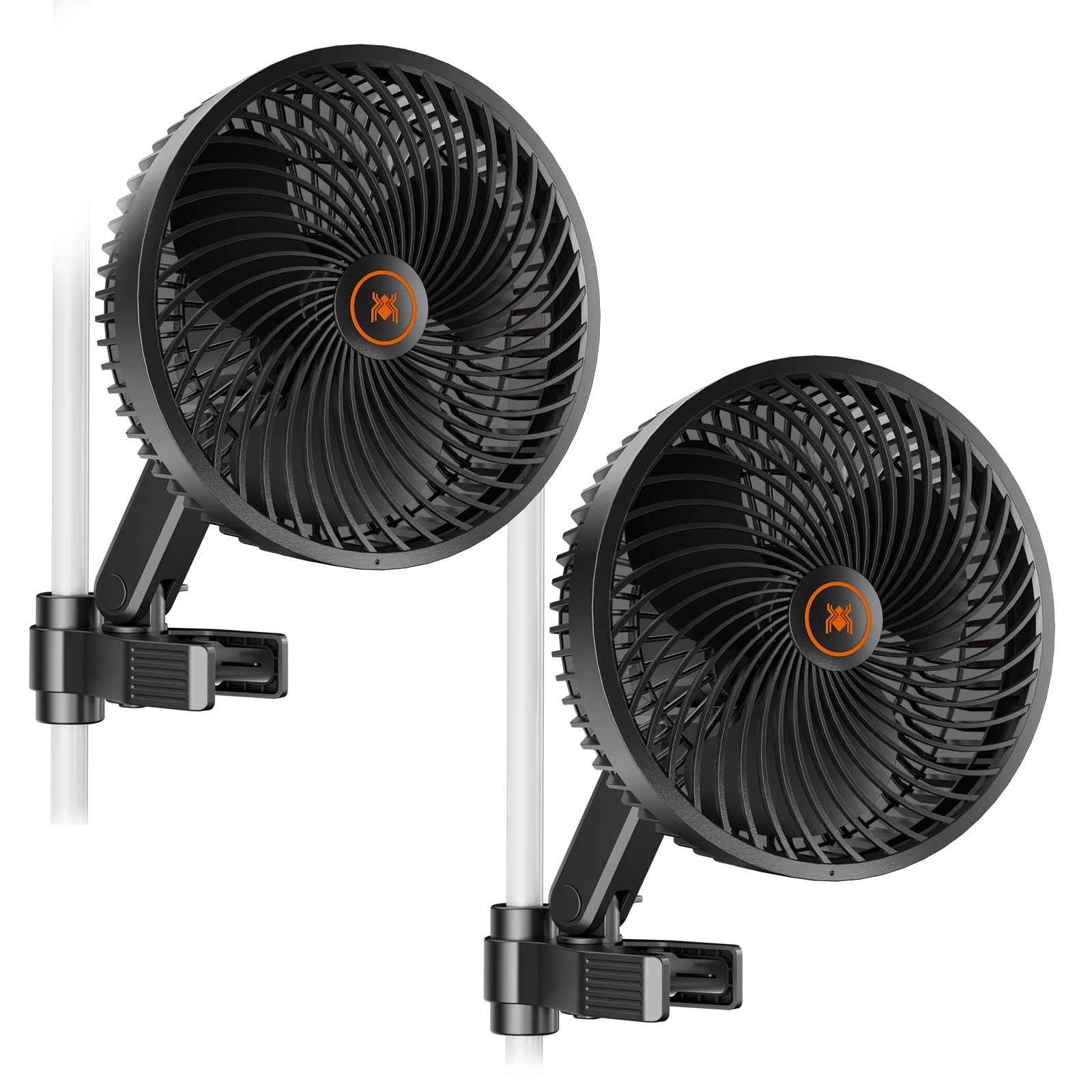
The two-pack is the reason to look at the Spider Farmer set: one fan clipped to each side of the canopy gives you gentler, more even movement than a single blower turned up high. Each fan is rated for 315 CFM at 33 dB, with 10 speeds and a 90-degree horizontal sweep. That is a lot of circulation for a clip fan, and the wide grip with rubber pads held onto our tent poles without scratching them.

We found the low end more useful than the headline airflow. On the first few speeds, the fan moves a soft breeze across seedlings without flattening them, and the clip stays put when you adjust the angle. The oscillation is the weak spot: some units stop sweeping, and the 90-degree range is narrower than the wide coverage the marketing suggests. The fan still blows when fixed, so it is a nuisance rather than a dead loss, but do not buy this pair only for oscillation.

Where the pair earns its place is coverage. Two fans on low are quieter and gentler than one fan on high, and you can aim each one at a different part of the canopy. We also appreciate the removable front frame, which makes cleaning the blades less of a chore. That flexibility is worth more than a single fan with a bigger number on the box.

Bottom line: We recommend the Spider Farmer pair for canopy circulation in a larger tent, where two gentle fans beat one blaster and the low speeds are genuinely useful.

3

AC Infinity RAXIAL S4

AC Infinity RAXIAL S4

Light-duty boosting

Our Score 8.8/10
Check Price

Worth Noting

  • Not for carbon filters or long duct runs
  • Full speed is audible
Airflow
106 CFM
Duct Size
4 inches
Noise Level
28 dBA
Speed Settings
3
Read the full review

The RAXIAL S4 is the support fan in this group. It is a 4-inch inline fan rated for 106 CFM at 28 dBA, with a three-speed dial and a die-cast housing. That combination makes sense for a short, straight duct run, a passive intake, or a small veg closet where a 205 CFM mixed-flow fan would be more than you need. It is also the least expensive way here to add a little ducted movement without buying a full exhaust setup.

We were pleasantly surprised by the build. The unibody die-cast body feels more solid than the plastic boosters here, and the balanced steel blades run smoothly at low speed. The three-speed dial is simple to use, and at the low setting the fan is easy to live with. It is the sort of compact metal housing that does not flex or rattle when you tighten it into a duct collar.

Where it earns a place is as a support fan: keep a small tent's air moving, boost a passive intake, or add a little extraction in a closet. We liked the simple three-speed dial for that job — set it and forget it. If you need one fan to do the tent's main exhaust, the CLOUDLINE is the better tool; the RAXIAL is the one for the job that does not need that much muscle.

Bottom line: We recommend the RAXIAL S4 as a light-duty duct booster for short runs and small spaces, where a compact three-speed fan is all the airflow you need.

How We Tested Grow Tent Fans in Real Tents

We started with roughly 40 fans on the market and cut the list down using the things that actually decide whether a fan works in a tent: whether the speed control was stepped or stepless and how low it could go, how the housing and clamp held up in the 60 to 70 percent humidity of a flowering tent, cord length, and airflow per dollar. That left 12 units, which we ran for five months from seedling through harvest across a 2x2, a 3x3, and a 4x4.

Noise was the first thing we logged, since most of these tents live in a spare room. We set a decibel meter three feet from the tent and again in the hallway with the door shut, taking a reading at every speed setting rather than just the loudest one, and noted when the lowest setting was still too loud to sleep beside and whether turning down cut the breeze to nothing. On oscillating models we watched the full light cycle: a few stalled or clicked at the ends of the arc within weeks, and more than one clamp crept down the pole under its own torque.

Airflow we measured with an anemometer at canopy height, then backed it up with a smoke test to see whether air reached the far corner or just churned at one end. A watt meter tracked draw at each speed so we could see what a fan costs to run 18 hours a day, and we wiped every housing weekly, checking grilles and blades for dust fouling. Build quality came down to small things: whether the clamp gripped a 16mm pole without shims, whether the housing flexed when we unplugged it one-handed, and whether it survived a knock off the frame onto concrete. Value, finally, was airflow per dollar at a speed we'd actually use — a cheap fan you can only run on high isn't a bargain.

How to Choose Grow Tent Fans

Match the fan to the job

An inline duct fan is the exhaust engine: it pulls hot, humid air out through a filter and duct run. A clip fan is for circulation inside the tent, keeping leaves moving and reducing stale pockets around the canopy. A small axial booster like the RAXIAL S4 sits in a third category, useful for a short straight duct run but not for pulling through a carbon filter. If you can buy only one fan first, buy the exhaust fan; add circulation once the tent is ventilating properly.

Airflow, pressure, and duct size

CFM gets the attention, but pressure is what gets air through a filter and a bendy duct. A mixed-flow fan like the CLOUDLINE S4 is rated at 205 CFM and is designed to work against resistance; a 4-inch axial booster is rated much lower and is happiest in a short, straight run. Match the fan to the duct collar you already own, and give yourself margin if the run is long. In a small tent, a good 4-inch mixed-flow fan can be enough; in a larger tent with a filter, a bigger fan is the safer choice.

Noise and speed control

Decibel ratings are usually taken at the quietest useful setting, so treat the number as a starting point rather than a promise. What matters more is how many speed steps you get and how low the fan can go. A 10-speed controller lets you run the fan just hard enough to keep the tent exchanging air; a three-speed dial is simpler but coarser. If the tent is near a bedroom or shared wall, pay for the finer control. We prefer a fan with a useful low end over one with a louder top end.

Oscillation, clip grip, and cleaning

For a clip fan, the clamp is as important as the airflow. Check the pole diameter it can grip, and look for rubber pads that stop it scratching or sliding. Oscillation should cover the canopy without hitting a wall or a light; a 90-degree sweep is useful in a small tent, while a larger canopy may need two fans. A removable front frame makes cleaning much easier, which matters because dust on the blades cuts airflow. If oscillation is the main reason you are buying, choose a fan with a strong warranty record.

Reliability and warranty

A grow tent fan often runs for hours at a time in warm, humid air, so long-term reliability matters more than a long feature list. Look for an IP rating on clip fans and a warranty you can actually use; keep the receipt and buy from a seller with easy returns. Even good fans can develop bearing noise or stop oscillating, and a replacement is easier than a repair. We treat a fan's first grow cycle as the real test, not the first afternoon.

Frequently Asked Questions

Final Verdict

The CLOUDLINE S4 is the fan we recommend first because it does the job a grow tent cannot skip: pulling air through a filter and out of the tent with enough pressure, while staying quiet and controllable. If your tent is larger or your duct run is long, move up to a bigger mixed-flow fan rather than adding a booster. For canopy circulation, the Spider Farmer two-pack is the better buy; the RAXIAL S4 is for light-duty boosting, not primary exhaust.