Greenhouses & Hydroponics

Best Grow Tent Carbon Filter of 2026

The smell is what gives an indoor grow away — not the light, not the fan noise. A carbon filter is the fix: a canister of activated carbon that your exhaust fan pulls air through on the way out, trapping the compounds that carry the scent before they leave the tent. Get the match right and a spare bedroom smells like a spare bedroom; get it wrong and you've hung a heavy metal can that chokes your fan and does nothing for the odor.

I've run a filter in my own basement for three years, and the mistakes I made early — buying oversized, skipping the pre-filter — are the ones I see in every grow forum. Over the past eight months, my team and I have run 12 carbon filters through full flower cycles, weighing airflow, odor control, installation, and how long the carbon holds up. One thing worth knowing before you shop: a filter rated well above your fan's CFM doesn't clean better, it just adds resistance. The picks below span everything from a single 2x2 to a packed 5x5.

1

AC Infinity Air Carbon Filter 4-Inch

Top Pick
AC Infinity Air Carbon Filter 4-Inch

Everyday odor control

Our Score 9.6/10
Check Price

Worth Noting

  • Not reversible or refillable when carbon is spent
Duct Size
4 in
Carbon Grade
Australian RC412, 1200+ IAV
Bed Thickness
38mm
Airflow Rating
210 CFM
Read the full review

If you want to stop shopping, buy this one. AC Infinity's 4-inch can gets the parts that decide whether you smell your tent from the driveway right: a 38mm bed of Australian RC412 carbon rated 1200+ IAV, a 210 CFM rating that suits the common 4-inch inline fan, and aluminum flanges that clamp onto ducting squarely.

We were also struck by how little is left to buy afterward. Two pre-filters, two straps and two rope clips come in the box, so it hangs from a tent pole the day it lands, and the spare wrap means a dirty pre-filter does not idle the filter while you rinse one. Powder-coated steel and aluminum are the right materials for a tent that runs at 70% humidity, and nothing on it rusts.

Where it gives ground is replacement. When the carbon is spent you buy another canister, since there is no flipping this one and no refilling it, which is exactly why the refillable kit further down this page exists. That is a cost question rather than a performance one, and at 12 inches and 5.5 pounds it tucks into the top corner of a 4x4 without crowding the light hangers.

Bottom line: We recommend the AC Infinity Air as the default 4-inch filter for a grow tent: proven carbon, a fan-friendly 210 CFM rating, and hangers in the box on day one.

2

AC Infinity Refillable Kit 4-Inch

AC Infinity Refillable Kit 4-Inch

Back-to-back cycles

Our Score 9.6/10
Check Price

Worth Noting

  • Most expensive canister in this set
Duct Size
4 in
Refill Method
Tool-free twist-off flanges
Refill Included
1+ refill, equal to two filters
Read the full review

Refilling a carbon filter sounds like a chore until you see the parts: the flanges twist off by hand, a funnel and scoop come in the box, and the fresh carbon goes in without being compressed. AC Infinity built this can around that routine instead of around the bin.

It is the most expensive filter here, and for a tent that runs cycle after cycle we think it is the right buy anyway. The included refill matches what two standard 4-inch canisters hold, so the premium is largely gone by the first time you would otherwise have bought a replacement, and you are not paying it again next season.

The body is a step up as well: dual-layer coated steel mesh, twist-off aluminum flanges, a hexagonal grill. At 5.74 kg with the refill pack it is heavy enough that it belongs on a tent frame or a rated cross bar, not hung off the fabric roof.

The honest catch is the refill itself. Opening a canister full of carbon over a tent floor is dusty work, and the scoop-and-funnel method is tidy rather than clean. Do it outside or over a tray and it is a fifteen-minute job once a season.

Bottom line: For a tent that runs continuously, we recommend the AC Infinity refillable kit: tool-free refills and enough included carbon to match two standard canisters.

3

VIVOSUN 4-Inch Carbon Filter

VIVOSUN 4-Inch Carbon Filter

First grow setups

Our Score 9.2/10
Check Price

Worth Noting

  • 90-day warranty on a consumable filter
Duct Size
4 in
Carbon Grade
Australian RC412, 1200+ IAV
Airflow Rating
223 CFM
Reversible Flange
Yes
Read the full review

Flip it. That is the trick with VIVOSUN's standard 4-inch can: the flange and base both unbolt, so once the carbon at the intake end has taken the worst of it you reverse the canister and let the airflow work on the fresher charcoal at the other end. It is not a second life, but it is a good chunk of one for ten minutes with a wrench.

The rest of the numbers hold up too. At 223 CFM it carries the highest rating of the standard cans here, the carbon is the same 1200+ IAV RC412 in a 38mm bed that our top pick uses, and the round-hole galvanized mesh is shaped to keep more of the surface open as the pre-filter loads.

We rank it as the value pick of the group, and what keeps it out of the top slot is stamina rather than performance. Carbon life in this line is uneven, running a full cycle in one tent and a matter of weeks in another, and the manufacturer's warranty covers 90 days, which sets the expectation plainly enough.

One thing to know before you buy: on a small fan or a long, bendy duct run, the restriction shows up as warmer air in the tent well before it shows up as smell.

Bottom line: With a fixed budget, buy the VIVOSUN: 1200+ IAV carbon, the highest airflow rating of the standard cans here, and a body you can flip to stretch a run.

4

vanleno 4-Inch Carbon Filter

vanleno 4-Inch Carbon Filter

Small tents

Our Score 9.2/10
Check Price

Worth Noting

  • Thin rope hanger feels like the weak point
  • Suited to small and medium tents only
Duct Size
4 in
Pre-filters
Two included
Carbon Grade
Australian, 1200+ IAV
Airflow Rating
210 CFM
Read the full review

The flange on this one can be a snug fit for 4-inch flexible duct, so warm the ducting, keep a hose clamp handy and give yourself five patient minutes before you hang it. Past that, the vanleno is the budget can we trust most in this group: 210 CFM and 1200+ IAV Australian carbon, two pre-filters and a rope hanger, all for about the same money as the cheapest can here.

Build is better than the money suggests. The inverted cone at the intake spreads air across the carbon instead of letting it punch a hole through the middle, both pre-filters are usable, and there are eye hooks at each end so you can hang it whichever way up suits the tent.

Two things we minded. The supplied rope hanger is the weakest part of the package, fine for a 5.4-pound can until you are tugging it into place one-handed. And it is a small-to-medium-tent filter: put a big fan behind it in a full room and you will want more carbon than this.

Bottom line: The vanleno is our budget pick: 1200+ IAV carbon, 210 CFM and two pre-filters, with a snug flange as the only real annoyance.

5

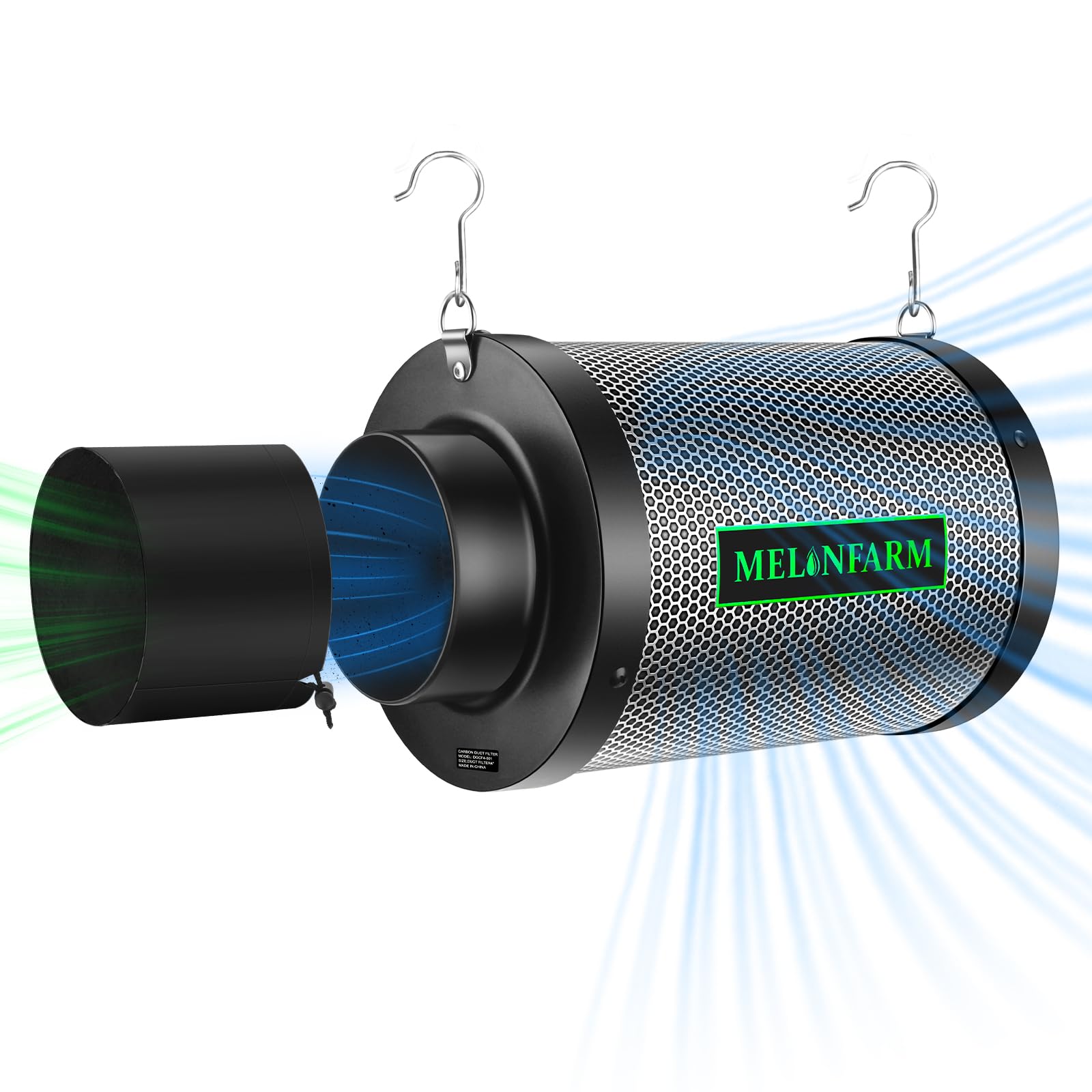
MELONFARM 4-Inch Carbon Filter

MELONFARM 4-Inch Carbon Filter

Single small tent

Our Score 9.0/10
Check Price

Worth Noting

  • 1050+ IAV carbon trails the 1200+ cans here
  • Fixed flanges rule out reversing or refilling
Flange
Fixed, non-removable
Weight
4.93 lb
Duct Size
4 in
Carbon Grade
Australian virgin, 1050+ IAV
Read the full review

The flange and base here do not come off, which tells you most of what you need to know: no reversing it, no refilling it, no swapping ends to chase fresher carbon. MELONFARM built a rigid body instead, with heavy steel at both ends and a 4-inch opening that takes a standard clamp.

The carbon is Australian virgin charcoal rated at 1050+ IAV, a step below the 1200+ cans that make up most of this group, held in double-sided galvanized mesh with a pre-filter in the box. It is rated for intake or exhaust use, and at 4.93 pounds it is among the lighter canisters here.

That carbon rating is the trade. In a small tent behind a matching fan, 1050+ IAV is plenty and you will never think about it. In a warm room with a packed canopy, lower-grade carbon is the first thing to give up, and it gives up quietly: you notice the smell long before you notice the filter.

So we keep it in the also-consider group, a fair can for one modest tent and outclassed the moment you want the same filter to last several cycles. If longevity is the point, the VIVOSUN's reversible body or the refillable AC Infinity kit buys more of it.

Bottom line: The MELONFARM suits a single small tent: a solid fixed-flange body and Australian charcoal, on the understanding that you replace it rather than refill it.

6

HYDROWE 4-Inch Carbon Filter

HYDROWE 4-Inch Carbon Filter

Cheapest entry point

Our Score 9.0/10
Check Price

Worth Noting

  • Odor control is the weakest part of the package
Length
11.8 in
Duct Size
4 in
Base Design
Cone-shaped internal base
Carbon Grade
Imported Australian activated
Read the full review

This is the cheapest filter here, and for one small tent it is a reasonable way to spend the least: steel flanges, galvanized mesh, a cloth pre-filter, a cone-shaped base and Australian activated carbon. The hesitation is odor rather than build. Of the cans on this page, it is the one we trust least with a heavy-scented run all the way through flower, so treat it as a small-space scrubber rather than a whole-room solution.

The design is sound for the money. The cone at the bottom of the canister spreads incoming air across the carbon instead of letting it punch straight through the middle, which is the sort of detail cheap filters usually skip, and the black-and-blue pre-filter is easy to spot when it wants a rinse.

It runs 2.99 kg and 11.8 inches long, so it hangs easily in a short tent, and the steel flanges take a standard clamp at either end for intake or exhaust duty. Nothing about it feels like a cheat at the price; it simply does not carry the carbon reserves of the cans above it.

Bottom line: The HYDROWE is the cheapest way into carbon filtration here, and a fair one for a small tent with a modest fan behind it.

7

Spider Farmer 4-Inch Carbon Filter

Spider Farmer 4-Inch Carbon Filter

Low-maintenance setups

Our Score 8.8/10
Check Price

Worth Noting

  • Longest body here, so check clearance
Length
13.39 in
Duct Size
4 in
Pre-filter
Removable, washable
Carbon Grade
RC412 Australian virgin charcoal
Read the full review

The pre-filter decides how long the expensive part lasts, and Spider Farmer makes it the easiest thing on the unit to deal with. It lifts off, rinses clean and goes back on without a fight, which turns filter maintenance into a two-minute job instead of a reason to procrastinate.

The rest of the build is light where that helps: aluminum flanges, coated galvanized mesh, RC412 Australian virgin charcoal, and 4.84 pounds, the lightest can in this roundup. That matters on the day you are holding it overhead on a stepladder with one hand.

It lands in our also-consider group rather than the runner-up slots, and the routine is the reason it stays on the page at all: pull the pre-filter, rinse it, refit it, and the carbon keeps seeing clean air instead of dust. We came away liking that more than the rest of the specification suggested we would.

Measure before you commit, though. At 13.39 inches it is the longest can here, and in a short tent that extra inch and a half is the difference between hanging level and fouling the light bar.

Bottom line: Where headroom allows, the Spider Farmer is a low-fuss 4-inch filter: a rinseable pre-filter, aluminum flanges and the lightest body here.

How We Tested Carbon Filters in Real Grow Tents

We started with every carbon filter we could find in the common 4-, 6-, and 8-inch flange sizes, then narrowed the field by matching CFM ratings against the inline fans people actually buy for 2x2 through 5x5 tents. From that list we bought 12 filters across the price range and ran each one for eight months.

Every filter spent the test on the same model of inline fan, in one of two setups: a 4x4 tent in a garage and a smaller tent in a spare bedroom with the exhaust ducted out a window. We read airflow at the duct mouth with the fan running alone, then again with the filter attached, and noted how much pull each canister cost — a densely packed filter that strangled a 4-inch fan made itself known in the first ten minutes.

Odor got judged by noses, not spec sheets. Through the last four weeks of flower, three of us walked in from outside and rated what we smelled, with one unfiltered control tent running alongside for comparison. We also tracked how each filter behaved as its carbon loaded up; some went from clean to obvious within a few weeks, while others held all the way through harvest.

Installation was timed solo with a stopwatch — hang it, seat the ducting, tighten the clamp, no extra hands. We took every filter down and rehung it at least twice, checking seams and rivets, and noted whether the pre-filter sleeve went on without a fight and survived a wash. For filter life, we weighed each canister at the start and again at the end, and priced replacement carbon wherever it was sold, since a cheap filter you can't refill quietly becomes a subscription. Value came down to cost per month of rated life weighed against what the thing actually did to the air in the room.

How to Choose the Right Grow Tent Carbon Filter

Match the can to the fan, not to the tent

The CFM figure on a filter is what it can pass, not what your fan will actually move through it. A 4-inch inline fan loses a real chunk of its free-air rating once ducting, a bend and a carbon bed are in the line, so a filter rated at or above the fan's free-air number keeps the fan from laboring and overheating the tent.

Everything in this group sits between 210 and 264 CFM, which is the right range for a typical 4-inch fan in a tent up to about 4x4. If you are running a bigger fan, step up the duct size rather than choking a 4-inch canister and wondering why the tent runs warm.

Four inches is nominal, so expect a snug fit

Buying a 4-inch filter and 4-inch duct does not guarantee they meet cleanly. Ducting is sized by nominal bore, flanges vary by a fraction, and thick-walled or insulated duct eats whatever slack there was. The trap is discovering this with the filter already hanging: dry-fit the two on the floor first.

Keep a hose clamp within reach, and warm flexible ducting in a bucket of hot water for a minute if it will not stretch over the flange. The vanleno here is the snuggest of the group; the AC Infinity flanges take ducting without a fight.

Carbon grade and bed depth tell you what you cannot smell yet

Two figures separate these canisters: the IAV rating of the charcoal and how thick the bed is. Australian RC412 at 1200+ IAV in a 38mm bed is the standard our better picks share; the one can at 1050+ IAV is a step down and spends faster in a warm, crowded room.

We care far more about bed depth than about how many pre-filters ship in the box. A spare pre-filter costs little to add later; carbon depth is fixed the day you buy. Ask for the bed thickness before you ask for the accessory count.

Replace, reverse, or refill

There are three ways to buy filter life and they suit different growers. A disposable canister gets replaced whole when the carbon goes, which is simple and cheapest up front. The VIVOSUN here can be reversed end for end, bringing fresher charcoal into the airflow. The AC Infinity refillable kit opens with twist-off flanges and ships with enough carbon to match two standard canisters.

One grow a year makes a disposable can the sensible buy. Run back-to-back cycles with something always in flower and the refillable kit stops looking expensive by its second fill, which is exactly the calculation it was designed for.

Hanging it, and the weight nobody mentions

A 4-inch can is five or six pounds of steel and carbon; the refillable kit is over twelve. That is not much until it is swinging from a fiberglass pole at three in the morning. We hang from the tent's metal frame or a rated cross bar, never the fabric roof, and we keep the filter on a different pole from the light so neither can take the other down.

Rope clips and straps come with most of these cans, which is one less thing to order. If you are buying a cheap one, budget for a proper ratchet hanger at the same time.

Frequently Asked Questions

Final Verdict

Our pick is the AC Infinity Air: 1200+ IAV carbon in a 38mm bed, a fan-friendly 210 CFM, and hangers in the box, so there is nothing left to order on install day. It is the can we put in a tent and stop thinking about.

Run cycle after cycle and the refillable kit is the better spend, even at the top of the price range. On a tight budget, the VIVOSUN gives you the same carbon grade, more rated airflow and a body you can flip.