Homesteading & Harvest

Best Grain Mills of 2026

A bucket of wheat berries will sit in your pantry for years without complaint, but the flour you grind from them starts losing its sweetness within weeks — that's the whole argument for owning a grain mill. Freshly milled flour smells faintly grassy and bakes into bread with a nuttiness that bagged flour can't touch. What stops most people is the sticker price and a nagging suspicion that a heavy, loud machine will end up on the shelf right next to the bread maker.

I've kept one mill or another clamped to my counter for the better part of a year, and the surprises weren't the ones I expected: the finest setting on a mid-priced mill and an expensive one are rarely the same, and a machine that handles wheat beautifully can gum up on oily grains like flax. Over eight months, my team and I put nine mills through wheat, corn, rice, and chickpeas. The ones genuinely worth your counter space are below.

1

NutriMill Harvest Stone Mill

Top Pick
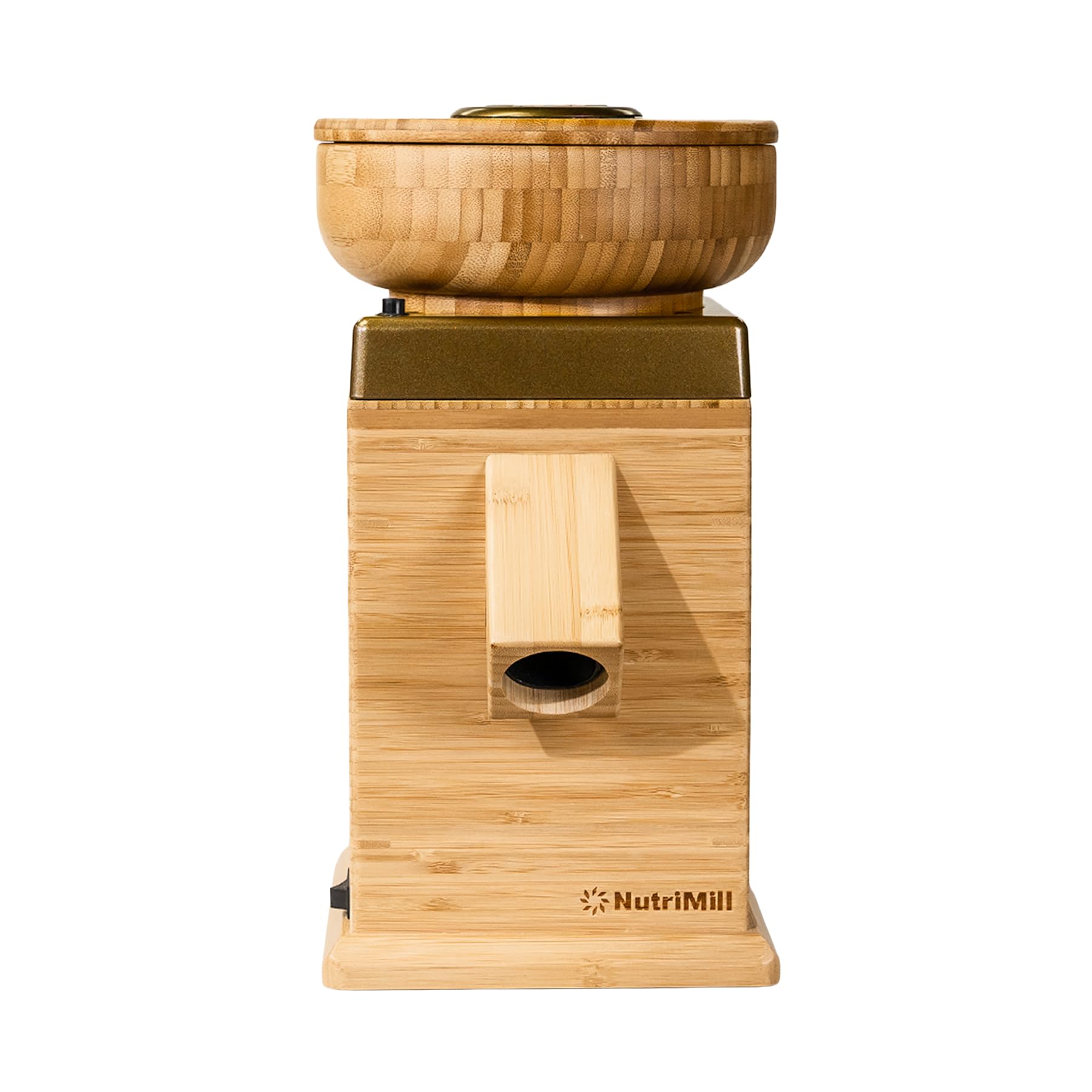
NutriMill Harvest Stone Mill

Everyday home flour

Our Score 9.4/10
Check Price

Worth Noting

  • Loud enough to plan your baking around
Motor
450 watts with thermal shutoff
Capacity
5 cups
Grind Control
Stepless texture knob
Milling Stones
Corundum, made in Germany
Read the full review

Pastry flour from soft wheat one weekend and cracked grain for Monday's porridge the next, one turn of the texture-control knob apart: that range is why the NutriMill Harvest is our top pick. The milling surfaces are corundum stones made in Germany, the motor is a 450-watt unit with thermal shutoff, the hopper holds five cups, and the whole machine is tested and listed by CSA. We trust it with fine flour because stones shear grain rather than smash it, so the flour comes off them cool — exactly what you want when you're milling hard wheat for a sandwich loaf.

The Harvest is also the best-looking mill here, and that isn't a small thing. Bamboo and aluminum, seven inches square and thirteen tall, finished in a soft gold: it reads as a piece of kitchen equipment somebody designed on purpose, which is why ours stayed on the counter instead of migrating to a cupboard. At 18.7 pounds it's light enough to move and heavy enough to feel planted, though it can creep on a polished surface while it runs, so give it a grippy mat or tuck it against the backsplash.

Day to day the routine is short: fill the hopper, set the texture, brush out the spout afterward. The thermal shutoff is the kind of protection you hope never to need. What gives us pause is longevity — the case and the stones feel substantial, but there's a motor and electronics in there, and that's the part that decides how many years of loaves you get. It's the one question no spec sheet answers.

Five cups at a time makes this a baking session rather than a bulk run, which suits a household turning out a loaf or two a week. It's the most expensive mill here, and it's the one we reach for first; if you mill most weeks, that cost spreads itself across a great deal of bread.

Bottom line: Buy this one if you mill most weeks and want flour that comes off the stones cool, from cracked grain to pastry fineness, out of a machine that looks good enough to leave out.
2

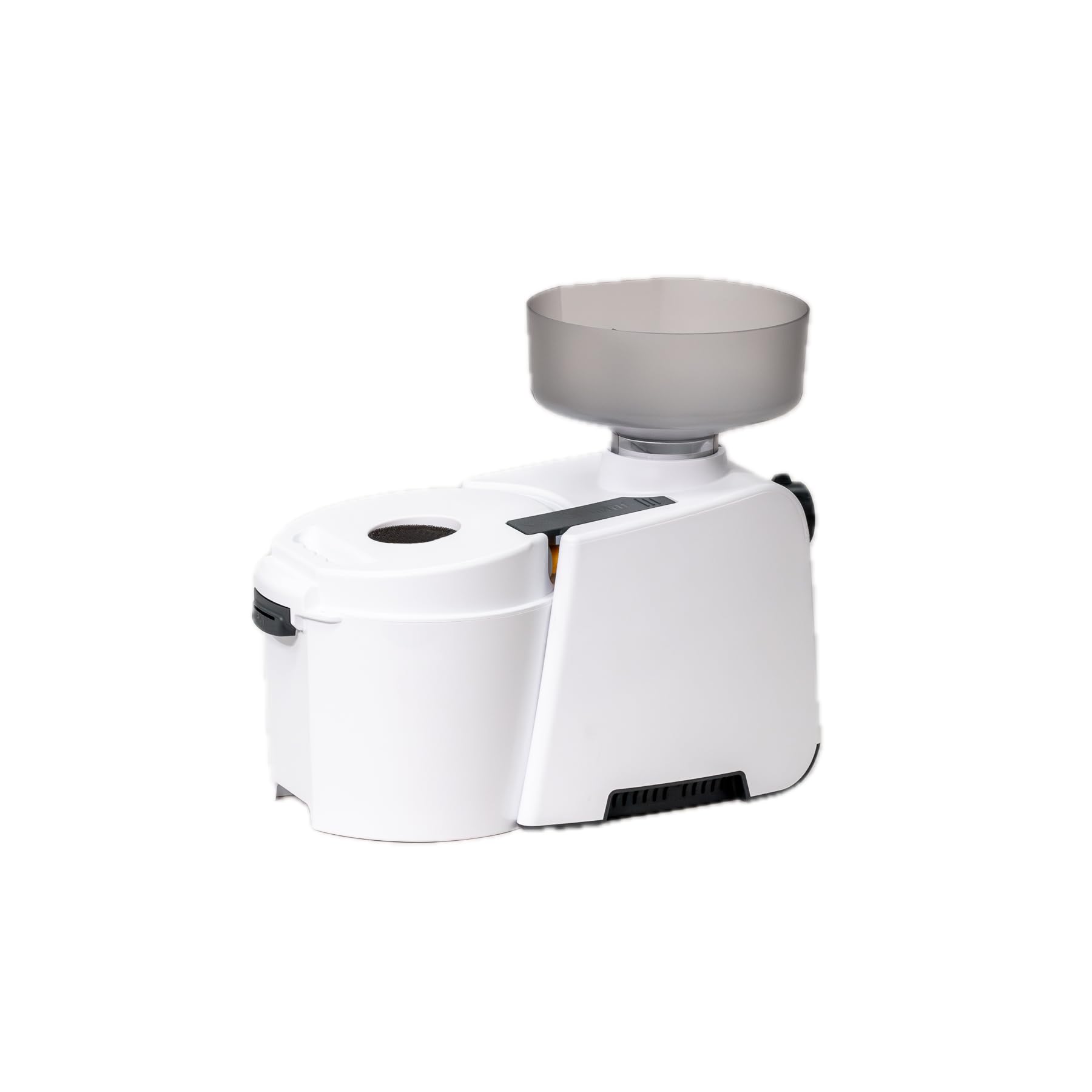
NutriMill Impact Compact

NutriMill Impact Compact

Fast, big batches

Our Score 9.2/10
Check Price

Worth Noting

  • Loud while it's grinding
  • No separate start button
Motor
1200 watts
Storage
Parts nest together
Milling Heads
Stainless steel impact
Hopper And Canister
8-cup hopper, 12-cup canister
Read the full review

Speed is the pitch, and it holds up: a 1200-watt motor drives stainless impact heads, an eight-cup hopper feeds a twelve-cup flour canister, and one run fills it. That's more flour per batch than the stone mills here and a great deal more than any mixer attachment will give you in a session.

What sold us is the rhythm it creates. You mill a large batch once, seal the canister, and bake from it twice or three times, which fits a working week better than grinding a single loaf at a time. Impact heads smash grain against a screen instead of shearing it between stones — faster, more aggressive, and the reason the cyclone air filtration matters, since airflow is what keeps the heads clear and the flour moving rather than clogging.

Storage is the quiet advantage: hopper, canister, and base nest together, so this is the one full-size electric mill here that packs into a cupboard between bakes. The thing to learn is the fill limit. The hopper doesn't make it obvious by eye, and overfilling is the fast route to a stalled or damaged machine, so measure grain into a cup rather than pouring from the bag.

It costs appreciably less than the Harvest and asks for less counter space, and in exchange you get a faster, warmer grind from a mill that is a little less forgiving about batch discipline. If you bake several loaves a week and want the flour done before the oven's up to temperature, this is the one.

Bottom line: This is the mill for a household that bakes several loaves a week and wants flour made quickly in large batches, without paying stone-mill money.

3

FOCOllK Grain Mill Attachment

FOCOllK Grain Mill Attachment

Low-cost mixer milling

Our Score 9.0/10
Check Price

Worth Noting

  • Dry, low-oil grains only
Body
Die-cast aluminum
Fits
KitchenAid stand mixers
Weight
3.25 lb
Grind Settings
9 levels
Read the full review

The least expensive mill in this guide does the one thing a mixer attachment has to do: it fits the hub on a KitchenAid stand mixer with no tools and no adapters, and it gives you nine grind settings from cracked grain down to a fine powder. The body is die-cast aluminum, it weighs a little over three pounds, and it's small enough that the drawer with the other attachments still closes.

Grinding is straightforward once you learn the sequence: start coarse and work down, because no attachment likes being asked to take hard wheat straight to its finest setting. Dry, low-oil grains are the remit — wheat, corn, oats, buckwheat, millet, coffee — and the manufacturer is explicit that peanuts, soybeans, and sunflower seeds are out. The grinding chamber detaches for cleaning, and cleaning means the brush; water never goes near it.

Our reservation is fit. On some mixers the attachment seats loosely, and a loose mill announces itself with a squeal that comes from the hub rather than the grind. Seat it firmly, run a small batch first, and stop if it rattles or the mixer's head starts to warm. A well-seated unit grinds quietly enough that you forget it's running, and for the money it's a reasonable risk to take on a mixer you already own.

Where it makes sense is as a trial: if you're curious about fresh flour and the mixer is already there, this gets you milling without buying another appliance. If it turns into a weekly habit, you'll want the capacity and speed of a standalone mill; if it stays a Saturday experiment, this is all the mill you need.

Bottom line: A low-risk way to try milling if you already own a KitchenAid, as long as you seat it firmly and stick to dry, low-oil grain.

4

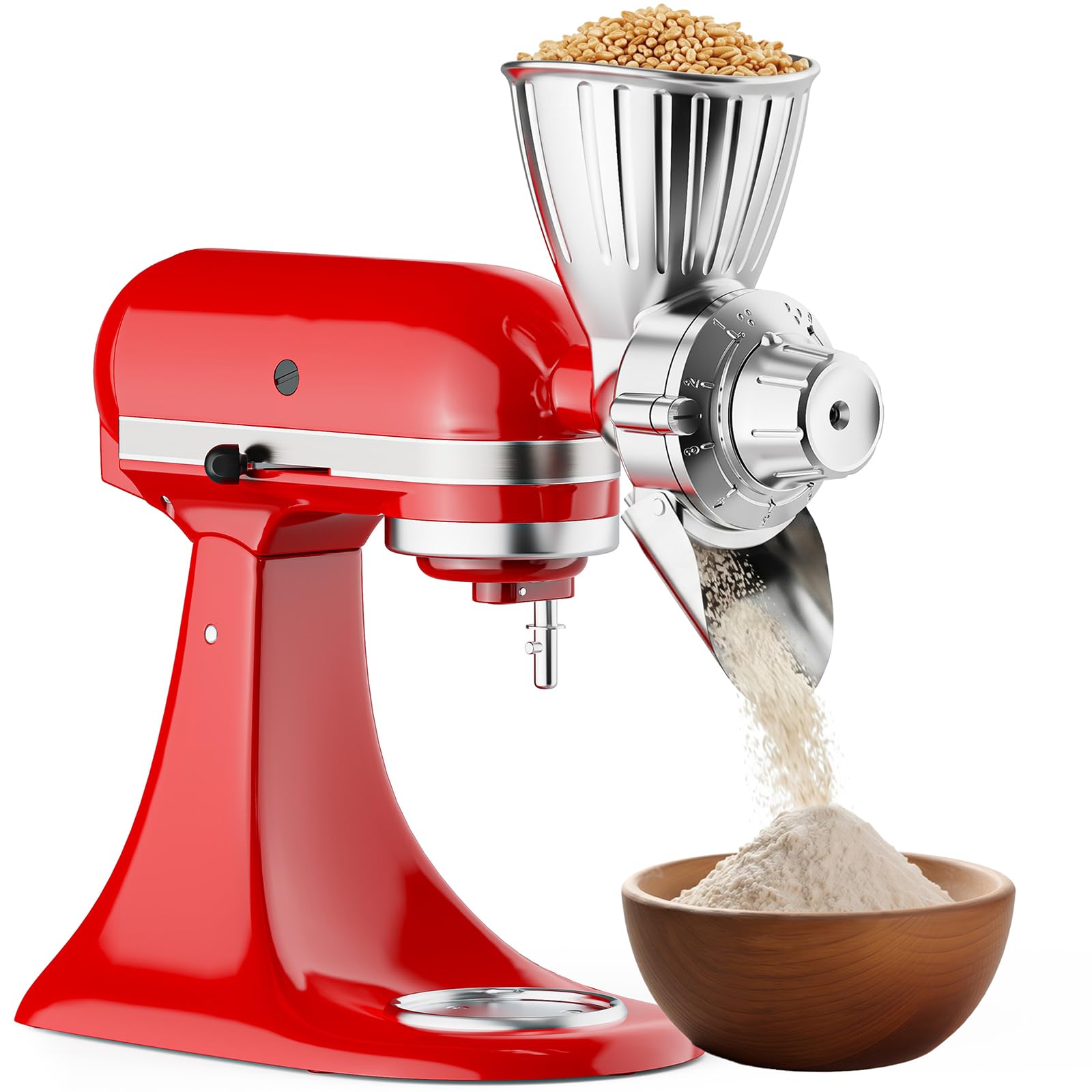
KitchenAid KGM Grain Mill Attachment

KitchenAid KGM Grain Mill Attachment

KitchenAid owners

Our Score 8.6/10
Check Price

Worth Noting

  • Slow going for a loaf's worth of flour
  • Long runs work the mixer hard
Body
All-metal aluminum
Fits
All household KitchenAid stand mixers
Dimensions
7.8"L x 4.5"W x 8.3"H
Grind Levels
12
Read the full review

If a stand mixer already owns a corner of your counter, the KGM is the shortest route to fresh flour. It mounts on the mixer's attachment hub, fits every household KitchenAid model, and brings twelve marked grind levels and an all-metal aluminum body to a machine you already own.

In use it's about as simple as an attachment gets. It clips on where the meat grinder goes, the lever clicks through the twelve settings, and you can change the setting with the mixer running. It's small — 7.8 by 4.5 by 8.3 inches — light enough for the drawer where the rest of the attachments live, and a cleaning brush comes in the box. For a cup of rice, a batch of oat flour, or a small run of wheat, that convenience is genuinely nice.

The catch is throughput. This is the slowest way to make flour in this guide: a loaf's worth of wheat takes a long session at the mixer rather than a few minutes, and the mixer's head warms up while it works. Fineness is the other limit — the finest setting gives you a decent whole-wheat flour for sandwich loaves, not the powdery pastry flour a stone mill produces. Keep batches small and let the mixer rest between them; a mill is a heavier load than dough, and long grinding sessions are hard on the machine.

It earns its place on the arithmetic of what you already own — no second appliance, no extra counter space, nothing new to learn beyond the dial. Bake bread a couple of times a month and want the grain fresh, and that trade is fair. Mill weekly for a family and a standalone electric will pay you back in time and flour.

Bottom line: Worth it if a KitchenAid mixer already lives on your counter and you want small batches of fresh whole-grain flour without adding another appliance.

5

LEJIEYIN 750g Grain Mill

LEJIEYIN 750g Grain Mill

Budget electric milling

Our Score 8.6/10
Check Price

Worth Noting

  • Three-minute runs, then a long cool-down
  • Flour packs into the cup and needs brushing
Motor
2000 watts
Capacity
1.65 lb
Run Cycle
3 minutes on, 5-10 minutes off
Blade Speed
25,000 rpm
Read the full review

The first thing you notice is how little time it spends working. A 2000-watt motor spins triple stainless blades at 25,000 rpm, and wheat berries go in coarse and come out as fine powder quickly enough that the grinding is finished before you've wiped down the counter. For the least expensive standalone electric mill here, that's a startling amount of force.

It's a pulverizer, not a stone mill, and the difference shows up in the routine. The instructions call for three minutes of grinding followed by five to ten minutes of rest, and the cup has to stay under two-thirds full. That's fine for flour for one bake and tedious if you're putting up several pounds on a Sunday. The motor also puts heat into the cup, so the flour comes out warm rather than cool the way stone-milled flour does.

Noise is the other thing to expect: this is blender-loud, the sort of sound that clears a kitchen. Cleanup is a brush job rather than a rinse — flour packs into the corners of the cup, the supplied brush doesn't reach all of them, and a dry pastry brush and a minute of patience finishes the job. Water never goes into the grinding chamber.

What we appreciate most is how broadly it earns its keep: rice for porridge, dried chilies, coffee, corn for cornbread, and wheat when you need it, all from one small machine that lives on a shelf. It's the mill we point to when someone wants to try home milling without committing to an appliance. Give it the cooling breaks it asks for and it keeps up with occasional baking; run it daily for a big family and you're asking more than the motor is built for.

Bottom line: A good buy if you want fast, fine grinding for occasional baking, spices, and rice, and you're willing to work around short runs and long cooling breaks.

6

Victoria Manual Cast Iron Mill

Victoria Manual Cast Iron Mill

Coarse grinds, corn

Our Score 8.6/10
Check Price

Worth Noting

  • Won't produce fine bread flour
  • Cranking takes real effort
Hopper
High hopper
Weight
4.4 lb
Clamp Range
1/2" to 2" thick surfaces
Grinding Discs
White iron
Read the full review

Two inches is the number to check before you order: the C-clamp opens for surfaces from half an inch to two inches thick, and it needs a lip you can hook under. Get that right and the Victoria is a genuinely good hand mill — 4.4 pounds of cast iron, white iron grinding discs, a wooden crank handle, and a high hopper so you're not refilling every minute.

Where it shines is coarse work. Field corn for cornmeal, cracked grain for porridge, coffee, dried beans, dried chilies — all of it comes out the way you want, at a speed set by how hard you crank. There's no cord, no motor noise, and nothing much to break. Where it disappoints is fine wheat flour for sandwich bread: the finest setting gives you a gritty meal rather than the pastry-fine flour a stone mill turns out. Buy it as a mill for corn, chops, and coarse meals and it does everything you ask.

A few practical notes. Clamp it to a sturdy table rather than a counter with a deep overhang, because the mill puts real torque through the clamp. The hopper seats loosely, so check it before you fill it. And cranking is work: a pound of wheat is a workout, five pounds is an afternoon.

None of that is a knock on the design so much as a description of what a hand mill is for. This is the mill that lives on a shelf and comes out for corn season, for a power cut, or for anyone who wants to know what grinding grain actually feels like — and it's one of the least expensive mills here.

Bottom line: A solid buy for corn, coffee, and coarse meals if you have a table edge under two inches and don't expect bakery-fine bread flour from a crank.

7

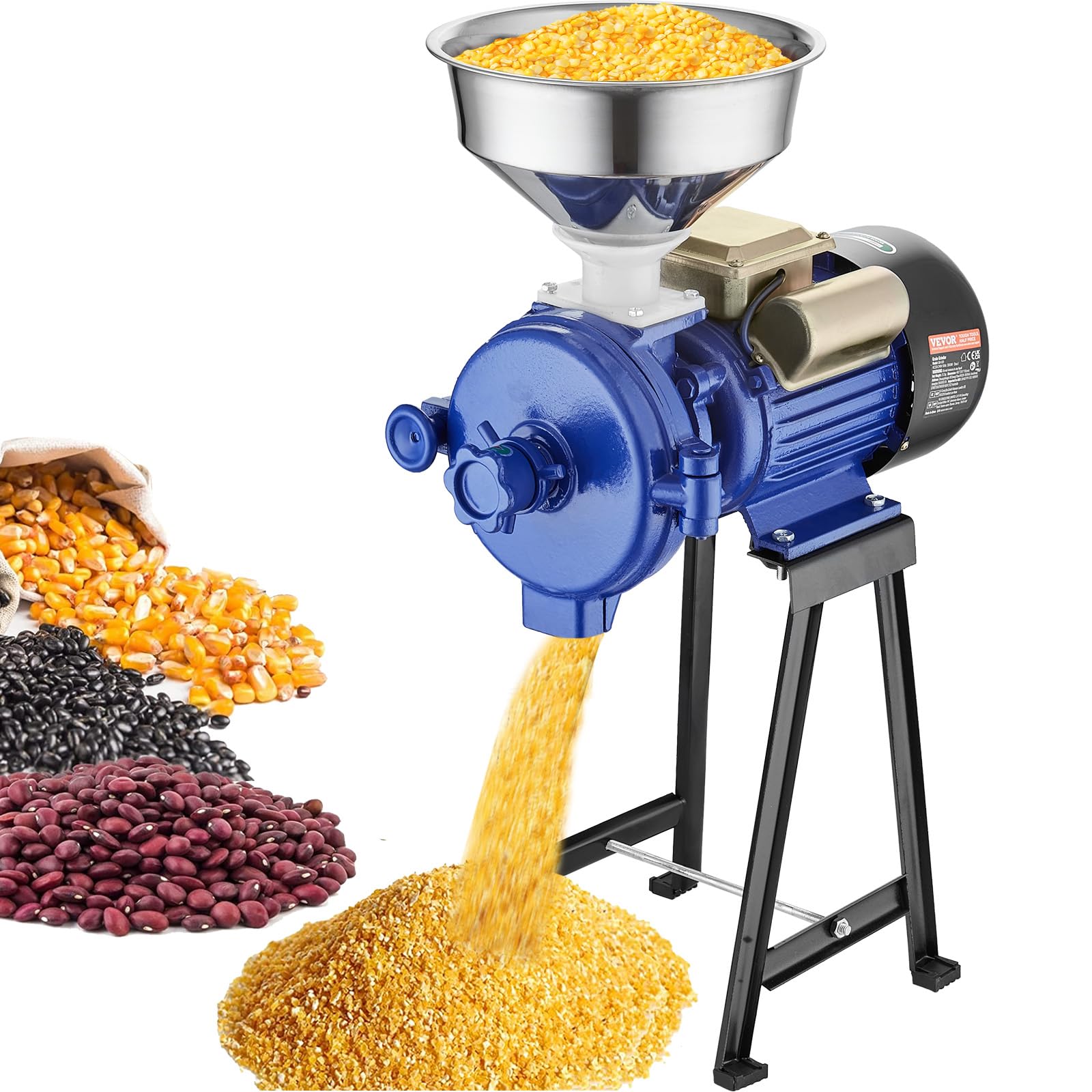
VEVOR 3000W Grain Mill

VEVOR 3000W Grain Mill

Big batches, feed

Our Score 8.4/10
Check Price

Worth Noting

  • 46.7 pounds; needs a permanent bench spot
Motor
3000 watts
Weight
46.7 lb
Dimensions
18.31"L x 10.04"W x 28.15"H
Grinding Plates
Cast iron
Read the full review

At 46.7 pounds and just over two feet tall, the VEVOR GM-001 is a mill you site rather than store, and that single fact tells you whether it's for you. Cast iron plates in a cast iron body, a stainless funnel on top, a 3000-watt motor, and a tension knob that takes the grind from cracked grain to fine meal — if you're putting up feed corn or a season's worth of meal, nothing else here is in the same class.

It grinds continuously and fast, which is the point of the motor and the plates: hard corn, soybeans, sorghum, and wheat all go through without the cooling breaks a small pulverizer demands. The tension knob adjusts while you work, so you can crack feed and then tighten down for a finer meal in the same session. Expect dust and a good deal of noise — set a bucket under the chute and put the machine where the mess doesn't matter.

Setup is the weak spot. There's no power switch on the body, so plan on a switched power strip, and the paperwork is thin enough that you'll spend a few minutes working out how the plates seat. Long term, the grinding plate is the part to watch; the rest of the machine is built to be maintained rather than replaced.

It isn't a pastry-flour machine and it isn't a kitchen-counter machine. It's the mill for a homestead, a big freezer, or a feed room, and for the money it's a serious amount of cast iron.

Bottom line: Buy this if you're grinding feed or putting up serious volume and can give a 46.7-pound cast iron machine its own permanent bench.

How We Chose and Tested the Best Grain Mills

We narrowed the field on paper first, looking at burr material (stone versus steel), motor wattage, hopper capacity, whether the maker sells replacement burrs, and price. Mills with a single grind setting or no parts support got cut before we plugged anything in. That left nine machines, from hand-crank models to countertop electrics.

For eight months, at least one mill lived on my kitchen counter, and every machine ground the same three things: hard red wheat for weekly sandwich loaves, corn for cornbread, and rice for a gluten-free blend. I timed how long each took to produce two cups on its finest setting and weighed the output to see whether the stated capacity held up in practice. To judge grind consistency, I sifted each batch through a fine mesh sieve, weighed what stayed behind, and rubbed the flour between my fingers to feel for grit. I also checked whether the flour came out warm, which tells you the burrs are heating the grain as they work.

Noise got measured at arm's length with a decibel meter and, more usefully, by whether a running mill woke a toddler napping one room away. After each session I took the machine apart and brushed out the burrs, noting where flour packed into corners and whether cleanup took five minutes or twenty. Ease of use was judged by handing the controls to a friend who had never used a mill, with the manual face-down. By the end, the top performers had run roughly 50 pounds of grain, and we re-checked the finest setting on each to see whether the burrs had drifted.

How to Choose Grain Mills

Stone, Impact, Blade, or Hand Crank

Stone mills shear grain between abrasive discs and run cool enough that the flour comes off them without heat; they also adjust steplessly from cracked grain to pastry flour, which is why the NutriMill Harvest is our default. Impact mills smash grain against a screen — faster, better at volume, and warmer. Blade pulverizers turn a cup of wheat into powder in seconds but need cooling breaks, and a hand crank trades all of that speed for silence and no cord. Choose the mechanism by what you bake most weeks, not by the motor figure on the box.

Wattage Tells You Less Than You Think

A 2000-watt pulverizer and a 450-watt stone mill are not competing on the same scale. Watts describe how much motor you have, not how fine or how even the flour will be; a small blade mill with a big number on the box still won't give you the pastry flour a slow stone does. Use wattage to judge how hard a grain the mill will take and how large a batch it can push through, then pick the mechanism that produces the texture you actually want.

Match the Batch to Your Weekly Bake

A five-cup hopper is a baking session; an eight-cup hopper feeding a twelve-cup canister is two or three. Think in loaves per week and decide whether you'd rather mill once and store flour or grind as you go. Then add the footprint: the full-size electrics here weigh between roughly eighteen and forty-seven pounds and want a permanent spot, while a mixer attachment or a hand mill lives in a drawer or on a shelf.

Check the Fit Before You Order

Two numbers decide whether a mill works in your kitchen. A clamp-on hand mill needs a surface from half an inch to two inches thick with a lip underneath, and a thick stone counter or a drawer front right below the edge can rule it out. A mixer attachment needs a stand mixer with an attachment hub, and fit varies between attachment makers, so seat it and run a small batch before you commit a bag of wheat to it.

Plan for Noise, Dust, and Cleanup

Every mill here is loud, and the quiet ones are quiet only relative to the rest. Grinding also throws flour dust around the spout and hopper, so a tray or mat under the machine saves you a wipe-down. And no grinding chamber should be rinsed: brush out the residue, keep the chamber dry, and accept that a little darker flour from the last batch will tint the first cup of the next one. Set the mill up where noise and mess matter least.

Frequently Asked Questions

Final Verdict

Most people who want fresh flour at home should buy the NutriMill Harvest. It grinds cool, moves from cracked grain to pastry flour with nothing but a knob, and it's built to sit out and be used. The price is the one real hurdle, and it's the reason the Impact Compact exists as an alternative: faster, bigger batches, less finesse.

If there's already a KitchenAid stand mixer on your counter and you want to try milling before buying an appliance, the KGM is the honest starting point — slow, but it works.