Homesteading & Harvest

Best Grafting Kits of 2026

A grafting kit is really two tools doing one job: a blade sharp enough to slice a scion without crushing the cambium, and a tape or wrap that holds the joint tight while it knits. Most home grafts fail on one of those two points — a dull knife that mashes the wood, or a wrap that loosens after a week of rain. The kit itself is simple; the difference between a good one and a cheap one is whether it lets you make that cut cleanly and keep it clean.

I've grafted apple and pear trees in my own yard for years, and this past season my team and I ran a dozen kits through real use — late-winter bench grafts at the kitchen table, spring field grafts on rootstock in the yard, and summer buddings on a plum. We looked at what came in each box, how the blades held an edge, whether a beginner could follow the instructions, and, most tellingly, how many grafts actually took. The kits below are the ones that earned a spot.

1

MIDOUWEST Grafting Knife Set

Top Pick
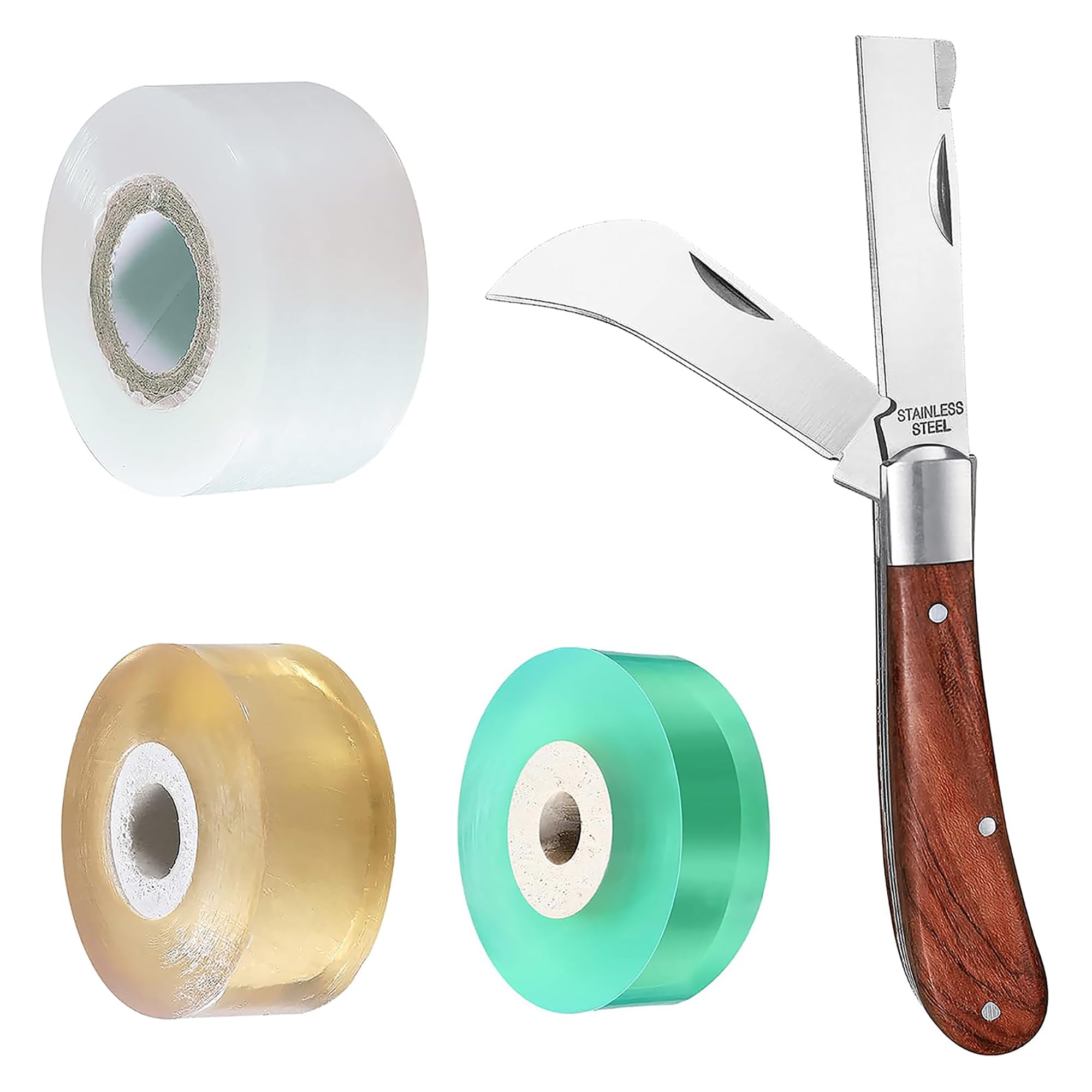
MIDOUWEST Grafting Knife Set

Budget knife kit

Our Score 9.0/10
Check Price

Worth Noting

  • Tape is thin and stretchy
Handle
Rosewood
Blade Shape
Curved and straight with bark lifter
Kit Contents
Knife and 3 tapes
Blade Material
2CR13 stainless steel
Read the full review

The MIDOUWEST knife set is the pared-down option: one folding grafting knife with curved and straight blades, a bark lifter, a rosewood handle, and three rolls of tape. There is no pruner, no spare cutter blade, no labels. For a gardener who already owns a grafting tool, that is not a shortage; it is the point.

We like it as the budget knife kit because the 2CR13 stainless blade takes a useful edge and the two blade shapes cover trimming and bark work. The handle is comfortable for a folding knife, and the three tape widths let you match the wrap to the stem. The catch is that the edge can arrive less sharp than a grafting knife should be, so plan on a little honing before the first cut; a few strokes on a stone make a real difference to how cleanly it slices.

That honing step is the price of the low-cost package, and it makes the knife a better match for someone who already sharpens garden tools than for a first-time grafter. If you want a knife that arrives ready to slice, the PUELDU kit is the better fit. The blade responds well to a stone, which is what keeps a budget knife in service.

Bottom line: The MIDOUWEST knife set is our low-cost route to adding a folding grafting knife and tape to a kit you already own.

2

NAYE 6-Blade Grafting Kit

NAYE 6-Blade Grafting Kit

Repeat blade swaps

Our Score 8.8/10
Check Price

Worth Noting

  • Blades may dull quickly on dense wood
  • Costs more than simpler knife-and-tape sets
Blade Styles
Omega, U, V
Blade Material
SK5 and #65 stainless steel
Blades Included
6 total
Branch Diameter
3/16–17/32 in
Read the full review

The NAYE kit is built around repetition: six cutting blades in total, three fitted and three spare, plus a separate grafting knife and tapes. That is the specification that matters if you graft a row of rootstocks in one sitting, because a dull blade stops the job faster than a missing accessory. We rank it as the best choice here for anyone who expects to wear through blades rather than baby one kit for years.

The pruner makes omega, U, and V cuts on 3/16 to 17/32 inch branches, and the Japanese SK5 blades are the part we trust most. The spare blades make it practical to keep working when an edge goes off. The grafting knife is a useful second tool for trimming and bark work, and the tapes cover both wrapping and sealing.

The blade-change routine is the part that tests your patience. It interrupts a rhythm, and the design of the retaining parts is fussier than on the simpler kits here. If you graft a dozen trees in a weekend, that interruption is a fair trade for the six-blade supply. If you graft one or two, a simpler kit will feel less fussy. The kit is also heavier than a knife-and-tape set, so it belongs in a tool bag rather than a pocket.

Bottom line: Six blades, a separate grafting knife, and tapes make the NAYE kit our choice for repeat grafting sessions and quick blade swaps.

3

PUELDU 3-in-1 Grafting Kit

PUELDU 3-in-1 Grafting Kit

Vines and labels

Our Score 8.8/10
Check Price

Worth Noting

  • Many small pieces to organize
Alignment
V-groove
Blade Count
3 interchangeable
Kit Contents
Pruner, knife, 32 ft tape, 30 labels, 6 clips, sheath
Blade Material
SK5 high-carbon steel
Read the full review

The PUELDU kit looks beyond the cut. Along with the three-blade grafting pruner and a folding grafting knife, it includes a 32-foot roll of self-adhesive tape, 30 plant labels, and six reusable clips. Those clips are the detail that separates it from a box of blades and tape, especially if you graft vines or thin stems that need support while the union knits.

We recommend it to gardeners who want the whole bench setup in one purchase. The SK5 blades are paired with a V-groove that helps align the scion and rootstock, and the kit gives you enough tape for a serious run of grafts rather than a single afternoon. The knife is a useful companion for trimming and bark lifting, and the pocket sheath keeps it from disappearing into a toolbox. The clips hold delicate vines without the crush of a tight tie.

The trade-off is that this is a bench kit rather than a pocket tool: the tape roll, labels, clips, and sheath take up more room than a folding knife and a single tape. For vines, roses, and modest fruit-tree wood, the PUELDU kit covers the job with fewer separate purchases. It is the set to leave in the potting shed, not tuck into a jacket pocket.

Bottom line: The PUELDU kit earns our recommendation when vines, labels, and tidy wrapping matter as much as the cut; the clips and long tape roll make it the most complete vine-friendly set here.

4

MIDOUWEST 6-Piece Grafting Kit

MIDOUWEST 6-Piece Grafting Kit

Two-tool simplicity

Our Score 8.8/10
Check Price

Worth Noting

  • No labels or clips included
Knife Steel
2CR13 stainless
Cutter Steel
SK5
Kit Contents
Cutter, knife, 3 tapes, twist tie
Branch Diameter
1/6–1/2 in
Read the full review

The MIDOUWEST six-piece set splits the work between two tools: an SK5 grafting cutter for the V, omega, and U cuts, and a 2CR13 grafting knife for trimming and bark work. That division makes more sense to us than a kit that asks one folding knife to do every job, especially when you are matching a scion to a rootstock and want a clean, repeatable cut.

We think it is the cleanest two-tool kit here. The cutter handles branches from 1/6 to 1/2 inch, and the kit supplies three rolls of tape plus a twist tie, so you can wrap and support a graft without hunting for extras. The rosewood-handled knife is a comfortable size for detailed work, though it is not the most refined folding knife in this group. The cutter's preformed jaws make the shape consistent, which is the main reason to choose this style over a knife alone.

The set is refreshingly uncluttered: no pruning shears, no second gadget to learn. That restraint is the appeal. If you already know you want a separate cutter and knife, this is the cleanest version of that idea in the group. If you are starting from zero and want every accessory in one box, the top pick is the safer buy.

Bottom line: We think the MIDOUWEST six-piece set is the cleanest two-tool kit here for grafters who want a dedicated cutter and grafting knife without a box full of extras.

5

ZALALOVA 2-in-1 Grafting Kit

ZALALOVA 2-in-1 Grafting Kit

All-around grafting

Our Score 8.6/10
Check Price

Worth Noting

  • Bulkier than a pocket knife and tape
  • Cutter tops out at 12 mm branches
Blade Styles
Omega, U, V
Kit Contents
Grafting tool, knife, 3 blades, 2 films, 160 bands, labels, wrench, screwdriver
Blade Material
#65 high carbon steel
Branch Diameter
5–12 mm
Read the full review

The ZALALOVA kit stands out because it removes the most excuses to stop mid-project. Alongside the two-in-one grafting tool and three cut profiles, it packs a separate grafting knife, two films, 160 rubber bands, color labels, a screwdriver, and a wrench. That is more consumables than many home grafters need for a first season, but it also means fewer trips back to the shed for tape, ties, or something to mark a branch.

We think that completeness is what earns it the top spot here. The pruner handles the typical range for home fruit-tree and rose grafts with omega, U, or V cuts, and the shaped jaws help scion and rootstock meet cleanly. The separate knife is not a token extra: it handles trimming and detail work when the preformed cutter is too blunt an instrument for the job. The whole set reads as a working kit, not a collection of fillers.

The rubber bands are the detail we appreciated most. Grafting tape holds moisture, but bands add pressure without the struggle of tying off a slippery strip, and having 160 of them lets you practice without rationing. The two film colors can separate graft types or dates, and the tag cards save you from trying to remember which branch got which scion.

The kit is not delicate. The high-carbon steel and ABS handles feel like workshop tools rather than a novelty set, and the separate knife gives you a second option when a preformed cut is not the right shape. Nothing in the box feels like a placeholder, which is rare in a kit that also supplies the consumables.

Bottom line: For most gardeners, we think the ZALALOVA kit is the one to buy: it covers cutting, wrapping, and labeling in one box, with enough rubber bands for a full season.

6

Glarks Grafting Pruner Kit

Glarks Grafting Pruner Kit

Thicker branches

Our Score 8.6/10
Check Price

Worth Noting

  • Only two spare blades included
  • Bulkier than a folding knife
Blade Styles
Omega, U, V
Kit Contents
Grafting pruner, 2 spare blades, tape, 36 bands, wrench, screwdriver
Blade Material
#65 high-carbon steel
Branch Diameter
5–14 mm (0.2–0.55 in)
Read the full review

Glarks gives the grafting pruner a little more reach: the three blade profiles handle branches from 5 to 14 mm, while the ZALALOVA tops out at 12 mm. That two-millimeter difference is not dramatic, but it matters when you are working through pencil-thick rootstock and do not want to switch tools.

The set includes the pruner, two spare blades, a wrench, a screwdriver, grafting tape, and 36 rubber bands. We found the rubber bands more useful than another roll of clingy film for holding a graft steady, and the wrench and screwdriver make blade changes less of a hunt for the right tool. The high-carbon steel blades cut omega, U, and V profiles, and the pruner body feels solid in the hand without being clumsy.

The Glarks kit is our pick when branch sizes creep above our top pick's range. It is the better complete pruner kit for thicker home-orchard wood, and the lower price leaves room for a separate grafting knife if you want one. What you give up is the top pick's broader accessory bundle; the Glarks kit is built around the cutter rather than around a bench full of supplies.

Bottom line: The Glarks kit is our pick when branch sizes creep above our top pick's range; it is the better complete pruner kit for thicker home-orchard wood.

7

KREWEY 2-in-1 Grafting Kit

KREWEY 2-in-1 Grafting Kit

Practice cuts

Our Score 8.2/10
Check Price

Worth Noting

  • Blades may need honing before use
  • Instructions are minimal
Blade Styles
Omega, U, V
Blade Material
#65 high carbon steel
Branch Diameter
5–12 mm
Handle Material
Plastic and steel
Read the full review

The KREWEY kit is a low-cost way to try the pruner-style grafting tool. It includes the two-in-one cutter and three blade profiles for 5–12 mm branches. If you are curious about the format and do not want to commit much, it gets you started.

The cut is where this kit separates from the better picks. The three profiles are useful, and the size range covers small fruit-tree wood, but the tool needs a light hand to avoid tearing the cambium. The body feels less solid than the Glarks or ZALALOVA cutters, and the blade-change routine is not as smooth.

It has the shapes you need, but it does not have the refinement that makes a long grafting session pleasant. Expect to slow down and check each cut rather than zip through a row of rootstocks.

We see it as a low-cost practice or backup cutter, not the set we trust for a first serious grafting season. The ZALALOVA kit gives you a cleaner starting point, and the Glarks kit is the better budget complete kit. The low price is real; the time you spend learning its quirks is the hidden cost.

Bottom line: We see the KREWEY kit as a low-cost practice or backup cutter; its three profiles are useful, but it is not the set we trust for a first serious grafting season.

How We Tested the Best Grafting Kits

To build the shortlist, we read nursery supply listings and grower forums, compared blade steel, handle shape, and what each kit actually includes, and filtered out anything that was mostly wax and stickers with a token knife. That left 12 kits, which we tested for eight months — from late-winter bench grafting at my kitchen table through spring field grafts in the yard and summer buddings. Every kit saw the same scion wood, the same rootstock, and the same weather.

Cutting performance was the first filter. I made a series of slicing cuts through apple and pear scions of the same diameter, then looked at the cut face: a clean, glossy slice means the blade severed fibers; a fuzzy, bruised end means it crushed them. We kept a log of how many cuts each blade made before it started tearing rather than slicing, and checked for rust, wobble at the ferrule, and loose handles after each session.

Tape got its own test: we wrapped joins on a dozen grafts per kit, left them through rain and two weeks of sun, then checked whether the tape still held tension or had gone slack and gummy. We also noted what came in each box and whether it was useful — a good knife and a roll of stretchy tape beat a kit with six blades and a plastic case. Ease of use mattered for the beginners on the team: could they follow the instructions and make a passable whip-and-tongue on the first try?

Value came down to what you actually reach for. A kit with one excellent blade and a good roll of tape often beat a bigger box of filler, even when the bigger box cost more. And at the end of the season we counted takes — how many grafts callused and pushed new growth — because that is ultimately what a kit is for.

How to Choose Grafting Kits

Start With Branch Size and Graft Style

The first check is the branch diameter the cutter is built for. Most home kits fall in the 5–12 mm or 5–14 mm range, which suits pencil-thick fruit-tree wood and many ornamental stems. If your rootstock is regularly thicker, choose the wider cutter and do not force a smaller one. The blade profile matters too: omega and U cuts hold alignment well for beginner splice grafts, while a V cut suits a simple wedge. We prefer a kit with all three because it lets you match the cut to the wood rather than the other way around.

Decide Whether You Need a Cutter, a Knife, or Both

A pruner-style cutter makes repeatable shaped cuts, but a grafting knife is the better tool for trimming, bark lifting, and budding. That is why we favor kits that include both, especially for a first purchase. If you already own a cutter you trust, a knife-and-tape set like the MIDOUWEST is the more sensible buy. Look for a true single-bevel grafting knife; a double-bevel utility-style blade can still cut, but it is harder to keep flat against the stock for a clean slice.

Count the Consumables, Not Just the Blades

Tape, bands, ties, and labels disappear faster than most new grafters expect. A generous roll of stretchy tape and a supply of rubber bands matter more than a fourth spare blade you may never fit. We like bands for holding a graft steady while the tape seals moisture, and labels for keeping track of scion varieties. Check that the tape stretches rather than tears and that the bands still have elasticity; brittle supplies make a good cutter feel worse.

Check the Blade Change and the Lock

Spare blades only help if you can change them without a fight. Look for a kit that includes the wrench or driver needed for its own cutter, and expect to clean sap from the mechanism before it hardens. On a folding grafting knife, a secure lock is not optional: it should open smoothly and stay put in use. If the lock feels vague or the blade wobbles, choose another knife. A sharp edge is useful; a knife that folds at the wrong moment is a hazard.

Frequently Asked Questions

Final Verdict

For most gardeners, we recommend the ZALALOVA kit. It is the most complete set here: the three-blade cutter, separate grafting knife, tapes, 160 rubber bands, and labels cover cutting, wrapping, and record-keeping without a second order. That completeness is why it beats the simpler kits for a first orchard or a season of rose grafts.

Choose the Glarks kit if your branches regularly run wider than 12 mm, or the MIDOUWEST knife set if you already own a cutter and want a low-cost folding knife and tape. The KREWEY kit is a practice or backup tool, not the one we trust for a first serious grafting season.