Lawn Care

Best Garden Sprayer Pumps of 2026

A garden sprayer is three parts doing one job: a sealed tank, a hand pump, and a nozzle. You build pressure with your arm, and the tank is supposed to hold it until you squeeze the trigger. Nearly everything that goes wrong lives in the seams of that idea — a gasket that weeps at the collar, a wand that dribbles onto your wrist, a nozzle that mists when you wanted a stream. Get it right and the fence line, the tomatoes, and the roses each take one pass instead of three.

One spring I refilled a leaking sprayer four times to finish a single bed of boxwoods, and I've been fussy about them since. My team and I spent four months working through 14 pump sprayers, filled from the same spigot and hauled around the same beds, and the differences came down to seals and nozzles more than tank size. Most of us want one sprayer to do everything — weed killer on the driveway, fertilizer on the beds, a fine mist on the roses — and that versatility is exactly where cheap units give out. Below are the ones worth carrying around the yard.

1

SOLO 418 1-Liter

Top Pick
SOLO 418 1-Liter

Seedlings and pots

Our Score 9.2/10
Check Price

Worth Noting

  • Nozzle and bottle thread are the parts that fail
Capacity
1 liter
Operation
One-hand pump
Spray Patterns
Stream, shower, mist
Read the full review

The job this handles better than anything else here is the fiddly one: a tray of seedlings that needs a fine mist, four pots along a balcony rail, a patch of chickweed in a bed where hauling a two-gallon tank and a hose is absurd. Fill it, give it a dozen pumps, and the trigger gives you a stream, a shower, or a fine mist depending on where you set the nozzle. The nozzle turns so you can spray up at the underside of leaves without bending your wrist.

It holds a liter and weighs under ten ounces empty, so it lives on a shelf rather than on a hook in the shed. The trigger slides forward to lock, which lets you pump and spray at the same time instead of doing the one-handed juggle a trigger bottle forces on you. Pressure builds quickly and lasts through a windowsill's worth of misting without a top-up.

What earns it a place rather than a shrug is the control we got from it. The mist is fine enough that it does not drench seedlings, and the stream is tight enough to hit a single weed between pavers instead of wetting the whole gap. It is not a lawn sprayer — a gallon of mix would be ten refills — but for everything within arm's reach of a path, it is the pick.

Bottom line: For seedlings, pots, and spot weeds, we reach for this one-liter hand sprayer; its fine mist and locking trigger make it the most controllable here.

2

Roundup 190260 2-Gallon

Roundup 190260 2-Gallon

Full-lawn spraying

Our Score 9.0/10
Check Price

Worth Noting

  • Heavy once both gallons are in
  • No gauge to show remaining pressure
Warranty
5 years limited
Hose Length
36 inches
Tank Volume
2 gallons
Nozzles Included
3
Read the full review

Three tips come in the box with the Roundup, and they change how the sprayer gets used rather than just how it is advertised. The flat fan wets a fence line or a run of deck boards in two passes. The adjustable cone reaches into a shrub. The foaming tip lays a visible band on gravel or pavers so you can see the edge of what you have treated. It is the only sprayer here that ships with three.

That flexibility, plus the least fiddly routine in this set, is why it is our default. Assembly is fill, pump, spray; the shut-off locks on for continuous work; and the pressure-release cap vents air and liquid down and away from you rather than up into your face. That last detail is the difference between a calm finish and a faceful when you open a tank that still has pressure in it. Five years of limited coverage is the longest stated warranty here, and it is the quiet reason this one is worth the extra over a cheap tank.

The joints are where it gives ground. The wand inlet and the shut-off are the places this one starts to weep, and it is the same story on every tank sprayer here — the fix is a wrap of thread tape on the wand nut and a habit of checking the connections before you fill, not a different sprayer. If your spraying is a couple of pots on a patio, this is more tank than you need; a handheld does it with less to carry.

Bottom line: Three nozzle tips, a five-year warranty, and the easiest fill-and-spray routine in this set make the Roundup our default for lawns, fence lines, and deck cleaning.

3

PetraTools HD101 1-Gallon

PetraTools HD101 1-Gallon

Long reach

Our Score 9.0/10
Check Price

Worth Noting

  • Thirty psi maximum is low for tall spraying
Hose Length
52 inches
Item Weight
2.2 lb
Tank Volume
1 gallon
Maximum Pressure
30 psi
Read the full review

Fifty-two inches of hose and a 16-inch wand put the nozzle a long way from the tank. That is the point of this one: set it down in the row and reach the whole bed without dragging it, or treat the top of a hedge with your feet still on the ground. Nothing else here gives you that much distance.

The rest of the package is sensible. A one-gallon translucent tank with a funnel opening, built-in filters to keep debris out of the tip, two nozzles — an adjustable one and a fan — a pressure-release valve, and a body that weighs 2.2 pounds empty. That last figure matters: it is light enough to carry by the handle up a stepladder, which is more than the two-gallon tanks can say.

The parts that fail on this one are the small ones. The spring inside the spray handle, the pressure-release valve, and the nozzle are the pieces that take a sprayer out of service, and any of them can go early. The valve and the handle are replaceable and a spare nozzle costs less than a new sprayer, so budget for the possibility rather than being surprised by it.

We keep it for reach. If your spraying happens at the back of a deep bed, along a fence line behind shrubs, or up the face of a hedge, the extra hose is worth more than the extra capacity a two-gallon tank would give you, and the 2.2-pound body means you will actually lift it down and use it.

Bottom line: We keep it for hedge tops and back-of-bed spraying, where 52 inches of hose lets the tank sit on the path instead of in the mud.

4

Chapin 22541 Foaming 2-Pack

Chapin 22541 Foaming 2-Pack

Visible spray trails

Our Score 8.8/10
Check Price

Worth Noting

  • Foam tip is a poor fit for fine misting
  • Pump handle and cap threads are the fragile points
Nozzle
Foaming
Hose Length
34 inches
Tank Volume
1 gallon
Sprayers Included
2
Read the full review

Foam is a marking tool as much as a spraying one. The nozzle on this Chapin lays down a visible white trail, so you can see exactly which boards, bricks, or bed edges you have covered — and, more usefully, which ones you have not. Anyone who has sprayed a fence line twice in one place and not at all in another will get the appeal immediately.

The rest of it is familiar Chapin. A one-gallon translucent tank, a 34-inch reinforced hose, a 12-inch wand, an anti-clog filter, 60 psi on the cap, and a pump handle that stays comfortable over a long run. This listing is a two-pack, so one bottle takes the deck cleaner and the other stays loaded on the shelf. The pump handle and the cap threads are the fragile points on these — seat the cap square and do not force it.

We rate it as a specialist rather than a general sprayer. For weed killer along a bed edge, a fan or cone pattern gives a faster, more even band, and a foam nozzle drinks mix. Buy the pair when marking your coverage on a hard surface is the whole job: decks, siding, pavers, and the gravel strip under a fence line.

Bottom line: Foam is the whole argument for this pair, and we are convinced: it marks exactly which boards and pavers you have covered.

5

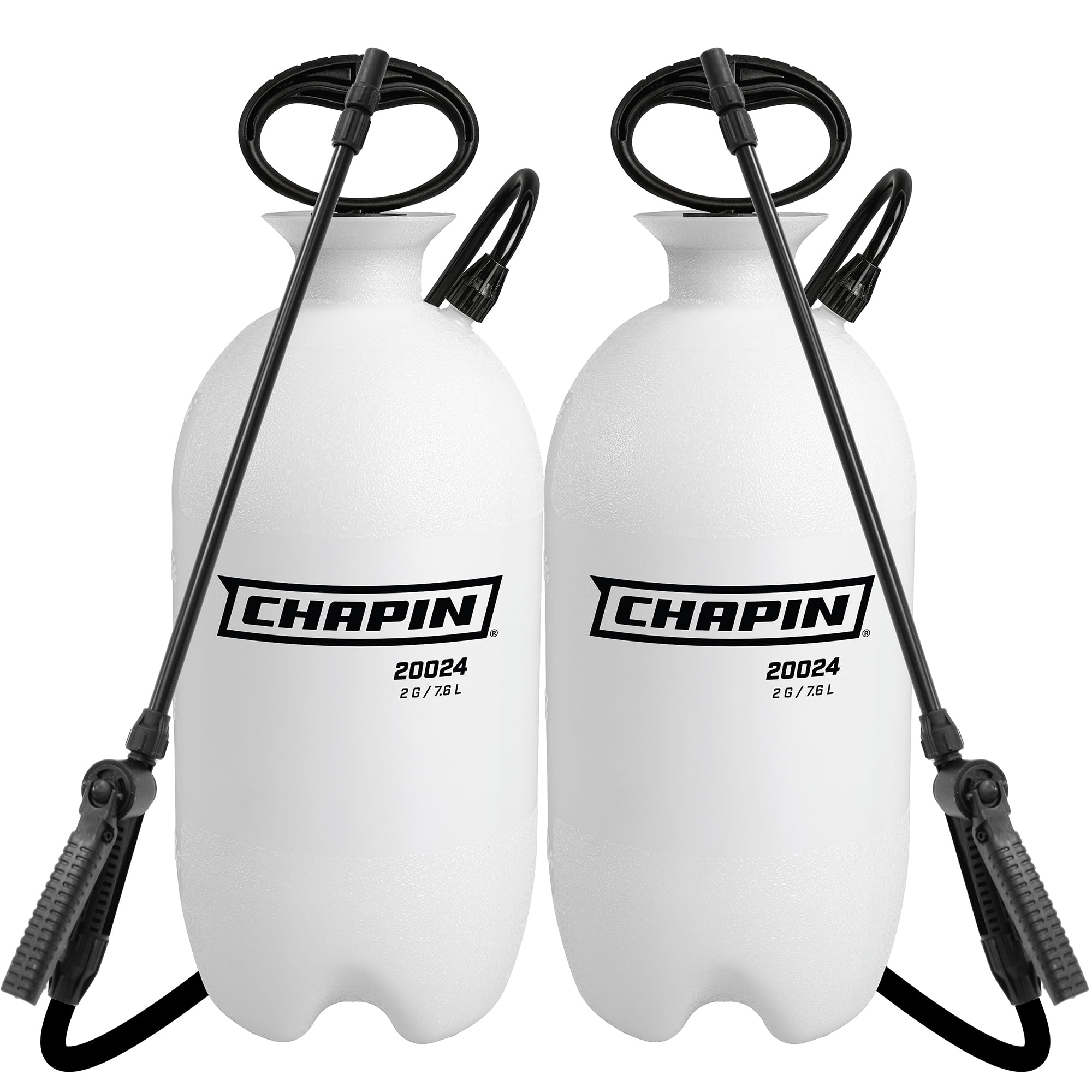
Chapin 20024 SureSpray 2-Pack

Chapin 20024 SureSpray 2-Pack

Two separate mixes

Our Score 8.6/10
Check Price

Worth Noting

  • Two full-size tanks need shelf space
  • One-year warranty against five on our top pick
Hose Length
34 inches
Tank Volume
2 gallons
Maximum Pressure
60 psi
Sprayers Included
2
Read the full review

The second tank in this pack is not a spare, it is a second mix, and that is the best argument for buying it. Weed killer stays in one, fertilizer or a fungicide in the other, and you never spend twenty minutes rinsing a tank to switch products mid-season. Two gallons each, translucent, with a funnel-shaped top that takes a pour straight from a bucket — we think the pair is the most practical thing here for anyone running more than one mix.

The tanks are the good part: wide funnel openings, a 34-inch hose, an adjustable cone nozzle, an in-tank filter to keep debris out of the tip, and 60 psi on the cap. The pump handle is the detail that decides your afternoon. It needs a firm push to seat and lock, and if it does not catch, the tank will not hold air at all. Seat it first, then pump, every single time.

Where the pair gives ground is at the lid seal and in the shed. The seal under the cap is where pressure escapes once these have a season on them, and two full-size tanks take up shelf space one would. Neither is a reason to skip it if you genuinely run two products. If you only ever mix one, buy a single tank and put the difference into a better one.

Bottom line: We recommend the pair for anyone running two mixes — a weed tank and a feed tank, always loaded, never rinsed between jobs.

6

Flo-Master 24101 1-Gallon

Flo-Master 24101 1-Gallon

Small yards

Our Score 8.6/10
Check Price

Worth Noting

  • Cone nozzle only; no fan or foam tip
  • One-year warranty coverage
Warranty
1 year
Hose Length
34 inches
Tank Volume
1 gallon
Item Dimensions
7.25"W x 15"H
Read the full review

There is nothing clever about the Flo-Master and that is rather the point. It is a gallon jug with a pump on top, a 34-inch hose, a wand, and an adjustable poly cone nozzle that goes from a mist to a pencil stream. Fewer parts than anything else here means fewer things to break, and a gallon is the honest size for a couple of beds and a fence line.

We think it is the right first sprayer for a small yard. Fill it, pump it, and the cone handles weed killer along a path edge, a foliar feed on the tomatoes, and a general soaking of a new bed — the familiar jobs where a two-gallon tank is more weight than the work deserves. The tank is translucent with a 128-ounce capacity, the body is corrosion-resistant, and it is small enough at 7.25 by 15 inches to store on a shelf.

What you give up is capacity. A full-lawn job means two or three refills, and if your spraying runs to a whole yard rather than a few beds, that gets old fast. For spot work, a small garden, and a first sprayer you are not sure you will use much, it is the sensible buy — and the one to hand a teenager who has been told to deal with the dandelions.

Bottom line: A plain gallon sprayer at the budget end that covers beds and fence lines without fuss; we think it is the right first sprayer for a small yard.

7

Happybuy 1-Gallon Stainless

Happybuy 1-Gallon Stainless

Pressure-critical jobs

Our Score 8.4/10
Check Price

Worth Noting

  • Heavy for its size, even before you fill it
Material
Stainless steel
Hose Length
3 ft
Tank Volume
5.4 liters
Maximum Pressure
87 psi
Read the full review

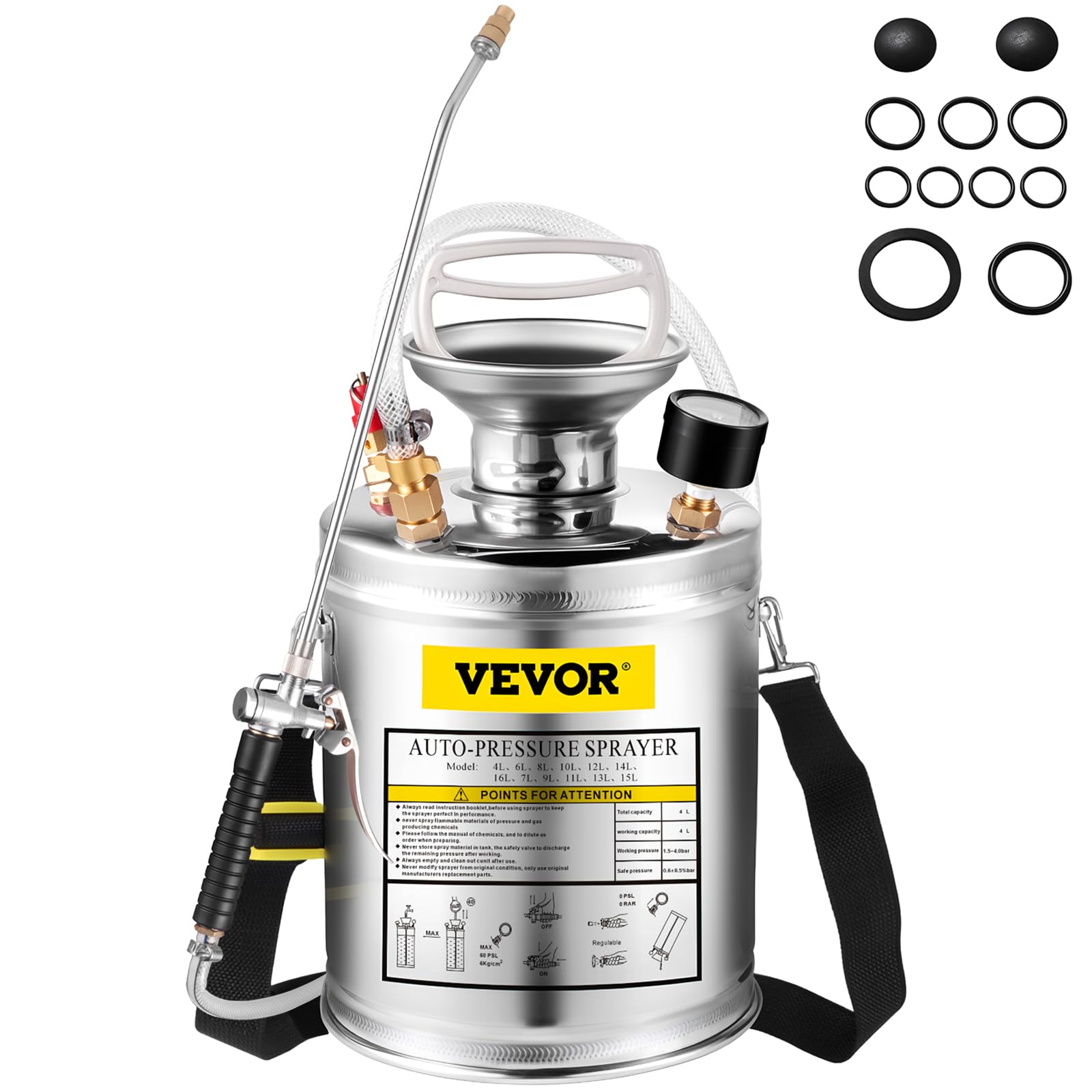
The gauge on the shoulder of this tank is why it is worth the money. Pump until the needle sits where you want it, spray at a steady rate until it drops, then pump again — instead of guessing by feel whether you have enough left to finish the row. We found that alone changes how a spraying job goes: you stop over-pumping, and you stop discovering halfway along a hedge that you are nearly out.

Everything around the gauge is built for the same idea. The tank is stainless rather than poly, the nozzle is brass, the hose is reinforced, and the safety valve vents on its own at the set pressure so you are not cracking a charged tank by hand. Maximum pressure is 87 psi, higher than any other stated maximum here, which is what lets a fine mist carry across a bed instead of landing at your feet.

The soft spots are the ones that are not metal. The lid seal is where pressure escapes first, and the handle on the wand is plastic, so it is the piece to treat gently. Both are cheap to replace, and neither has much to do with the tank, which is the part you are paying for. For anyone spraying weekly, or running a mix that eats ordinary seals, that trade is worth making.

Bottom line: Worth the premium if you spray often or mix harsh chemicals: the gauge and stainless tank give you control the plastic sprayers here cannot match.

8

VIVOSUN 50oz Handheld

VIVOSUN 50oz Handheld

Indoor plant care

Our Score 8.4/10
Check Price

Worth Noting

  • Fifty ounces runs out fast outdoors
Nozzle
Adjustable brass
Hose Length
1.5 meters
Item Weight
1.04 lb
Tank Volume
1.5 liters
Read the full review

A clear scale up the side of the bottle does more for a small sprayer than it sounds. Mixing a teaspoon per quart is guesswork in an opaque jug; here you fill to the line, drop in the concentrate, and the ratio is done. For anyone mixing small batches of foliar feed or insecticidal soap, that is the feature that gets used every time.

The rest is well thought out for a 50-ounce bottle. An adjustable brass nozzle covers mist through to a jet, the trigger locks on for continuous spraying, there is a pressure-release valve so you are not wrestling a charged bottle open, and a 1.5-meter hose means the bottle sits on the ground while you work. It weighs about a pound empty and takes up a shelf corner.

Where it stops is outdoors. Fifty ounces is three or four planters' worth, not a bed, and you will be refilling and re-pumping every few minutes if you try to use it as a garden sprayer. Indoors — houseplants, a windowsill of seedlings, the car wheels, the windows — it is the right size, and the brass nozzle gives a finer mist than the plastic tips on the bigger tanks.

Our favorite use for it is mixing. The graduated bottle, the brass nozzle, and the release valve make a small batch easy to get right and easy to rinse out afterward. If your spraying is measured in quarts rather than gallons, this is the one to buy; if it is measured in beds, start with the SOLO for spot work and a tank for the rest.

Bottom line: Our favorite use for it is mixing small batches: the clear scale takes the guesswork out of a quart of foliar feed.

How We Chose and Tested the Best Garden Sprayers

We started with a list of around 40 pump sprayers sold by garden suppliers and hardware retailers, then filtered by the things that actually separate them: capacity from half a gallon to four, wand and nozzle style, whether replacement O-rings and gaskets are sold separately, and how much comes in the box. That left 14 models, which we bought at retail rather than accepting samples.

Testing ran from the first warm week of spring into midsummer, so each one did a season's real work: pre-emergent on driveway cracks, fertilizer down the tomato rows, fungicide on the roses, and a couple of rounds of deck cleaner. Every sprayer was filled at the same outdoor spigot to its marked fill line. We timed how long it took to pump up to working pressure, then started a stopwatch to see how long it held before the spray went soft, and we sprayed a chalk line on concrete to compare pattern width and evenness from stream down to mist.

Leaks got their own attention. We pressurized each tank, upended it over dry pavement, then left it in direct sun for an hour to see whether anything wept at the collar or the wand joint. Each one was dropped from waist height onto grass while full, carried by its handle out to the far beds to judge balance, and rinsed after use to check how easily the last of the fertilizer came out of the fill opening. Anything with a chemistry-specific seal sat loaded for a week to see if it swelled.

At the end we tallied what shipped with each unit — spare O-rings, a second nozzle, wand length, a shoulder strap — because a sprayer with no replacement parts is one you'll end up replacing. The ones still in rotation earned it.

How to Choose Garden Sprayer Pumps

Pressure: what the maximum number actually buys you

A pressure rating is a ceiling, not a setting. Higher pressure atomizes the mix into a finer mist that carries further — the Happybuy's 87 psi throws a mist across a bed where the PetraTools' 30 psi lays down a wetter, shorter pattern. Neither is better in the abstract. Fine mist is what you want on the underside of leaves and the tops of shrubs; a lower, wetter spray is right for soaking weed foliage and wetting a fence line.

Match the ceiling to the furthest thing you plan to spray, and expect to re-pump as the tank empties. The bigger the air space above the liquid, the longer a charge lasts, which is why a nearly empty tank needs pumping more often than a full one.

Where they leak, and what you can do about it

Nearly every leak starts in the same three places: the lid gasket, the wand inlet, and the shut-off. They are threaded joints under pressure, and threaded joints work loose. A wrap of thread tape on the wand nut and a habit of snugging the connections before each fill prevents most of it, and it costs nothing.

What tape will not fix is a gasket that has hardened or a lid that no longer seats flat. Check the gasket sits cleanly before you pressurize, and treat the warranty as part of what you are buying — five years of coverage is worth more than one when the seal is the part that fails.

Capacity is a weight decision

Two gallons sounds better than one until you carry it. Water runs a bit over eight pounds a gallon, so a two-gallon tank is around twenty pounds full and a one-gallon tank around ten, before you add the wand work. A gallon covers a couple of beds and a fence line; two gallons is for a full lawn or a big deck, where fewer refills are worth the load.

If your spraying is pots, seedlings, and spot weeds, skip the tank entirely. A one-liter handheld costs less to fill, fits in a bucket for rinsing, and gets used for jobs a two-gallon tank would talk you out of.

Nozzles: cone, fan, and foam

The nozzle decides what the spray does. An adjustable cone is the generalist — twist it for a mist or a stream and it covers most garden work. A fan tip lays a flat, even band, which is what you want along a driveway edge or across a run of deck boards. A foam tip marks where the mix landed, which matters on gravel, pavers, and siding where a mist is invisible until it dries.

Extra tips are cheap to make and the reason to prefer a sprayer that ships with two or three. The Roundup's three-tip kit is the clearest example here; the fan tip in particular gets used far more than the marketing suggests.

Frequently Asked Questions

Final Verdict

The Roundup 190260 is the sprayer we point most people to: two gallons, three nozzle tips, and the least fiddly routine of anything on this page, backed by five years of coverage. Snug the wand fitting once a season and it earns its place in the shed.

Buy the Chapin two-pack instead if you keep a weed mix and a feed mix going at the same time — the second tank saves more time than the extra nozzle does. And if your spraying never leaves the patio, the SOLO 418 is the one that actually gets picked up.