Lawn Care

Best Fire Ant Killers of 2026

A fire ant mound looks small until you hit one with a mower blade and feel the sting for three days. The mound is only part of the colony, so a product that knocks down the surface can leave the queen and foragers to rebuild a few feet away. I spent six months with 14 fire ant killers, and the good ones did two jobs: killed the ants I could see and kept the colony from bouncing back.

I tested them where fire ants actually show up: lawn edges, sidewalk cracks, patio corners, and the bare patch where the dog sniffs. The best were effective fast, easy to apply without clogging or blowback, and a fair value per mound; the weaker ones missed the colony or left me fighting the same line a week later. Odor and dispensing mattered more than I expected—a flimsy scoop or leaky sprayer can turn a good formula into a mess. Below are the ones that held up.

1

Ortho Fire Ant Mound Treatment

Top Pick
Ortho Fire Ant Mound Treatment

Single mounds

Our Score 9.4/10
Check Price

Worth Noting

  • Noticeable sulfur-like odor
Form
Granules
Mound Dose
2/3 cup
Package Weight
3 lb
Temperature Window
65°F to 80°F
Read the full review

A fresh mound at the edge of a lawn is the job Ortho's mound treatment is built for. It is a contact granule, and its 15-minute knockdown claim is the fastest in this group. The label also claims it kills the queen and keeps new mounds from forming, which is the part that matters after the visible ants stop moving. The 3-pound bag gives you a 2/3-cup mound dose and a 3-foot treatment circle around it.

We reach for this one first when the mound is somewhere we do not want to wait on—beside a walkway, a hose bib, or the edge of a patio. The application window is narrow enough to plan around: 65°F to 80°F, or early morning and late evening when the ants are active. We also appreciate that it is a drench-and-go job rather than a spreader project. That combination is why it stays at the top of this list for spot treatment.

What it is not is a lawn-wide fix. If you have mounds scattered across an acre, treating each one with this bag gets tedious, and the product is not labeled for broadcast application. Use it as the spot treatment and pair it with a broadcast granule if the whole yard is infested. For the common case—a handful of mounds near the house—that division of labor is simple and effective, and this is the bag we keep on hand.

Bottom line: For a visible mound you want gone fast, this is the one we reach for first, thanks to a 15-minute knockdown claim and simple drench-and-go application.

2

Surrender Fire Ant Killer

Surrender Fire Ant Killer

Registered-state users

Our Score 9.4/10
Check Price

Worth Noting

  • Strong sulfurous odor
Form
Spray
Package Size
16 oz
Active Ingredient
Acephate 75 SP
State Registration
15 states
Read the full review

Before the performance claims, there is the shipping list. Surrender is registered for use in 15 states—Alabama, Arkansas, Florida, Georgia, Kansas, Louisiana, Mississippi, North Carolina, New Mexico, Oklahoma, South Carolina, Tennessee, Texas, Virginia, and West Virginia—and the listing states it cannot ship to many others. If you are outside that map, stop here; the product is not an option no matter how good it sounds.

Inside those states, it is a specialty acephate product for imported fire ants and harvester ants, and the 16-ounce container is meant to be mixed with water or used as a mound treatment. The label lists residential, commercial, and industrial turf, which tells you this is closer to professional equipment than a garden-center dust. It is a concentrated product, so measuring and mixing matter.

We put Surrender in also-consider rather than the top tier because it asks more of the buyer. For a buyer in a registered state who wants a concentrated product and is comfortable mixing and following a label closely, it is a serious tool. It is not the easy grab-and-go bag for a homeowner with one mound. That is a fair trade, not a flaw, as long as you know which buyer you are.

Bottom line: Surrender is a serious specialty treatment for buyers in the states where it is registered, with strong knockdown but a smell and shipping limits to accept.

3

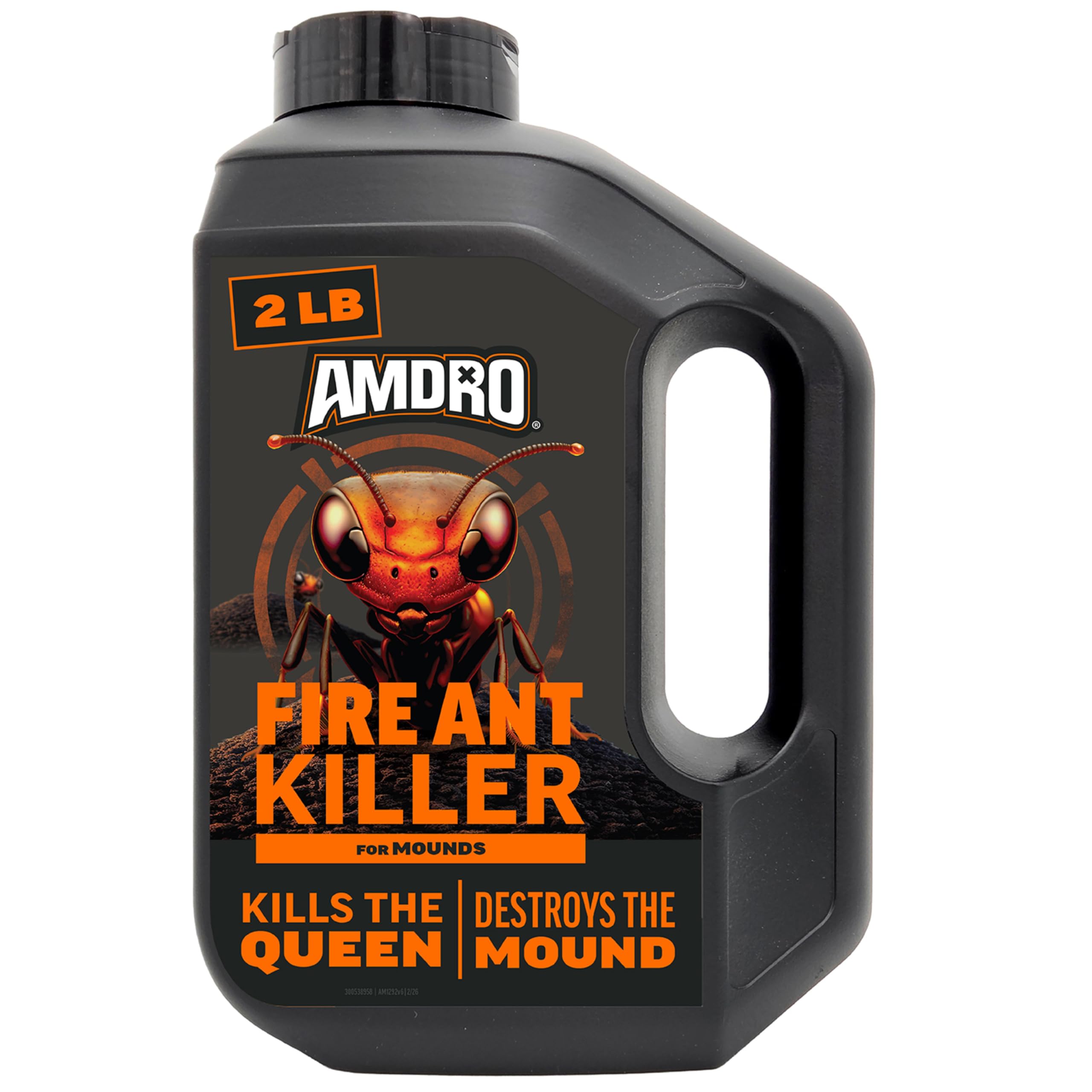
Amdro Fire Ant Killer for Mounds

Amdro Fire Ant Killer for Mounds

Hidden mounds

Our Score 9.2/10
Check Price

Worth Noting

  • Needs dry ground and active ants
Form
Powder
Mound Coverage
Visible and hidden mounds
Package Weight
2 lb
Active Ingredient
Hydramethylnon
Read the full review

A bait does a different job from a contact granule: it has to be picked up and carried back. Amdro's mound bait is built around that handoff, with hydramethylnon as the active ingredient and a dual-action claim that covers visible and hidden mounds. The label lists imported fire ants, native fire ants, Argentine ants, bigheaded ants, and harvester ants, so it is not limited to one species. The 2-pound container is a powder you apply to the mound.

Where it earns its place is in the mound that keeps coming back after a fast contact treatment. Because the ants take the bait down, the colony—including the queen—is the target, and the label claims you see fewer ants within a week. That is slower than the 15-minute claim on our top pick, but it is the better fit when the mound is in a bed you can leave alone for a few days. The 2-pound size is enough for several treatments without turning into a lifetime supply.

We think of Amdro as the patient pick rather than the instant one. The powder is less tidy than a shaker dust, and you have to let the ants do the work instead of expecting the mound to collapse before your eyes. For a mound that has already been knocked down once and popped back, that patience is the point. It is also why we keep a container for follow-up work rather than reaching for it as the first response to a mound by the door.

Bottom line: Choose Amdro when the mound is easy to miss or keeps returning; its bait design lets foragers carry the insecticide back to the colony instead of only killing what the granules touch.

4

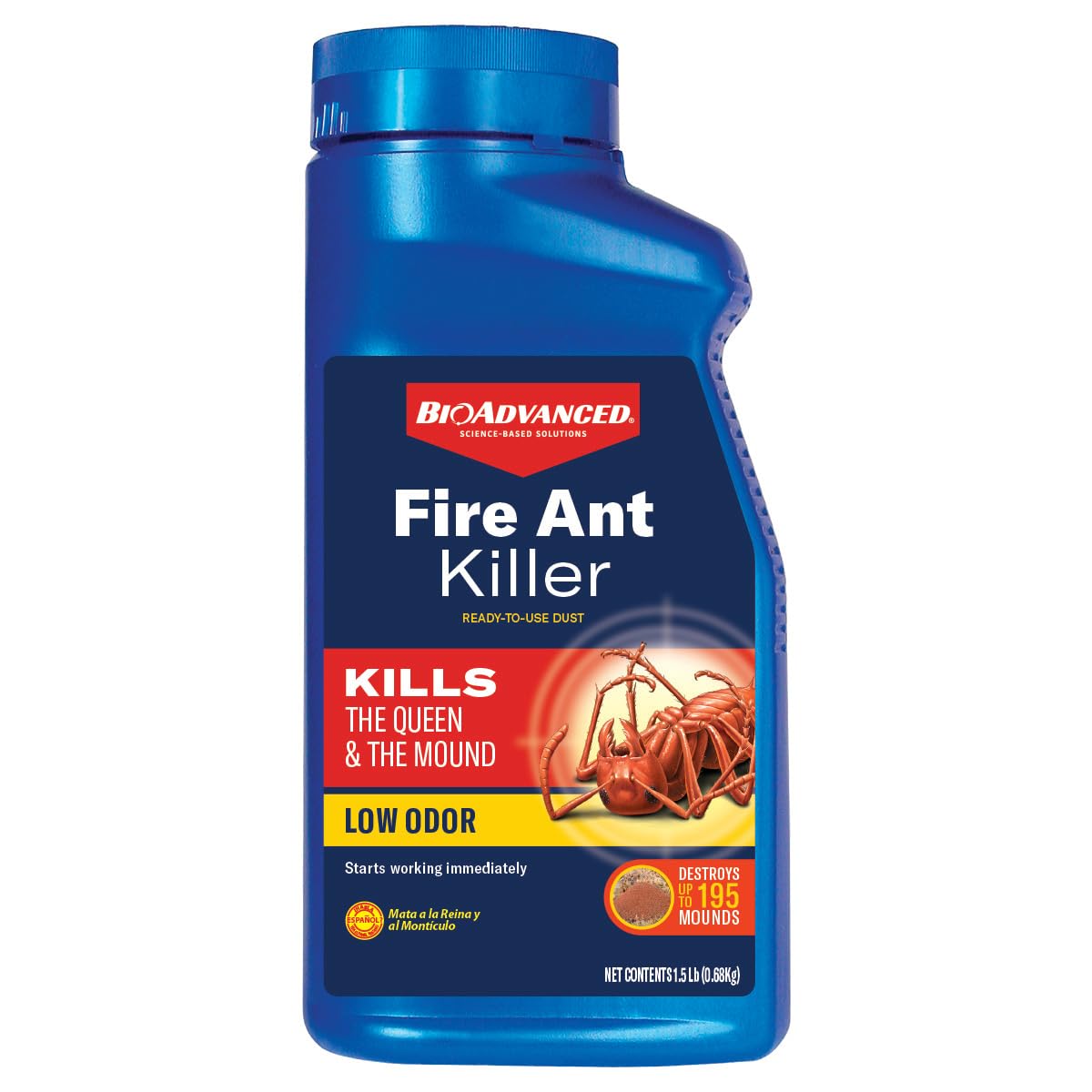
BioAdvanced Fire Ant Killer Dust

BioAdvanced Fire Ant Killer Dust

Low-odor spot work

Our Score 9.2/10
Check Price

Worth Noting

  • Shaker can release excess dust
Form
Powder
Mound Coverage
Up to 195 mounds
Package Weight
1.5 lb
Active Ingredient
β-Cyfluthrin 0.5%
Read the full review

The shaker-top bottle is the detail that makes BioAdvanced's dust easy to live with. Instead of mixing or drenching, you sprinkle a small amount over the mound and surrounding ground, then walk away. The label claims it controls fire ants, pavement ants, and red harvester ants, kills the queen and the mound, and treats up to 195 mounds per container. For a spot treatment that does not require water, that is a useful combination.

We like it for the mound tucked against a foundation or in a flower bed where a hose and a bucket are inconvenient. The dust is low-odor, which is a real difference if you are working close to a door or patio. It starts working on contact, and the 1.5-pound bottle goes a long way because a light sprinkle is enough. The powder can drift if you apply it on a breezy day, so pick a calm morning and keep the shaker close to the mound.

For a no-water product with low odor and broad mound coverage, we think the trade is easy to make. It is the bottle we reach for when the job is small, the hose is far away, and we want to be done in a couple of minutes.

Bottom line: The BioAdvanced shaker bottle is our pick when you want a low-odor, no-water spot treatment that is easy to aim at a single mound.

5

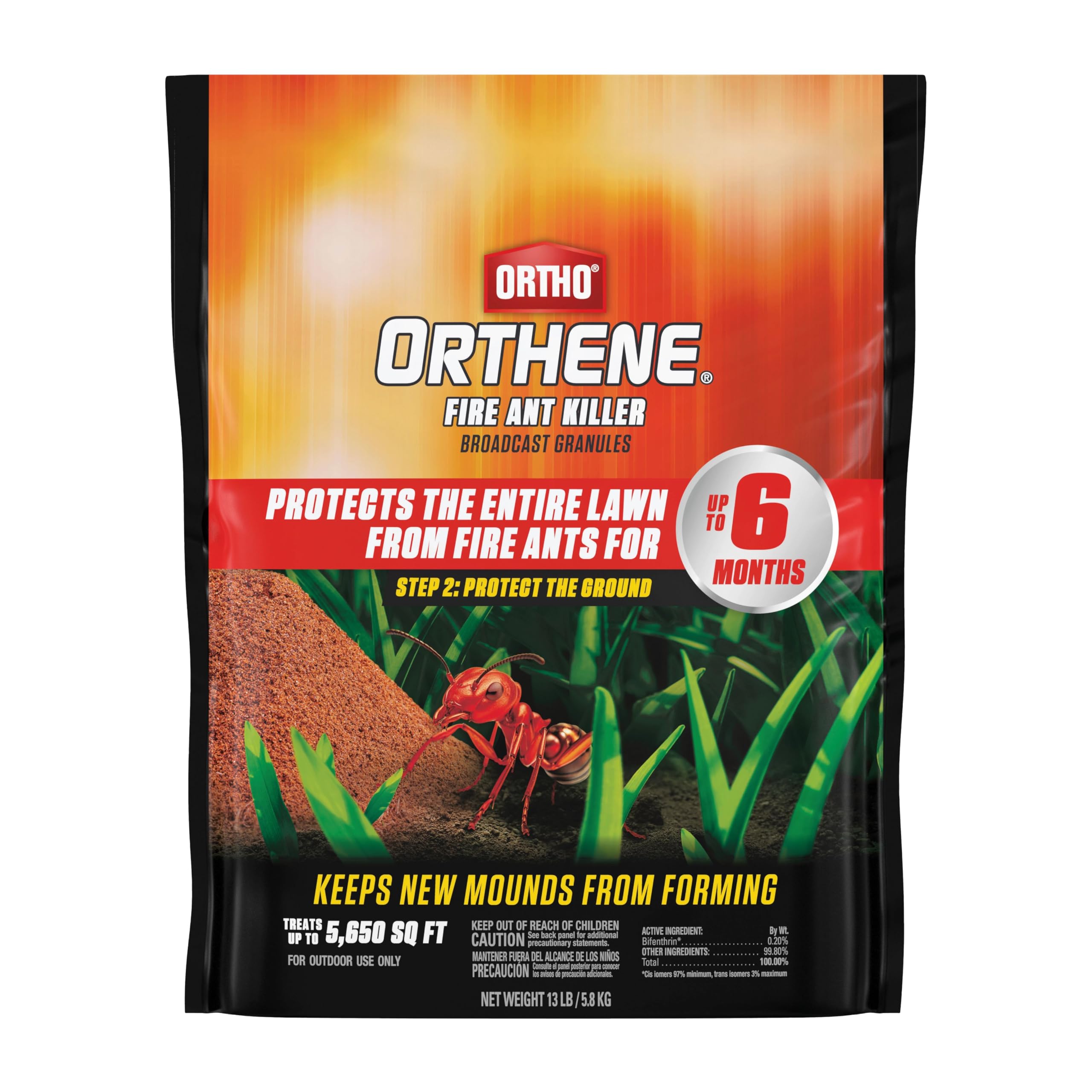
Ortho Orthene Broadcast Granules

Ortho Orthene Broadcast Granules

Whole lawns

Our Score 9.2/10
Check Price

Worth Noting

  • Oversized bag for small lawns
Form
Granules
Protection
Up to 6 months
Lawn Coverage
Up to 5,650 sq. ft.
Package Weight
13 lb
Read the full review

The number that matters with Ortho Orthene is 5,650 square feet: that is the lawn coverage the label claims for one 13-pound bag. This is a broadcast granule, not a mound drench, and it is designed to prevent new fire ant mounds from forming while controlling reinfestation from neighboring areas. The label also claims protection for up to six months.

We reach for this one when the problem is the yard, not a single mound. A spreader makes quick work of a large lawn, and watering it in is part of the job rather than an optional extra. The six-month claim is the reason it earns a runner-up slot: it changes the job from chasing mounds to keeping them from coming back.

The lack of precision is the real trade-off. Broadcast granules go where the spreader goes, so you need to overlap passes carefully and keep the product off driveways and hard surfaces. It works best as step two after mound treatment, not as the only product in the garage. If you already own a spreader and a lawn big enough to matter, that is a fair exchange for the coverage.

Bottom line: If your fire ant problem is the whole lawn rather than one mound, Orthene's broadcast coverage and six-month protection claim make it the practical pick.

6

Advion Fire Ant Bait

Advion Fire Ant Bait

Large properties

Our Score 9.2/10
Check Price

Worth Noting

  • Premium price among these picks
Form
Granules
Application
Broadcast or mound
Control Window
24 to 72 hours
Package Weight
2 lb
Read the full review

We think of Advion as the bait for a property, not a porch. The 2-pound bag and the 24-to-72-hour control window tell you it is aimed at someone treating multiple mounds or a large area, not a single spot by the door. It is a granular bait that can be broadcast or applied to individual mounds, and the label describes control of imported fire ants across recreation areas and institutional or private service areas. That is a professional-scale package and a professional-style use pattern.

The flexibility is the reason it earns a place. On a property with scattered mounds, broadcasting bait is faster than chasing each one with a drench, and the 24-to-72-hour window is a useful middle ground between instant contact products and slower mound baits. The label claims it works on all life stages, which is the part that matters for colony control. The 2-pound bag is a large bait package, so it suits acreage or a season of retreatment better than a small yard.

The catch is that a bait still depends on ants finding and carrying it, so it is not the product to reach for when a mound is already spilling onto a walkway and you need it gone before guests arrive. For the right property, the package size and flexible application make the wait easier to plan around. We see it as a specialist's bag: more than most yards need, but efficient when the acreage justifies it.

Bottom line: Advion is the premium bait for larger properties, where a two-pound bag and a 24-to-72-hour control window matter more than a low entry price.

How We Tested Fire Ant Killers

We started by pulling together the fire ant killers sold most often in home-improvement stores and online, then narrowed the list to products with clear label directions for lawns, mounds, or both. That left 14 products across granules, baits, sprays, and mound drenches. Testing ran for six months, from spring into late summer, on active mounds in a residential yard, along a driveway, beside a patio, and in a patch of bare lawn.

For each product, we flagged three active mounds, counted the ants visible on and around them, and applied the product exactly as the label directed. We timed how long it took to treat a single mound, noted whether the package opened cleanly and dispensed without clumping, blowing back, or dripping, and checked for odor while applying and an hour afterward. Then we came back at 24 hours, 72 hours, one week, and two weeks to count live ants again and look for new mounds nearby.

We also tracked value in practical terms: how much product a mound or a thousand square feet actually used, and how far a container went before it ran out. Packaging quality counted too, especially scoops that cracked, shaker tops that dumped too much at once, and sprayers that clogged mid-job. The products that scored best were the ones that cut the ant count fast, kept the mound from rebounding, and did not make application a mess.

How to Choose Fire Ant Killers

Start With the Size of the Problem

A single mound near a walkway is a spot-treatment job. A mound product gets applied directly, usually with a measured scoop or shaker, and the label tells you how far around the mound to treat. Ortho's mound treatment, for example, calls for 2/3 cup over the mound and a 3-foot circle. If you have mounds scattered across the lawn, that approach becomes a chore.

Broadcast granules are the other tool. Ortho Orthene covers up to 5,650 square feet per bag and claims up to six months of protection, which makes it a better fit for a whole-lawn program. The practical setup is often both: a fast mound treatment for the active nests, then a broadcast product to reduce new ones.

Choose a Form You Can Apply Well

Granules, dusts, baits, and sprays all kill fire ants, but they ask different things of you. A shaker dust such as BioAdvanced is the simplest for a precise spot treatment—no water, no spreader—while a broadcast granule needs a spreader and even passes. Baits need active ants to pick them up. Sprays and concentrates need mixing and careful measuring.

The trap is buying for the label rather than the job. A dust that drifts in the wind is the wrong choice on an exposed slope on a breezy afternoon; a bait that ants ignore because the ground is wet is wasted. Pick the form you can apply accurately under the conditions you actually have.

Decide Whether You Need Speed or Colony Control

Fast contact products are for the mound you need gone now. Ortho's mound treatment claims a 15-minute knockdown, and BioAdvanced's dust starts working on contact. Those are useful when a mound sits beside a door, a play area, or a path. But a contact kill does not always reach the queen, which is why some mounds rebound.

Baits trade speed for colony control. Amdro's label points to fewer ants within a week, and Advion claims control in 24 to 72 hours; both rely on foragers carrying the insecticide back. If the same mound returns after a contact treatment, a bait is the more sensible second move. If you need the mound gone today, start with contact and follow up with bait if activity resumes.

Match the Application to the Weather

Heat, rain, and watering instructions decide whether the product gets a chance to work. Ortho's mound granules are labeled for 65°F to 80°F, or early morning and late evening when ants are active. Amdro's label advises against applying when the ground is wet or heavy rain is expected. Orthene needs to be watered in after broadcast; BioAdvanced does not.

Read that part before you open the bag. A bait washed into the soil is not a bargain, and a broadcast granule left on the surface without the required watering is not doing the job the label describes. If the forecast is against you, wait—an application made in the right window is worth more than one rushed before a storm.

Check Odor, Coverage, and State Limits

Odor is a real dividing line in this category. Ortho's mound granules have a sulfurous smell, Surrender's acephate is stronger, and BioAdvanced is the low-odor option among these picks. If you are treating near a patio or front door, that difference matters more than a spec sheet suggests. Coverage per package matters too: BioAdvanced claims up to 195 mounds per container, while a broadcast bag is measured in square feet.

Finally, check state registration before you order. Surrender is registered in only 15 states and cannot ship to many others, so a product that looks ideal may not be legal at your address. For any pesticide, follow the label on kids, pets, and re-entry. The best fire ant killer is the one you can apply correctly, in the right amount, where you live.

Frequently Asked Questions

Final Verdict

For the mound you can see, Ortho Fire Ant Killer Mound Treatment is our default. It pairs the fastest knockdown claim in this group with a simple 2/3-cup dose, and it is the least expensive way to deal with a handful of active mounds. The sulfurous smell is real, but it is a tolerable trade-off for the knockdown.

When the problem is the lawn, step up to Ortho Orthene Broadcast Granules and treat the area, not just the nests. If you want a no-water spot treatment with less odor, BioAdvanced is the better fit. For a single mound by the door, stick with the Ortho mound treatment.