Lawn Care

Best Lawn Fertilizers of 2026

A tired lawn rarely needs a miracle — it needs the right nitrogen at the right time, spread evenly. Get that wrong and the results are obvious: scorched patches, stripes from a badly calibrated spreader, or a flush of weeds where thick grass should be. A good fertilizer releases slowly enough not to burn, thickens turf so weeds have less room, and improves color without forcing weak growth. I spent this growing season using 12 different granular and liquid fertilizers on my lawn and a few team members' yards, and the differences in greening and density were plain to see.

Ease of use separated the field quickly: bags that load cleanly, liquids that mix without clumping, and sprayers that keep an even pattern instead of sputtering. I also weighed cost per 1,000 square feet, because a cheaper bag that needs three applications is no bargain. Cool- and warm-season lawns have different appetites, so I noted which formulas were forgiving about timing. The picks ahead made the grass look healthier without turning feeding into a chore.

1

Milorganite 6-4-0

Top Pick
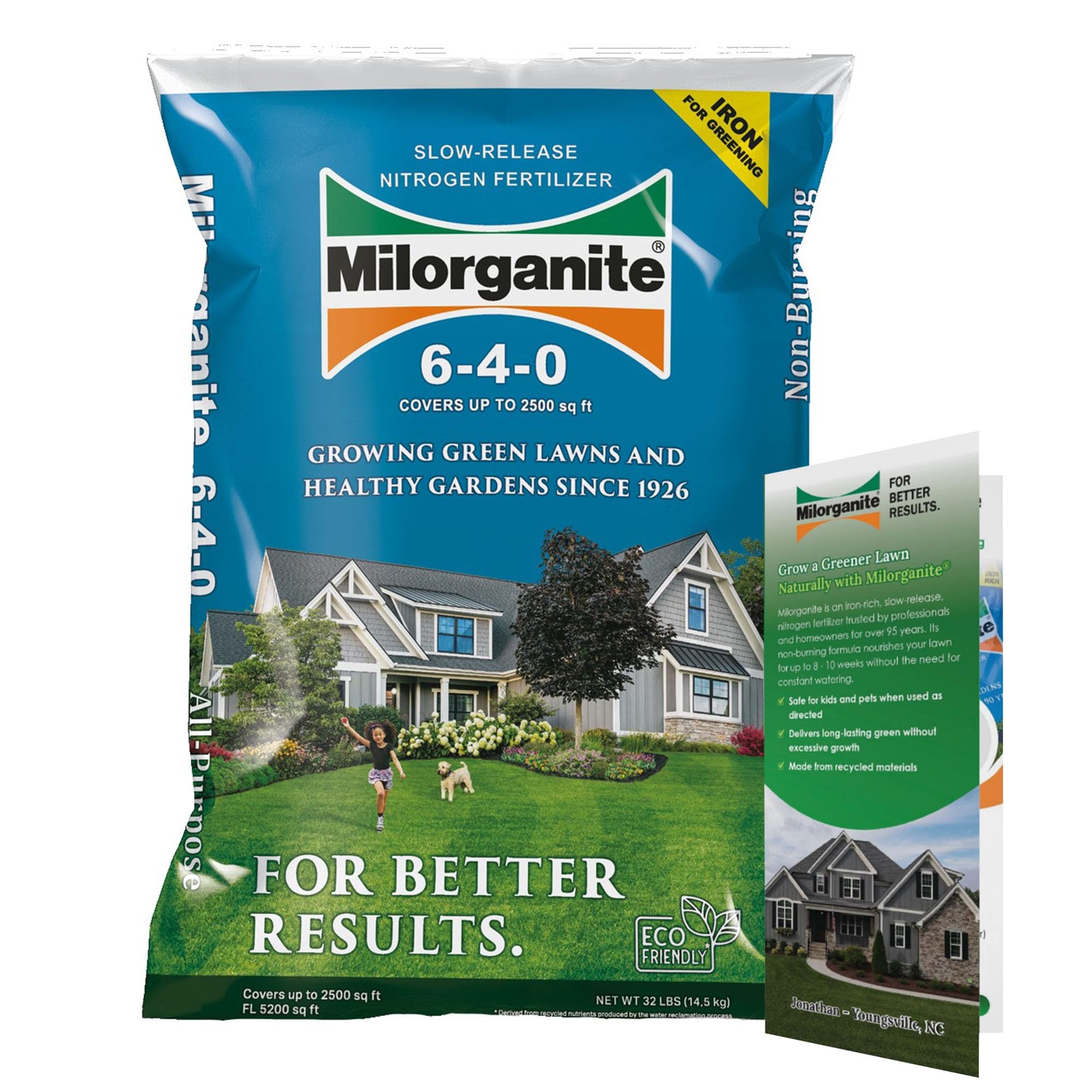
Milorganite 6-4-0

Burn-prone lawns

Our Score 9.4/10
Check Price

Worth Noting

  • No weed control at all
  • Greening builds gradually, not overnight
Form
Pelletized
Coverage
2,500 sq ft
NPK Analysis
6-4-0
Feeding Window
8–10 weeks
Read the full review

This is the bag for anyone who has ever scorched a lawn with a fertilizer and does not want to do it again. A 6-4-0 analysis is a fraction of the nitrogen in the synthetic bags here, the salt content is close to nothing, and the iron that does the greening is organically complexed, so it will not leave rust-brown shadows across a concrete drive the way iron salts can.

Where we reach for it is grass that is already under stress: late summer, a sandy lot, a slope where water runs off before it soaks in. The pellets feed for eight to ten weeks from one application, and because the analysis is so mild you can put it down in heat that would make a 32 percent nitrogen bag a gamble.

Forgiveness is what you are paying for, and on a lawn you cannot babysit it is worth it. We also like that this is the one bag here the maker lists for flowers, shrubs, trees, and the fruit and vegetable garden, so a single purchase covers the beds as well as the turf, and the printed feeding guide that ships with it saves you guessing at a spreader setting that is nothing like a synthetic's.

The arithmetic is the part to sit with. A 32-pound bag covers 2,500 square feet, so a normal suburban lawn takes four or five bags and the cost per pass climbs well above the big synthetic sacks. That is the trade for a formula this gentle, and on a stressed lawn in August it is usually the right one.

Bottom line: For a lawn that scorches easily, or a gardener who wants one bag for turf and beds, this low-salt, iron-rich pellet is the gentlest feed here — just buy enough bags.

2

Scotts Turf Builder Lawn Food

Scotts Turf Builder Lawn Food

All-purpose feeding

Our Score 9.2/10
Check Price

Worth Noting

  • 37.5 lb bag is awkward to haul and store
Form
Granules
Coverage
15,000 sq ft
Grass Types
Any grass type
NPK Analysis
32:0:4
Read the full review

Fifteen thousand square feet out of a single bag is what earns this one the top spot. That is a quarter acre from one 37.5-pound sack, matched here only by the two GreenView bags, and the 32:0:4 analysis goes down in spring, summer, or fall on any grass type — Bermuda, fescue, zoysia, whatever mix you happen to own.

We ran it through a drop spreader and the granules fed out without bridging in the hopper, which sounds like a small thing until you have spent twenty minutes shaking a bag over a half-finished pass. The 32 percent nitrogen is a serious dose, and that is the entire point: this is the bag for a lawn that has gone thin and pale and needs to push blades.

Overlap is where it bites. A nitrogen hit this high landing twice on the same strip, or going down on grass that is already drought-stressed, is how scorched tips and stripes happen. Split the rate into two passes at right angles, keep the spreader moving at the edges, and water it in if there is no rain coming.

What it will not do is touch a weed, and that is by design — there is no herbicide in the bag, which is why it is the one we reach for on a lawn where kids and dogs spend their afternoons. If dandelions and clover are the real complaint, the Weed & Feed3 below does that job. For grass that only needs feeding, this is the bag we come back to.

Bottom line: The best default here for a lawn that just needs feeding: 15,000 square feet per bag, any grass type, any season, and no herbicide to complicate the timing.

3

GreenView Fairway Formula Fall

GreenView Fairway Formula Fall

Fall feeding

Our Score 9.2/10
Check Price

Worth Noting

  • The highest-priced bag in this guide
  • No fast colour hit
Season
Fall
Coverage
15,000 sq ft
NPK Analysis
30-0-12
Slow-release Nitrogen
59%
Read the full review

Fall feeding is not spring feeding with a new date on it. In autumn the grass is banking carbohydrate for winter instead of pushing blades, so what helps is nitrogen that releases slowly and a decent slug of potassium — roughly what GreenView has put in this bag: 30-0-12, with 59 percent of the nitrogen in slow-release form and no phosphate at all.

We judged it on behaviour rather than speed. There is no three-day colour hit here; the lawn comes on evenly over a couple of weeks and holds that colour as the weather turns, which is the difference between feeding for next spring and forcing growth you will have to mow in November.

A 45-pound bag covers 15,000 square feet, so one bag handles a quarter acre in a single pass — the same ground as the Scotts bag at the top, with a slower release and triple the potassium. That is the trade: less immediate flash, more winter hardiness, and a lawn that goes into dormancy thick rather than soft.

It is a fall formula, so you still need something else in April, and Lebanon Seaboard backs the bag with a money-back guarantee — a small comfort if you have ever had a lawn food do nothing at all. Put it down while the grass is still growing and let the rain take it in.

Bottom line: The fall bag we recommend: slow-release nitrogen and 12 percent potassium build a lawn for winter instead of pushing soft growth you will mow again in November.

4

Scotts Turf Builder Weed & Feed3

Scotts Turf Builder Weed & Feed3

Weedy lawns

Our Score 8.8/10
Check Price

Worth Noting

  • Covers only 5,000 sq ft per bag
  • Broadleaf only
Form
Granules
Coverage
5,000 sq ft
Bag Weight
14.3 lb
Weed Control
Dandelion and clover
Read the full review

Two jobs, one pass: that is the pitch, and on a weedy front lawn it is a good one. The granules carry 2,4-D and mecoprop along with the fertilizer, so dandelions and clover curl while the grass around them thickens and crowds out what is left. Feeding and spraying separately does the same thing with more afternoons and more equipment.

The herbicide is the part we paid attention to. Those two actives are old, well-understood broadleaf chemistry, and the reason they work is also the reason they can go wrong: they have to land on the leaf at the right rate. A thin pass lets the weeds shrug and return; a doubled pass in hot weather can set the turf back with them.

Then there is the arithmetic. A 14.29-pound bag treats 5,000 square feet, so a quarter-acre lawn takes five of them — this is not a cheap way to feed a lot of grass. It is, though, a reasonable way to sort out a weedy front lawn once a season, and that is the job it is actually built for.

Timing matters more than the bag makes obvious. Put it down on damp grass when the weeds are genuinely growing, so the granules stick to the leaves instead of rolling into the soil, and keep everyone off until it is dry. Do that and it is one of the more satisfying products here; skip it and you have fed the lawn and missed the weeds.

Bottom line: Buy this one if broadleaf weeds are the reason you are shopping and your lawn is on the small side — it feeds and kills dandelions and clover in a single pass.

5

PetraMax Neighbor's Envy

PetraMax Neighbor's Envy

Liquid application

Our Score 8.6/10
Check Price

Worth Noting

  • You supply the sprayer and do the mixing
Form
Liquid
Iron
2.5%
Coverage
16,000 sq ft
Nitrogen
19%
Read the full review

Not everybody wants to push a spreader. If you already own a sprayer, or your lawn is chopped up by beds, paths, and a slope that makes a broadcast pass miserable, a concentrate gets the job done in a fraction of the time — and a gallon of Neighbor's Envy is rated for 16,000 square feet.

The two numbers that matter on this label are 19 percent nitrogen and 2.5 percent iron. Iron is what puts deep colour into a lawn, and 2.5 percent is a real dose rather than a token; the nitrogen does the growth. The rest of the list — humic acid, sea kelp, sulfur — is where we get sceptical. Those ingredients have their adherents, but nothing ties them to a result you can see, and the nitrogen and iron are doing the visible work.

Application is a hose-end applicator or a pump sprayer, and colour is quoted at seven to fourteen days. No hopper to calibrate and no granules kicked into the flower beds, but you supply the gear and mix at the right rate. Keep the spray off the drive and rinse any overspray, since an iron-rich liquid can mark concrete.

It is the pick here for awkward ground and spot-feeding, and for anyone who would rather spend twenty minutes with a sprayer than an hour with a spreader. On a flat, open quarter acre, a bag is still less fuss.

Bottom line: The liquid option: 19 percent nitrogen and a serious iron dose cover 16,000 square feet through a sprayer, with no spreader to calibrate.

6

GreenView Lawn Food 48 lb

GreenView Lawn Food 48 lb

Value coverage

Our Score 8.6/10
Check Price

Worth Noting

  • 48 lb bag is a storage commitment
Coverage
15,000 sq ft
Bag Weight
48 lb
NPK Analysis
22-0-4
Feeding Window
Up to 8 weeks
Read the full review

Per square foot, nothing else on this page costs less. Forty-eight pounds covers 15,000 square feet at a price per pass that undercuts every other bag here, and that alone is why it is on the list — a large lawn is expensive to feed, and this is the version that does not make you wince at the register.

The 22-0-4 analysis is a middle path. Where the Scotts bag at the top pushes 32 percent nitrogen for fast top growth, this one leans on enhanced-efficiency nitrogen that keeps feeding for up to eight weeks — a slower, steadier dose that is harder to overdo on a hot day. If the soil is decent and the lawn just needs to hold colour through summer, that is the temperament you want.

The coverage is what sold us. Fifteen thousand square feet means the bag does not run out halfway down the side yard, and the granules are a medium mesh, which is what you want in either a broadcast or a drop spreader. Put that together with the eight-week feed and you are making one pass instead of three.

Deep shade, compacted soil, the corner the dog uses — no bag fixes those, and this one does not pretend to. For everything else, it is the bag to buy when the lawn is big and the budget is not.

Bottom line: The value pick: 15,000 square feet per bag at the lowest cost per square foot here, with nitrogen that keeps feeding for up to eight weeks.

How We Tested a Dozen Lawn Fertilizers

We began by rounding up more than 40 granular and liquid fertilizers sold for home lawns, then narrowed that list by nitrogen source, coverage per bag or bottle, lawn-type suitability, and cost per 1,000 square feet. The 12 we tested were used from the first spring feeding through early fall on my lawn and a few team members' yards. We kept an untreated strip beside each test section for comparison.

Applications happened on Saturday mornings, usually with a calibrated broadcast spreader for granules and a hose-end sprayer for liquids. I noted whether bags loaded cleanly, whether granules clumped or dusted, and whether measuring scoops were easy to level. With liquids, we watched for clogged nozzles, leaking connections, and uneven spray patterns, then rinsed the sprayer as directed. Ease of use got judged on all of that, not just the label instructions.

After watering in, we checked each section at one, two, and three weeks, taking photos in the same light and looking for even greening, deep color, and any scorched edges. We also ran a ruler through a few spots to see how quickly blades thickened, and counted dandelions and crabgrass in fixed three-foot squares before and after each application. A fertilizer scored well only if the grass filled in enough to crowd weeds rather than simply feeding them.

We compared tall fescue, Kentucky bluegrass, and Bermuda sections separately, since grass preference and shade tolerance change how a formula performs. Value came down to cost per 1,000 square feet across the season, not sticker price, and quality meant consistent granules or a smooth mix every time we opened the package. The products that rose to the top showed visible greening without burn and held their color for weeks, not days.

How to Choose Lawn Fertilizers

Read the analysis before the marketing

The three numbers on the bag are nitrogen, phosphorus, and potassium, always in that order. Nitrogen drives top growth and colour, phosphorus supports root development, and potassium helps grass handle heat, cold, and drought. An established lawn usually needs little or no phosphorus, which is why both GreenView bags here sit at zero in the middle slot. Match the first number to your goal: a high figure like the Scotts Turf Builder's 32 percent gives a fast green-up, while a low one like Milorganite's 6 percent lets you feed repeatedly without much risk.

Do the coverage math first

A bag that looks big can still only treat a small lawn, and coverage is printed on the front. It is also the number that decides what you actually spend. The Scotts Weed & Feed3 treats 5,000 square feet; the GreenView bags treat 15,000. Measure your lawn in rough rectangles — front, back, sides — add them together, then divide by the coverage figure. A 10,000-square-foot yard needs two bags of a 5,000-square-foot product or one 15,000 bag with some left over for a second pass.

Feed only, or feed and kill weeds

A feed-only product such as the Scotts Turf Builder Lawn Food puts everything into the grass. A weed and feed adds a herbicide that has to land on a weed leaf to do anything at all. That is the trade: one pass instead of two, but only worth it if you have broadleaf weeds — dandelion, clover, plantain — worth killing. If your lawn is mostly grass and the complaint is colour, you are paying for chemistry you do not need.

Granules or liquid, and how to apply either

Granules need a spreader and an even hand; liquid needs a sprayer and a few minutes of mixing. Granules are more forgiving on a big open lawn, and slow-release formulas are almost always granular, which is why they feed for weeks rather than days. Liquid wins on awkward ground — beds, slopes, narrow strips — and for spot-feeding a patch. Whichever you choose, calibrate it. If a bag has been sitting in a shed, break up the clumps before you load the hopper; caked granules jam spreaders and dump the dose in one stripe.

Time it to the growing season

Grass has to be actively growing to take up fertilizer. Spring and early fall are the windows most lawns respond in, and fall is the one that pays off next spring: the grass is storing reserves rather than pushing blades, so slow-release nitrogen and a decent potassium figure matter more than a big nitrogen hit. Skip the high-nitrogen pass in the middle of a heat wave or drought, and put a weed and feed down when weeds are growing and the grass is damp.

Frequently Asked Questions

Final Verdict

The Scotts Turf Builder Lawn Food is the bag we hand most people: 15,000 square feet, any grass type, any season, no herbicide and no fuss. If weeds are the reason you are shopping rather than colour, the Weed & Feed3 does both jobs in one pass — just budget for a third of the coverage. And for a fall feeding on a lawn that has had a hard summer, the GreenView Fairway Formula is the one to put down.